Tag Archives: Travel

Trip to the Antipodes series : New Zealand (part I)

1st January 2015 : Sydney to Christchurch –  As you can see from my sketch I started the year with a tall glass of promising ‘Green and Lean’ juice at Lumiere Cafe on Bourke Street. Five seconds later, a massive portion of Egg Benedict followed. New Year resolutions be damned.

To work that off we voted for a walk from City Hall to Sydney Opera House and see the iconic building one last time. What seemed like a great idea, gradually lost its appeal as the day became hotter. Most shops were closed and there were understandably few people on the streets after last night’s revelries, making our stroll even less fun. The chilled passion fruit smoothie at Starbucks saved me from passing out before the flight.
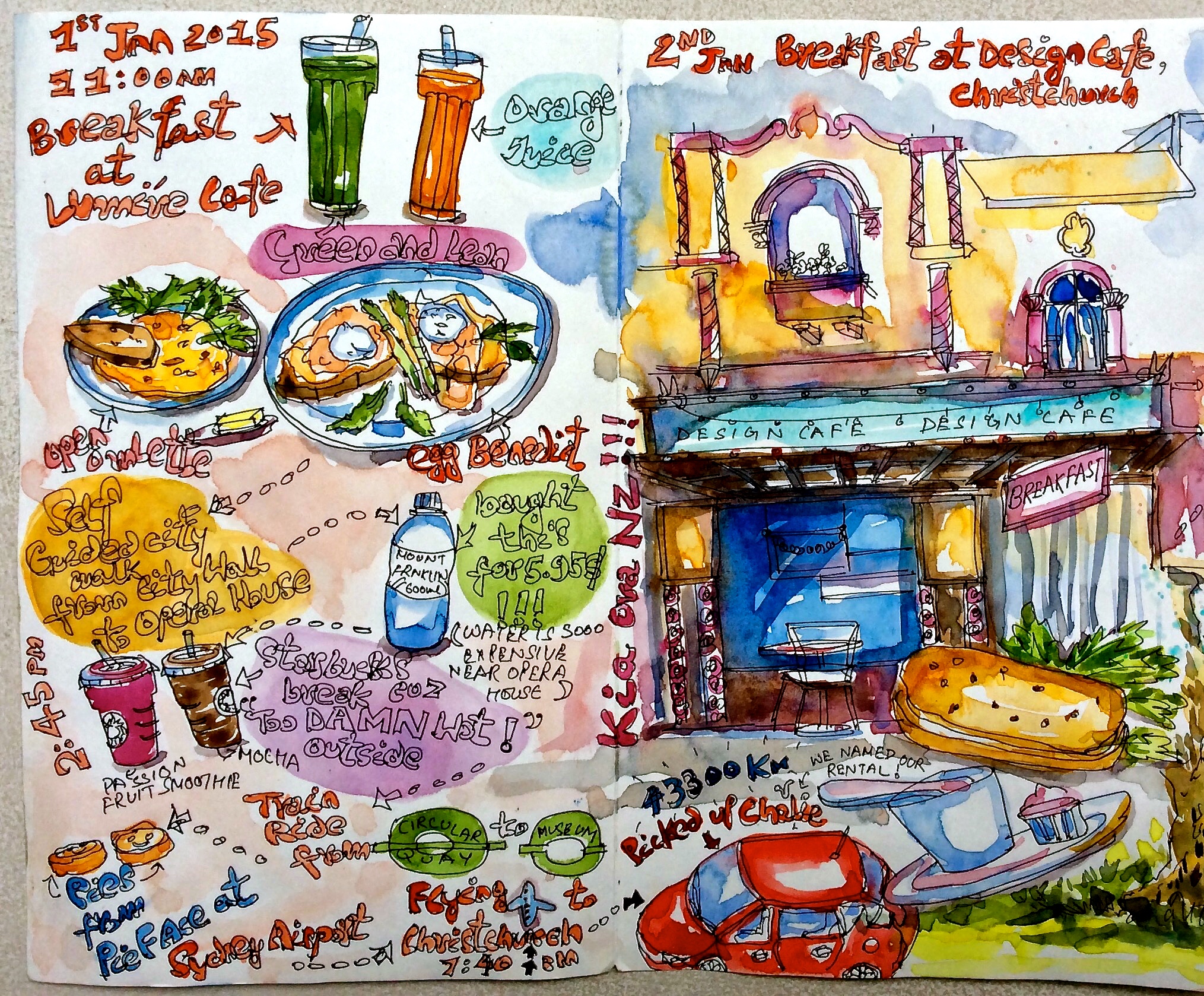
Sydney to Christchurch / 1st Jan : Highlight of the day was picking up Charlie from the airport.

Sydney to Christchurch / 1st Jan : Picking up Charlie from Christchurch airport was the only highlight of the day.

And then – Kia Ora New Zealand! We picked up Charlie, our rental car from Christchurch airport around midnight. John Steinbeck may have something to do with my naming our red Toyota Corolla. Charlie’s Odometer Reading showed : 43300Km at the time of pick up. I kept a record of the readings on my sketchbook to gauge how much we drove each day.

2nd January 2015 : Hanging out in Christchurch –  The scars of the 2011 earthquake, were prominent on Christchurch. Vast spaces lay bare in between buildings. We walked past piles of rubble, damaged structures, collapsed, stripped to the core with iron rods sticking out of them. It was heartbreaking especially the plight of the 100 plus years old Christchurch Cathedral. Outside these cordoned off areas containing the wreckage, the story was one of resilience and hope.

The Re:start mall seemed such a beacon. Everything from food, carpets, sweaters, shoes, clothes, souvenirs and kiwi knick knacks were sold from inside of colourful shipping containers! We shared a bench with a family from Wellington and sipped lemonade right in front of a bright red metal box that had become the home for Scorpio books.
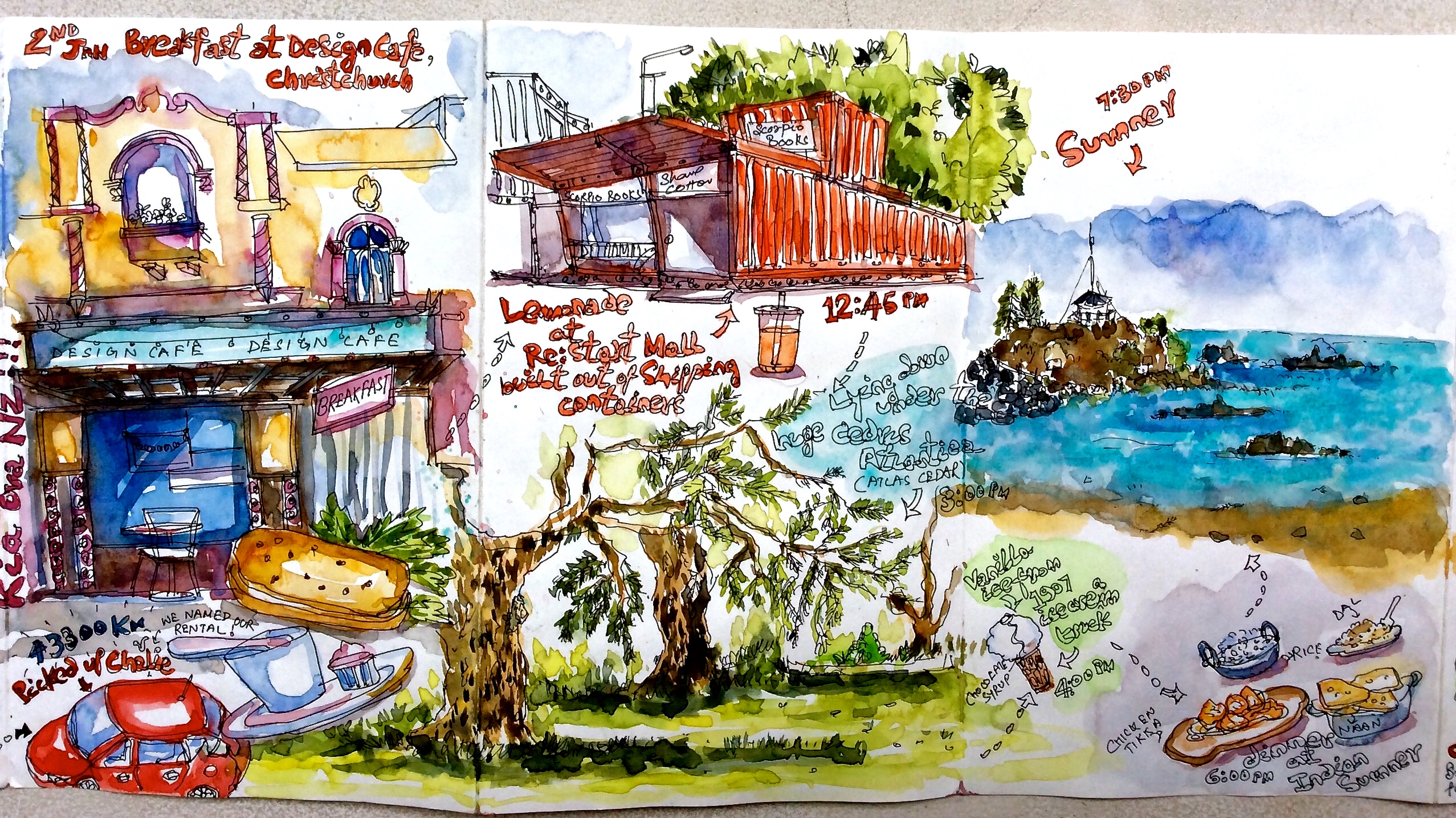
Christchurch / 2nd Jan : We had dinner at Indian Sumner, an Indian restaurant at Sumner. After surviving on Egg Benedict, Fish and Chips, sandwiches, wraps and burgers for days, a slice of home felt heavenly.

Christchurch / 2nd Jan : We had dinner at Indian Sumner, an Indian restaurant at Sumner. After surviving on Egg Benedict, Fish and Chips, sandwiches, wraps and burgers for days, a slice of home felt heavenly.

If there’s one place I’d like to return to in Christchurch, it would be the Risingholme garden, inside the Botanical garden. The serenity of nature, the meditative silence and the feeling of being minuscule, inconsequential amid the giant oaks, cedars, beeches and Spanish chestnut will remain special. I flitted from one tree to another, hugging, smelling, caressing their massive trunks, finally settling under the shade of Cedrus Atlantica, from where this sketch was done.

In the evening, Charlie drove us to Sumner – a pretty seaside suburb of Christchurch, about 12 km away. We watched a dramatic sunset and walked on the long beach in the golden light, listening to waves violently crash against the jagged rocks. It was cold, so we huddled up close to each other and held hands. For a little while, the poignant reminders of a brutal calamity writ large upon Christchurch was forgotten.

3rd January 2015 : Onwards to Lake Tekapo  – Black Betty, a stone’s throw from Southwark Apartments, was open for business, post new year. We were among the firsts to show up. The gothic accents were interesting but thankfully not overpowering for detractors. The hot chocolate and blueberry muffins lived up to the great reviews.

But we didn’t want to fill up because our next stop was Lyttelton Farmers Market, in the port town of Lyttelton, about 12 Km away. I was so enamoured with Sue’s marinated olives that we spent an inordinate amount of time at her stall. It was very hard to turn away from the rest of her wares – semi-dried tomatoes, dolmades, marinated artichokes, several kinds of dips and hummus – everything fresh, fragrant, glistening and ready to eat! “I used to own a cafe there (apparently the legendary Volcano Cafe)“, she said pointing to her right. Then added “..but after the earthquake destroyed it, I do this.” Sue has developed the volcano brand of delicatessen food that she sells at various farmers markets.  After she helped me pick out 4 different kinds of olives, I sketched her little set up. She graciously signed her name under it, at my request.
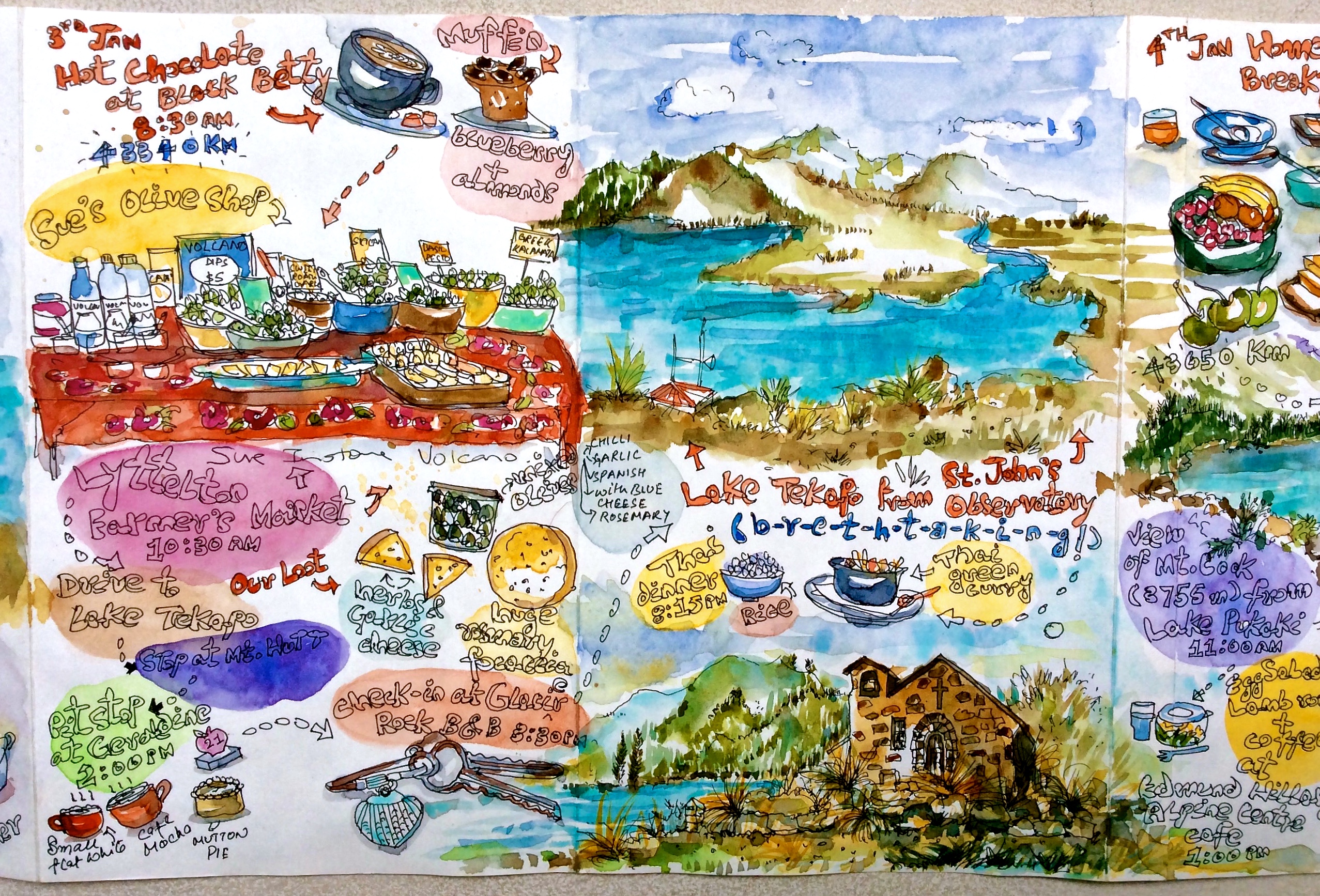
Christchurch to Lake Tekapo / 3rd Jan : We were lucky to be able to experience something as local as a farmer's market at Lyttelton. Meeting the people, chatting with them, hearing their stories and, watching them go about their business trumps any tourist attraction. And sketching is the fastest way to make friends!

Christchurch to Lake Tekapo / 3rd Jan : We were lucky to be able to experience something as local as a farmer’s market at Lyttelton. There were times when I wished I was a local just to be a part of their spirited community. Meeting the residents, chatting with them, hearing their stories and, watching them go about their business trumps any commercial tourist attraction. It felt real and authentic. And sketching seemed like a great way to start conversations and make friends out of strangers!

Walking through the market felt like gatecrashing a private party. ‘How’s your mother doing?’, “You looked great in that bikini the other day”, “Were you out of town?”, “Happy New Year!” were some of the snippets of conversation I heard been exchanged between the bread, mince pie, cheese, sausage, herbs, fruit and vegetable stall owners and their customers.

A band played slow music beside a cafe and the harbour across the street looked beautifully blue. Armed with a gigantic ( about 20cm in diameter) Focaccia bread that took us 5 days to finish, 100 gm each of herb and garlic cheese and my treasured olives, we forged ahead towards our destination.

The first sight of Lake Tekapo had us swooning over its terrific blueness. It was bluer than the bluest blue I had seen. Up at St. John’s Observatory, the air was so clean and transparent that the farthest mountains in the backdrop became visible, forming a soft undulating dark green outline in contrast to the stark and edgy blue foreground. For urban dwellers heavy-handed with photoshop and Instagram filters, this sight would be a revelation.

4th January 2015: Mount Cook bound – The owner of Glacier Rock B&B – our fantastic lodging (the view from the patio alone makes it worth the stay) in Lake Tekapo said to us at breakfast, ” I have a feeling that you’ll have a clear view of Mt. Cook today“. Apparently, it isn’t uncommon for the weather to turn without warning and for us that could mean losing our only chance to view the highest peak of New Zealand. Already the radio was abuzz with the news of the three missing mountaineers attempting to scale Mt Cook after the weather deteriorated. I hoped Mrs. MacLaren was right.
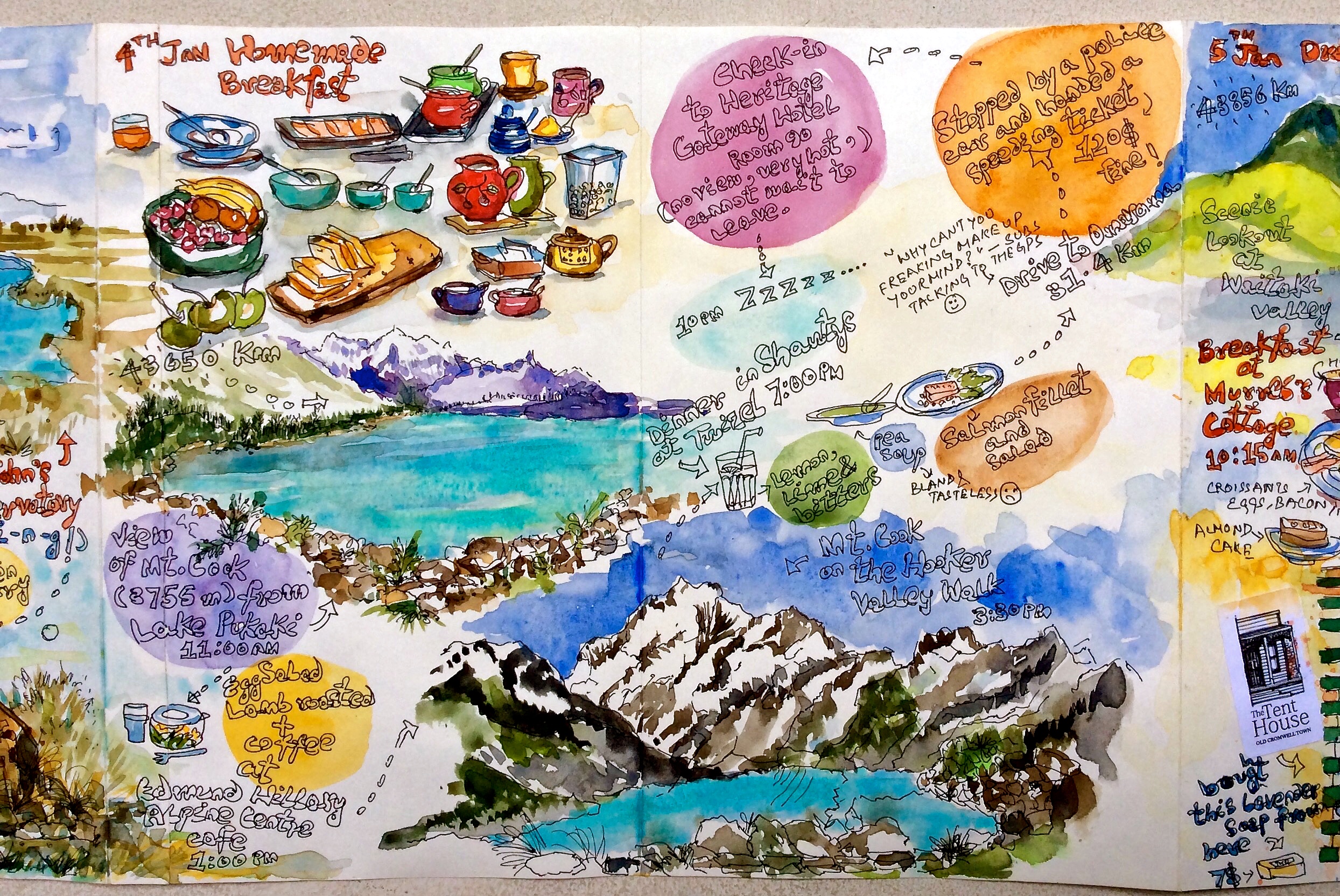
Lake Tekapo - Mount Cook - Omarama / 4th Jan : Peak of the day was dipping my feet in glacial water at the end of Hooker Valley Walk. And the bland under seasoned pea soup I had at Shawtys in Twizel has to be the slump of the day. Yes, it was worse than the 120$ speeding ticket.

Lake Tekapo – Mount Cook – Omarama / 4th Jan : Peak of the day was dipping my feet in glacial water at the end of Hooker Valley Walk. And the bland under seasoned pea soup at Shawtys in Twizel has to be the slump of the day. Yes, it was worse than the 120$ speeding ticket.

After a short stopover at Lake Pukaki, the plan was to drive non stop to Hermitage Hotel, take in the famed view of the mountain from there, then start on the 4hours tiring yet spectacular Hookers Valley Walk that ended at the Hooker glacial lake. But the closer we got to the mountain, more compelled were we to make random roadside stops just to adjust our senses to the beauty unfolding. Unsullied nature at such a grand scale was a lot to take in. It was humbling to stand on that listless road snaking feverishly though a sweeping landscape of massive forbidding mountains surrounding us, rising from the ground like mighty waves.

The day ended at Omarama – the starting point of our ‘gold heritage trail’.

5th January 2015 : A long winded route to Dunedin – There is of course a straightforward and quicker route to Dunedin which we did not take. Relaxing is something we forget to do on holidays. Instead we carved out a day long plan to drive through the preserved goldrush towns of Cromwell, Clyde, Alexandra, St. Bathans, Naseby, Ranfurly, Middlemarch and finally to Dunedin, that claim their origins to the discovery of gold in 1861.
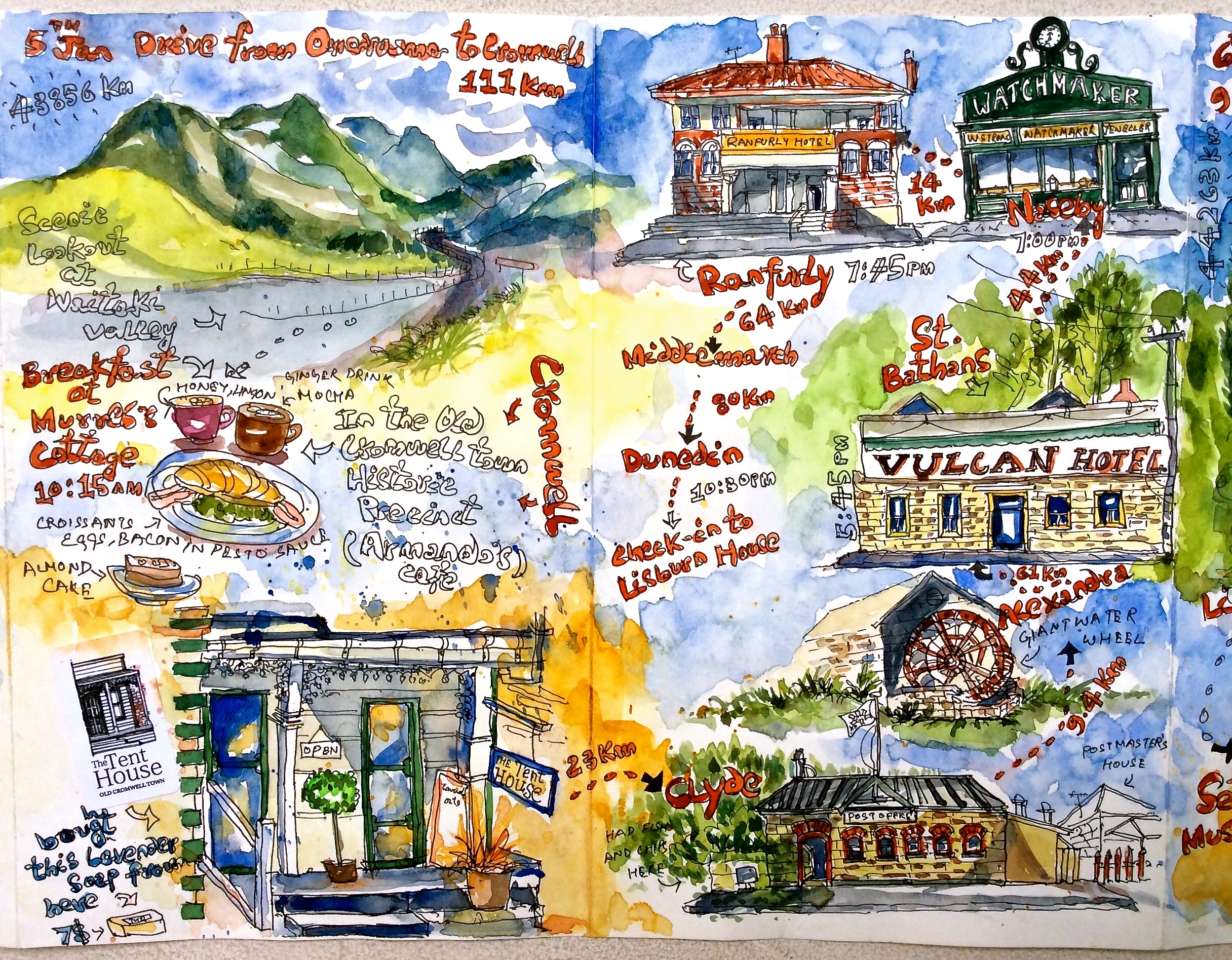
Otago's Gold Heritage Trail/ 5th Jan :  I got myself four souvenirs from this trail - a 'Lavender, Lime and Spice' soap bar from Cromwell, a maori dolphin tail locket made out of bone from Clyde, a tacky fridge magnet from Alexandra, a sticker for my diary from St. Bathans. I cannot bring myself to use the soap. For now it perfumes my study table.

Otago’s Gold Heritage Trail/ 5th Jan : I got myself four souvenirs from this trail and none of them was gold. I picked a ‘Lavender, Lime and Spice’ soap bar from Cromwell, a maori dolphin tail locket made out of bone from Clyde, a tacky fridge magnet from Alexandra and a sticker for my diary from St. Bathans. I cannot bring myself to use the soap. For now it perfumes my study table.

The historic precincts in each of these towns being pedestrian, it’s easy to slip back in time just by walking past the retro architecture. Art galleries, restaurants and cafes are housed in some of these establishments. Some act as museums, some sell handcrafted soaps. But together they exude a cute picture postcard beauty and nostalgic charm that made the detour every bit worthwhile.

6th January 2015 : Touring Dunedin – Except Omarama, where our lodging didn’t turn out as expected, I did a pretty good job in finding unique accommodations on this tour, the creme de la creme being Lisburn House in Dunedin – a stunning 19th century Victorian property turned into B&B that will feed your fantasy of living as a member of 19th century English nobility.

I spent a ridiculous amount of time at the Otago Settlers Museum. Not because it was hot outside and I needed the shelter, but because it was of the best curated museums I had visited – one of those educational establishments that believes in telling a compelling story through its exhibits, encouraging its viewers to join the dots instead of spoon feeding them.
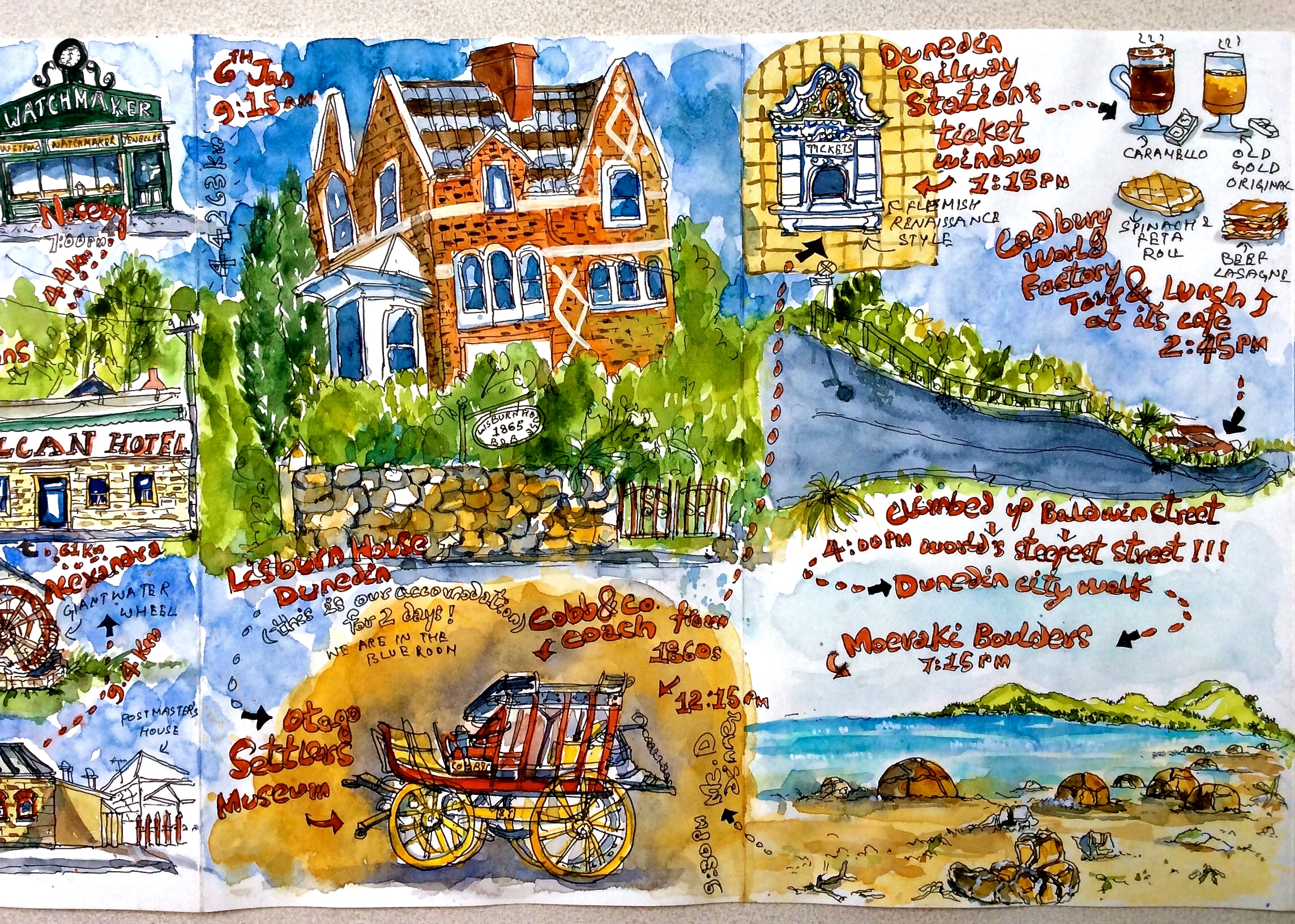
Dunedin / 6th Jan: We woke up in a Victorian dream home, toured a chocolate factory and climbed the world's steepest street, all in one day. Pretty productive, I'd say!

Dunedin / 6th Jan: We woke up in a Victorian dream home, toured a chocolate factory and climbed the world’s steepest street, all in one day. Pretty productive, I’d say!

After romping about the city some more, we drove 70 Km to see an unique geological sight that had intrigued us ever since we saw its pictures. Moeraki Boulders seemed like gigantic concrete cannonballs randomly lying on the beach, some in clusters, some solitary. There were deep cracks all over their surface, like some sort of design. Some boulders were intact, whole – people climbed over them and took pictures, while others lay cracked open like an egg shell, with fragments scattered all over the sand.

At sunset, the tip of the boulders became golden tinged. The waves crashed against their smooth bodies, trying to pull them in, but failing and sliding off the sand around them instead. It was hard to make sense of their existence, but that was a good thing because it’s better to be curious than blasè. Isn’t it why we travel?



Trip to the Antipodes series : Sydney

30th December 2014 : Melbourne to Sydney –  George’s apartment in Surrey Hills that we found through an intense search on Airbnb, was close to the CBD. Trust me, that is all one needs – an affordable (100 – 150$ over budget is called affordable during this time of the year) place to crash after New Year fireworks. A place that doesn’t wring your pockets dry and is not in the back of beyond taking 5 hours to reach*.

Dumping our luggage in the room, we venture out for sightseeing. Serendipity strikes. Spotting a woman wearing a neon green ‘I’m Free’ lettered T-shirt ( That was Justine, co-founder of I’m free walking tours) circled by about thirty people, right out side QVB, near the talking dog statue, we join her. And what follows is a peek into the city’s history and a walk past Sydney’s major sights described in a fun, extremely informative narrative.

30th December / Sydney: I decided to sketch the opera house today because we didn't know where we would be watching the fireworks from the next day and if I would even get this view or not.

30th December 2014/ Sydney: I decided to sketch the opera house today because we didn’t know where we would be watching the fireworks from the next day and if I would even get this view or not. After the free walking tour of “The Rocks”, we bought a picnic mat and nibbles for the next day and had Fish and Chips dinner on our way back to George’s apartment.

We pass by Martin Place and stop a while to look at the flowers and read the heartwarming messages at the makeshift memorial. The tour ends with a view of the opera house and then the Harbour bridge. Justine dispenses tips on the ‘most ideal free spots to watch the fireworks’ to anyone interested. “Do not go to Circular Quay” she warns. Then adds, ” To find a good spot there, you’ve to reach there at 10 in the morning and wait the entire day in this heat. It’s suicide.”

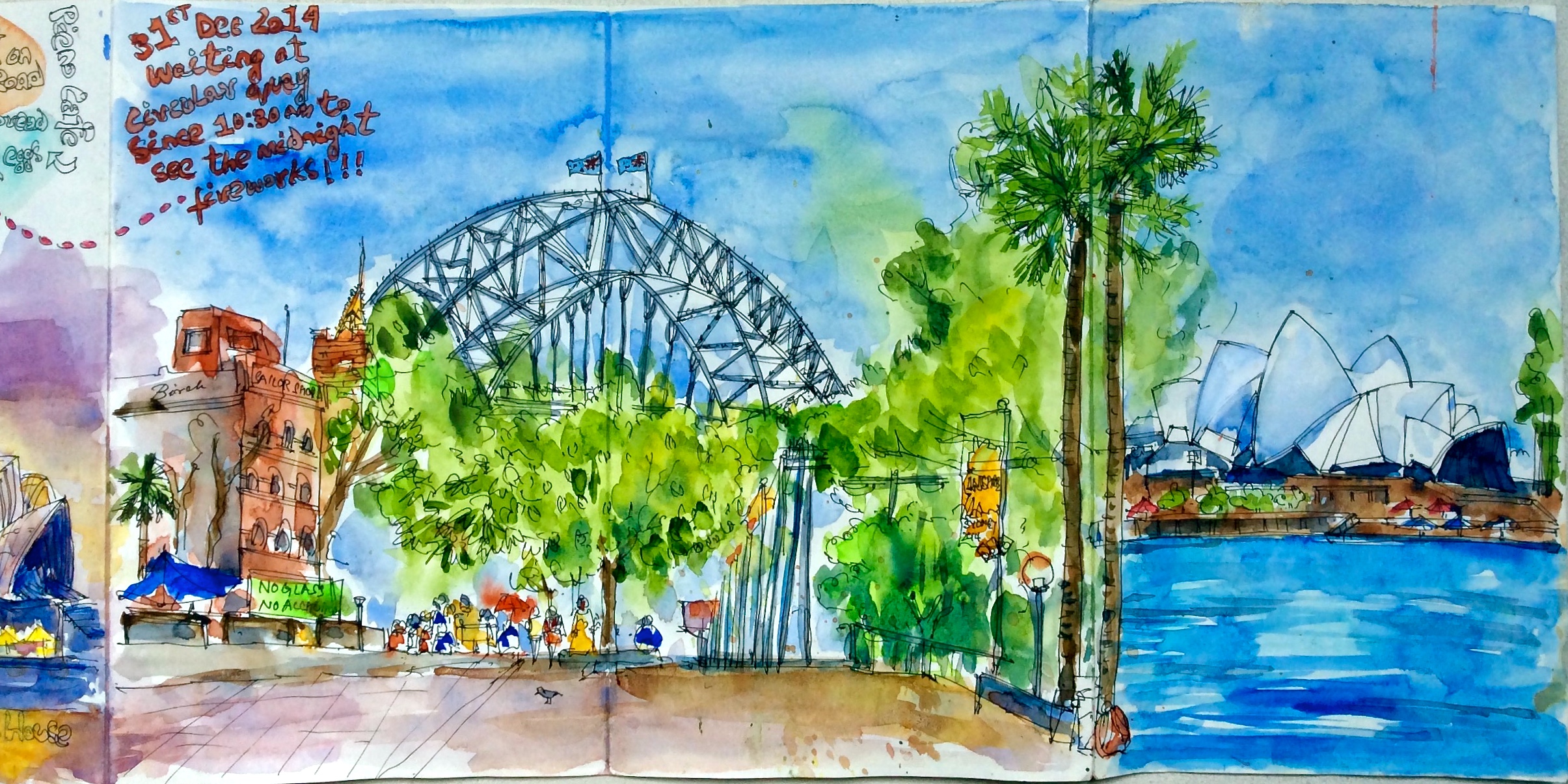
31st December 2014 : The Big Day – We were at Circular Quay at 10 in the morning. The Sydney New Year Eve official website listed several vantage points for watching the fireworks along with their maximum capacities. This place could hold 26,000 people. Of that, twenty six were already here, lying down on their picnic mats, rubbing sunblock. No alcohol or glass was permitted on the premises. Upon finding a great spot** (after active debating), which meant unobstructed view of the Harbour Bridge and the Opera House, we settled down with our stash of nibbles under the hot sun to spend what was left of that year.

Waiting for midnight

31st December 2014 / Sydney – After a hearty breakfast at Pieno Cafe on Crown Street, we walked to Circular Quay at around 10am to see if there’s empty space. There was. So we parked ourselves here till midnight. This was my view for the entire day.

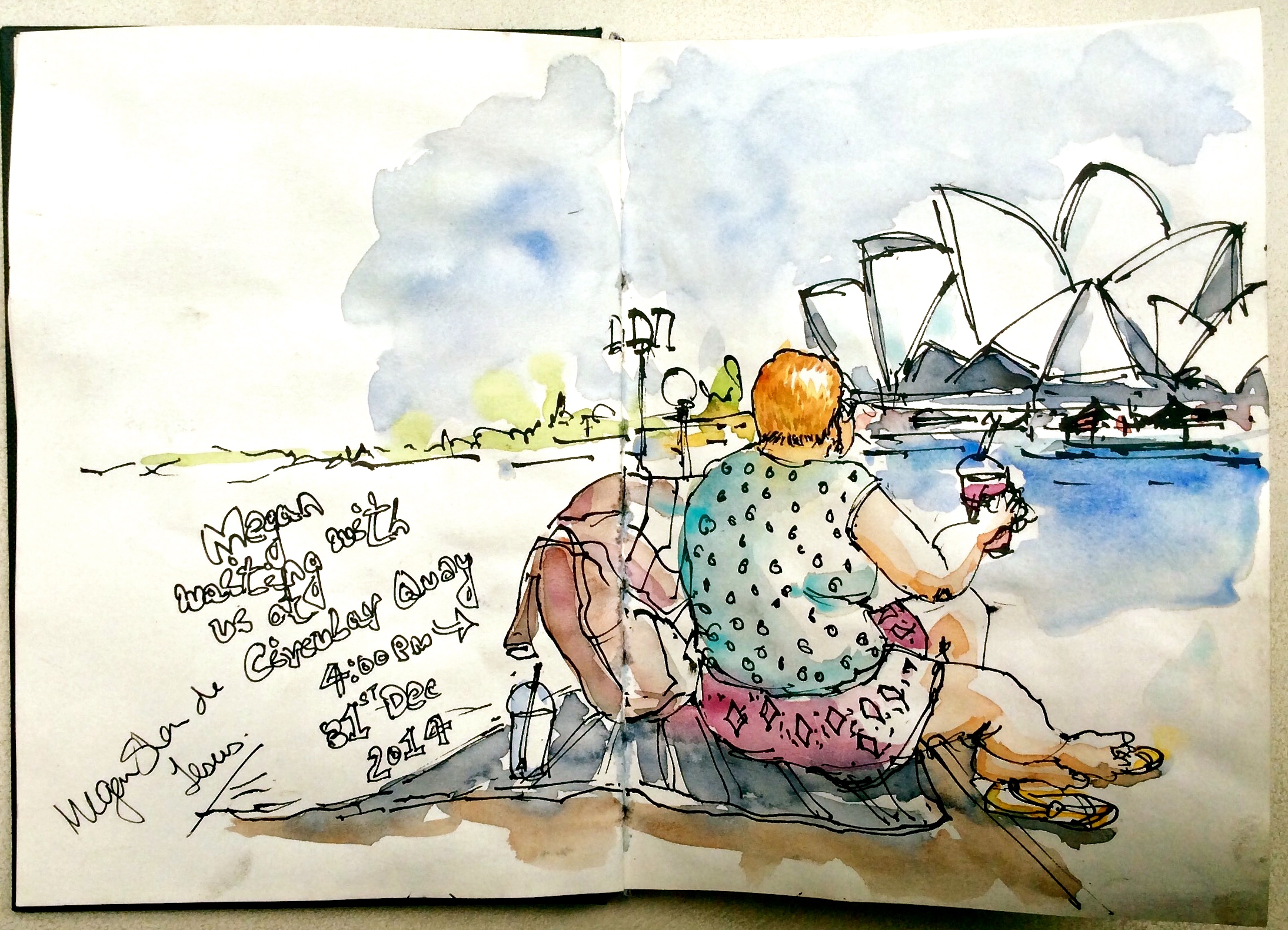
That’s when we saw our neighbours – Megan from Wales and her Portuguese husband Becas. They were back from New Zealand and ending their 25th anniversary celebratory tour with the Sydney fireworks. “How romantic”, we gushed and got talking. There’s only one way to describe the short haired, chubby cheeked Megan. She’s a veritable force of nature that overpowers anybody in her vicinity with love, vivacity, humour and charm.

This is Megan. Of course, I had to draw her. I also got her to sign my sketch. Notice her surname - 'Jesus'!

31st Dec 2014, Sydney – This is Megan. Of course, I had to draw her. I also got her to sign my sketch. Notice her surname – ‘Jesus’!

She has a big personality and a bigger heart that constantly expanded to accommodate more people. Megan took us under her wings and every other person who came over to sit near or around her – the Iraqi family from New York, the two pimply German guys who sang – ‘Deutschland über alles’ at every cue, the young Brit couple and the 20-something giggly selfie addicted Belgian girls. She would take turns to chat with each of us and every once in a while, call out a name and ask, “Are you okay?”.

This is Circular Quay at about 4pm. People were taking up the spaces in front of us and were ready with their cameras and tripods for an event that was still 8 hours away.

This is Circular Quay at about 4pm. People were pouring in from all directions and taking up any empty space available. All around, you could see bright ‘2015’ hats wiggling on heads, huge cameras and unwieldy tripods on standby for an event that was still 8 hours away.

As Circular Quay started filling in, the member’s of the Megan club, huddled closer to each other, with its hawk eyed matron at the helm, guarding and protecting our space and precious view. No one could sneak in and block it, although many tried. The picnic mat became her ‘home’ and we were its members who were bound by its rules. Like chanting a Welsh rugby cheer every time Megan felt there was a slump in our energy levels. “Group hug, everyone”, she’d shout and make us stand. We’d feel silly but get up like obedient pupils. Thousands of revellers at Circular Quay would witness us huddled in a circle with arms around each other shouting at the top of our voices, following Megan’s lead.

Megan : Oggy Oggy Oggy!

Us: Oi Oi Oi!

Megan : Oggy Oggy Oggy!

Us : Oi Oi Oi!

Megan : Oggy! ; Us : Oi!

Megan : Oggy! ; Us : Oi!

Megan : Oggy Oggy Oggy!

Us :Oi Oi Oi!

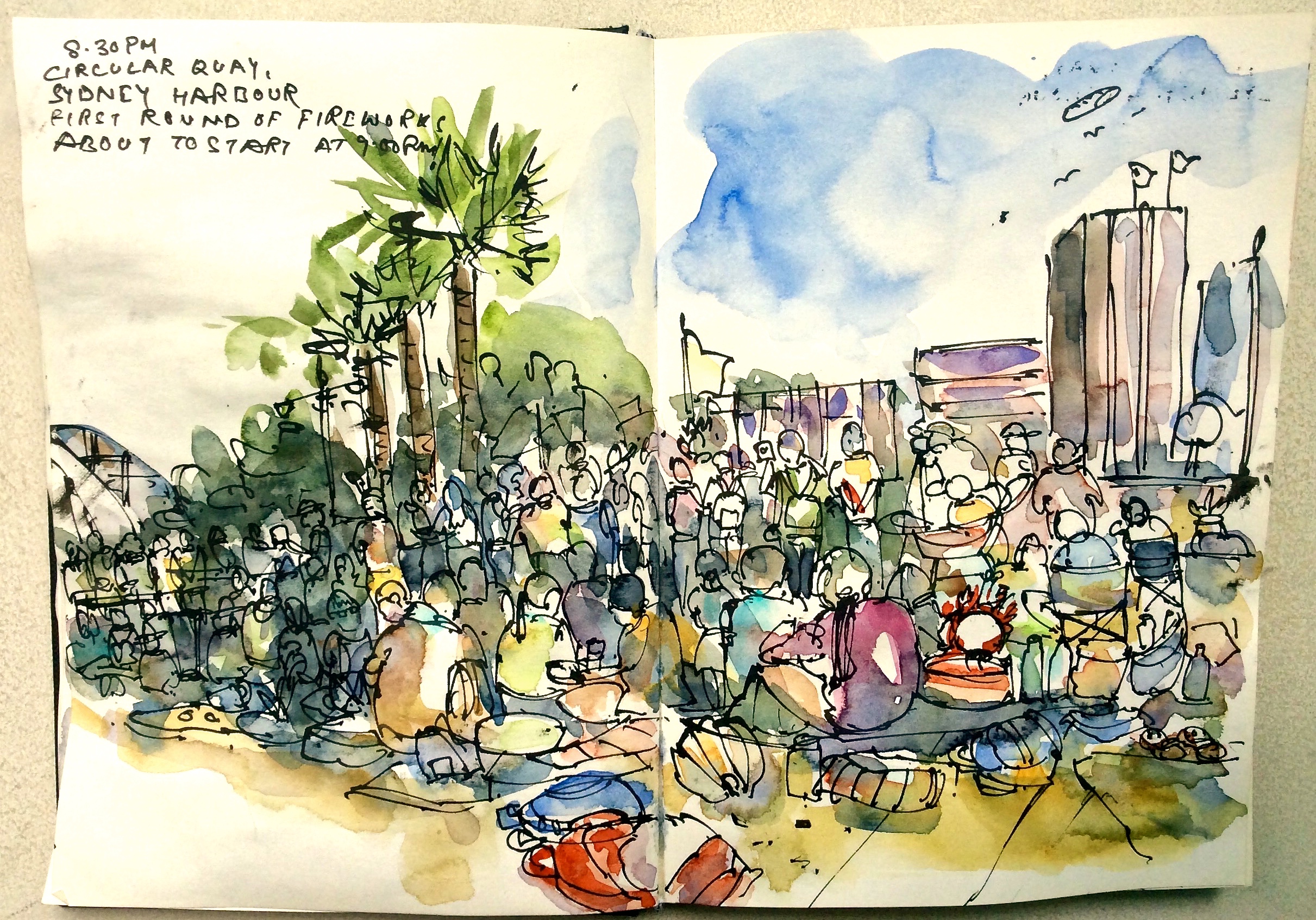
31st December / Sydney - This is how Circular Quay looked like at 8:30pm - sea of revellers. It took my husband 45 mins to go through this crowd to the toilet stalls about 500 meters away and come back. The place had reached its maximum capacity i.e 26000 people.

31st December / Sydney – This is how Circular Quay looked like at 8:30pm – sea of revellers from every country imaginable. It took my husband 45 mins to go through this crowd to the toilet stalls about 500 meters away and come back. “This place has reached its maximum capacity” was being continuously announced. 26000 people had gathered here to welcome the new year and I was one of them.

And just like that, it was midnight. We watched the sky light up our faces in a million ways. This event was in our bucket list for years, at the centre of our itinerary, planned months in advance. It delivered what we’d hoped for, probably more and yet looking back it isn’t the spectacular fireworks that I remember from that day. It’s Megan, and her chants and her made up ‘home’ and ‘family’ that lasted for 14 blissful hours under a punishing sun. Such are the perks of travel.


*Tips for finding an accommodation during Sydney NY fireworks – Unless you’ve booked your accommodation an year ahead to watch the inimitable Sydney fireworks, choices become very limited towards the end of the year. In such cases, book a budget friendly accommodation as close as you can get from the CBD, that offers free cancellation and check back again for better options say two weeks before the new year – you’ll most likely find a decent place. E.g – We used booking.com to block a cancellable hotel in Chatswood, 15 kms from CBD in October and Airbnb to find our accommodation in Surrey Hills, a 15 mins walk from CBD, in the last week of December.

It is highly preferable that you stay within walking distance from CBD – you’ll thank yourself for this prudence when you look at the sea of revellers standing still outside train stations after the fireworks. Though I didn’t find a free spot, but university stays (http://www.universitystays.com.au/) could be an inexpensive and interesting lodging option in Sydney, specially during this time. Lastly, most places mandate a minimum stay of 3 nights – 30th Dec, to 1st Jan. So for easy availability, plan your stay accordingly.

**Tips on finding a good spot to watch Sydney fireworks – Check the New Year’s Eve official website and scout some of the vantage points in person, a day before. Find a place with a good view of both the Opera House and Harbour Bridge. Bring food, drinks, picnic mat, umbrella, sunscreen and anything that will keep you occupied. There are spots that do not allow alcohol and glass – take note of that when choosing. Come early by 10, latest by afternoon. Take it easy, be prepared to spend the whole day. Lastly find Megan. She will get you through the wait.


Trip to the Antipodes series : Melbourne


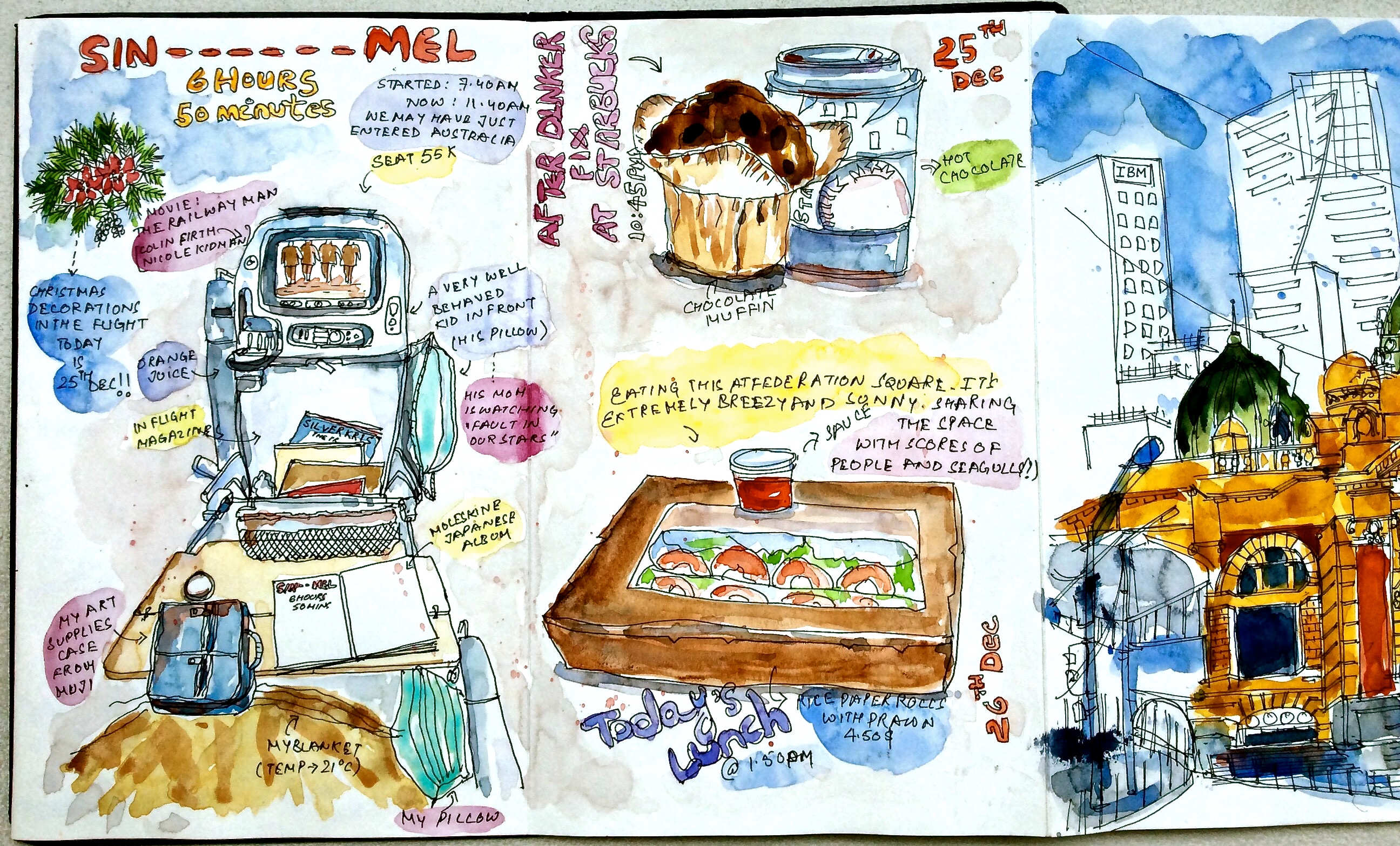
25th December 2014 : Singapore to Melbourne  –  The flight was decorated with mistletoe and holly and in the middle of service, flight attendants pinned snowflake shaped brooch to their uniforms. “As a part of our special Christmas Menu, we have turkey today! Would you like to opt for that, Ma’am?” I was asked by the flight attendant, with immense hope and expectation, as if there was some tacit Christmas turkey consumption target, she had to meet and my choice of meal would greatly affect her cause. No thanks. I’ll stick with chicken I said and tried to smile as bright as her. I really tried. “How about you Sir?”, she moved on. ‘Ummm..what the heck..I’ll try the turkey!’ said my husband with enough benevolence for both of us.

Sketched on flight from Singapore to Melbourne

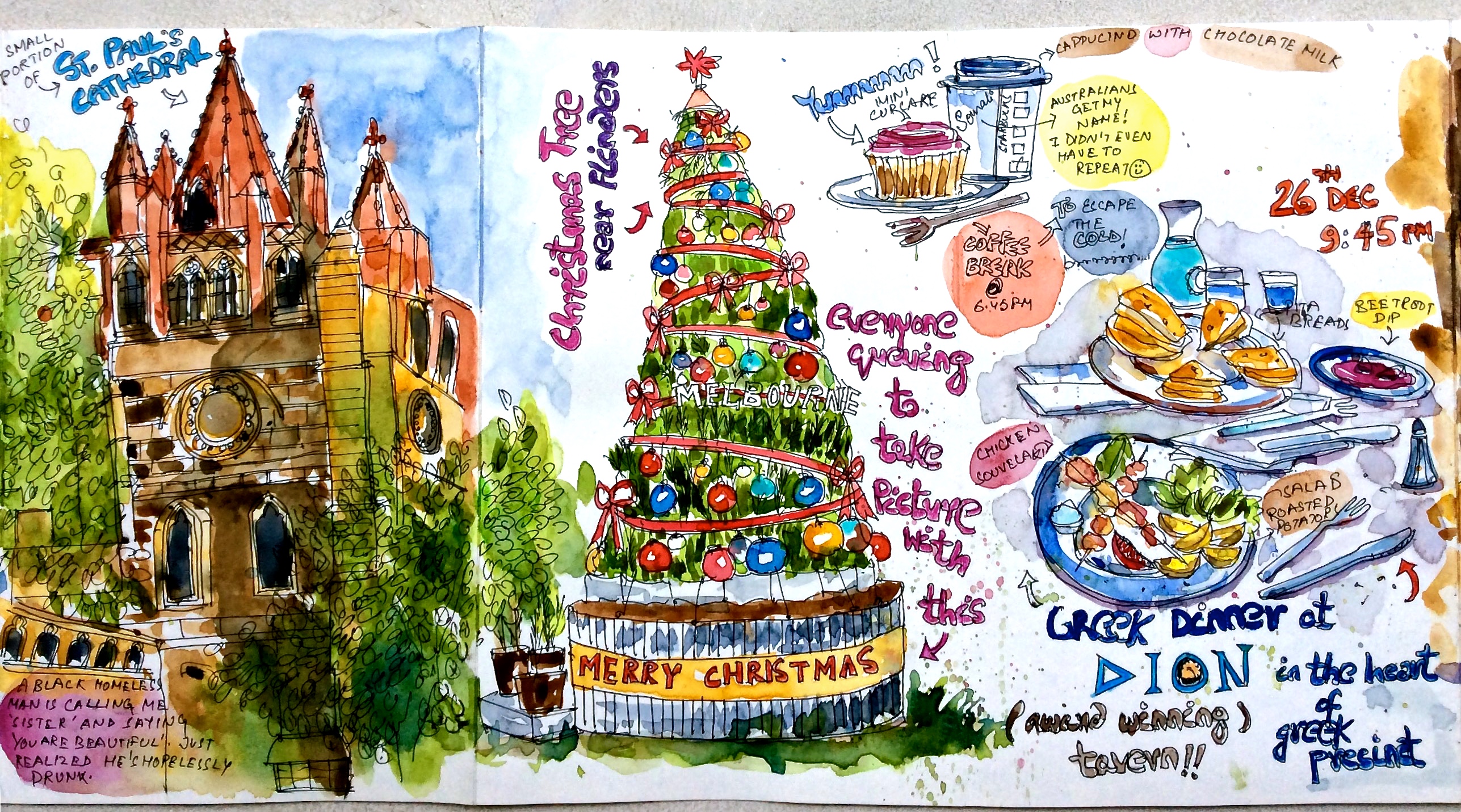
25th Dec + 26th Dec/ Melbourne :  Inflight sketch from from my seat; Hot chocolate and muffin at Starbucks; Rice paper rolls bought on Flinders street consumed at Fed Square with seagulls and people.

In the evening, we jostled against hundreds of people to watch the Christmas light show projected on Melbourne’s Town Hall, had great dinner, clicked some praiseworthy photos of Flinders station, sipped warm coffee and munched on deliciously fluffy chocolate muffin at Starbucks. If the first day on the trip is any indication of what’s to come, we were pretty optimistic. Then, came the abrupt uncalled for, unprepared for rain right after the coffee people shooed us away at closing time. Without umbrella and jackets, we shivered in the cold under the shop’s awning in the peak of Australian summer, and after a very long wait, deep in the throes of the night with hobos and drunk for company, we finally trudged back to the hotel in clumsy rain soaked shoes.

Karma caught up with me. I should’ve accepted the turkey. And with grace.

26th December 2014: On our Own – As much as I love the Indian cricket team, I didn’t accompany my husband to the famous Boxing Day Test match between India and Australia held at Melbourne Cricket Ground. While my husband walked to his pilgrimage early morning, I set out to soak the city, explore, observe, experience and make impressions. It was a day with no itinerary and no agendas. I perched on the steps of St. Paul’s Cathedral and watched a sea of people, cars, trams criss crossing each other at the traffic signal.

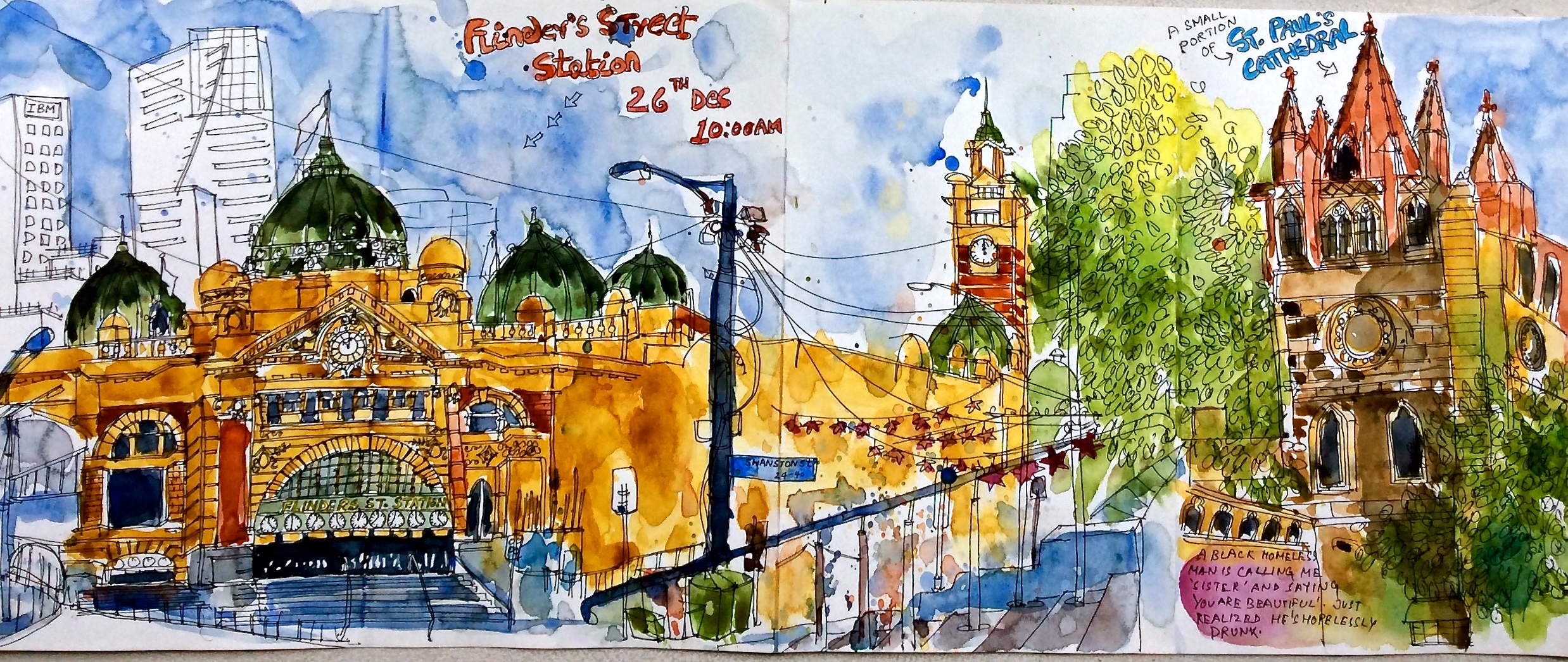
26th Dec / Melbourne : Flinders Station sketched from the steps of St. Paul's Cathedral

26th Dec / Melbourne : Flinders Station sketched from the steps of St. Paul’s Cathedral. It was extremely breezy. I had a hard time holding on to the paper.

When my interest waned, which was by the time I finished this sketch, I crossed the road, bought myself some Vietnamese lunch from a Flinders street eatery and came back to Fed Square to finish it. The seagulls begged and begged for scraps but I was too hungry. The inimitable Immigration Museum consumed my entire afternoon and in the evening I went back to the same Starbucks for coffee and was quite pumped when the lady at the counter got my name right the first time. That instantly erased memories of the night before.

26th Dec / Melbourne : Right in front of the Starbucks was a green patch where stood this giant Christmas tree which everybody queued to take pictures with; Greek Dinner in the heart of Greek precinct

26th Dec / Melbourne : Right in front of the Starbucks was a green patch where stood this giant Christmas tree which everybody queued to take pictures with; Greek Dinner in the heart of Greek precinct was chicken and lamb souvlaki with pita and beetroot dip.

Having checked off one of the items on his bucket list, my husband joined me for sumptuous Greek dinner at DION. Between mouthfuls of souvlaki and pita, we talked about our day and tried to prove which one of us had a better time.

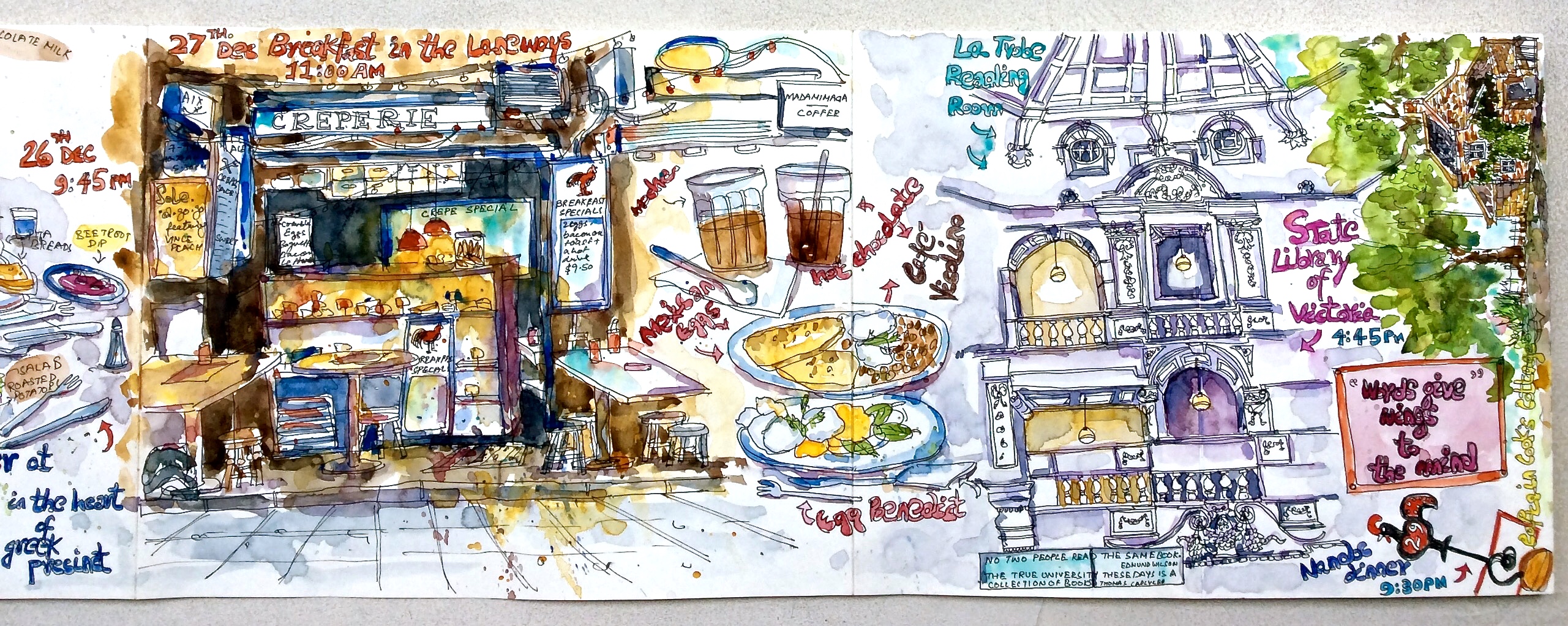
27th December 2014: Initiation to the Laneways – Vicolino Cafe on Degraves Street served the most surreal Egg Benedict I had ever tasted in my life. This breakfast perked me up so much that I immediately landed a detailed sketch of a creperie right opposite Vicolino in my sketchbook, while shuffling on the tiny stool I was perched on, in the cramped corner of a grungy back lane riddled with graffiti, exposed wires and torn posters. It was unconventionally atmospheric and an unkempt tipsy man slinking through the shadows with his beer bottle fitted the scenery seamlessly. Reams of tourists and locals streaming in and out of the narrow cobbled street, eating, drinking, shopping, people watching, fed to the palpable energy. We kept coming back like hopeless addicts.

27th Dec / Melbourne : Breakfast in the laneways;State Library of Victoria; Captain Cook's Cottage

27th Dec / Melbourne : I sketched this cute eatery called ‘Creperie’ while having breakfast at Cafe Vicolino on Degraves Street; a portion of the magnificent La Trobe Reading Room was tackled inside the State Library of Victoria; a tiny Captain Cook’s Cottage in the extreme right was sketched in the late evening under the tall shadows of English Elms.

Part of the day was spent admiring the fabulous octagonal La Trobe Reading Room in the State Library of Victoria. Ever since I read Pico Iyer’s insightful article ‘Shelter from the storm’, where he says, “..one of the best places to visit in any new city is the library”, I’ve been actively frequenting these emblems of stillness. Imagine cozying up to a musty smelling tome on a period reading table fitted with bottle green-reading lamps, under a spectacular white dome! I was wielding a sketchbook, but it had the same effect.

By the time we ambled through the splendid Fitzroy Gardens and arrived at the doorstep of Captain Cook’s Cottage, nobody was home. It was way past visiting hours. But the silky grass, the lulling breeze and the slanting rays of the golden sun causing the stately English Elms to cast tall sombre shadows called for a brief stopover. I captured some memories on paper before ending the day at Nandos. I sketched our food order number, which was 29, while listening to our neighbours blithely discussing their recent trip to Singapore. They sounded very pleased.

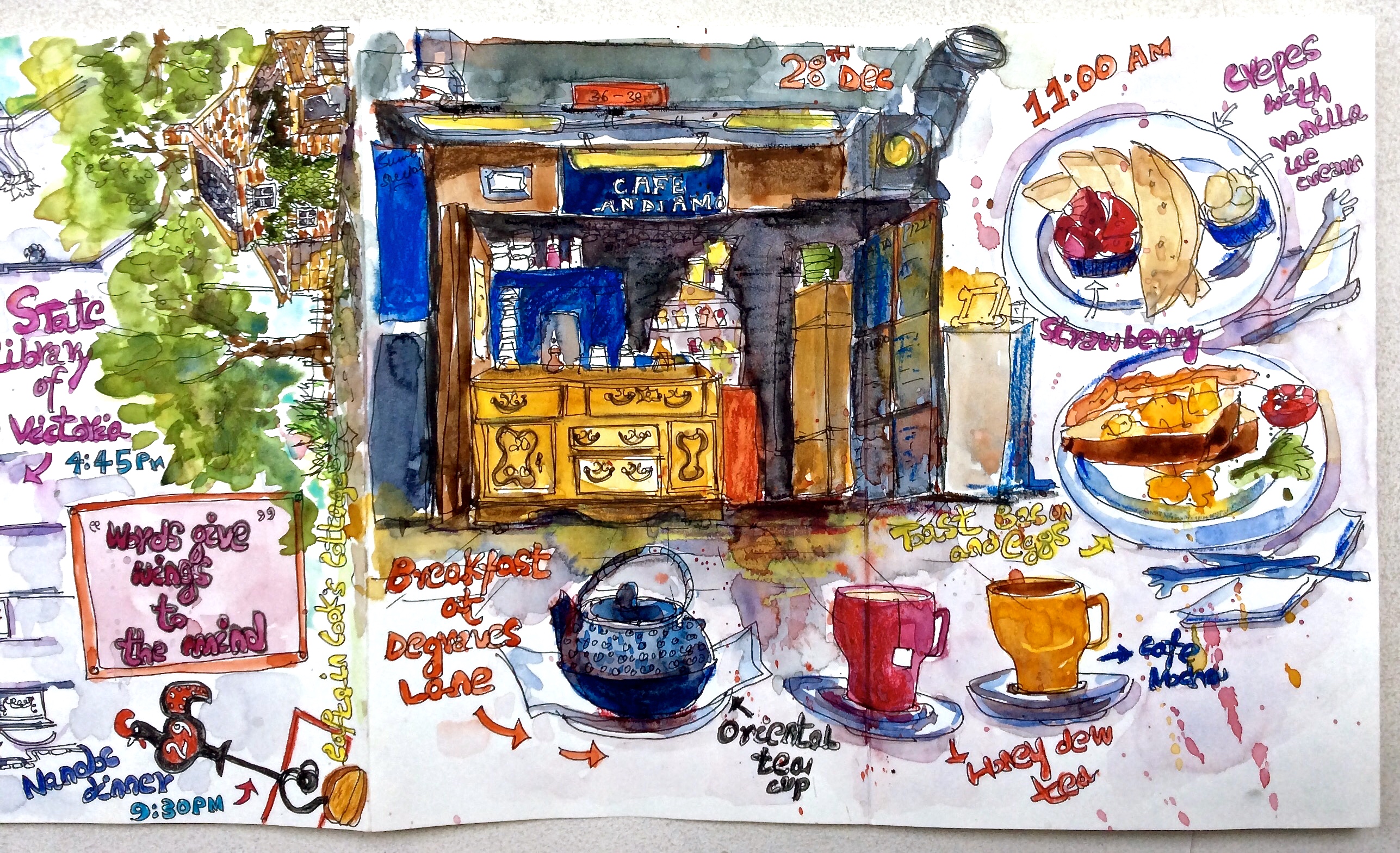
28th December 2014: Away from the CBD – Starting the day with a Laneway breakfast was a no brainer! Back on Degraves, Cafe Andiamo served the most scrumptious crepes with strawberries and vanilla ice-cream that melted by the time I finished my sketch. Well, the day was hot. And by the time we finished a 2 hours walk along the waterfront from Southbank Promenade to South Wharf along the Yarra, we were cooked and toasted by the blazing sun.

28th Dec / Melbourne : Laneway breakfast

28th Dec / Melbourne : Laneway breakfast at Cafe Andiamo

A very long ‘passion fruit smoothie’ break later, we landed ourselves on a silky green patch of land beside the Ornamental Lake in Melbourne’s Royal Botanic Gardens, where I sketched this scene because sometimes you’re so overwhelmed with what you see, you need to express your joy and gratitude in some way.

The evening was quiet except for the screeching of the cockatoos. It was getting colder, pleasant actually. I took my shoes off and rubbed my feet on the grass, releasing a raw earthy smell. A slanting golden light coloured the trees, plants, bushes and shrubs of variegated foliage, arranged like little jewels along a turquoise lake, that held their reflection in absolute stillness. It was one of those rare moments when you sense a primordial connection with your environment.

28th Dec

Dinner was at Blue Train, back at Southgate promenade, which was now teeming with evening strollers and joggers. The lesson that I took away from eating here, was to garnish my future homemade pizzas with spring onions – it makes a phenomenal difference!

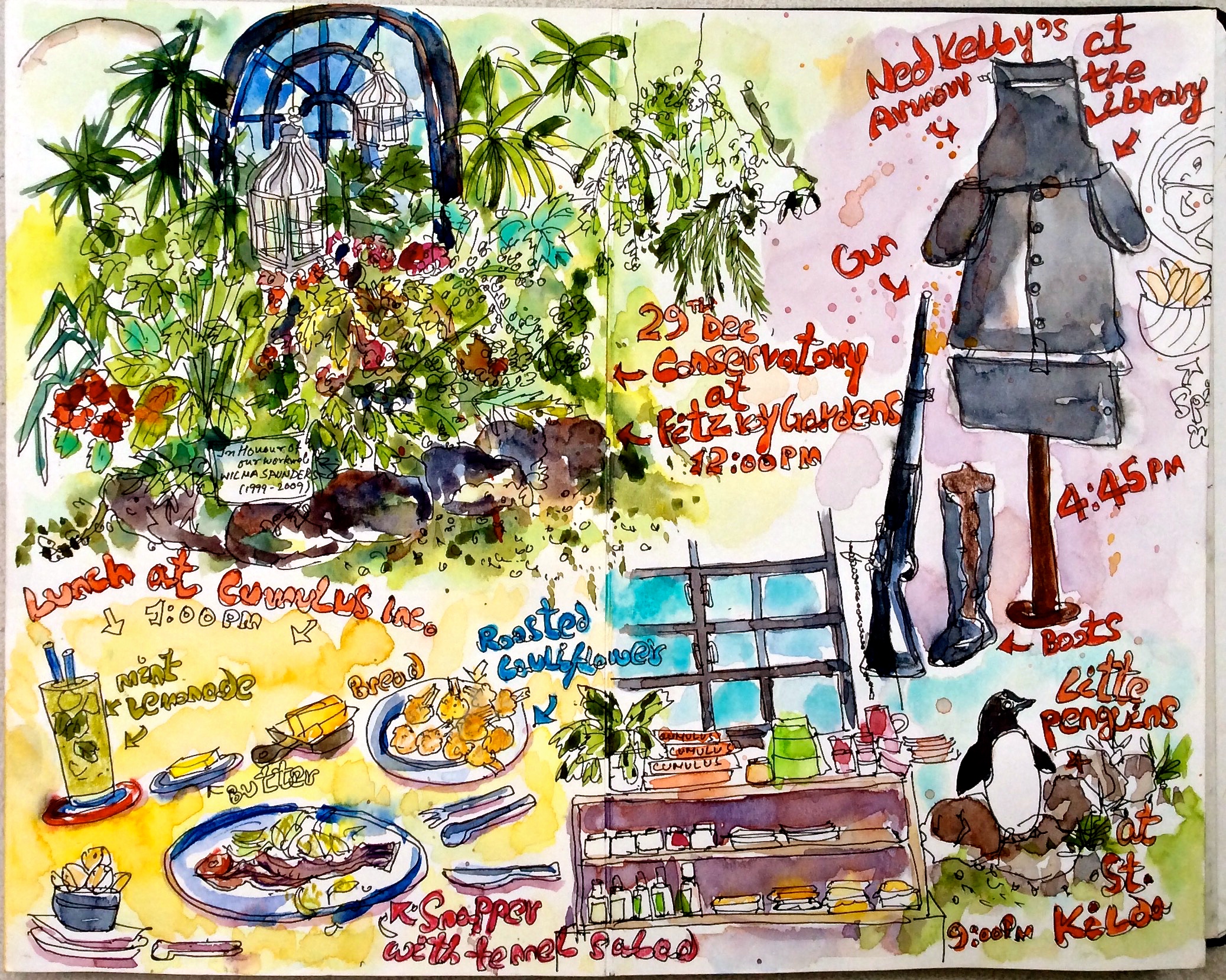
29th December 2014: Taking it easy – Just when I thought nothing could top my love for the stately English Elms of Fitzroy Gardens, we found the conservatory. It is one happy rendezvous of plants and flowers in all kinds of shapes, sizes and colours, arranged in pleasing designs. There are empty cages hanging from the top, a tiny bridge  with railings at the centre and old fashioned benches for people to rest and take photos. Soft muted light streams in through the beautiful arched transom windows. Obviously I sketch.

Lunch was at Cumulus Inc. at nearby Flinders lane and I cannot say this enough – If you’re ever in Melbourne, eat here at least once. Unparalleled customer service (which seems to be the norm in Melbourne, though) pales in comparison with the food. Your taste buds will experience a firework of flavours. Probably this should be their tagline.

While I was sketching the conservatory, an old British couple breathed over my neck. They were pretty intrigued and while leaving said. "You're clever, aren't you?".

29th Dec / Melbourne: While I was sketched in the conservatory, an old British couple breathed over my neck. They were pretty intrigued by what I was doing and while leaving said. “You’re a clever girl, aren’t you?”. Ahh..ummm..mmm..I’ll be better prepared next time.

St. Kilda’s Pier hogged our last evening in Melbourne. We strolled hand in hand (more so coz I needed something to cling on to) on the historic pier with waves crashing on either side and the wind throwing us off balance. It was an exciting change from what we’ve been doing past four days. The day ended with an intensely golden sunset and the sight of penguins swimming to the shore at dusk.


Absconding with a reason!

Hatching the plan

Having tackled the drudgery of life for an entire year (also known as living!) we decided to get our lungs some antipodean air and come back ably renewed and refreshed to pick up the yoke of 2015. By the way, Happy New Year folks!

Seeing it through

That innocent decision birthed in a moment of romantic wanderlust was followed by endless reading, preparing, planning, discussing, arguing, booking, packing and apprehending. The process was tedious and grossly unromantic. But we didn’t give up. Not because the smell of adventure kindled our vigour. The flight tickets were non-refundable.

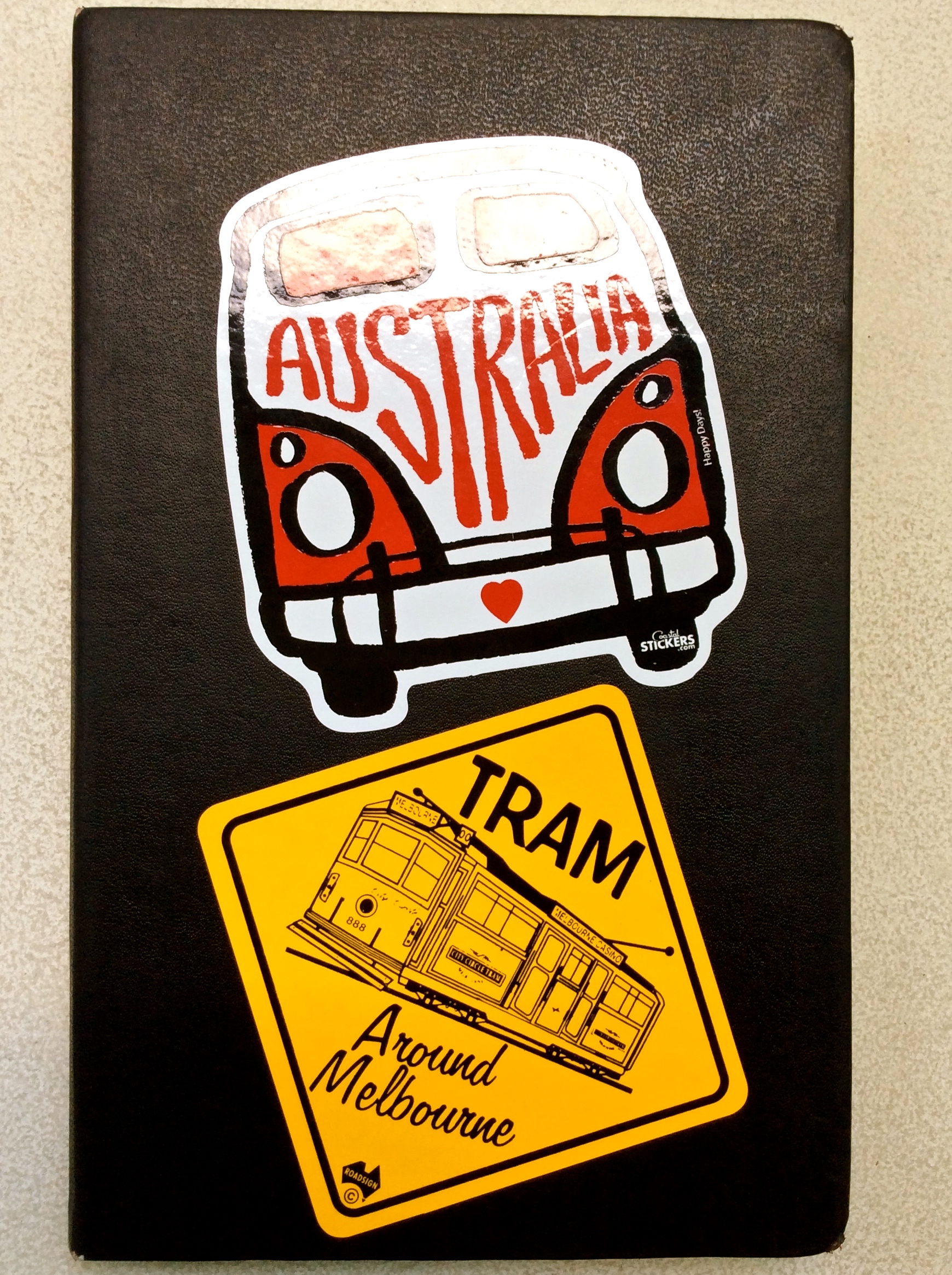
Front Cover of my trusty Moleskine Japanese Album. I gave it a facelift!

Front cover of my trusty Moleskine Japanese Album. I gave it a facelift!

Making a decision (at least trying to)

When things started falling in place, this is what the itinerary looked like : We’d spend 25th Dec to 31st Dec in Melbourne and Sydney, Australia and from 1st Jan to 10th Jan we will hire a car and drive around scenic routes in the South Island of New Zealand. So naturally, even before deciding what to wear, my one track mind was thinking of ways to capture the experience in pages. It made lofty promises of filling sketchbooks and loose sheets with astounding art and demanded I buy suitable art supplies to be able to achieve that. We debated day and night, weighed pros and cons, charged each other with a salvo of arguments, defended with smart retorts. It wasn’t easy. ( Yes, I have a fertile imagination and a very active inner dialogue). But we came to a decision.


Justifying that decision

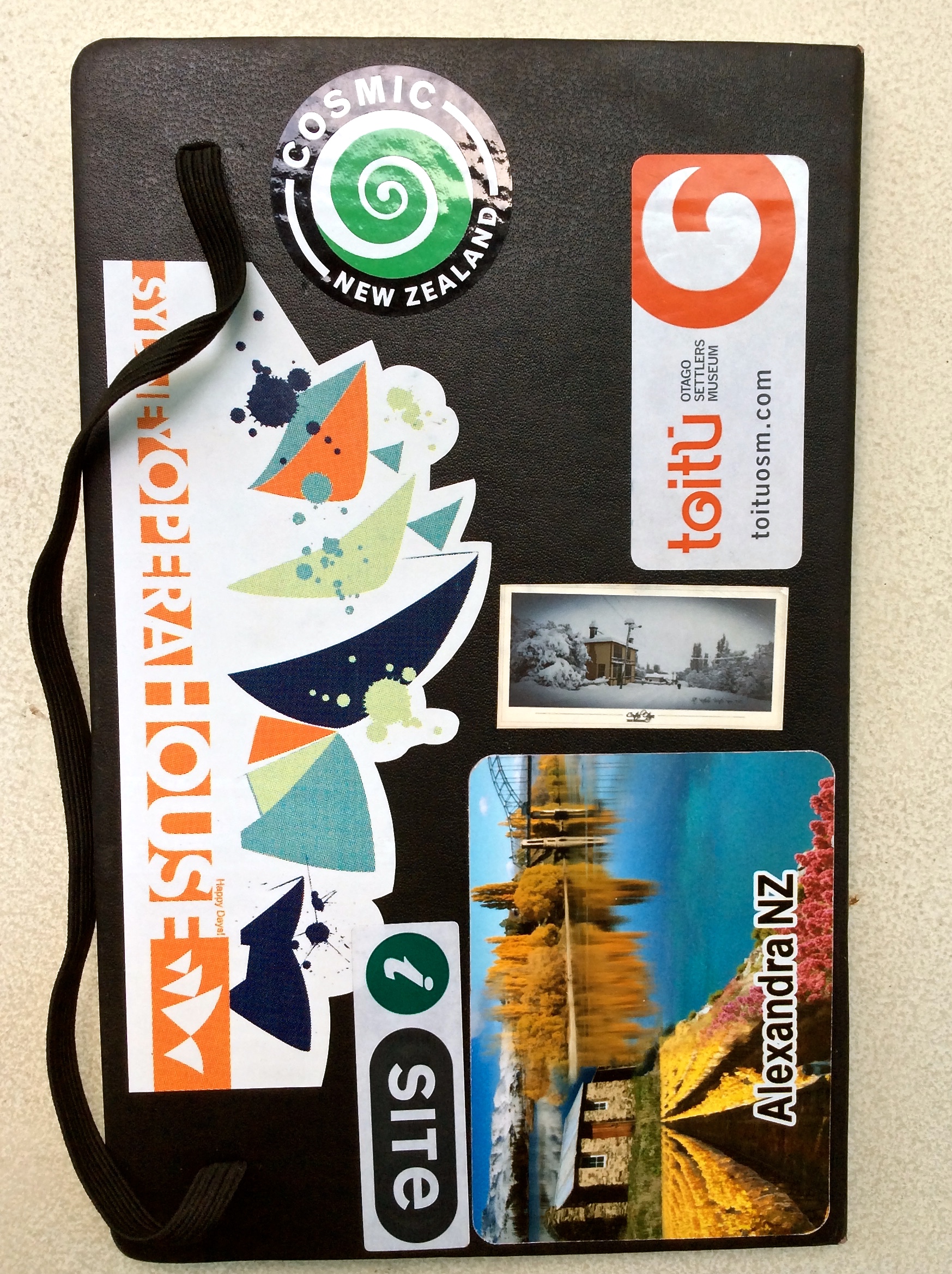
Backcover of my Japanese Album decorated with stickers I collected from various locations - some bought, some handed for free by museums, souvenir shops, tourist info centres who thought it was 'such a neat idea'!

Back cover of my Japanese Album decorated with stickers I collected from various locations – some bought, some handed for free by museums, souvenir shops, tourist info centres who thought it was ‘such a neat idea’!

It would have to be Moleskine’s Japanese Album with 50 pages, 165gsm.

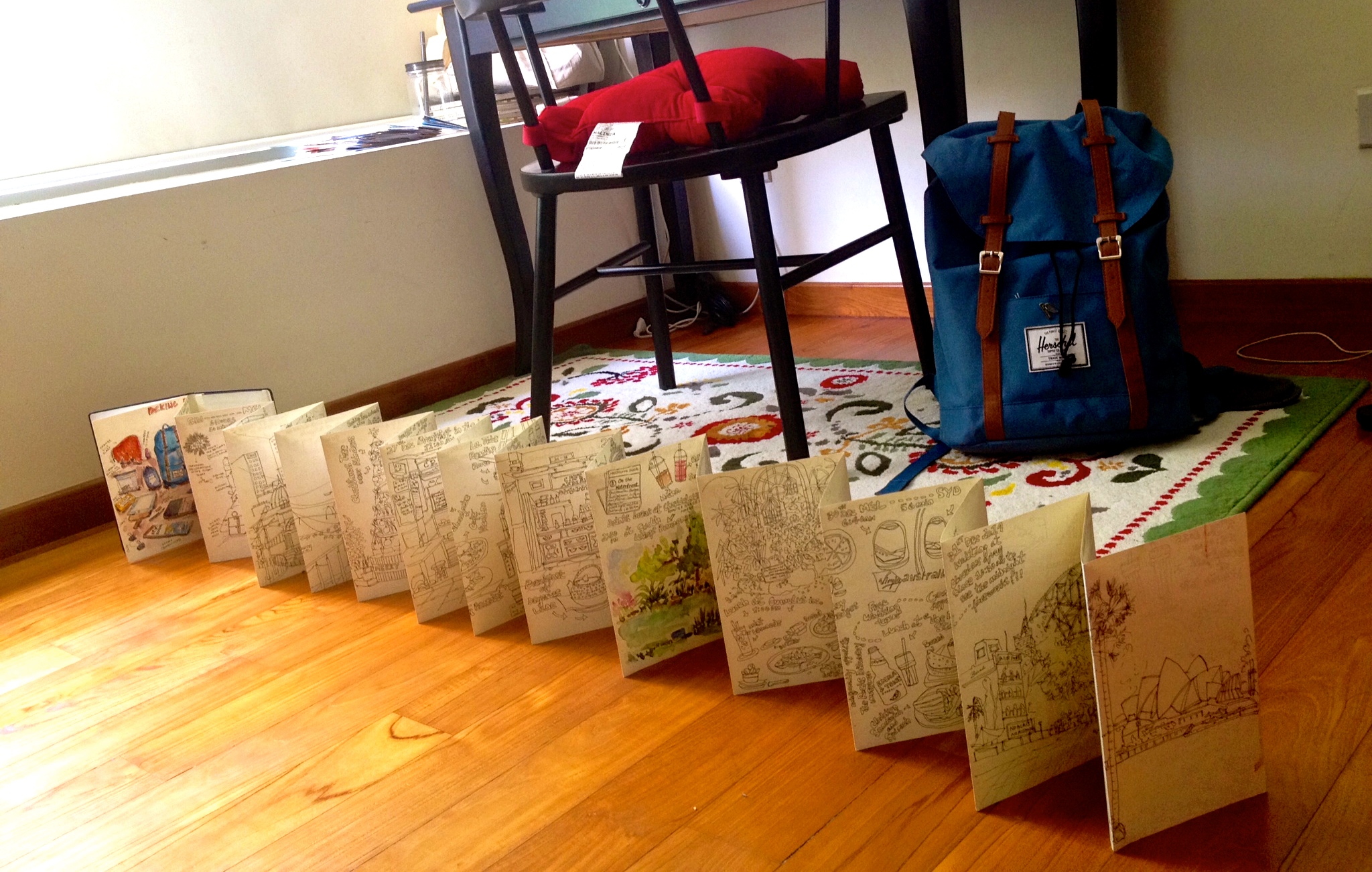
It ticked almost all the boxes. The idea was to carry something handy that fits in the bag easily, isn’t heavy and definitely not intimidating for my subjects. A smaller page would also mean lesser time investment when filling it. But most of all, I was hunting for something, where I could illustrate the entire trip, the whole 19 days in one continuous sheet of paper, where daily events can merge into one another and the observer can see everything without having to turn the page! Wouldn’t that be fun! As you can see from the picture below, the Japanese Album fits the bill! The only quibble is that the paper isn’t great for watercolours, but accepts light washes. I took that in my stride coz, the aim was not to produce elaborate frame worthy paintings, but to document the journey by illustrating my thoughts, misgivings, explorations, observations.


This is how the sketchbook looks when I open it

I unfolded the sketchbook and laid it on the floor of my study.

Going for it

I documented every single day on the trip starting 25th December 2014 and ending on 12th January 2015. It took a bit of getting used to initially both for me and my husband until with a bit of discipline it became second nature. Every single morning I’d sense the potent urge to record my observations for that day and my travel partner would learn to give me time and space, sometimes patiently lingering in the background or finding things to do on his own. In that sense, the 50 pages worth of memories that I hold in my hand is a collaboration.

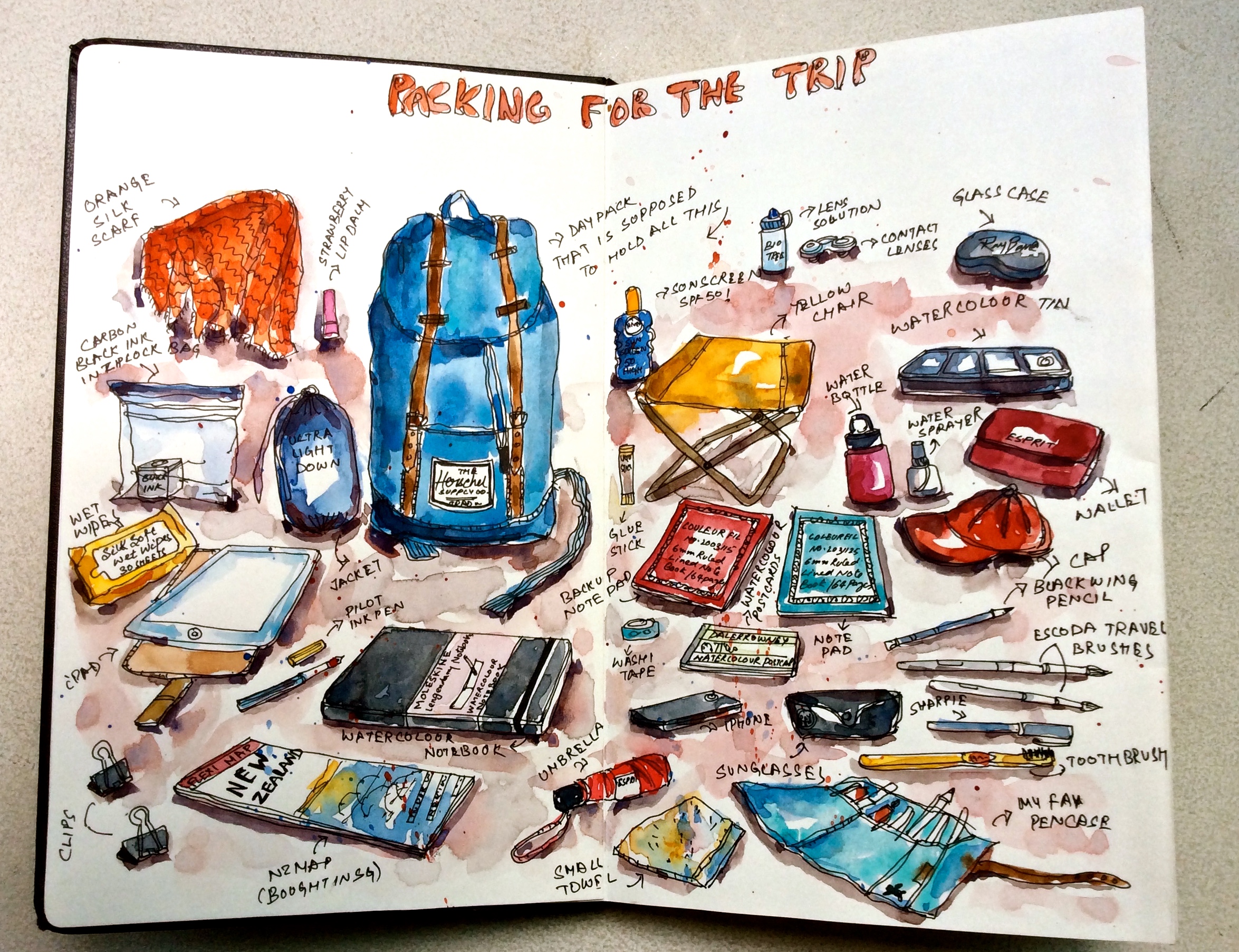
In the first two pages I drew every single item that went inside my blue Herschel daypack that I carried on the trip, for sketching on the go. It weighed slightly less than 5Kgs, although I learnt to downsize based on what I wanted to carry on a particular day.

This is what I packed in my backpack for sketching on the trip

This is what I packed in my backpack for sketching on the trip

I’ll share the rest of my sketches from the trip on this blog, accompanied by little stories. Should be fun! Regurgitating and reminiscing begins.


New kid on the block

Shopping, eating, drinking and sometimes gawking at the mind bending architecture of shopping malls is what we relate Orchard Road with in Singapore.

Sitting with a book in a quiet meditative corner isn’t what you particularly come to Orchard for. Well, you can be adamant and try sitting in a cafe perhaps, burying your head in a pile of text, but what you can’t do is obstruct the relentless stream of people gushing in and out through its doors with shopping bags, the drone of their collective orders of latte and green tea jabbing your focus, their hot fervent gossips about the latest bag, gadget or underwear tingling your ears, and their restless animated bodies scuffling to find that elusive ‘perfect’ seat’ making you want to stand up and offer yours.

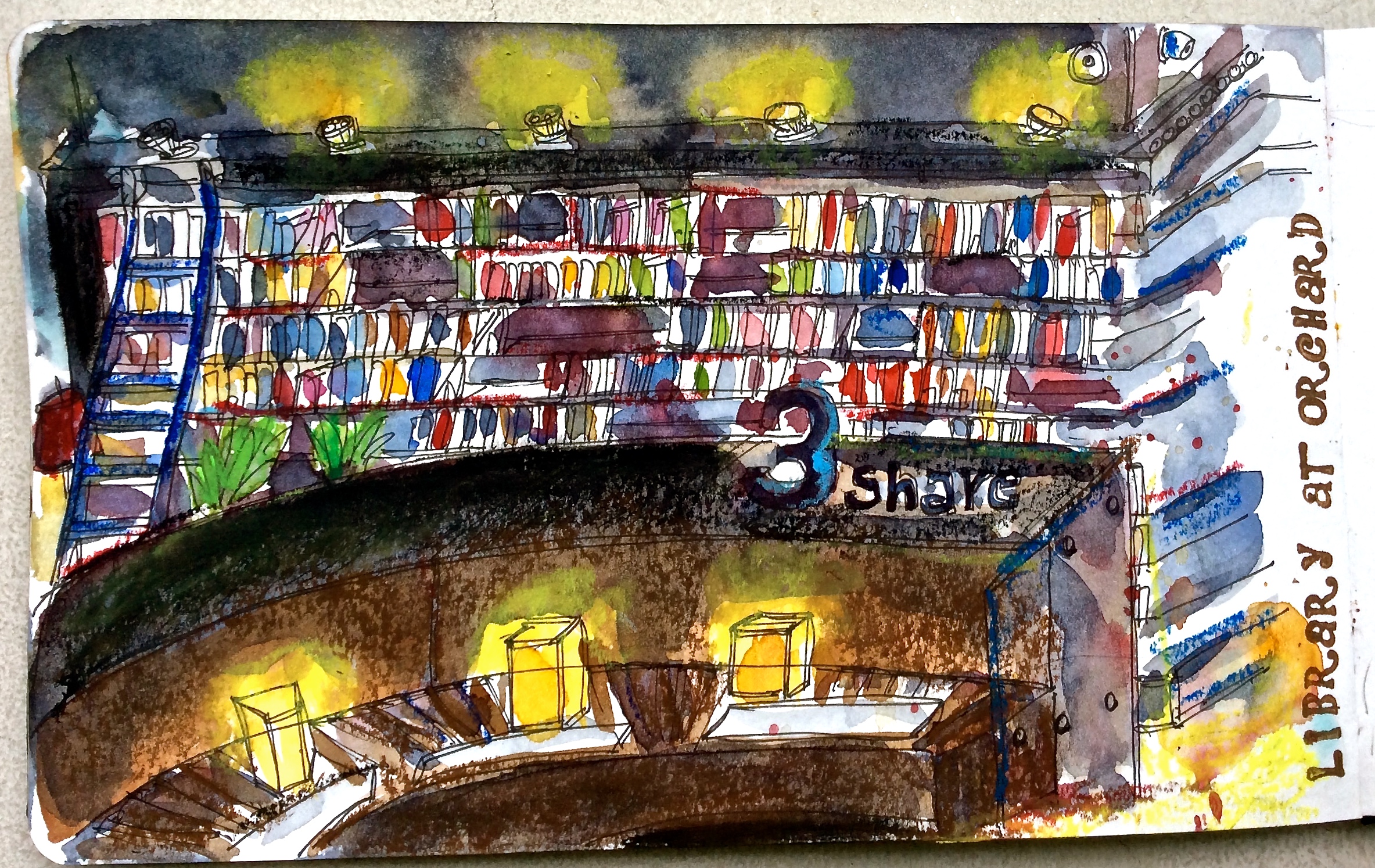
Library at Orchard Gateway

Library at Orchard Gateway – a section of the wooden theatre-style seating gets sketched here

Well, the good news is, as incongruous as it may sound, Orchard Road – the queen of glitz and glamour, has gained a public library in its armoury. And as soon as we got a whiff of the news, my friends and I rushed to check it out, sketchbooks in tow. Clearly the space wasn’t designed in a hurry – the new kid on the blocks, spanning across two floors, has lot of style and panache! One of the floors have wooden wiggly, wave shaped book racks flanked by a theatre style seating affixed with plug points and lights.

Upstairs has even more interestingly designed seating areas – some with a glimpse of the streetscape, some reminding you of an airport lounge and some cozy and secluded, just the way you want it. Though primarily stocked with design and applied arts books, the fiction and cookbook section is pretty verdant. The book drop off and borrowing points are niftier and there’s a huge section of magazine drawers aligned in straight rows with lush glossy covers staring out at you, giving the impression of a heavily postered wall!

While the Central Library at Bugis, still remains my mecca, this one’s a new favourite. Finally, Orchard Road isn’t all about spending anymore.


Out and about

I am enamoured with Singapore’s shop houses.  It’s official. These picturesque palimpsests of the past have been recorded in my sketchbook so many times that I can draw them to a tee even if someone blindfolded me and trussed me up in a cupboard.

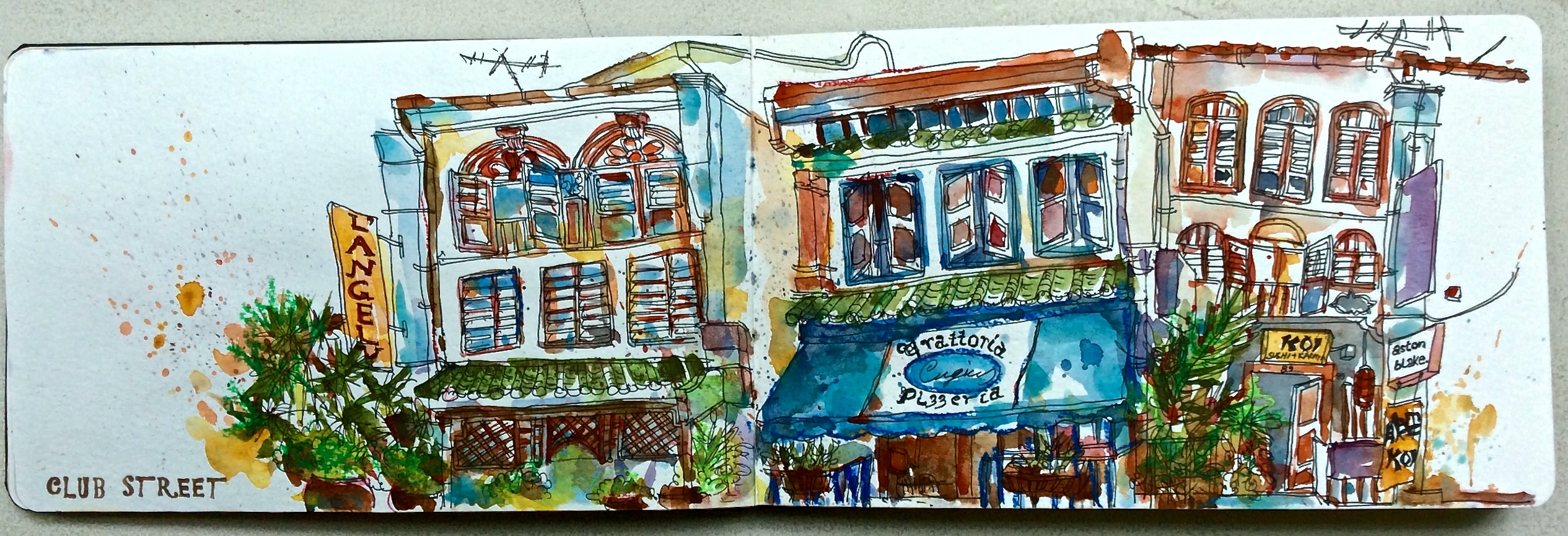
Club Street

The shophouses have remained but clearly the businesses have changed. Sketched at Club Street

To the untrained eye, most shophouses may look alike, but if you’re the curious and observant kind, you’d know that’s hardly the case. Their purpose as residential and commercial establishments may have remained unaltered, but the architecture of these two, sometimes three storied narrow facade terrace houses continuously evolved from the 1840s to 1960s, when they monopolised the cityscape of Singapore.

Pre 20th century shophouses were functional and austere – low two storey buildings with one or two louvered windows with hardly any embellishment on the facade. Chinese-Baroque style from 1900 to 1940s, saw extensive use of decorative mouldings, pilasters, carved wood-work and imported glazed tiles on the facade, representing the fusion of Eastern and Western architectural styles and giving great aesthetic pleasure even today when you look at their refurbished selves. Moving forward, heavily ornamental gave way to simplified and streamlined.

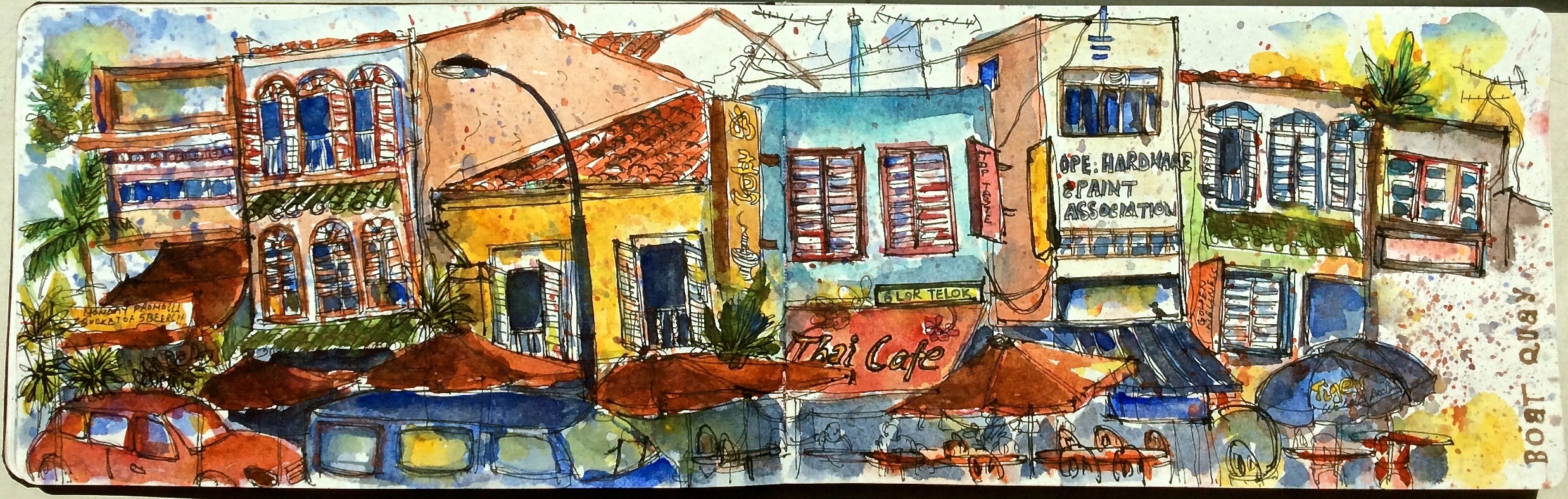
Boat Quay

Such an amazing potpourri of architectural styles seen at Boat Quay

Designers and builders began combining ornately carved transoms and colourful tiles with Art Deco elements such as cross-braced glass window panels and geometric balustrade designs, finally joining the Art Decco bandwagon in 1930s and continuing till the 60s. Stepped pediment with a flag post is a typical giveaway of this stye. Modern shophouses of 1950 – 60s, were plain and unadorned except for a concrete fin air vent perhaps, thus coming full circle in terms of design simplicity.

All this may seem very textual, but what thrills me is to be able to catch these nuances of evolution when I am out and about in the city, running errands, going to the library, working at a cafe or sketching. Especially, sketching. Tracing this potpourri of personal taste, temperament and lifestyle of the residents of yesteryears, sometimes on a single street feels like time travel. Every single time.


Skewer-y Thaipusam

“I am Karna”, said a voice on my right. Since I didn’t look up from my sketchbook, he said, “You know Karna, the warrior prince from Mahabharata? ”. When I am sketching in crowded public spaces, I am used to people peering over me, breathing over my neck, appraising my work like art connoisseurs, pointing cameras to my face, nudging friends to take a look, but rarely does one talk to me while I am working, except slipping in a few words of encouragement when they leave, to which I nod or smile in bashful acknowledgement.
 
But not Karna, the warrior prince from Mahabharata. He wanted to butt right in.
 
Thaipusam celebrations in Singapore

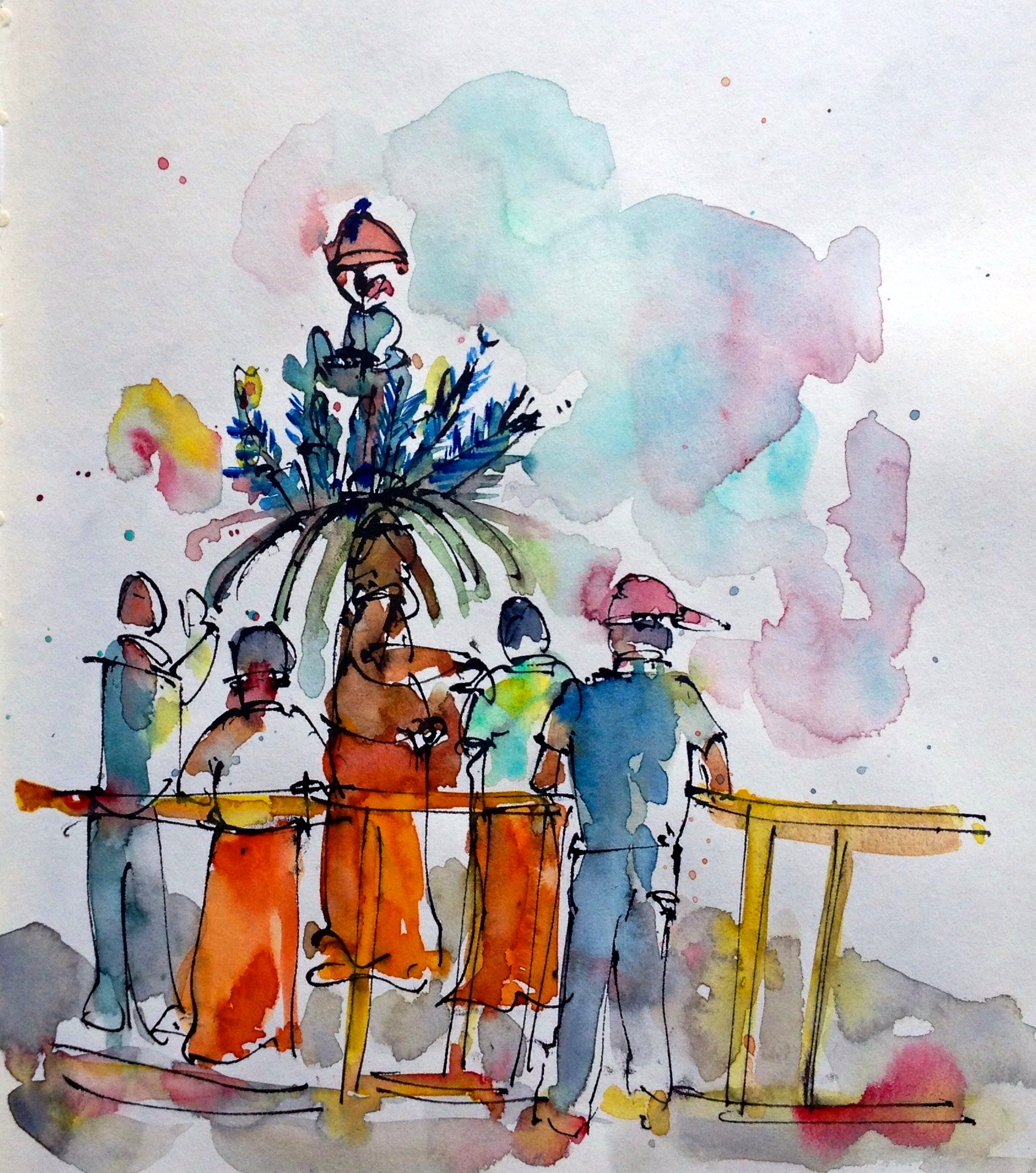
Thaipusam celebrations in Singapore

 
His gigantic frame in an untucked white pinstripe shirt and loose trousers leaned against the yellow barricade and faced me. A mop of dark curls, slick and shining with oil was pushed back; round dancing eyes like two pingpong balls smiled under the shade of bushy eyebrows and an inch wide moustache revealed the largest, whitest pearls I had seen in a long time.  ’The skill you have there’, he said pointing to my sketches and folding his hands and looking heavenwards, ‘is God’s gift’. He scrunched up his eyebrows such that the long tilak on his forehead disappeared between the folds. First time in my four year stay in Singapore, when I finally mustered the courage to watch Thaipusam – a Hindu festival celebrated by Tamils by honouring Lord Murugan –  up close, I was victim of small talk.
 
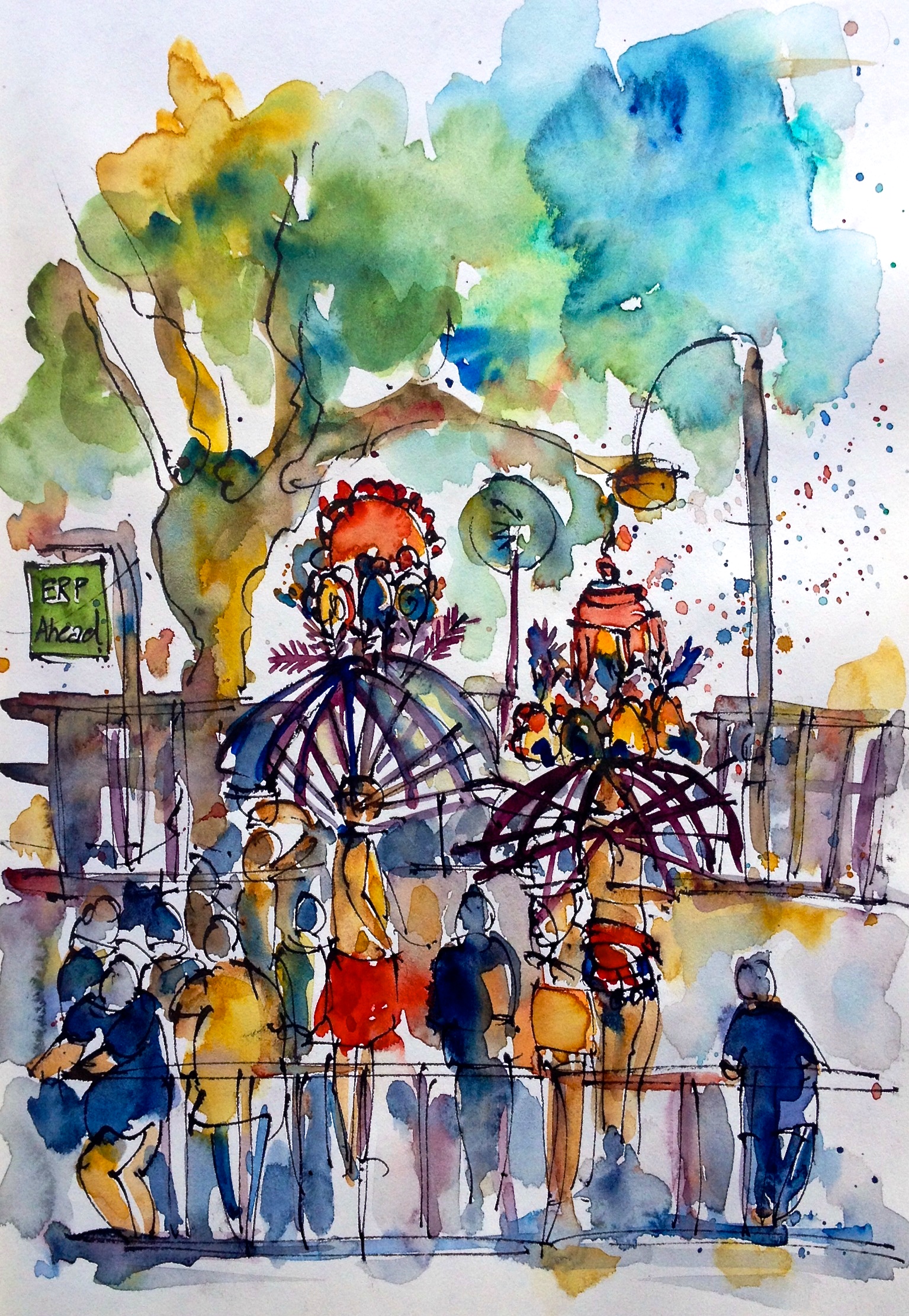
Thaipusam in progress

The kavadi bearing men are bare chested, bare footed and wear yellow, orange or red loincloths

 
But, when you’re on foreign soil and want to make sense of the place, it isn’t a bad idea to indulge local voices to tell you their stories, from their perspective, laced with their sentiments. I didn’t want to kill the story yet, if there was one. So waving at the pilgrims, I asked Karna, a question that was on the top of my mind, “Aren’t they in pain?”.  There was no blood, it was hard to tell.
 
 
“When you fast and pray for 48 days, your body is prepared to endure such pain”, said Karna,  slightly irked at the mushy overtones. But for the uninitiated, Thaipusam is extreme. Thaipusam isn’t for the faint hearted. Even the befuddled spectator needs to keep her nerves. The sight of these men, regular men – perhaps one of them is your office colleague, your school teacher, a neighbourhood grocer – turn into a pincushion overnight, with scores of metal skewers fastened to their chest and back, one going right through the cheek or tongue, a gigantic, elaborately decorated canopy balanced on the head will elicit the question I just asked.
 
 
But bearing a kavadi or physical burden by undertaking such painful ventures is how one expresses gratitude to Lord Murugan, the god of war and victory. “In return the god, protects you from misfortune.” says Karna.  As each devotee passed by, I searched his eyes for signs of exhaustion, discomfort, resignation. All I got was a misplaced sense of calm.
 
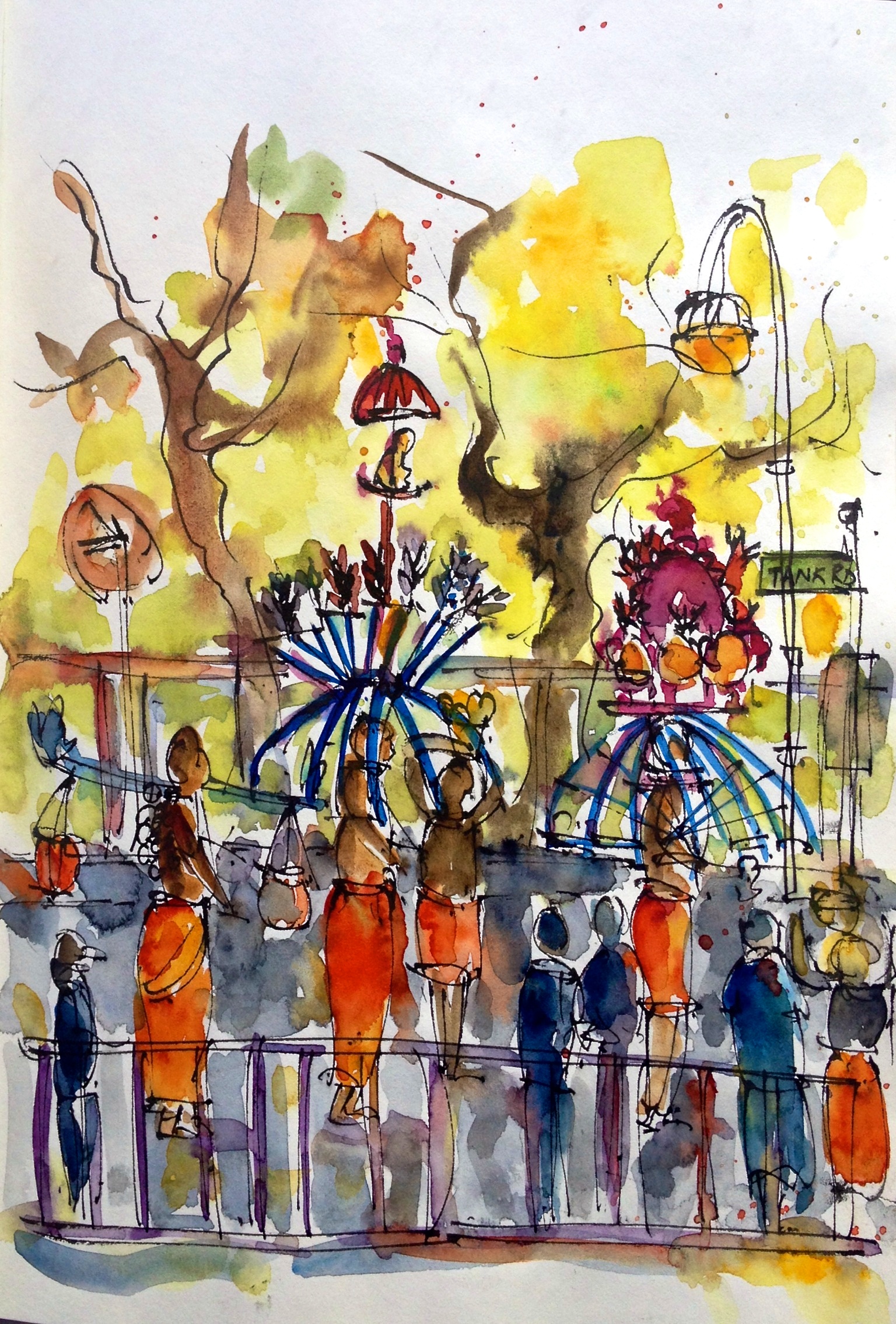
Devotees approaching Tank Road

Devotees approaching Tank Road and the supporters are cheering them on, singing religious songs and clapping

I had joined the procession midway on foot from Dhoby Ghaut station, and reached Tank Road, where they were slowing their march and queuing up to enter the Sri Thendayuthapani Temple, which would terminate their 4.5 km trek from Sri Srinivasa Perumal Temple in Little India. Canary yellow barricades had been laid on roads directing the devotees and separating them from the curious spectators, omnipresent photographers and culture-shocked tourists. Volunteers were directing people at road crossings with urgency and handing out water in plastic cups and food from capacious tents pitched along the road, to exhausted participants and their families who were walking with them, cheering them on, singing religious hymns to drum beats. The police were calm and observant from their posts.
 
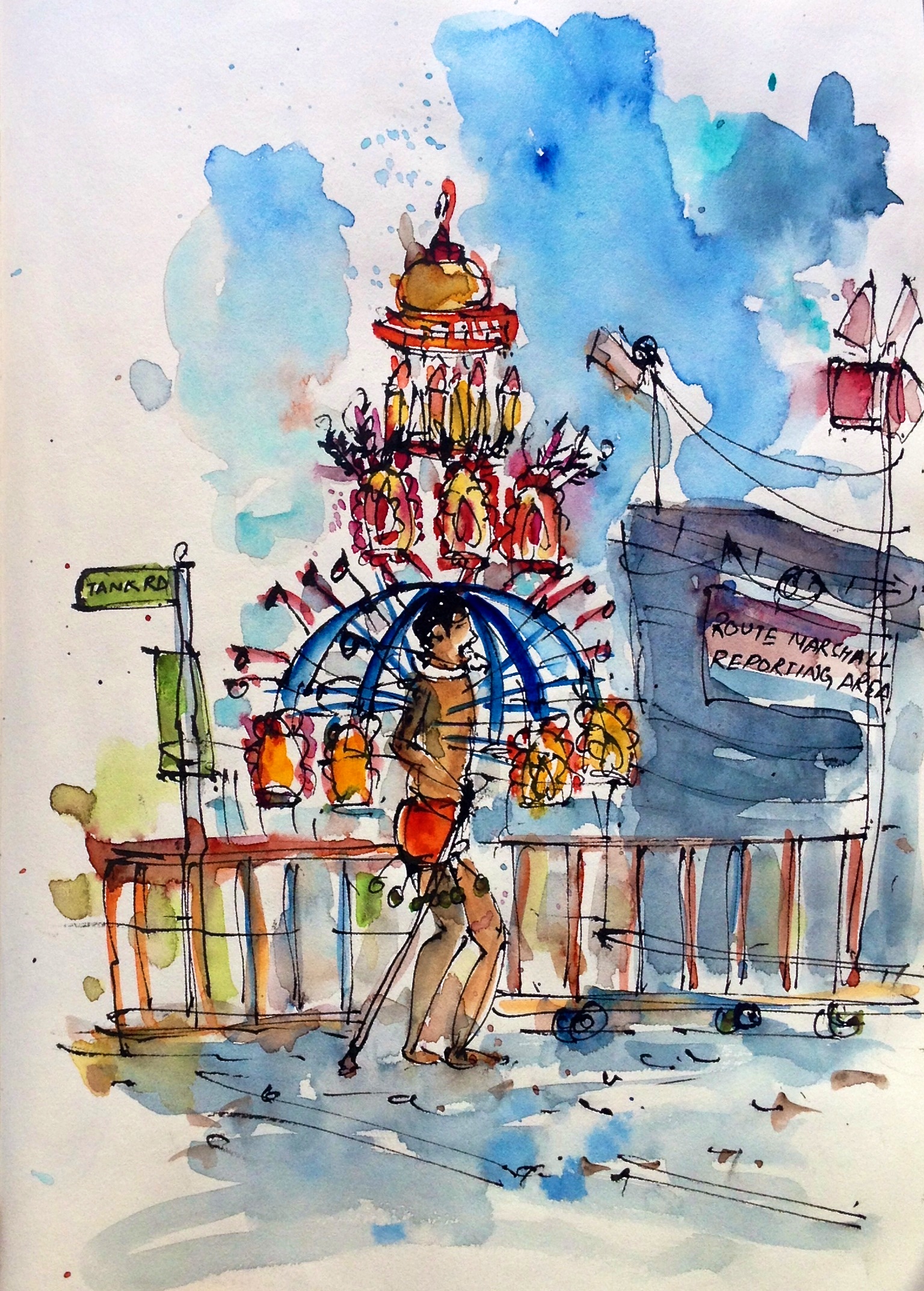
Close-up of a Thaipusam participant

Some kavadis are flower and peacock feather embellished wooden structures with arched metal frames that are supported by skewers hooked to the chest and back of the bearers.

 
‘It wasn’t like this before, you know’, said Karna, when a group of devotees slowed before us, offering a close up. A bunch of supporters, perhaps friends and relatives circled a thickly skewered and canopied man and broke into a perky devotional song, clapping their hands animatedly. The man started swinging and swaying to the chants along with his kavadi. The ankle bells tied to his feet tinkled. The energy was palpable. I don’t understand a word of Tamil but my feet didn’t need to. They were tapping on their own.
 
“Even a few years ago, there was much greater fanfare and spirit; now there are too many restrictions on what you can and cannot do”, said Karna, reminiscing. “ The music used to be so loud, it would ring in your ears long after you left.”
 
Thaipusam in progress

A kavadi bearer, swinging to the beat of drums

I was frantically sketching, trying to capture the guy with at least three dozen lemons hooked to his back, quickly outlining the exhausted drummers catching a breather and getting the many kavadi bearers balancing a gigantic mass of flowers, peacock feathers, folded metals and sharp skewers down on paper. The jubilant yet awestruck crowd guarding the fanfare made the scene complete. There was almost a kilometre long wait to enter the temple and at having their subjects come to a halt, the photographers went delirious.
 
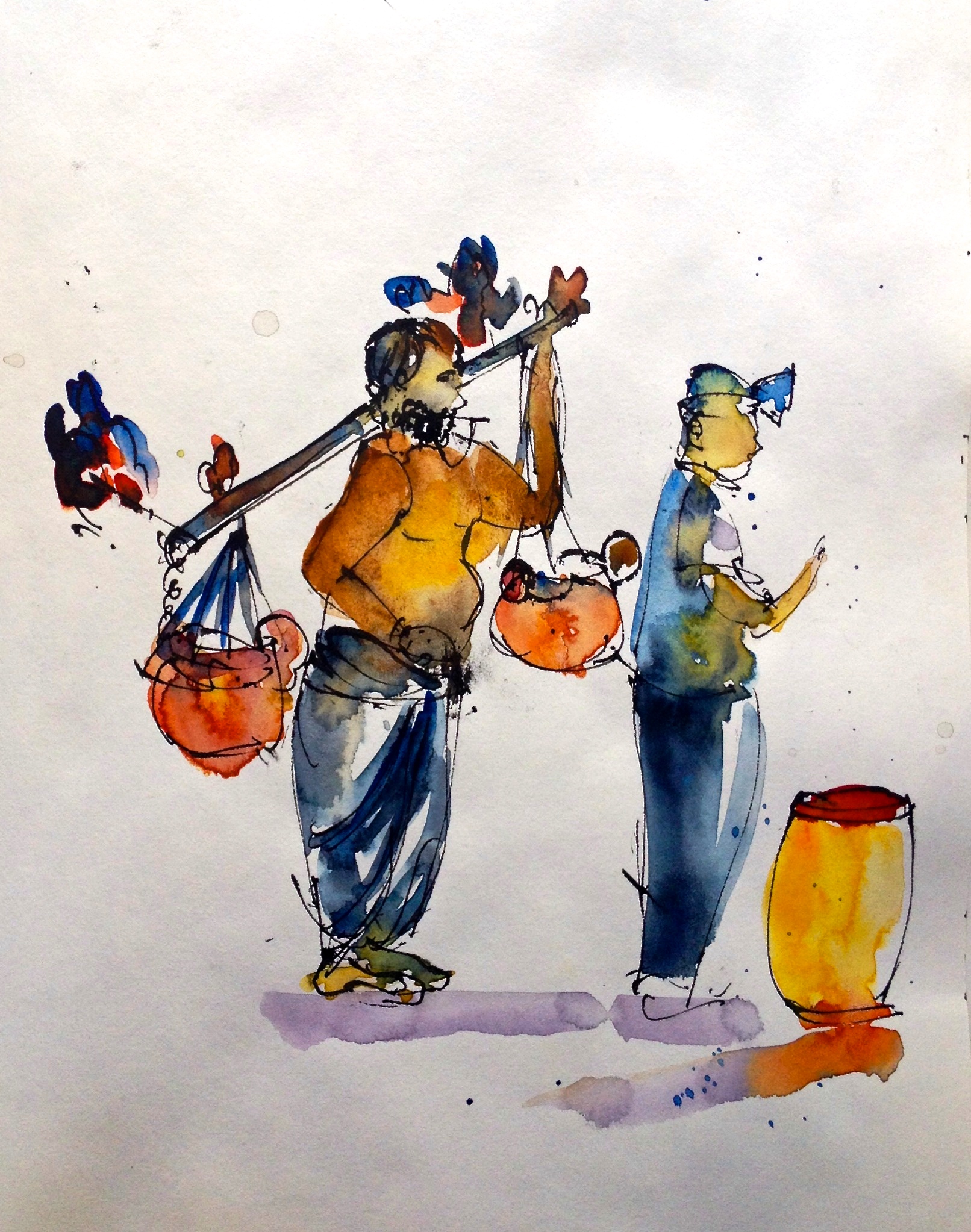
Kavadi bearing devotee swinging to the drum beats

A not-so-extreme kavadi of milk pots balanced on a wooden rod. He still has his tongue pierced.

Few steps away from the temple door, decorated with banana leaves, a pilgrim was approaching with his kavadi on two wheels. It looked like a wooden toy chariot. The steel skewers hooked to his back flexed under the load and stretched his skin, while he negotiated a bump on the uneven stretch. Standing on the sides, we clenched our fists and held our breath. The remaining few steps would end his arduous yet spiritual journey. He tilted his head, arched his back and pumped his chest. Then he pulled hard. The sidekicks cheered him as loudly as they could, their heave-hos bold and distinct, but the kavadi slumped back. Others glided past him with no trouble. Some people have a bumpy ride till the end. Or perhaps he’d asked for a much bigger favour.
 
The pilgrims entering Sri Thendayuthapani Temple to offer their kavadis to Lord Murugan

The pilgrims entering Sri Thendayuthapani Temple to offer their kavadis to Lord Murugan and end their arduous trek

 
Pilgrims exiting the temple, freshly relieved from their kavadis, seemed visibly transformed – smiling and spirited – with only red holes on their body – that they were now proudly flaunting as a proof of their penance.
 
Karna didn’t accompany me till the end. In fact, midway through our conversation, he abruptly shook hands, wished me luck and left me alone to experience the festival and make my own stories. When I reached home, the songs, the chanting, the drum beats and fervent clapping were still ringing in my ears. I think Karna would’ve approved.

Jones the bugger

Jones is not a bugger. He’s a grocer. Well, I don’t know who exactly he or she is per se but the black and white sign hanging at the cheerful, laid back cafe filled up to the brim with people, caught in the post Christmas and pre-New Year limbo definitely said – Jones the Grocer. Why the insinuation? I’ll come to that.

I was having a perfect day. And by a perfect day anywhere in Singapore, I mean – great weather (of course!) combined with a great location combined with an even greater pursuit. The sun was pinned down by cherubic cotton candy-ish clouds. They wouldn’t purge until late afternoon. It was all sorted. The early morning breeze was refreshingly cool and gentle on the skin but pitiless on the gigantic trees, that seemed to be swinging in response to some invisible political agenda and saying yay or nay.

Pasardina Fine Living

Pasardina Fine Living

And I, who was chuffed at having an otherwise crowded Dempsey Hill – a 1860s military barrack refurbished and rebranded as an entertainment and lifestyle enclave – all to herself, and a handful of other sketchers, was sent volleying towards my loose sheets of handiwork that flew away the second time in the last half hour. I didn’t mind at all.

Plonked on my yellow folding stool and armed with art ammunitions, I faced Pasardina Fine Living at 13 Dempsey Road, one of the lifestyle stores, out of many in this bohemian jungle retreat and was trying to frame the scene in mind before putting down on paper. Should I include the giant rain tree on the right with silver Christmas decorations hanging from it? How about the island with the signboards and a Balinese stone sculpture as a foreground? “Yay or nay?”. Yay said the trees.

If you’ve lived among anorexic concrete and reflective glass high-rises for too long, the architecture out here will seem earthy, extravagantly stretched out and stunted but oh-so pleasing to the senses, as if you’ve just unbuckled a tight leather belt after a heavy meal and let your tummy expand to it’s fullest girth. During military camp days, each building in the barrack was built to accommodate at least 50 soldiers, which explains their dorm-like architecture. Pasardina’s three tiered red tiled roof structure looked spacious and airy with the many windows built for ventilation in a tropical climate. Woody Teak Collection on my left, which I tackle next, is even longer.

Woody Teak House

Pleasant and unhurried as Dempsey Hill was at that hour, I knew the impending weekend rush would reclaim it eventually. Cars, shiny from their wash, were already pulling up into the driveways of cafes and garden restaurants for their morning cuppa and breakfast. Instead of marching soldiers, today we have hyperactive kids spilling out on the expansive tree lined roads in the precinct and upon discovering one thing that Singapore is terribly short of – space – and lots and lots of it, 213 acres to be precise, they start running amok in every direction with wild abandon. I fish out my watercolors and quicken my pace.

When it comes to eating, I have been privy to Dempsey Hill’s chic dining culture being branded as ‘atas’, which in local lingo means snobbish or highbrow. On a previous visit, I was bemused by seven red Ferraris decorating Dempsey’s parking lot, if that’s any indication of the flock visiting this area. But to put things into perspective, a plate of sublime and appropriately filling Fish Croquette Benedict at PS Café, costs a little over 20$, which isn’t unreasonable given the quality and ambience, but is probably six times of what you’d pay at a food court.

Atas or not, we planned on having lunch here because once in this dreamy resort-like enclave, you’d want to stretch your time as much as possible. Plus, PS cafe at 28B Harding Road, has the best truffle fries and has a shaded, partly obscured stone pathway leading to a dining area in a glass gazebo with an open verandah running along it’s side. You are barricaded from all sides by stupendous trees and unhindered vegetation. And above the din of clinking wine glasses and fluttering bus boys, birds sing, cicadas hum and frogs croak. Nowhere in SIngapore did we feel so nestled and cocooned by nature.

Jones the Grocer is where we have the talk

Jones the Grocer

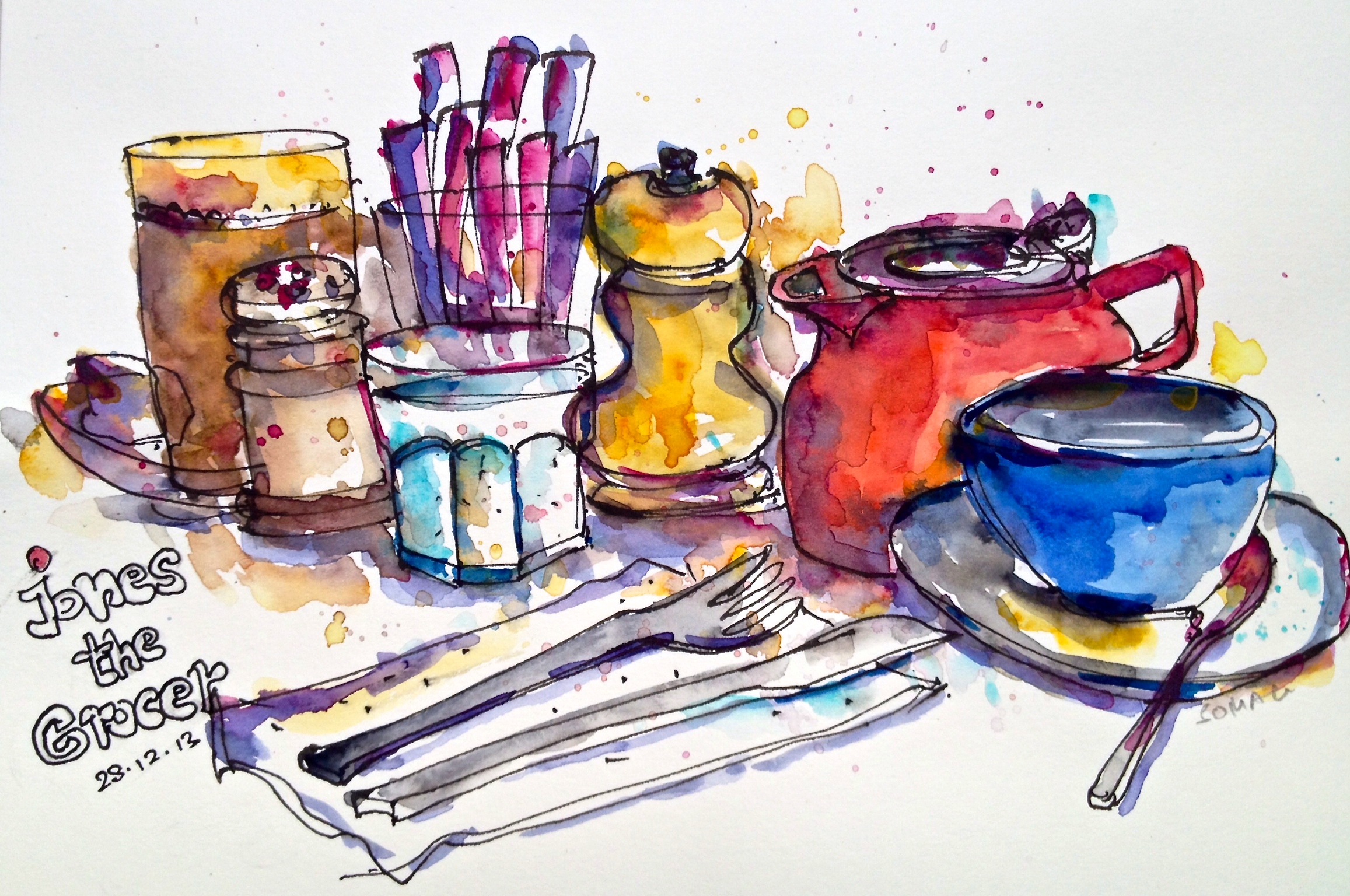
Wouldn’t we linger for a cup of tea or coffee perhaps before leaving? We most definitely would and that brought us to Jones the Grocer at 12 Dempsey Road. I promptly sketched the set up with the red teapot brewing my berries infusion, my husband’s glass of cappuccino with marshmallows, the sugar sachet holder, the salt and peppershaker, which together made a great bunch of props. Like every other barrack building, this too had a cheerful verandah going round it, now fitted with tables, chairs and high stools. To verify, the ‘grocer’ bit I checked the interiors, which along with a seating area and kitchen, had all sorts of pasta, pesto, olive oil, cheese, charcuterie, on shelves and inside temperature, controlled glass case.

Everything was perfect, till we did the thing. The ‘thing’ everybody does before fresh starts, before going on to the next grade, before starting a new job, before upgrading to a new phone, before relocating to a new country, before, like two days before starting a new year – contemplate. And because they are from two different planets, men and women do not contemplate the same way. While one is drawing up mental Excel sheets of current year, last year and the new year’s goals and agendas in tabular form, the other is trying to remember what he had for lunch.  What follows is a game called ‘whose fault is it anyway’.

You mean it’s my fault?

Well, it certainly isn’t mine.

Then whose fault is it?

We never found out. But Jones got unsuspectingly tainted because of a stupid fight.

Nanyin Concert at Singapore’s Oldest Temple

Sketching has its perks, specially in this country because you get invited to all sorts of interesting events, that you otherwise wouldn’t have a clue about. Well, it might not be entirely true for everybody, considering  how well networked and resourceful some people are, but being an expatriate trying to get intimate with the country she is living in, invitations to events featuring local history, culture, heritage and people in some way or the other is serendipity dropping into your hands like a ripe plum.
And what better way to explore a country intimately than sketching your backyard and writing about it, specially if it’s a diverse 710 sq km city state, that you can cross via subway in less than two hours! The possibilities are endless, although I didn’t harbour this mindset two years back when like many others I was trapped in the hamster wheel of shopping malls, food courts,  boutique cafes and movie theatres. That’s all there is to do in Singapore, I thought.
But somehow, this simple attempt at documenting life through sketching has freed me off the nasty blinkers. Since then, I have befriended locals and heard their stories, observed their diurnal rhythms, their idiosyncrasies, mannerisms, their pidgin lingo, their obsession with food, their materialism and altruism, their traditions and customs – those celebrated widely with pomp across the island as well as those that falter at the brink of oblivion, their collective sense of pride and also their anxiousness,  their self expression, their drive to grow, develop, compete and succeed both globally and locally and also their struggle to conserve their identity and heritage in the wake of urbanisation and immigration.
Not just sketching, but sketching with a purpose has opened my eyes.
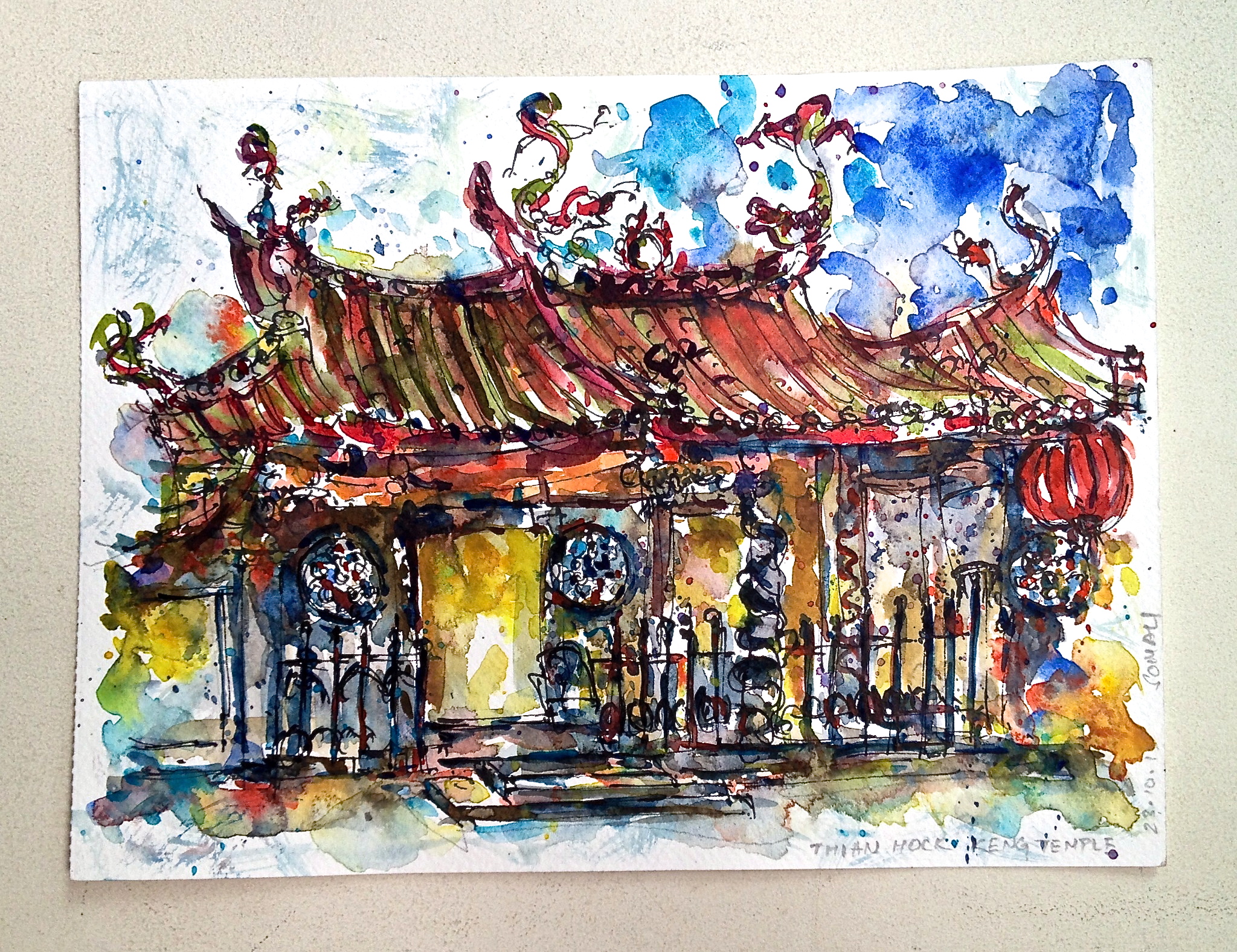
My impression of Thian Hock Keng Temple

Artist’s impression of Thian Hock Keng Temple

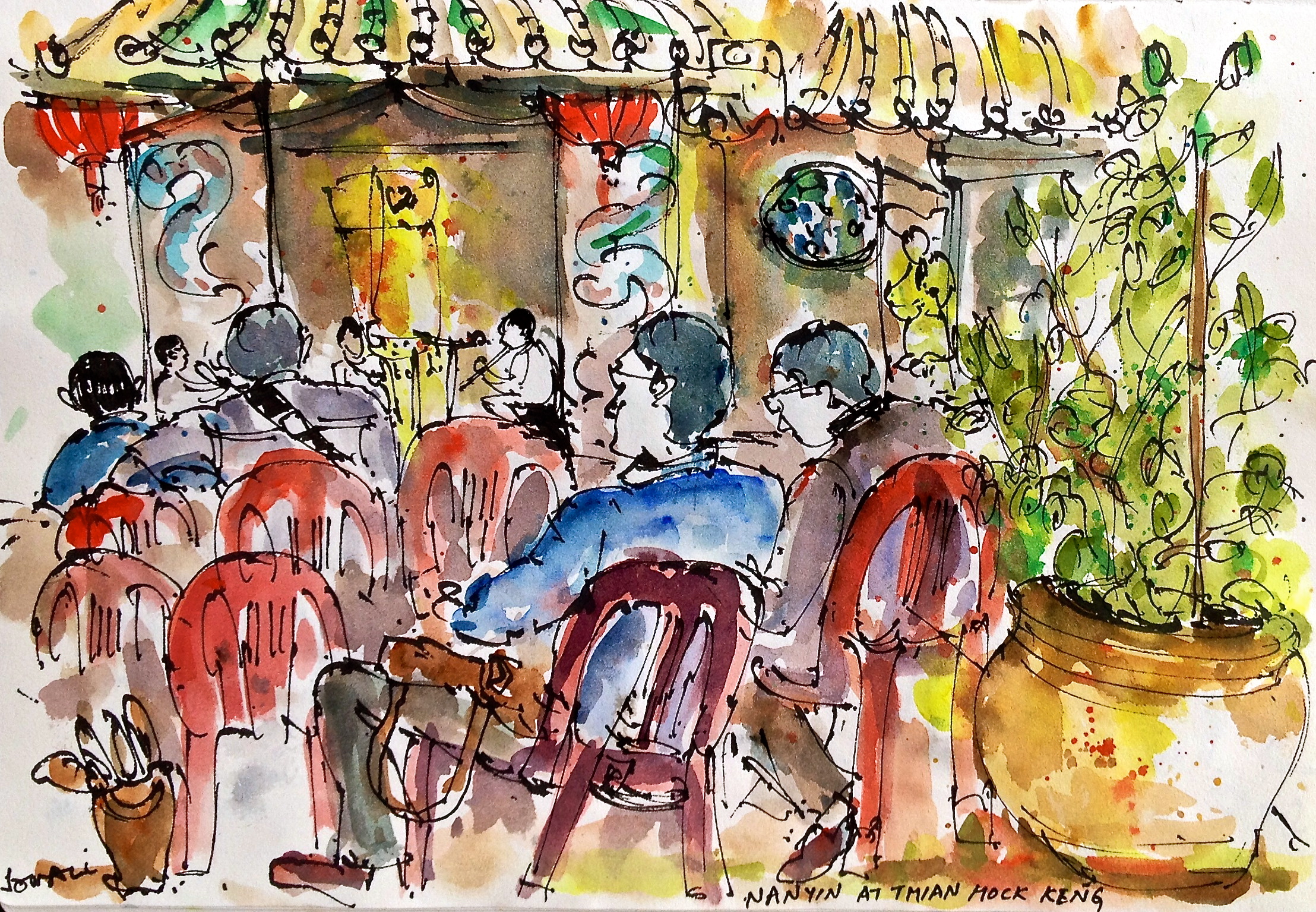
My sketch reportage of many such events I’d been invited to, though disparate – like recording the make-up session of a Teochew opera group, or trying my hand at wrapping rice dumplings at a Taoist temple, or drinking coffee at a shophouse kopitiam or visiting a heritage Peranakan house and so on – have brought me closer to understanding the country I live in. And what more, the equation is symbiotic – while the invitee gets an interesting premise to sketch and talk about,  the inviter gets to promote a cause or create awareness, which brings me to the courtyard of Thian Hock Keng Temple, on 158 Telok Ayer Street, where I along with other fellow sketchers have gathered upon one such invitation – to sketch and see a Nanyin concert performed on the temple premises only thrice a year by Siong Leng Musical Association.
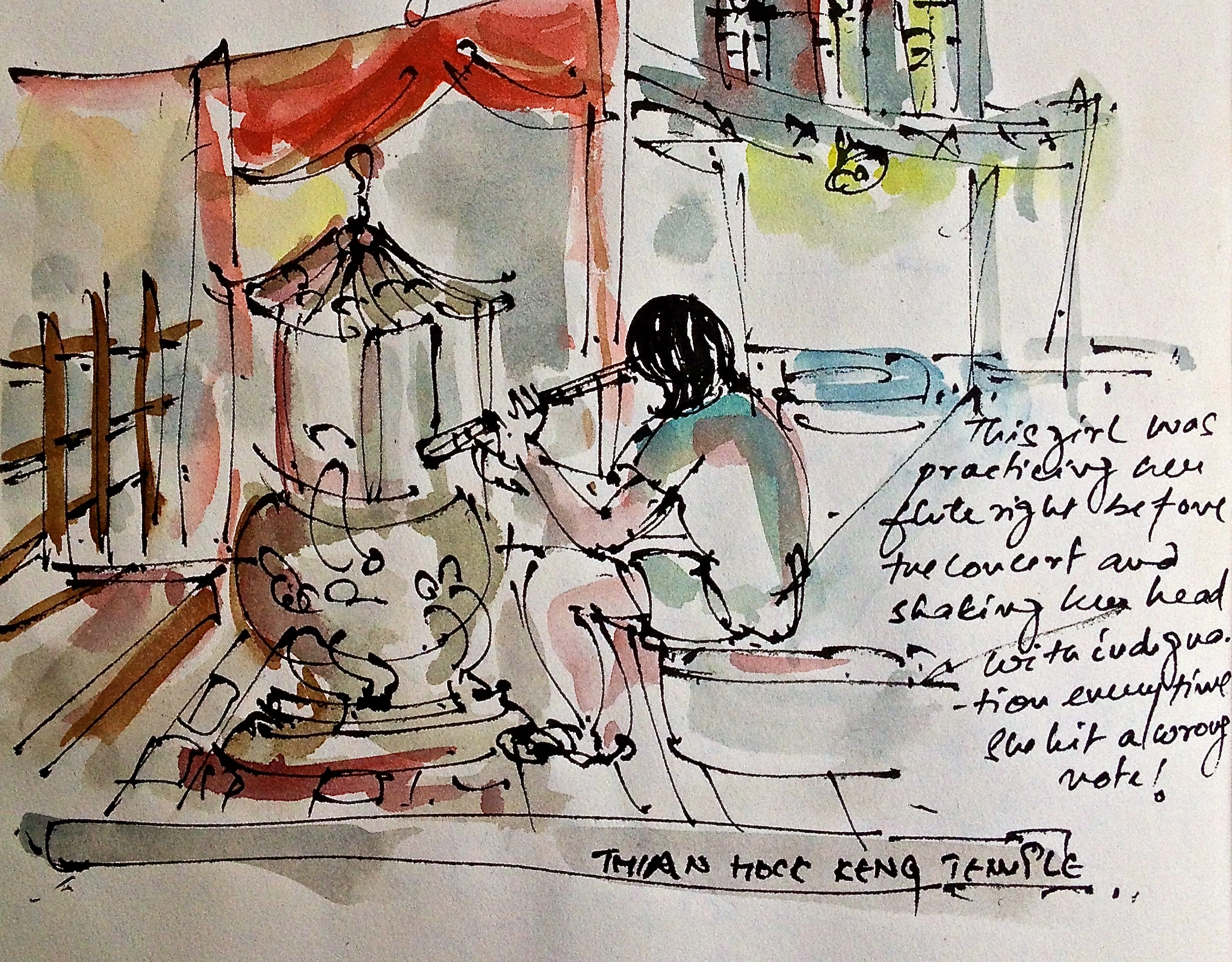
Sitting in a lone corner in the outer courtyard,  this girl was practicing her flute right before the concert began.

Sitting in a lone corner in the outer courtyard, this girl was practicing her flute right before the concert began.

It is not everyday that you experience centuries old and preserved art form, performed against an equally historic backdrop, so I took the bait the moment it appeared in my newsfeed.  The temple’s location couldn’t have been more incongruous, with sparkling high-rises, nifty eateries and watering holes in the vicinity. I wanted to slow down and process the interesting juxtaposition but instead was taking long strides towards the temple, to catch some of the receding light and start sketching before it hit 7. Because at 7 in the evening, the sun goes down in this country, every single day of the year with such mundane consistency that can only be managed if you’re just a degree away from of the equator.

By the time I post myself by a kerb opposite the magnificent facade of the temple, a gigantic truck plonks itself in front and blocks my view. Cars are zipping past and waves of people are making their way from work, without so much as glancing at the imposing green tiled roofs and the multicoloured motifs, the fiery dragons charging at the sky, the carved pillars and the massive red lanterns. It is amusing to even imagine that in 1820, when the temple used to be a humble joss house, early immigrants from Fukien Province in China,  who’d voyaged across the turbulent South China Sea, flocked in to offer their gratitude to Ma Zhu – the goddess of the sea, even before they went scouting for work and shelter. Before land reclamation of 1880, Telok (bay in Malay) Ayer( water in Malay) was the seafront!
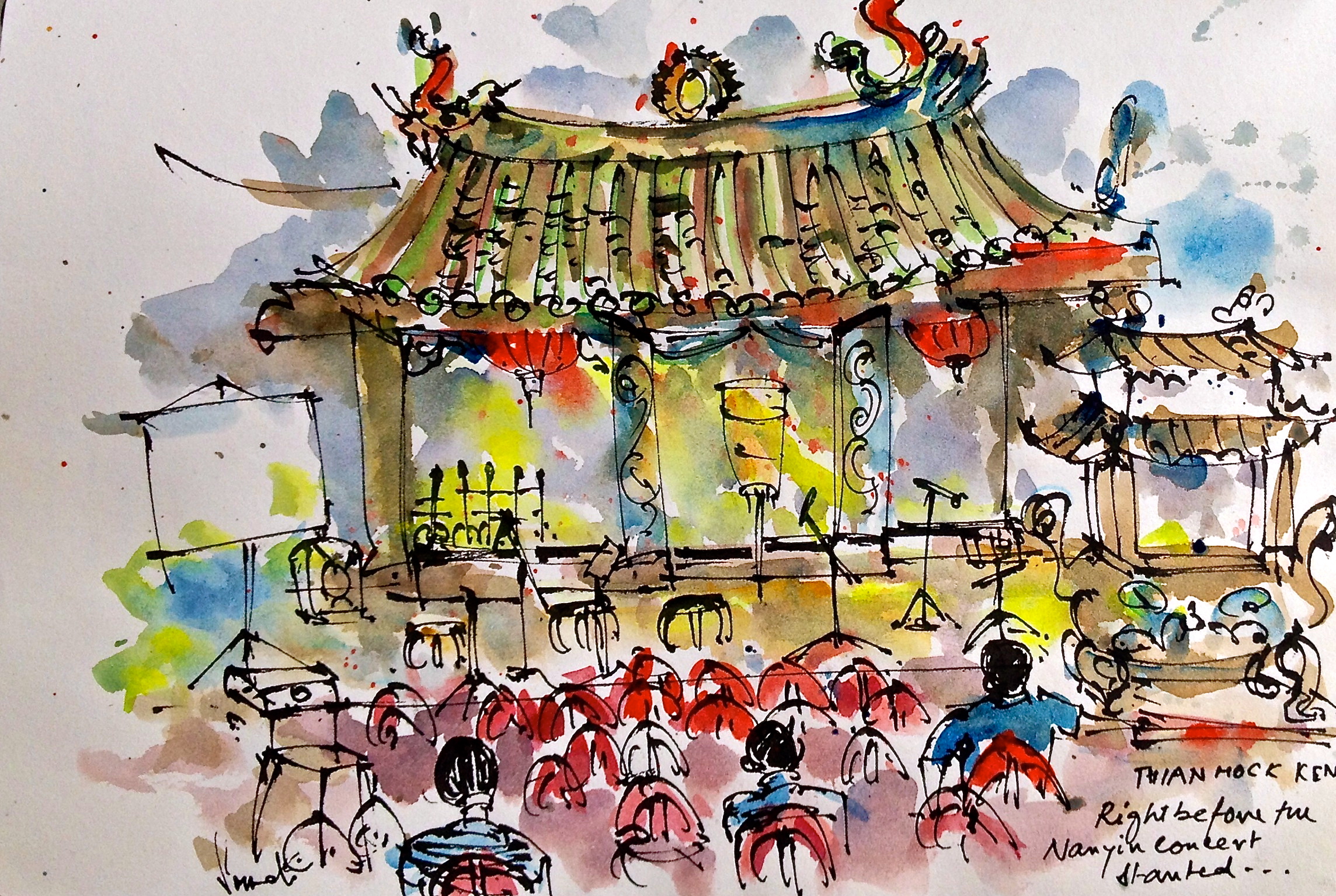
The stage being set up for the concert
From where I stand, I can see plastic chairs being arranged and the stage being set up for the concert. TV crews are interviewing the organisers and the glare from their portable LED light is gushing out through the massive wooden doors and blinding my vision. Dodging the parked truck and the dazzling light, I further shift my vantage point and begin sketching the facade. But darkness has fallen on the city. I struggle to capture the relief patterns on the roof ridges that have been rendered using chien nien technique, a Fujian architectural stylewhich involves breaking unusable pottery and porcelain to create beautiful three-dimensional work.
That’s when Paul, a fellow urban sketcher quipped, “Don’t go for the details, try to capture the essence”. He made it look simple with his casual yet bold strokes that told the story and held it back at the same time for the onlooker to be amused and bemused – a dab of yellow for the blinding light, few sinuous strokes for the temple’s roof, some dark shadows around the threshold and so on. But for some, simplifying isn’t all that simple. The left brain kicks up a storm when you try working at a scene holistically, leaving hints here and there like breadcrumbs leading to a revelation, rather than getting sucked into the details and showing all your cards. The left brain implores you to mark and annotate every stone, tile, wood and all the amazing carvings, intricate sculptures, imposing columns and the decorations with dragons and phoenixes. I try to heed Paul’s advice and try to sketch and paint from what I feel, rather than what I see or straining to see. It isn’t easy.
In the temple courtyard, a stage has been set with mikes, stools, projectors and floodlights, the participants are hustling up, some donning make-up, some straightening the creases of their flowing costumes and fixing their hair. A volunteer hurriedly places the concert schedule on every chair. The musical instruments – pie, pipa, samhen, xiao, lihen are lined at the corner, waiting to be picked up. Guests are streaming in, taking places incoherently. A young girl, away from the action is practicing her bamboo flute and shaking her head in indignation, every time she hits a wrong note.
Nanyin in progress. The audience is enthralled.

Nanyin in progress. The audience is captivated.

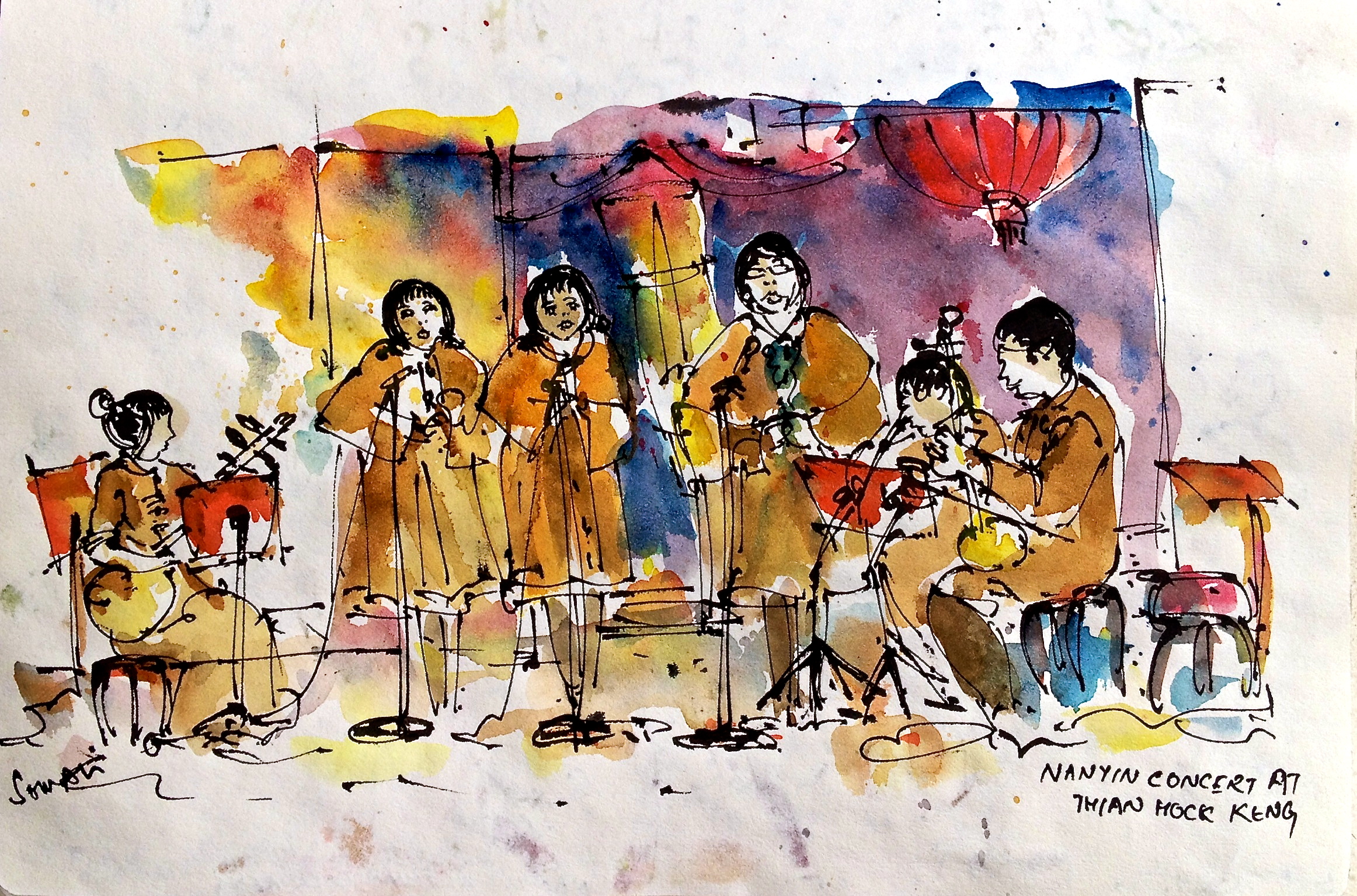
Nanyin, which literally means the ‘music of the south’ has originated from the southern Chinese province of Fujian and is one of the oldest music genres of China that still exists. The music is soft, gentle and graceful – something that would seep through the pores of your skin and serenade you and fill your senses to the hilt. As the music trickled into the temple’s ancient courtyard, the audience – a motley crew of young and old, locals and foreigners, residents and tourist – sat enthralled and motionless, which was perfect for sketching.
Understanding the lyrics would’ve heightened my experience, because most of the time it felt like standing at the edge of an alluring pool and not knowing how to swim. Perhaps, my inability kept me rooted to the task at hand without getting emotionally invested. On that night, I let the music guide my pen.
Nanyin performers at Thian Hock Keng

Nanyin performers at Thian Hock Keng

Sketching Moscow – Part III

Making travel itineraries for the last five years have led me to a displeasing yet profound axiom. It states that the number of sites and activities that you want to visit or experience in a place will inevitably exceed the number of days that you stipulate for them. Be it 3 days or 3 months, you can never fit in everything you want to see and do. After hours of handwork, persistence and deliberation, you may pat your back on birthing a befitting itinerary, customized to your very needs, but there in it’s shadow will always lurk a nasty ‘waiting list’, of sites that were your second and third choices – those that couldn’t make it to the list but are dangerously sneaky. While you pet and fawn over your prized itinerary, they’ll plot and scheme to wriggle their way in. Most of the times you surrender. Is it worth it? Sometimes it is.

Like in the case of the historic Novodevichy Convent , that wasn’t in our itinerary simply because we didn’t have enough time to fit it in plus it was a bit far off from the cluster of sites we were hanging about. But we squeezed it in, on an early morning even before the ticket counter opened, when the men were still cleaning with huge water hoses, mopping and dusting the place, the gardener was still trimming the bushes and nuns were hurriedly moving in and out of the many churches in the expansive compound, prepping for morning prayer, when people were still walking their dogs along the river outside its red and white fortified walls, and when the air was cool and there was dew on the grass and every tree, when you could still hear the song of the birds piercing the meditative silence, that only such an hour of the day can claim.

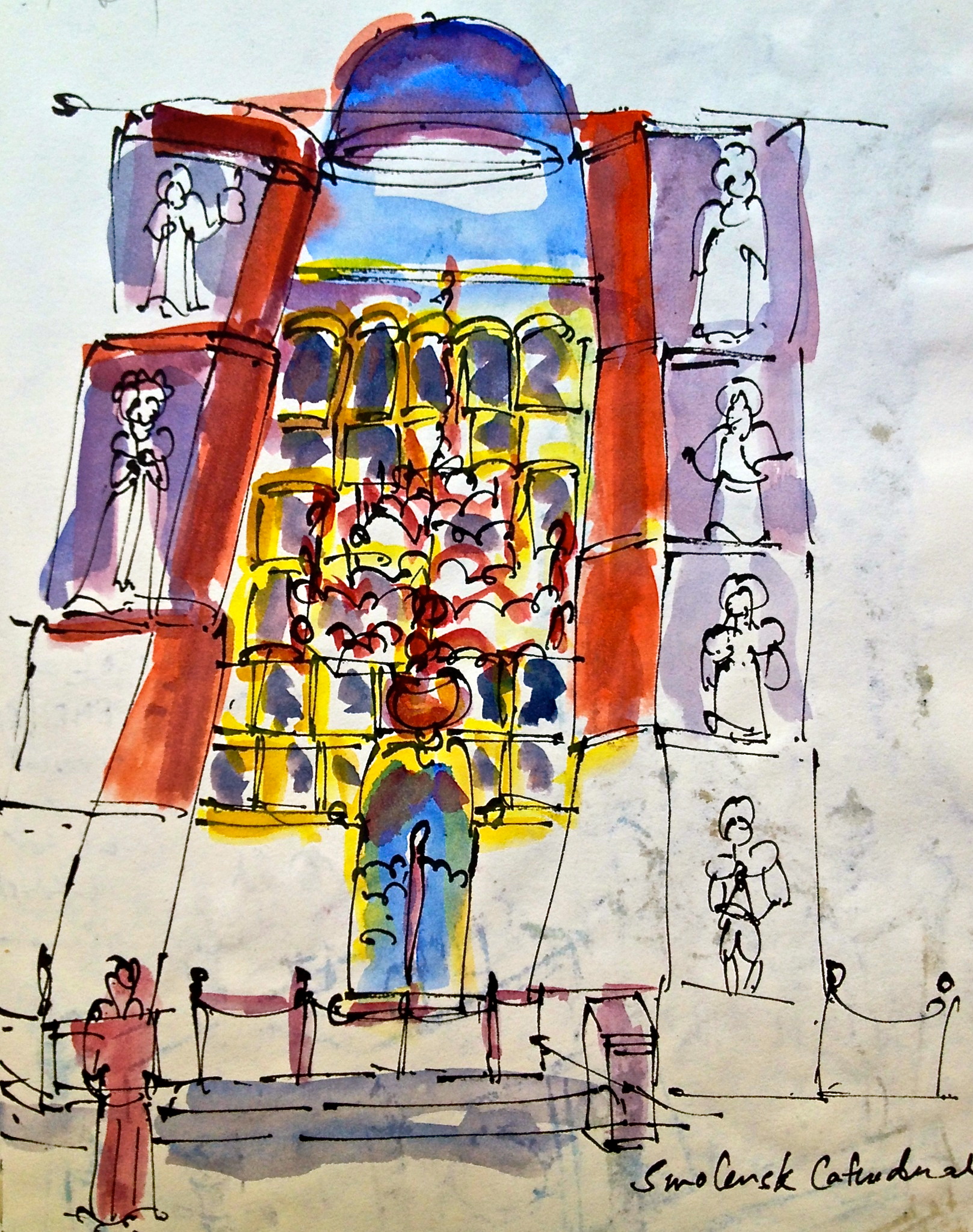
Hands down this is the perfect time to visit because, you have the place to yourself. In an hour or two, the tour buses and tour groups will appear with their guides speaking all at a time and over each other. The transient magic will be lost. While you are allowed to roam inside the fortified compound amid greenery and beautiful golden domed churches free of cost, a ticket worth 250 roubles will gain you entry inside some of these churches, like the breathtaking Smolensky Cathedral (dating back to 1524) and the Assumption Church.

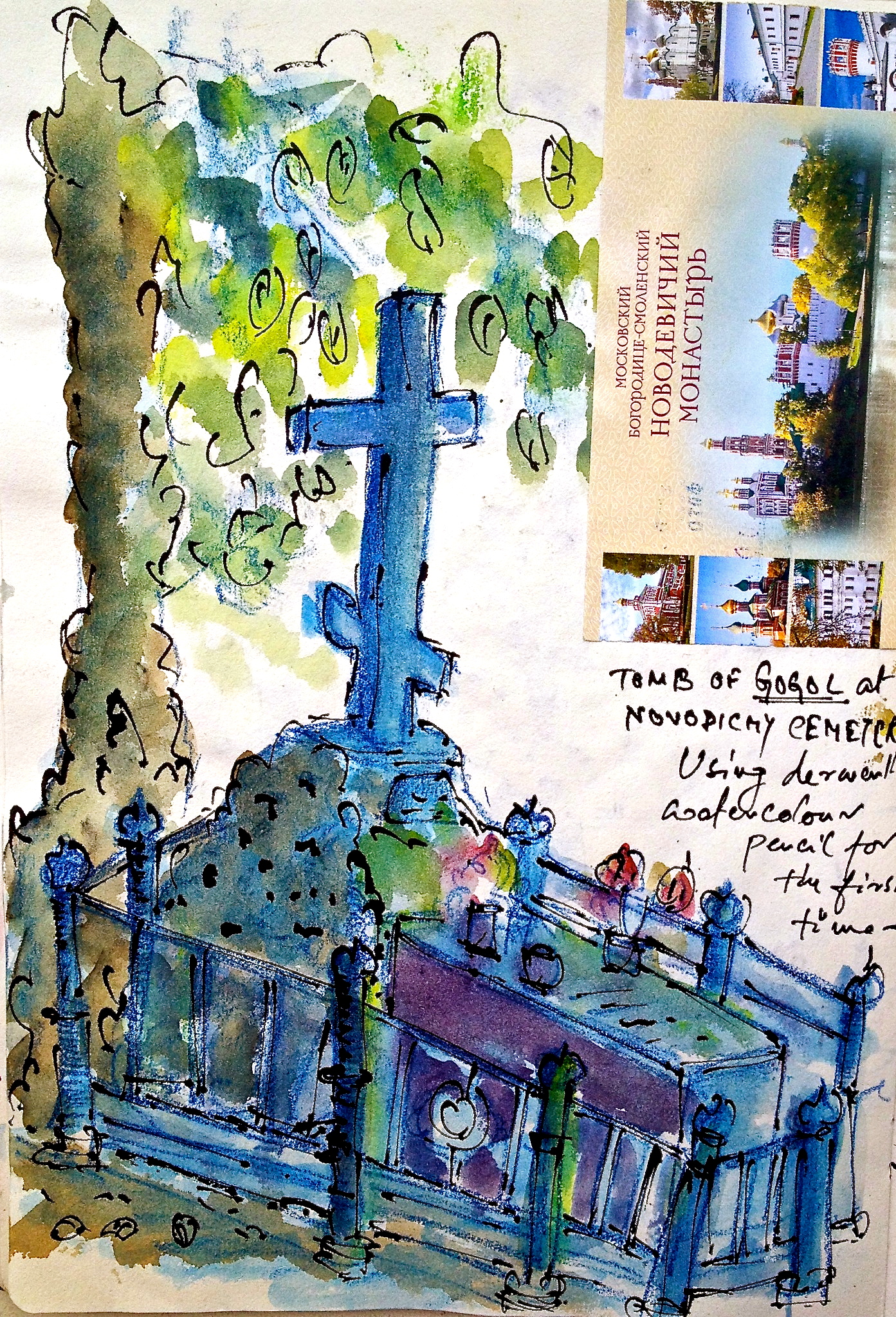
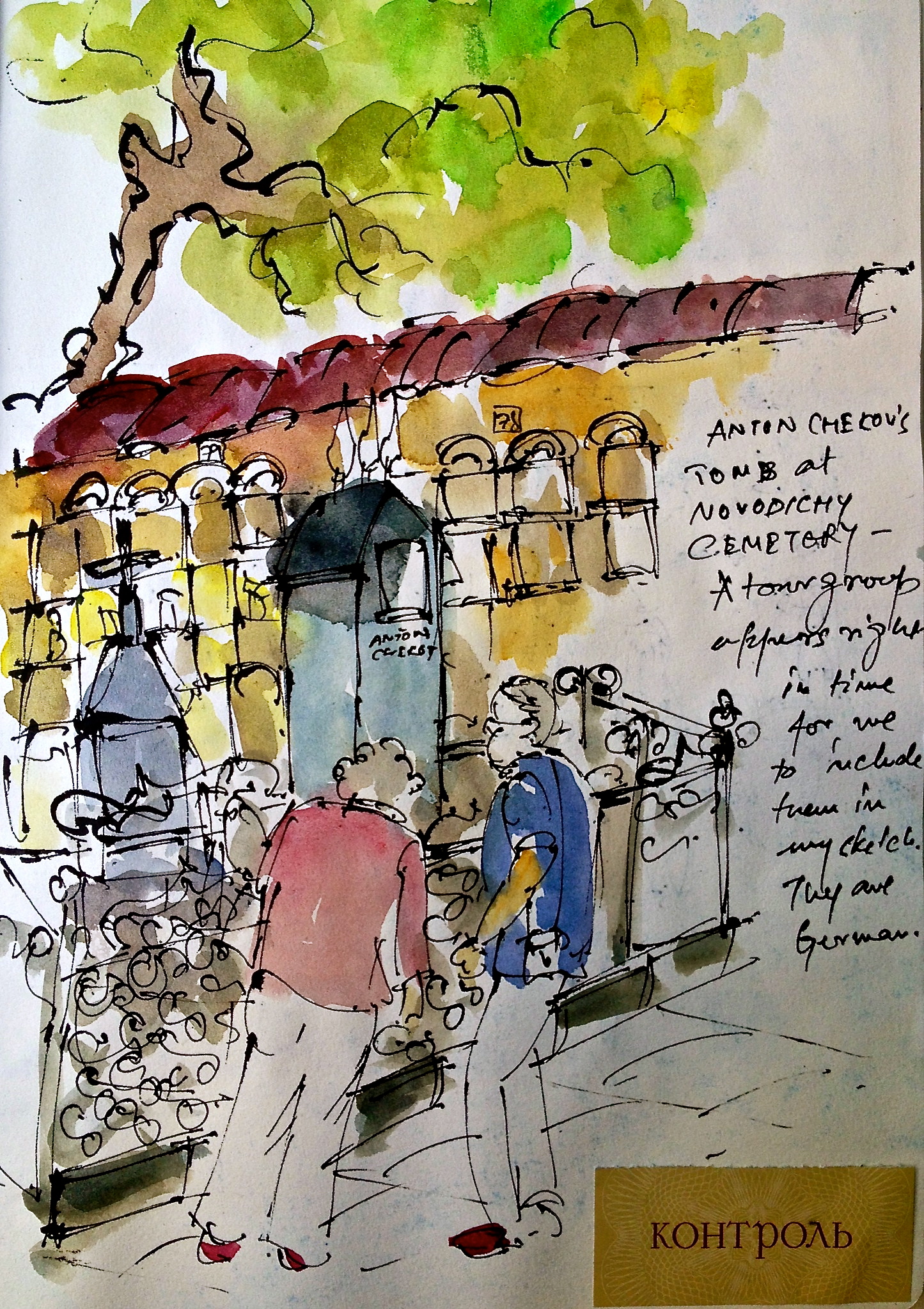
Behind the Cathedral, within ten minutes walking distance is the Novodevichy Cemetery, theTomb of Gogol resting place for Russia’s many stalwarts from different walks of life – poets, playwrights, political leaders, academicians and many more. Admission is free and the absolute lack of English signs turn the grave hunting for Russia’s who’s who into a guessing game bordering on frustration, if you are running on a schedule. After combing through rows upon rows of fascinating stone sculptures decorating the graves – a life size dog resting at his master’s feet, a sensuous ballerina holding a precarious pose, a swan taking flight  – we hunt down the glass covered grave of Tchaikovsky. It’s unpretentious, unseemly modest in comparison to its neighbours. Seeking help from the resident gardener on the grounds, we further hunt down the resting place of Chekov, Bulgakov and Gogol – all impressive in their austere simplicity. Tour guides make hurried stops and even before their patrons can absorb the solemnity of their surroundings, they leave. I take my time and sketch in peace.

What is fascinating and peaceful to one may seem depressing to others. “Excuse me, how do IAnton Chekov's Tomb exit from here?” ask two women. The frown lines on their face give away their distaste for the necropolis. “We don’t like graveyards. Which way is the convent?” We show them the way out, but linger around. The sun has climbed, but the cool serenity of the manicured garden, keeps us comfortable. A forlorn woman dressed in a flowing gown is poised on a gravestone, her head slightly tilted, eyes downcast and with a delicate hand she’s touching her heart.

The sun shines a side of her face, but casts a melancholy shadow on the other. The flowers at her feet have dried and there’s gut-wrenching sadness in her eyes. If she weren’t in stone, I would beseech her with questions. The Cyrillic alphabets at her feet mean nothing to us. I wonder who she was, what was her sorrow and how she passed. Did she leave somebody behind? But, sometimes, knowing less, is feeling a great deal more. Such is the beauty and majesty of the stone sculptures here, that they bring the deceased as close to life as possible to strangers who can’t even read their names. The language of hammers, chisels, rasps and rifflers on these stones transcend the need for anything more comprehensible and for now this seems enough.

Pavillion at Patriarshy PrudyLunching at the exquisite “Pavillion” on wooden chaise set up on a summer patio, overlooking a tree-fringed lake at Patriarshy Prudy (Patriarch’s Ponds) was a fantastic idea. The food is good and a bit expensive, but you’ll lose your heart to the still unchanged 19th century locale – where Michael Bugalov’s The Master and Margarita is also set. The author himself lived nearby and so did many prominent Russian poets, singers, painters, scientists and authors. No wonder the area has been stamped as the cultural heritage of Russia and is protected by the government. While noshing on bread and chicken Kiev, you’d almost feel like floating on water. And if you hint the ducks and the two majestic white swans that you might have something for them to nibble at, they’ll happily glide right to you seat, clacking all the way. Walk around the pond lazily or spend hours sitting on one of the benches beside the ornate lamps, under the cool shade of trees. Feel the breeze on your face, unwind and think nothing.

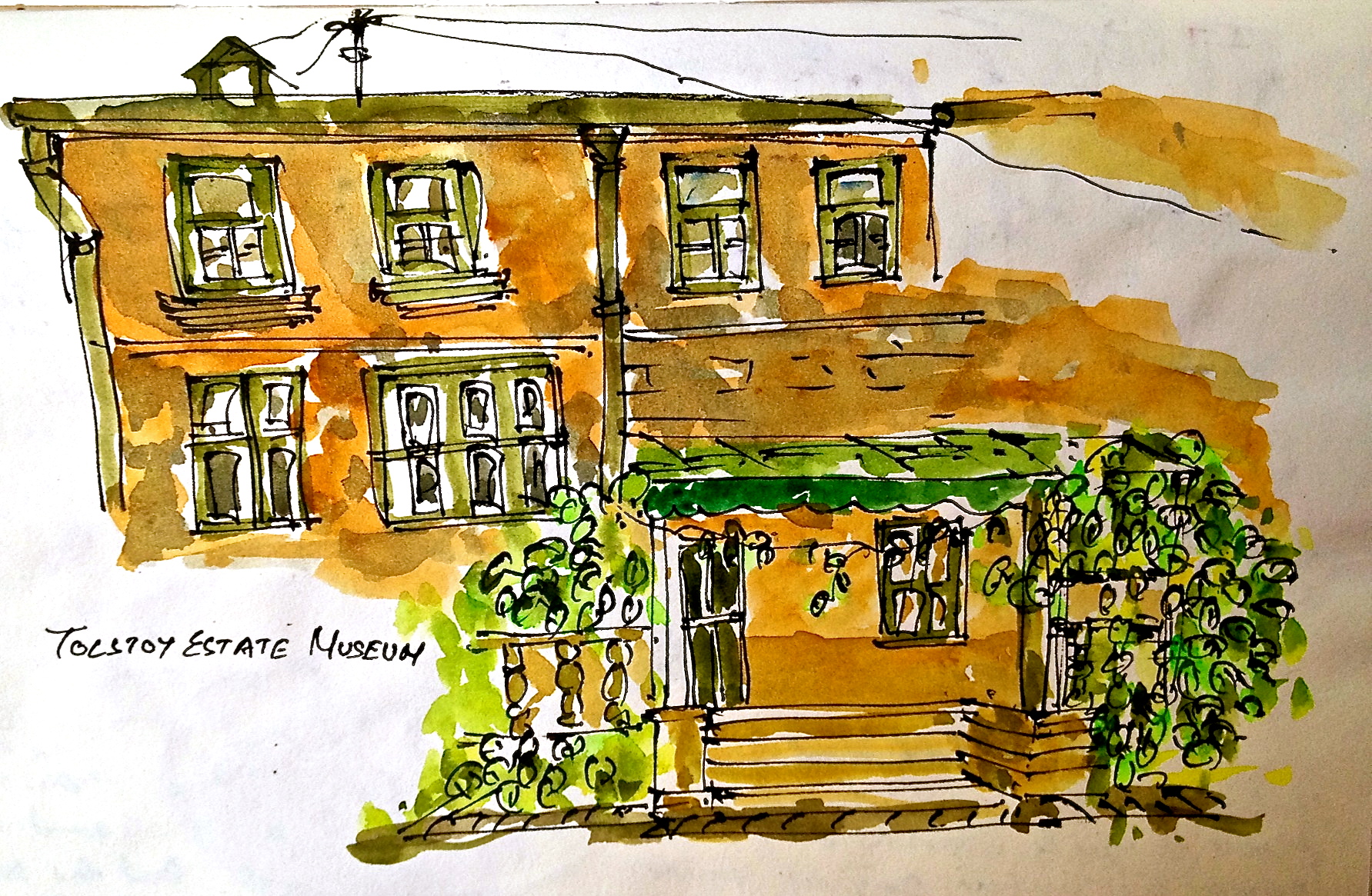
Tolstoy Museum EstateI arrive at the Tolstoy Estate Museum with barely an hour to spare before it’s closed for the day. A handsome yellow ochre house of mediocre size with green windows and a small patio ensconced by ivy, sits amid a small garden with large shady trees. A bottle green picket fence goes round the estate. My mobile phone and hand bag is stowed away before I start touring Tolstoy family’s winter home since 1882.

How does it feel to step inside someone’s private domain? Well, I paid 200 roubles for the privilege and am wearing protective cover over my shoes, but the feeling is that of uneasiness and repressed excitement as if I am about to trespass into private property. But that is a good thing in this context because the 6000 original exhibits of the family has been curated so well that together they lend the house a character that was once its own and get it to tell its story. Short descriptions in English tell you about the display, what the room was used for and stories of their domestic life. The visual imagery is strong and your imagination runs wild. This is how museums should be – not just educational and academic but engaging and inspirational too.

The dishes laid on the dining table where the author had meals with his family, the recreation room where his children played games, the wooden bed where the author and his wife Sofie slept, her desk where she transcribed the author’s manuscripts, the children’s toys splayed on the floor of the nursery, the portraits painted by his eldest daughter adorning the wall, their gowns hanging in their closet with matching shoes, a huge piano standing upon a bear skin in the drawing room and Tolstoy’s study table with his writing paraphernalia and his chair that he trimmed to be closer to the desk (being short-sighted), his clothes, boots, dumbbells, bicycle and such inanimate yet intimate details will get you many folds closer to the author as a man. Later, I sit on one of the benches in the garden and sketch the house. One by one all the visitors leave and I am left with a fidgeting guard with a padlock in his hand, lingering near the gate and staring in my direction. I collect my things and put him out of his misery.

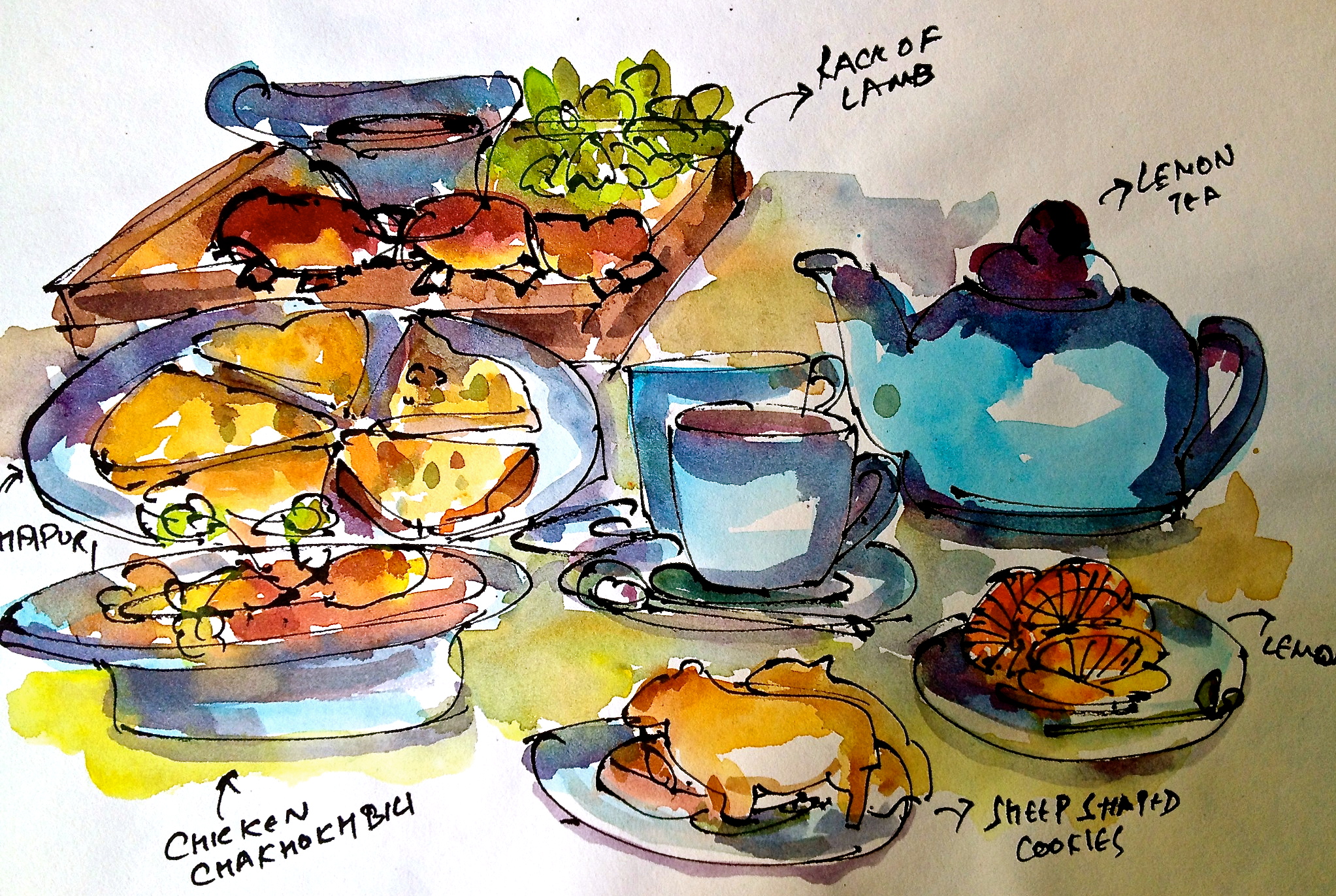
For dinner, we pick Georgian and “Khachapuri” at Bolshoy Gnezdnikovsky per 10,  is perhapsGeorgian Dinner at Khachapuri the most cheerful place to deliver that in a warm, unassuming, homely atmosphere. The strong aroma of fresh coriander wafts out from the spicy yet heartwarming Chicken Chakhokhbili (although later I learn that it has parsley, tarragon, basil and dill as well) – unexpectedly reminiscent of my mother’s Indian curry – and the rack of lamb seems quite contemporary but what surprises us is the addictive Khachapuri – freshly baked cheesy bread or “pizza of the 21st century” as per the cafe’s website! We order lemon tea, munch on the sheep-shaped cookies and head back to the hotel around midnight under a semi-dark summer sky.