Tag Archives: sketching

Jones the bugger

Jones is not a bugger. He’s a grocer. Well, I don’t know who exactly he or she is per se but the black and white sign hanging at the cheerful, laid back cafe filled up to the brim with people, caught in the post Christmas and pre-New Year limbo definitely said – Jones the Grocer. Why the insinuation? I’ll come to that.

I was having a perfect day. And by a perfect day anywhere in Singapore, I mean – great weather (of course!) combined with a great location combined with an even greater pursuit. The sun was pinned down by cherubic cotton candy-ish clouds. They wouldn’t purge until late afternoon. It was all sorted. The early morning breeze was refreshingly cool and gentle on the skin but pitiless on the gigantic trees, that seemed to be swinging in response to some invisible political agenda and saying yay or nay.

Pasardina Fine Living

Pasardina Fine Living

And I, who was chuffed at having an otherwise crowded Dempsey Hill – a 1860s military barrack refurbished and rebranded as an entertainment and lifestyle enclave – all to herself, and a handful of other sketchers, was sent volleying towards my loose sheets of handiwork that flew away the second time in the last half hour. I didn’t mind at all.

Plonked on my yellow folding stool and armed with art ammunitions, I faced Pasardina Fine Living at 13 Dempsey Road, one of the lifestyle stores, out of many in this bohemian jungle retreat and was trying to frame the scene in mind before putting down on paper. Should I include the giant rain tree on the right with silver Christmas decorations hanging from it? How about the island with the signboards and a Balinese stone sculpture as a foreground? “Yay or nay?”. Yay said the trees.

If you’ve lived among anorexic concrete and reflective glass high-rises for too long, the architecture out here will seem earthy, extravagantly stretched out and stunted but oh-so pleasing to the senses, as if you’ve just unbuckled a tight leather belt after a heavy meal and let your tummy expand to it’s fullest girth. During military camp days, each building in the barrack was built to accommodate at least 50 soldiers, which explains their dorm-like architecture. Pasardina’s three tiered red tiled roof structure looked spacious and airy with the many windows built for ventilation in a tropical climate. Woody Teak Collection on my left, which I tackle next, is even longer.

Woody Teak House

Pleasant and unhurried as Dempsey Hill was at that hour, I knew the impending weekend rush would reclaim it eventually. Cars, shiny from their wash, were already pulling up into the driveways of cafes and garden restaurants for their morning cuppa and breakfast. Instead of marching soldiers, today we have hyperactive kids spilling out on the expansive tree lined roads in the precinct and upon discovering one thing that Singapore is terribly short of – space – and lots and lots of it, 213 acres to be precise, they start running amok in every direction with wild abandon. I fish out my watercolors and quicken my pace.

When it comes to eating, I have been privy to Dempsey Hill’s chic dining culture being branded as ‘atas’, which in local lingo means snobbish or highbrow. On a previous visit, I was bemused by seven red Ferraris decorating Dempsey’s parking lot, if that’s any indication of the flock visiting this area. But to put things into perspective, a plate of sublime and appropriately filling Fish Croquette Benedict at PS Café, costs a little over 20$, which isn’t unreasonable given the quality and ambience, but is probably six times of what you’d pay at a food court.

Atas or not, we planned on having lunch here because once in this dreamy resort-like enclave, you’d want to stretch your time as much as possible. Plus, PS cafe at 28B Harding Road, has the best truffle fries and has a shaded, partly obscured stone pathway leading to a dining area in a glass gazebo with an open verandah running along it’s side. You are barricaded from all sides by stupendous trees and unhindered vegetation. And above the din of clinking wine glasses and fluttering bus boys, birds sing, cicadas hum and frogs croak. Nowhere in SIngapore did we feel so nestled and cocooned by nature.
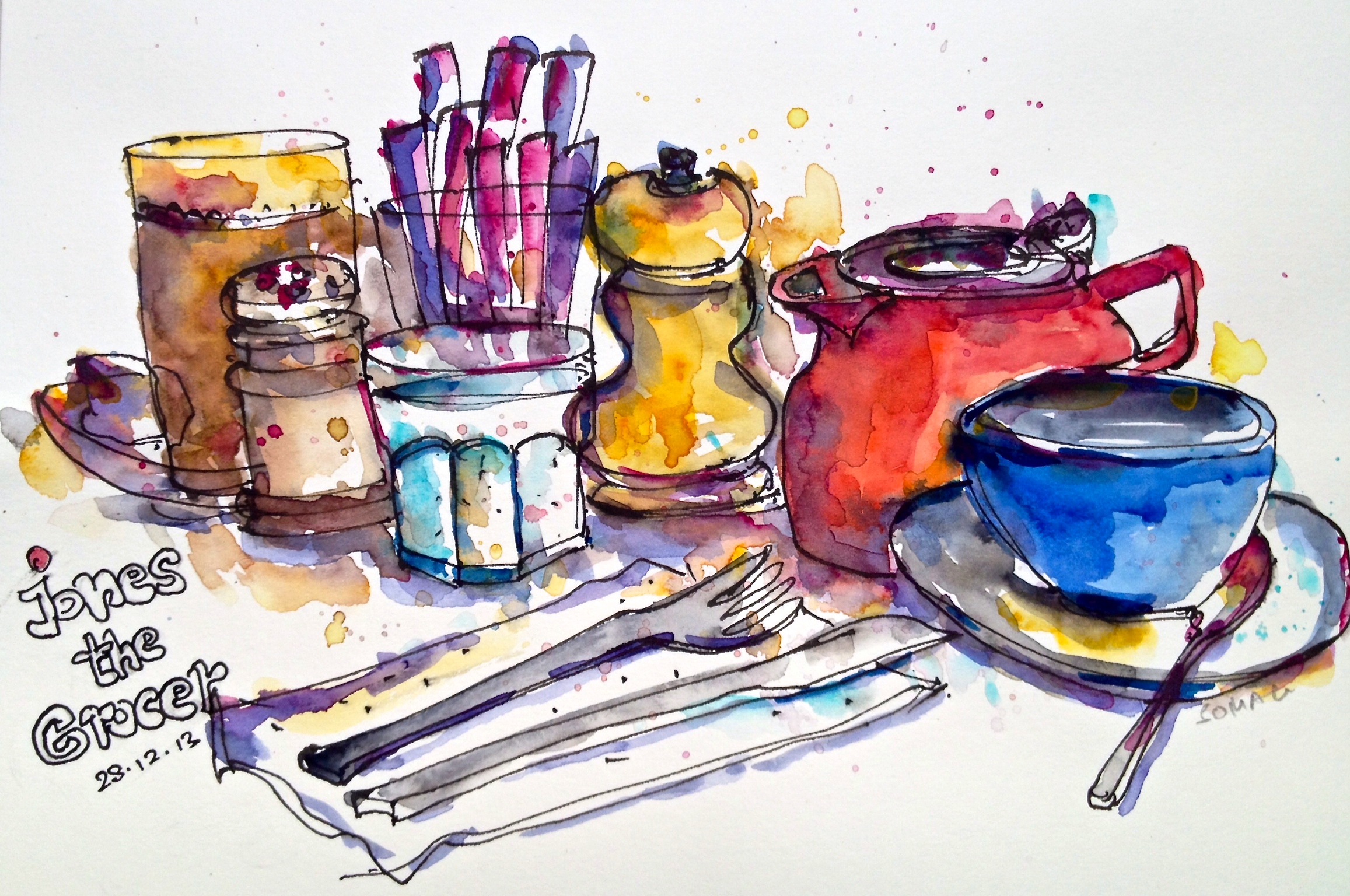
Jones the Grocer is where we have the talk

Jones the Grocer

Wouldn’t we linger for a cup of tea or coffee perhaps before leaving? We most definitely would and that brought us to Jones the Grocer at 12 Dempsey Road. I promptly sketched the set up with the red teapot brewing my berries infusion, my husband’s glass of cappuccino with marshmallows, the sugar sachet holder, the salt and peppershaker, which together made a great bunch of props. Like every other barrack building, this too had a cheerful verandah going round it, now fitted with tables, chairs and high stools. To verify, the ‘grocer’ bit I checked the interiors, which along with a seating area and kitchen, had all sorts of pasta, pesto, olive oil, cheese, charcuterie, on shelves and inside temperature, controlled glass case.

Everything was perfect, till we did the thing. The ‘thing’ everybody does before fresh starts, before going on to the next grade, before starting a new job, before upgrading to a new phone, before relocating to a new country, before, like two days before starting a new year – contemplate. And because they are from two different planets, men and women do not contemplate the same way. While one is drawing up mental Excel sheets of current year, last year and the new year’s goals and agendas in tabular form, the other is trying to remember what he had for lunch.  What follows is a game called ‘whose fault is it anyway’.

You mean it’s my fault?

Well, it certainly isn’t mine.

Then whose fault is it?

We never found out. But Jones got unsuspectingly tainted because of a stupid fight.
Nanyin Concert at Singapore’s Oldest Temple

Sketching has its perks, specially in this country because you get invited to all sorts of interesting events, that you otherwise wouldn’t have a clue about. Well, it might not be entirely true for everybody, considering  how well networked and resourceful some people are, but being an expatriate trying to get intimate with the country she is living in, invitations to events featuring local history, culture, heritage and people in some way or the other is serendipity dropping into your hands like a ripe plum.
And what better way to explore a country intimately than sketching your backyard and writing about it, specially if it’s a diverse 710 sq km city state, that you can cross via subway in less than two hours! The possibilities are endless, although I didn’t harbour this mindset two years back when like many others I was trapped in the hamster wheel of shopping malls, food courts,  boutique cafes and movie theatres. That’s all there is to do in Singapore, I thought.
But somehow, this simple attempt at documenting life through sketching has freed me off the nasty blinkers. Since then, I have befriended locals and heard their stories, observed their diurnal rhythms, their idiosyncrasies, mannerisms, their pidgin lingo, their obsession with food, their materialism and altruism, their traditions and customs – those celebrated widely with pomp across the island as well as those that falter at the brink of oblivion, their collective sense of pride and also their anxiousness,  their self expression, their drive to grow, develop, compete and succeed both globally and locally and also their struggle to conserve their identity and heritage in the wake of urbanisation and immigration.
Not just sketching, but sketching with a purpose has opened my eyes.
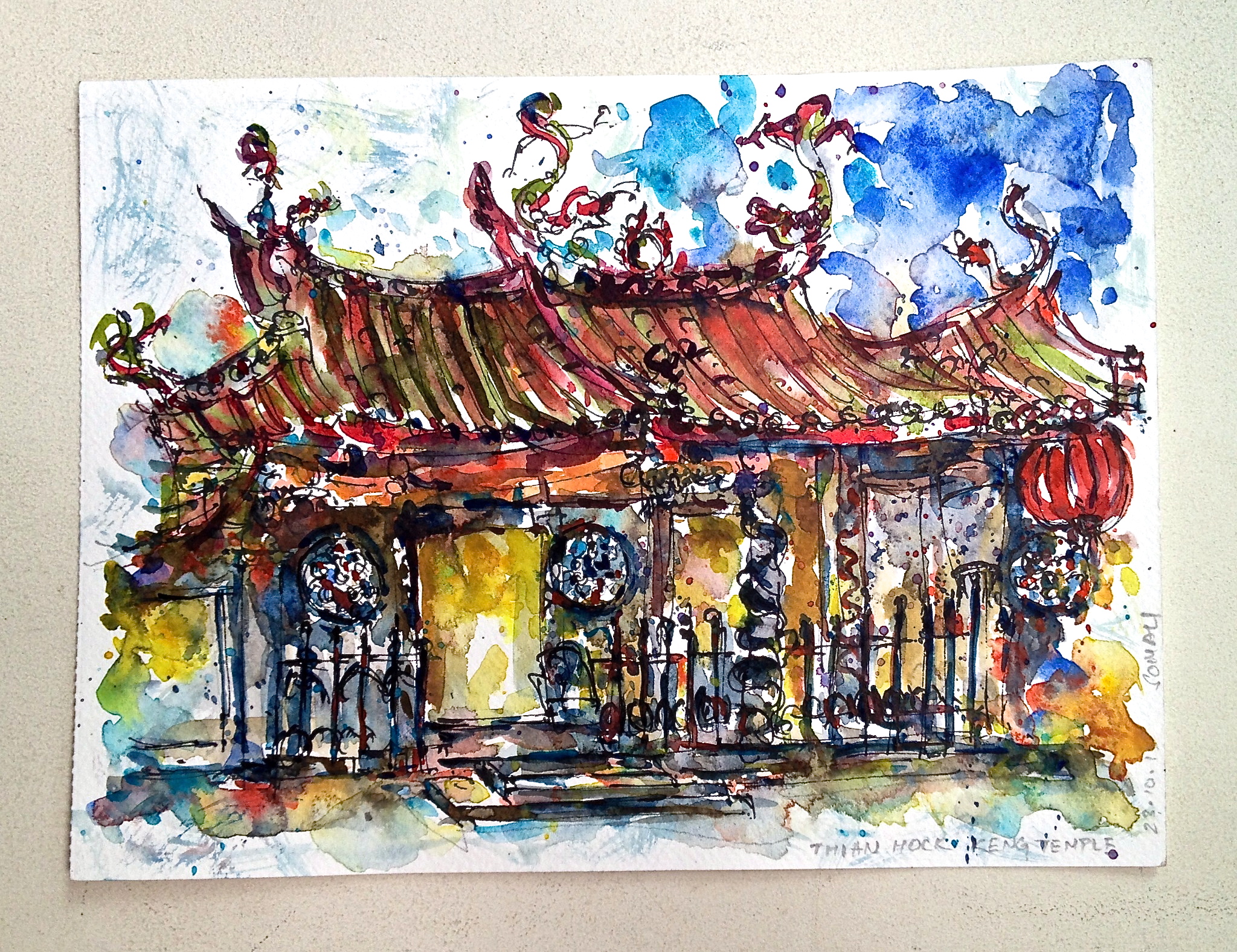
My impression of Thian Hock Keng Temple

Artist’s impression of Thian Hock Keng Temple

My sketch reportage of many such events I’d been invited to, though disparate – like recording the make-up session of a Teochew opera group, or trying my hand at wrapping rice dumplings at a Taoist temple, or drinking coffee at a shophouse kopitiam or visiting a heritage Peranakan house and so on – have brought me closer to understanding the country I live in. And what more, the equation is symbiotic – while the invitee gets an interesting premise to sketch and talk about,  the inviter gets to promote a cause or create awareness, which brings me to the courtyard of Thian Hock Keng Temple, on 158 Telok Ayer Street, where I along with other fellow sketchers have gathered upon one such invitation – to sketch and see a Nanyin concert performed on the temple premises only thrice a year by Siong Leng Musical Association.
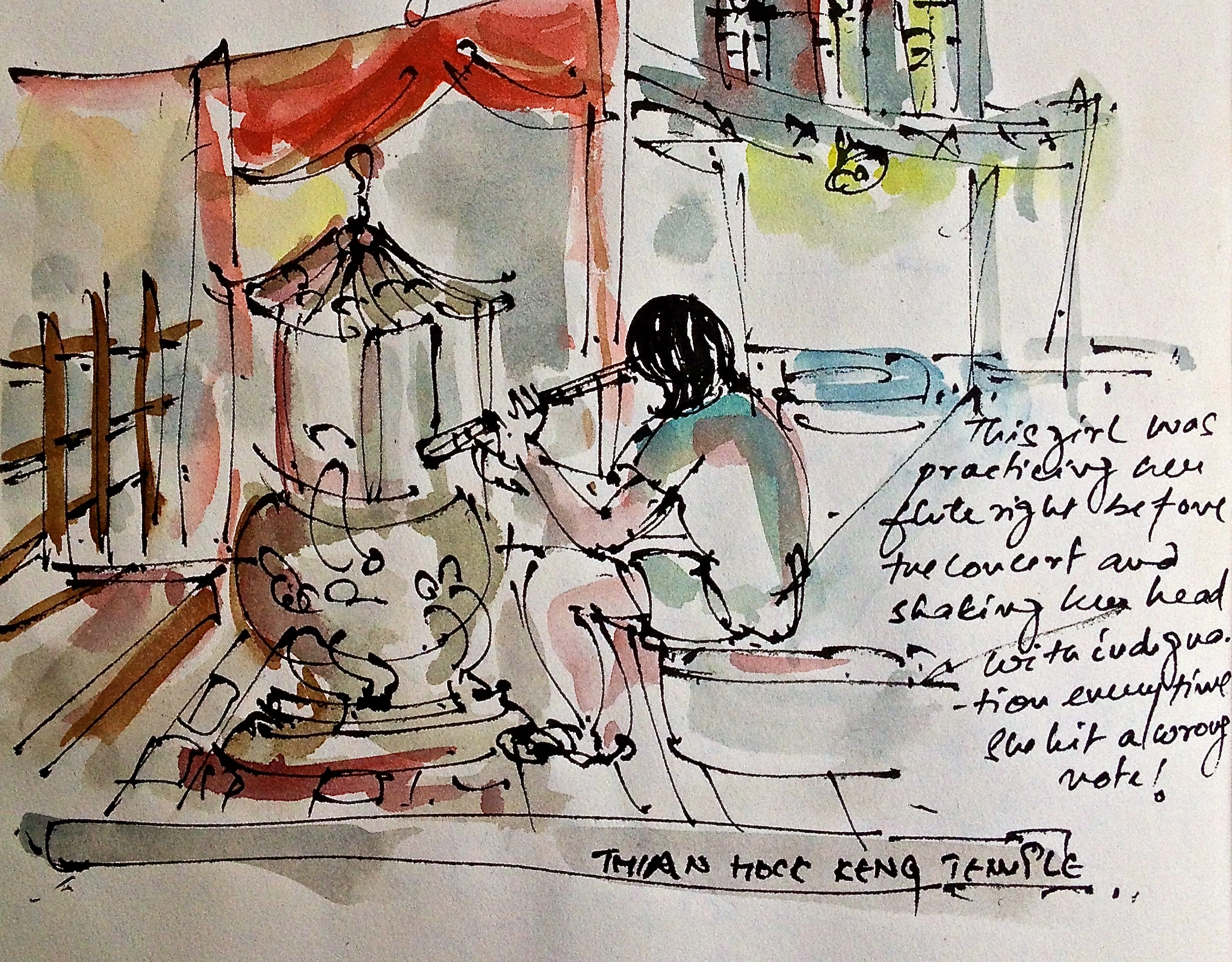
Sitting in a lone corner in the outer courtyard,  this girl was practicing her flute right before the concert began.

Sitting in a lone corner in the outer courtyard, this girl was practicing her flute right before the concert began.

It is not everyday that you experience centuries old and preserved art form, performed against an equally historic backdrop, so I took the bait the moment it appeared in my newsfeed.  The temple’s location couldn’t have been more incongruous, with sparkling high-rises, nifty eateries and watering holes in the vicinity. I wanted to slow down and process the interesting juxtaposition but instead was taking long strides towards the temple, to catch some of the receding light and start sketching before it hit 7. Because at 7 in the evening, the sun goes down in this country, every single day of the year with such mundane consistency that can only be managed if you’re just a degree away from of the equator.

By the time I post myself by a kerb opposite the magnificent facade of the temple, a gigantic truck plonks itself in front and blocks my view. Cars are zipping past and waves of people are making their way from work, without so much as glancing at the imposing green tiled roofs and the multicoloured motifs, the fiery dragons charging at the sky, the carved pillars and the massive red lanterns. It is amusing to even imagine that in 1820, when the temple used to be a humble joss house, early immigrants from Fukien Province in China,  who’d voyaged across the turbulent South China Sea, flocked in to offer their gratitude to Ma Zhu – the goddess of the sea, even before they went scouting for work and shelter. Before land reclamation of 1880, Telok (bay in Malay) Ayer( water in Malay) was the seafront!
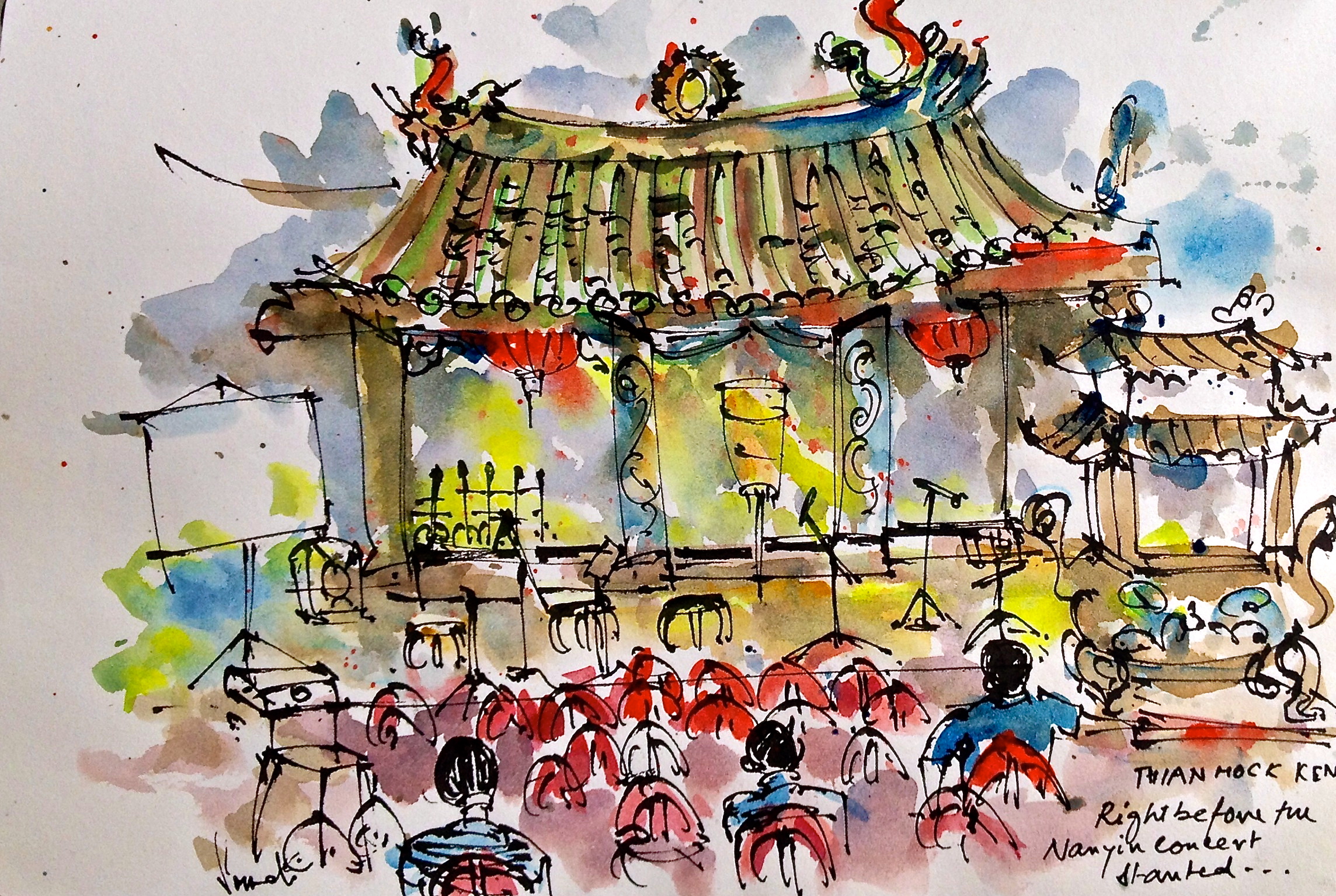
The stage being set up for the concert
From where I stand, I can see plastic chairs being arranged and the stage being set up for the concert. TV crews are interviewing the organisers and the glare from their portable LED light is gushing out through the massive wooden doors and blinding my vision. Dodging the parked truck and the dazzling light, I further shift my vantage point and begin sketching the facade. But darkness has fallen on the city. I struggle to capture the relief patterns on the roof ridges that have been rendered using chien nien technique, a Fujian architectural stylewhich involves breaking unusable pottery and porcelain to create beautiful three-dimensional work.
That’s when Paul, a fellow urban sketcher quipped, “Don’t go for the details, try to capture the essence”. He made it look simple with his casual yet bold strokes that told the story and held it back at the same time for the onlooker to be amused and bemused – a dab of yellow for the blinding light, few sinuous strokes for the temple’s roof, some dark shadows around the threshold and so on. But for some, simplifying isn’t all that simple. The left brain kicks up a storm when you try working at a scene holistically, leaving hints here and there like breadcrumbs leading to a revelation, rather than getting sucked into the details and showing all your cards. The left brain implores you to mark and annotate every stone, tile, wood and all the amazing carvings, intricate sculptures, imposing columns and the decorations with dragons and phoenixes. I try to heed Paul’s advice and try to sketch and paint from what I feel, rather than what I see or straining to see. It isn’t easy.
In the temple courtyard, a stage has been set with mikes, stools, projectors and floodlights, the participants are hustling up, some donning make-up, some straightening the creases of their flowing costumes and fixing their hair. A volunteer hurriedly places the concert schedule on every chair. The musical instruments – pie, pipa, samhen, xiao, lihen are lined at the corner, waiting to be picked up. Guests are streaming in, taking places incoherently. A young girl, away from the action is practicing her bamboo flute and shaking her head in indignation, every time she hits a wrong note.
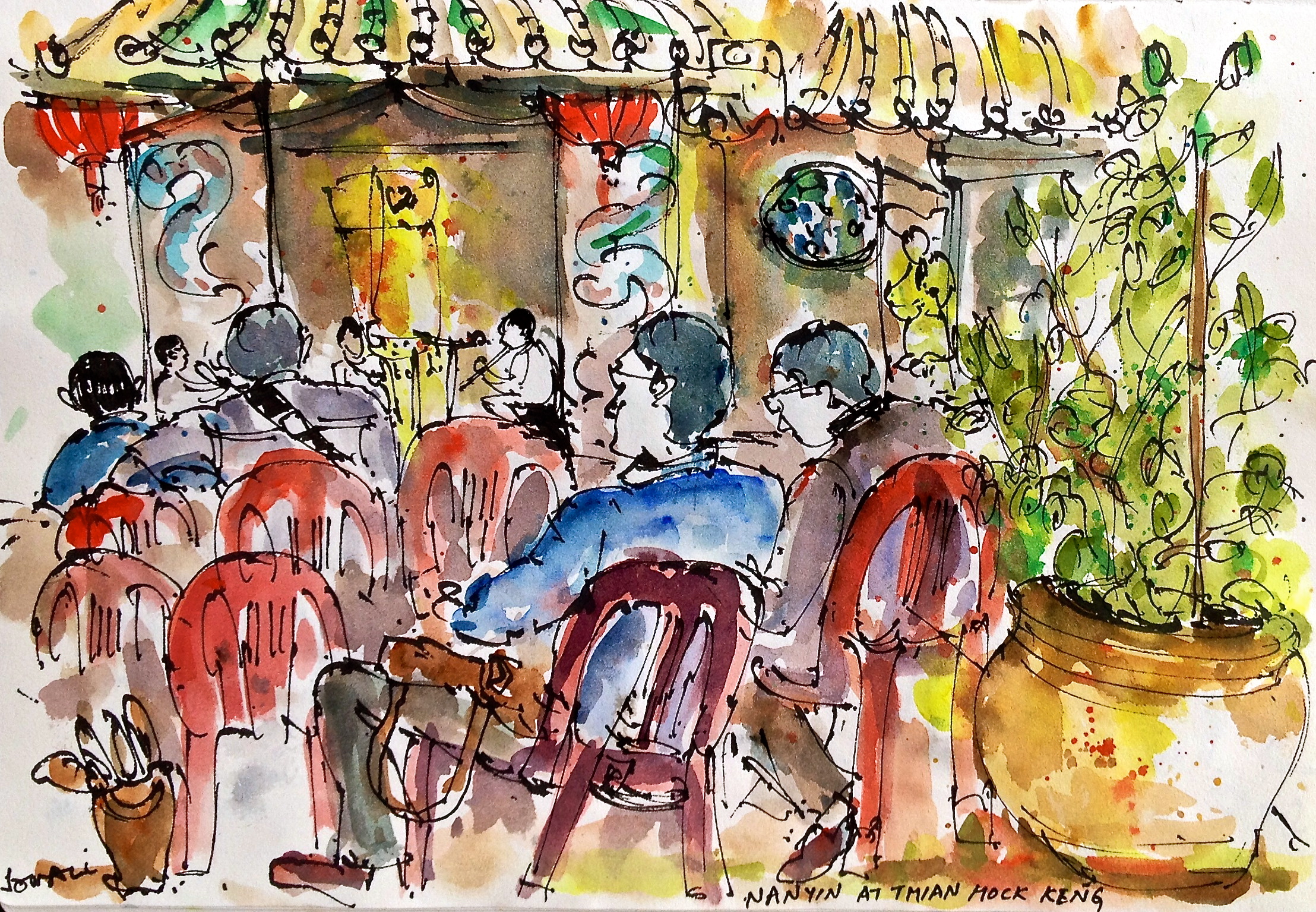
Nanyin in progress. The audience is enthralled.

Nanyin in progress. The audience is captivated.

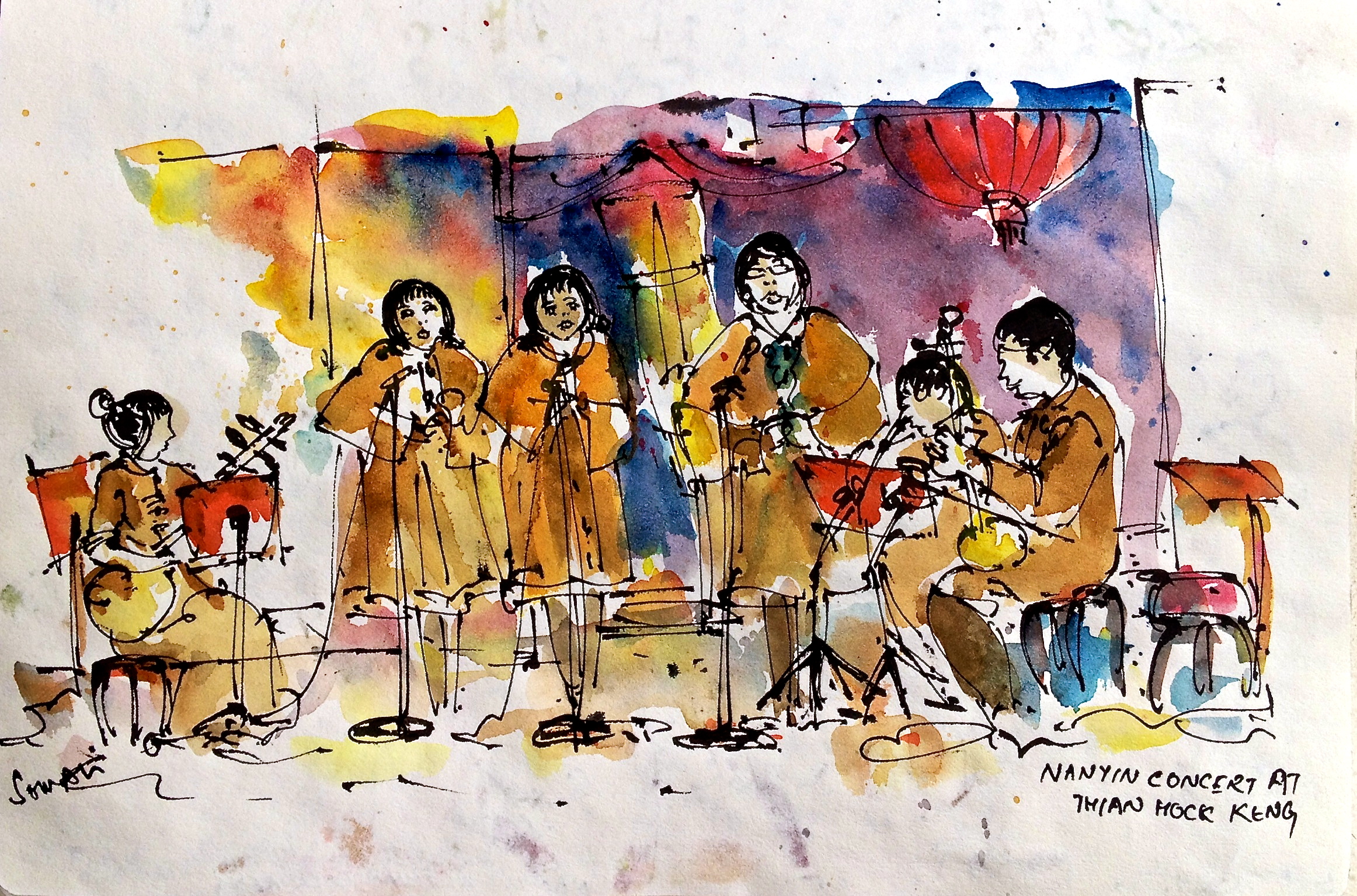
Nanyin, which literally means the ‘music of the south’ has originated from the southern Chinese province of Fujian and is one of the oldest music genres of China that still exists. The music is soft, gentle and graceful – something that would seep through the pores of your skin and serenade you and fill your senses to the hilt. As the music trickled into the temple’s ancient courtyard, the audience – a motley crew of young and old, locals and foreigners, residents and tourist – sat enthralled and motionless, which was perfect for sketching.
Understanding the lyrics would’ve heightened my experience, because most of the time it felt like standing at the edge of an alluring pool and not knowing how to swim. Perhaps, my inability kept me rooted to the task at hand without getting emotionally invested. On that night, I let the music guide my pen.
Nanyin performers at Thian Hock Keng

Nanyin performers at Thian Hock Keng

Visiting Singapore’s Baba House

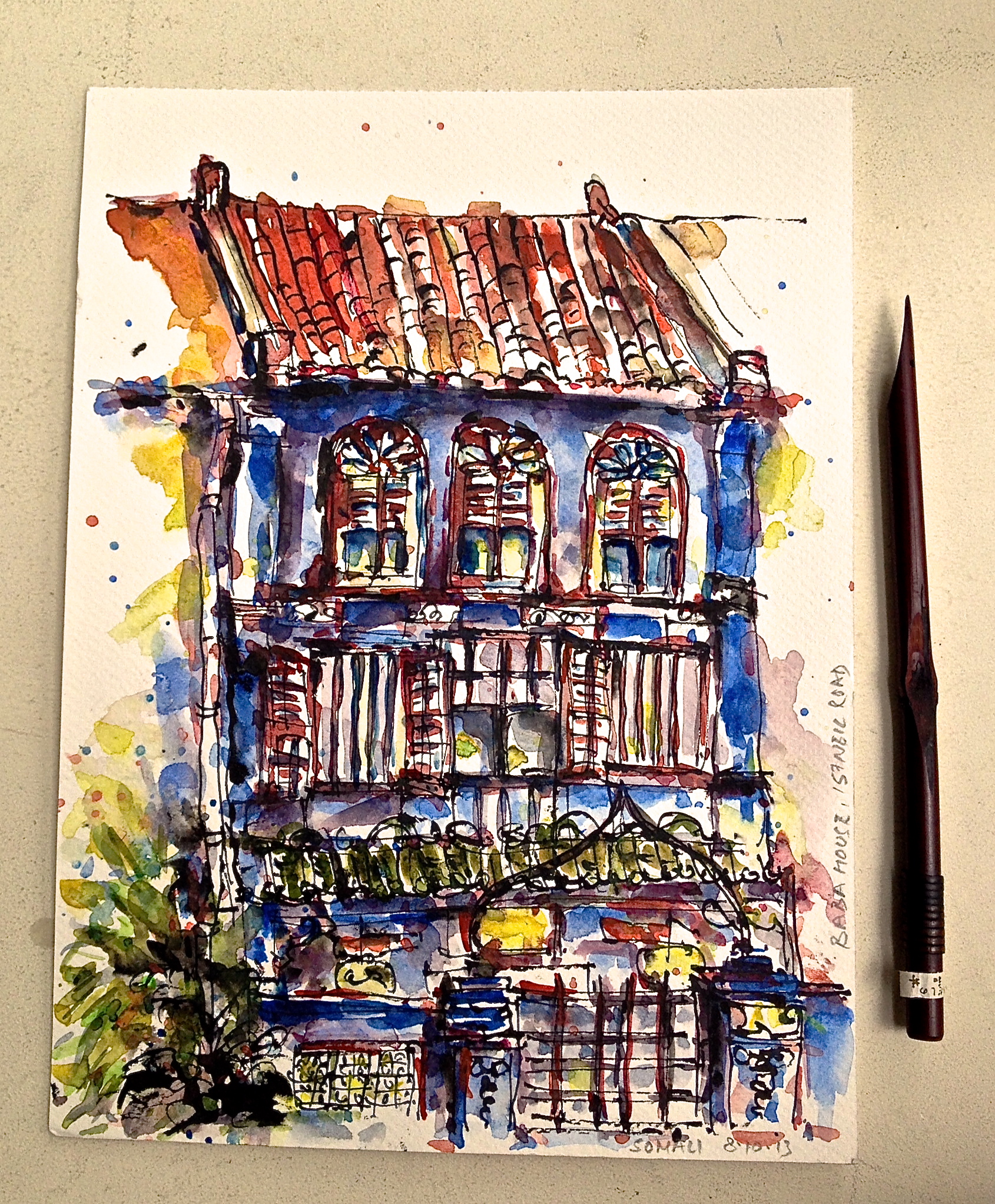
Facade of Baba House, drawn with a bamboo stick

Facade of Baba House, drawn with a bamboo stick

The Setting
The old British couple was posted right before a dark wooden cupboard. An American man, probably in his middle age was sitting on a decorative oriental chair, hunched over a notepad and pen, the Russian dame in a sleeveless maxidress was leaning against the heavy ornamental door, arms akimbo and a fidgety Spanish duo of mother and daughter with disheaveled hair and brutally sunburnt arms and face was just waiting for it to start and then finish, so they could go back to their hotel, put a tick on their list of things to visit in Singapore and order room service. Then there was the suave Australian couple – the man in a tailored suit and the blond woman in a red dress with long distracting legs emerging from it, poised on the short rotund chairs in the middle of the room. I was of course with my sketchbook and pen lingering at the back, trying to read them as much as they would let me.
It felt like walking into one of those penultimate scenes in the small screen adaptations of Agatha Christie stories, where the inimitable Poirot has called upon the suspects in the living room so he could unfurl the mystery. My ears are almost tuned in to hear the rising crescendo of David Suchet’s voice – “Mesdames et Messieurs, it’s time to reveal the truth about this terrible crime” – and finally pinning down the murderer – “After everybody left, it was you Mr. Doyle, who picked up the gun, ran along the deck and shot your wife in her sleep.”
A tap on the shoulder requesting me to deposit my bag before the tour, broke my post-lunch reverie. Egg-headed Poirot had been replaced by grey-haired Chia Hock Jin, our amicable tour guide and I along with the other ‘suspects’ were crowding inside the remarkably restored living room of ‘Baba House’, the ancestral home ( built around 1895) of a wealthy Peranakan shipping merchant Wee Bin.
The Peranakan Story
Having introduced himself, Hock Jin warmed us up with a short history of the Peranakans, which started with the settling of Chinese merchants in the Straits of Malacca during the 15th century, who began integrating certain traits of local Malayan culture into their own Chinese heritage, thus giving birth to a distinctive hybrid culture with an identity of its own. By the 19th century, the Peranakans were mostly working as intermediaries between the mainland Chinese traders and the Dutch, Portuguese and British colonial traders, thus amassing immense wealth, which they spent lavishly in building such elaborately decorated houses.  “They were sending their children to English medium schools rather than Chinese schools, or abroad for tertiary education or professional qualifications, so when they were back they could join the British administration.” said Hock Jin with arms deep inside his trouser pockets.
The Facade 
Leading us out of the drawing room through the main door, Hock Jin insisted, we take a closer look at the cobalt blue facade of the house with red gable and pitch roof, and not just admire its many architectural components for their beauty but understand their significance and symbolism as well. “Houses in those days were not numbered, so to understand who lived where, all you had to do was look at the facade”, he says, pointing at the two lanterns which have the origin of the family and surname of the resident written on them in winding strokes. The Chinese signboard with golden characters above the main door spell out the name of the house – ‘Everlasting Prosperity’. Motifs of peonies and phoenix on the facade, signify prosperity, peace, good wealth and luck. Hock Jin has been cupping a canary yellow ceramic bowl, which he suddenly holds out in public view. “Notice those friezes below the louvered windows? Those were made from tiny ceramic chips of different colours.”
The facade seems deceptively narrow for its wealthy owners but Hock Jin reassures that the house is much longer inside than what its entrance suggests. “During the Dutch rule, property owners were taxed as per the width of the frontage”.
Hock Jin standing in front of the Living Room alter

Hock Jin standing in front of the Living Room alter

Living Room
“The living room is where the patriarch entertains his guests” begins our guide as we make our way inside again. Ornately carved Qing dynasty blackwood furnitures with mother of pearl inlay frames border the room on all sides giving it a rich luxurious feel; dainty ceramic vases, porcelain figurines and crockery adorn the corners atop side tables and cupboards; decorative venetian mirrors hang from the walls, an Austrian round table and chairs set, popular in the 19th century, sits at the centre while one of the four family altars that every Peranakan house must have, is placed at the head of the room facing the main corridor. Despite the heat and humidity outside, the dark interiors help in keeping the temperatures down.
“Feng Shui played an important role in the design of the house in those days. Do you know why there are two side entrances from this drawing room into the house?” Most nod their heads in negative.”So any bad energy that barges into the house through the front door, dissipates before flowing inside.” More fascinating details stumble out of our guide that we greedily lap up – demons tend to shuffle their feet and the high threshold serves as a hurdle for them to trip and fall if they enter the house, or the mirrors are hung so when the demon looks at his reflection, he realises how ugly he is and leaves pronto!
Family Room of Baba House

Family Room of Baba House

Family Room
 
“The women and the children were not allowed in the living room in those days. But that didn’t mean they couldn’t see what was happening here”, says Hock Jin with a obscure smile as he points at the small openings in the carved wooden partition screen dividing the first and the second hall, through which unmarried Nonyas could peep through. The Family Hall was the matriarch’s domain, where the second altar was kept along along with a cupboard that stored ancestral tablets with recordings of the family’s eldest son’s birth details, through several generations. Elaborately painted portraits of the Wee family adorns the walls. The architecture is predominantly tropical with a refreshing airwell on the side that also helps keep the house cool. “This is where the family well was supposed to be but since this house is on a slope, the well is at the back.” explains our guide.
After the extravagant and slightly dark living room, the unexpected indoor-outdoor feel of the family room is refreshing. “Design of Peranakan houses always account for the five elements of Feng Shui – wood, fire, earth, metal and water” says Hock Jin, as we scrutinize the interesting amalgamation of Eastern and Western architectural elements. The colourful tiles lining the wall of the air well were distinctly British, there’s a buddhist swastik in the room and an attractive white panel on the wall with Chinese zodiac signs etched on it.   
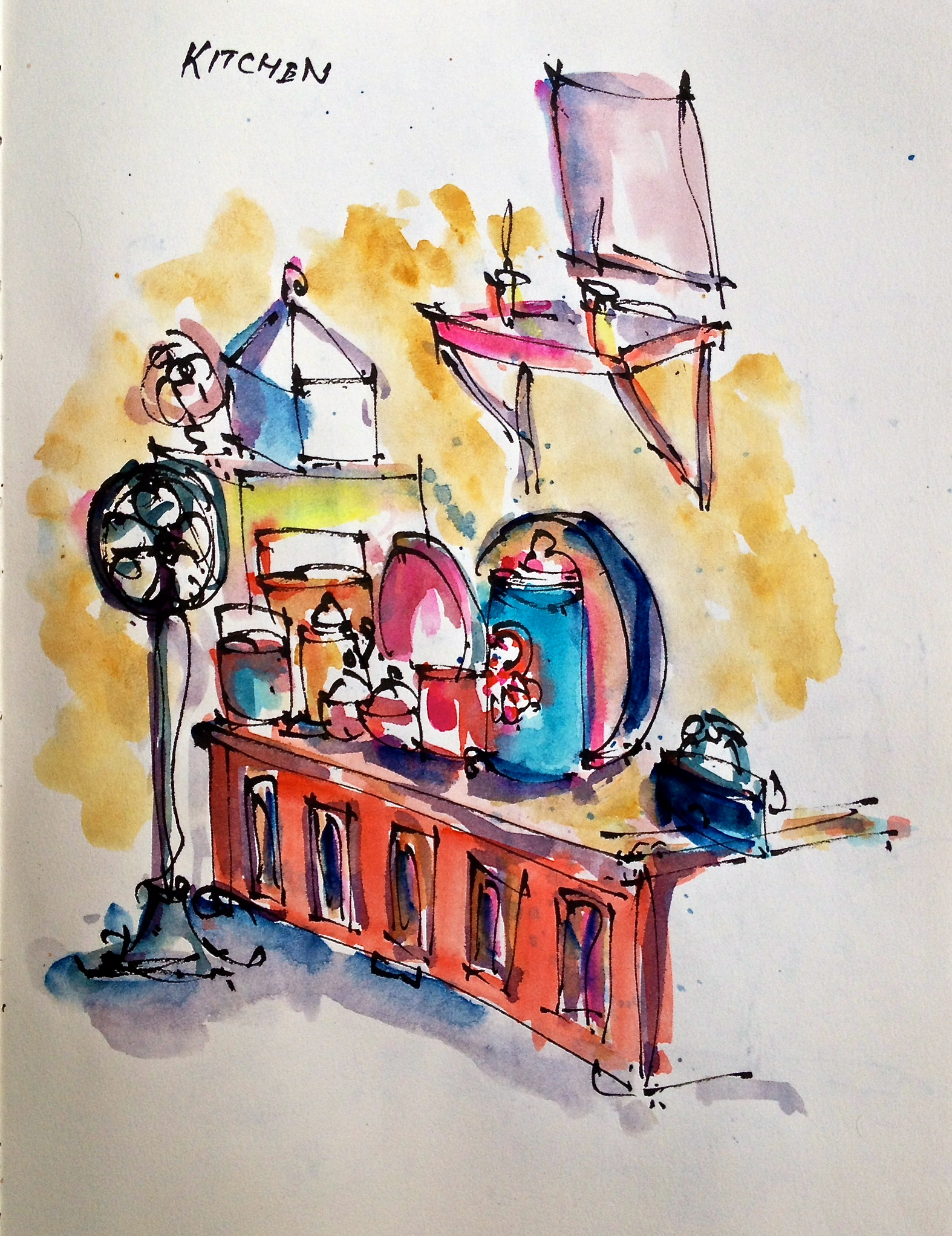
Kitchen

Kitchen

Kitchen
Hock Jin leads the group from the family room to a surprisingly sparse kitchen with brightly coloured Nonya cooking paraphernalia neatly displayed – lacquered stackable meal containers, scarlet coloured dishes, cups, jars, vases, dessert moulds, a traditional grinding stone along with an oven from yesteryears with metal woks stacked atop, a mortar and pestle, and a blue ceramic kettle. The alter of the kitchen god is affixed to the wall, as if to oversee and bless the laborious cooking of mouthwatering Nonya dishes.
Second Floor Bedrooms
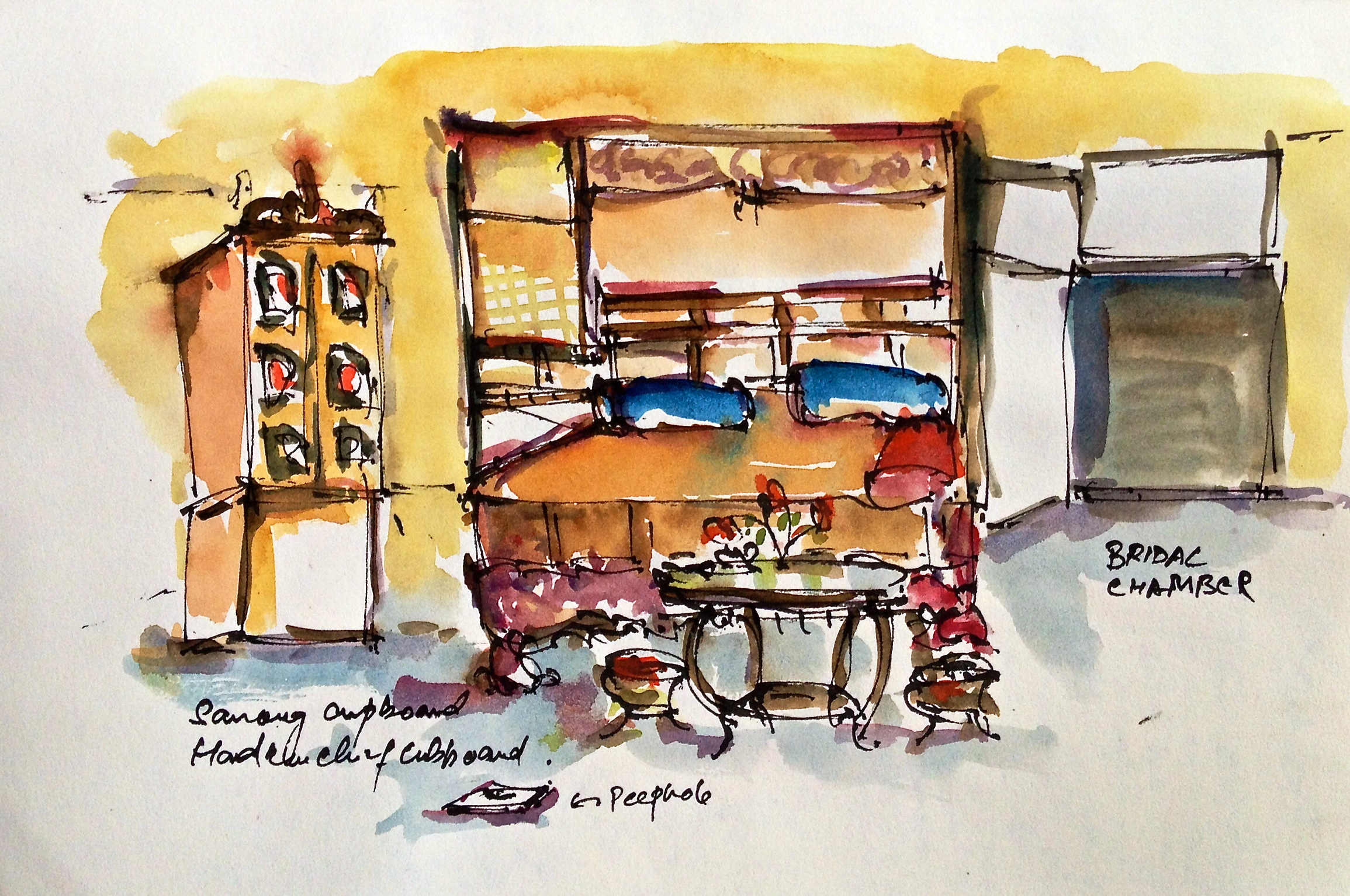
A flight of wooden stairs lead us to the highly polished second floor with more Chinese dark wood furnitures and two bedrooms, one of which is a bridal chamber, dedicated to the 12 day ritual of Peranakan weddings.  Just like the living room, the bridal chamber is flamboyant with an exquisitely carved, lacquered and gilded canopied bed from 19th century with motifs featuring fertility symbols. Across the room are several ornate armoires for storing the bride’s sarongs, kebayas, handkerchiefs and so on.  The most intriguing feature that hooked the tour group was the peephole on the floor, that gave an unobstructed view of the living room and the main door. “So a Peranakan wife could see all who came to call on her husband.” says Hock Jin to his audience, now sitting on their haunches, trying to shove their face into a tiny gap on the floor.
 

Bridal Chamber

Bridal Chamber

End of Story? Not quite!
The tour ends on the third floor which houses a contemporary exhibition on Batik. “Please feel free to look around” says, Hock Jin and offers a perfunctory “thank you” for taking his tour, which sends the Spanish mother and daughter scooting down the stairs towards the exit. Others follow, making thumping sounds on the wooden steps as they climb down. But some of us linger around Hock Jin because his eager eyes haven’t dulled yet. He might have more to say if we poke the fire. He begins talking about the Great Depression of 1930s, when prices of tin and rubber on which the Peranakans heavily relied, fell rock bottom. The two world wars dealt heavy blows to Peranakan wealth, status and influence (as loyal British subjects, they contributed to the wars by making considerable donations), when many fell into poverty and had to sell off their landed houses and family heirlooms. “Then came the Rent control Act of 1947” says Hock Jin, pausing briefly. This mandated the rent of pre war houses like this, to be controlled in Singapore, and in effect frozen, resulting in further deterioration of income.
In 1966, Lee Kuan Yew’s government enacted the land acquisition act, to promote urban renewal, which empowered the government to acquire land for compensation, to be paid on a predetermined formula. Pre-war houses made way for high rises. “Many Peranakans converted to Christianity in the 1940s and 50s, women started working after the war and gradually with urbanisation, intermarriages and modernisation, the Peranakan culture stagnated and their identity suffered”, says Hock Jin, with eyes cast on the parquet floor.
Howver, the recent years have marked a conscious revival in all things Peranakan, with the conservation of heritage Straits Chinese buildings, with exhibitions showcasing the Peranakan way of life, with growing interest in the language, food, attire; and with restaurants serving Peranakan cuisine and antique shops selling artefacts such as silverware, beads slippers, porcelain, furnitures etc cropping up across Singapore. “Restoring Baba House and opening it to the public was one such revival effort” says Hock Jin.

Sketching Vintage

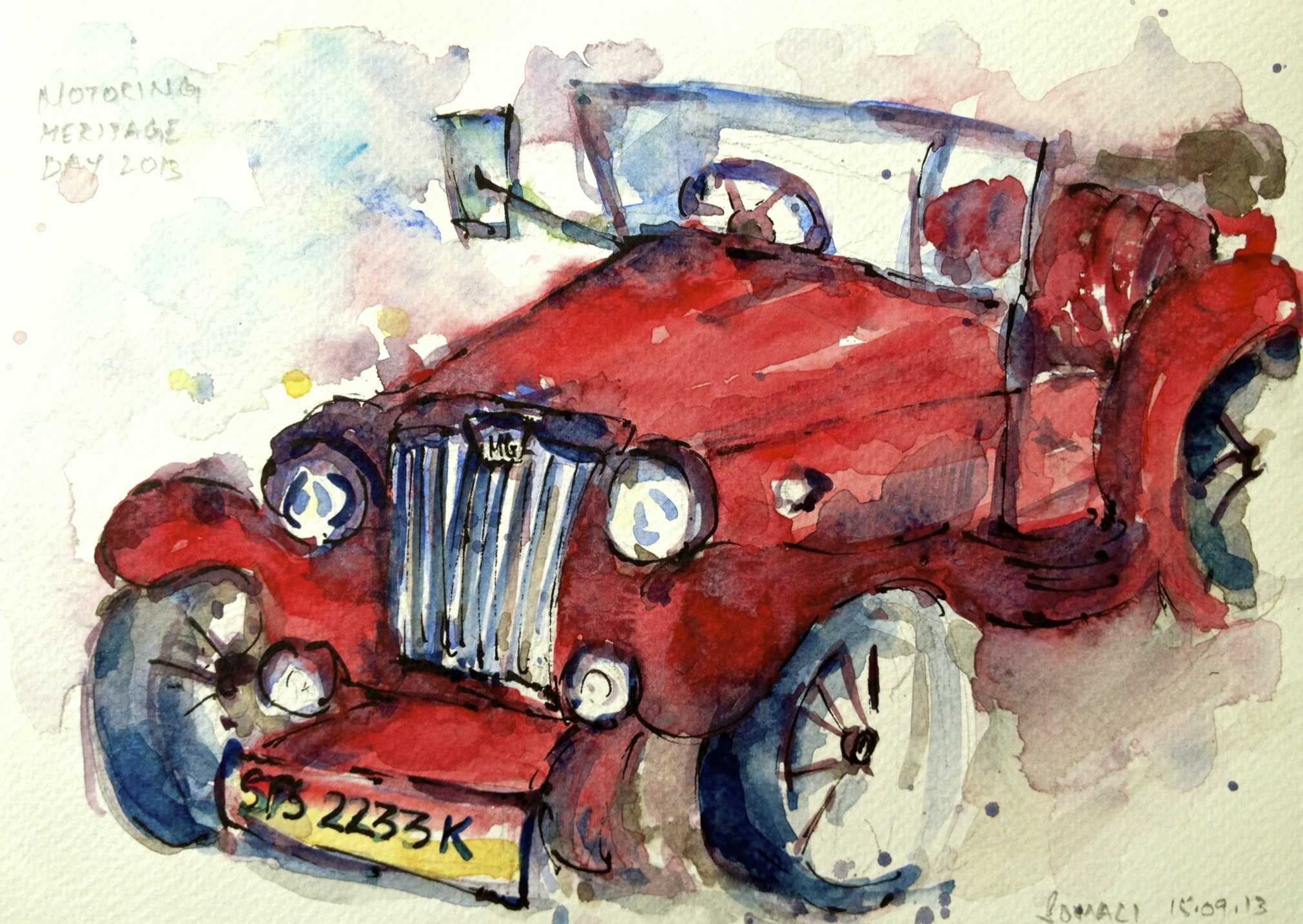
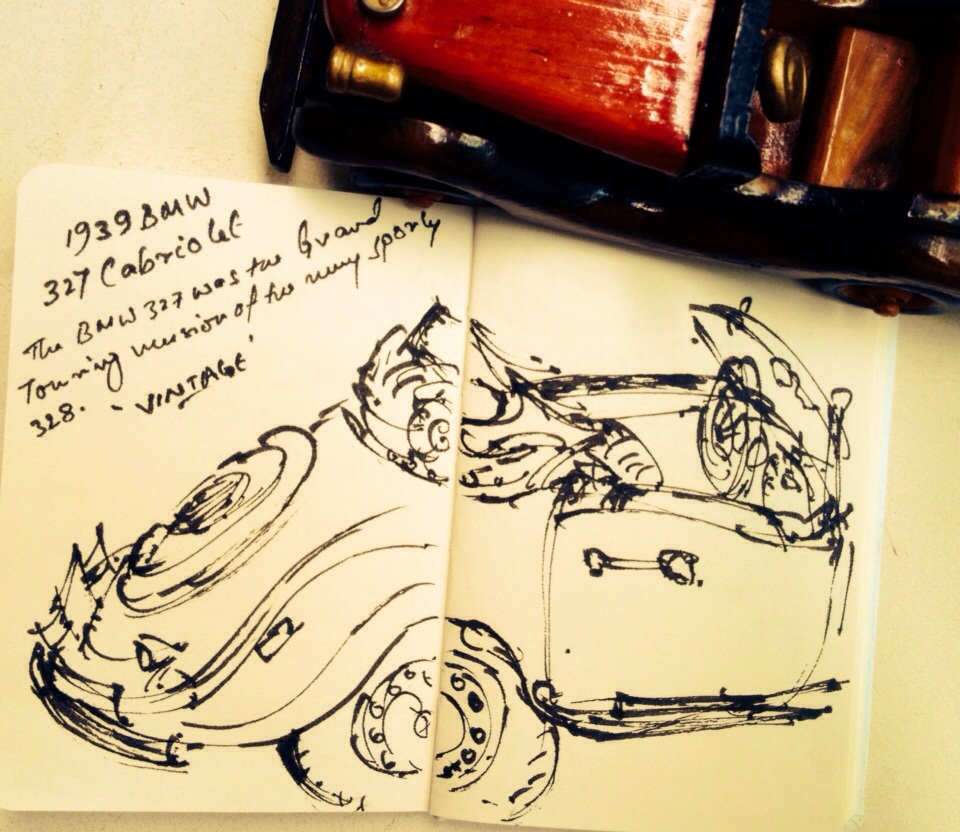
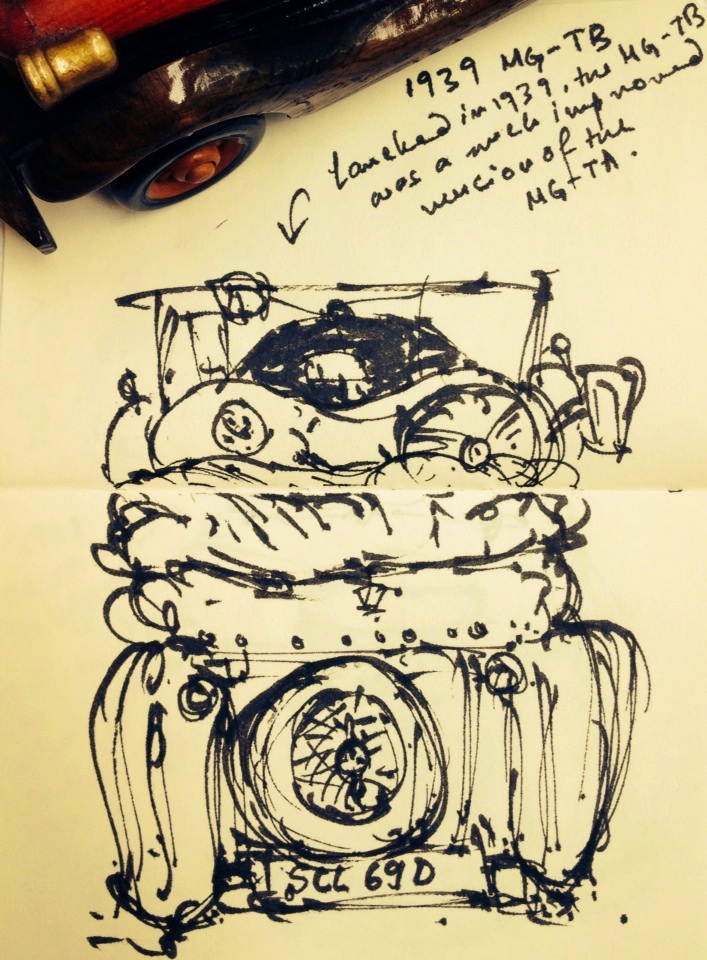
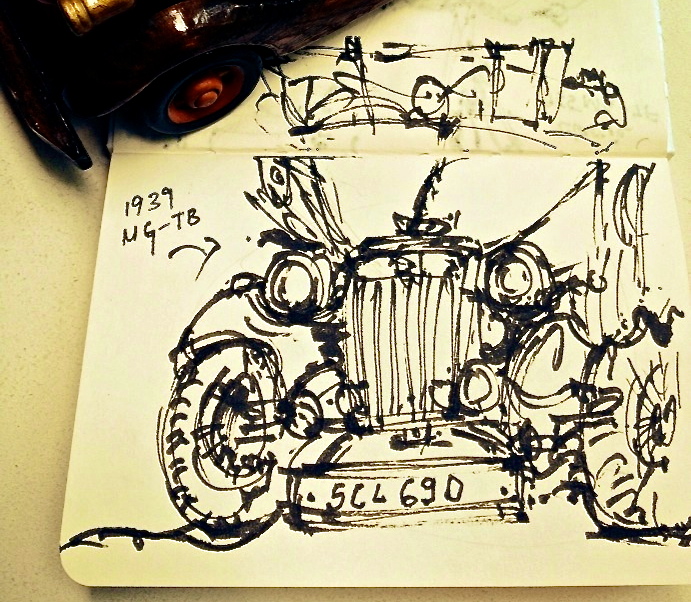
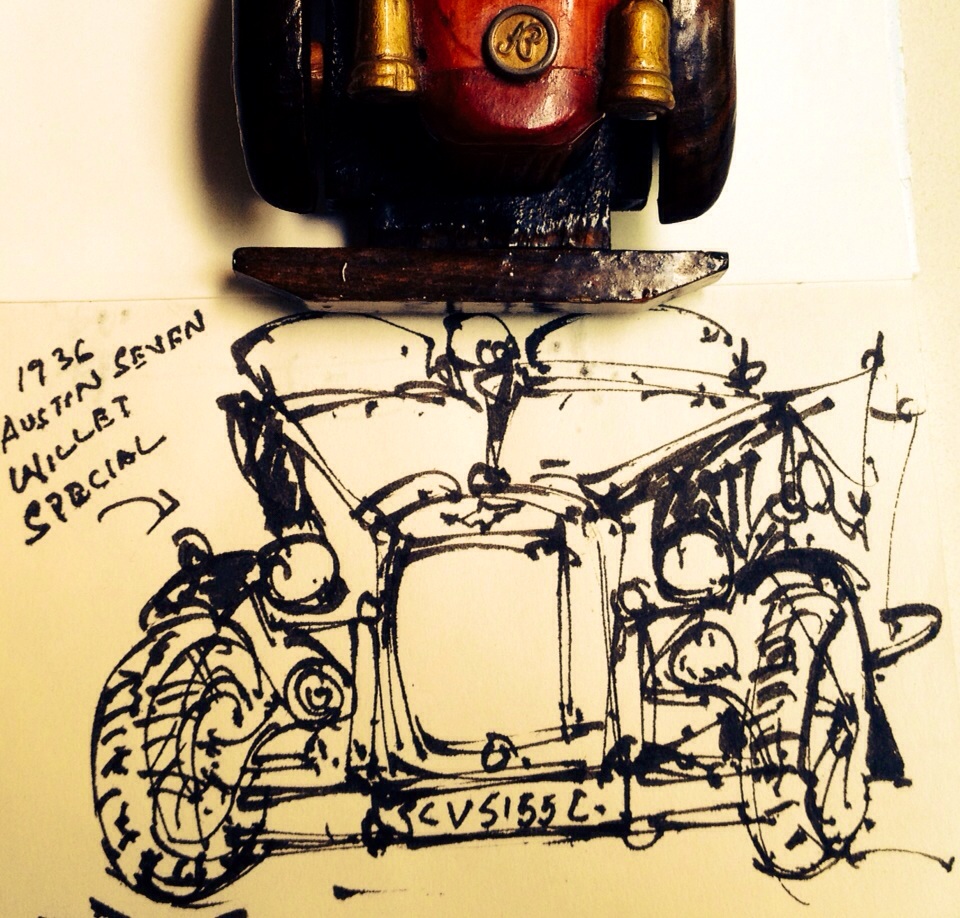
Vintage Car

‘You have the sexiest babe out here’, I say to Andrew Webster’s face, the moment I walk into him with my sketchbook and pen. He grins. ‘You think so! Well, people do like her colour…but there are many beautiful ladies out here.’ he says modestly and scans the row of luscious dames standing in a neat array with information plates displaying their names, make and other interesting snippets. IMG_4254

National Heritage Board(NHB) of Singapore with Malaysia & Singapore Vintage Car Register (MSVCR) had jointly organised “Motoring Heritage Day 2013”, a spectacular display of 50 vintage and classic cars from the 1930s to 1970s era. The location for the exhibition – the 79 year old art deco Tanjong Pagar Railway Station which had ceased operations two years ago and was gazetted as a national monument – couldn’t have been more befitting.
V1The day is muggy and grey and the platform is ageing, monochromatic but the burst of colours on the glistening bodies – in sparkling shades of blue, red, yellow, green and so on – along the abandoned railway track is all it takes to swing the mood. Scores of visitors pour in to view the finest, immaculately preserved historic vehicles in Singapore –  photographing, videotaping, sketching or just gaping at them, documenting the scene in some way, imprinting in their memory this rare once in a year exhibit.
Some owners of these million dollar beauties sit behind their cars impassively, in mild coloured polo necks matched with a beret, semi-casual shorts and moccasins, smoking cigars, talking about the yesteryears, reminiscing, while others in Tees, sneakers and sombreros make rounds, mingle with the crowd and answer questions.
I have never drawn cars before, but am instantly drawn to these period vehicles. Their exotic features, classy design and scrumptious colours make each one seem like a work of art and immeasurably desirable.
IMG_4243
Desire catapults inexperience, and soon enough I start outlining their smooth and flowing bodies with deeply valenced fenders and elegantly cowled back wheels, footboards, long hoods and showy chrome radiator jackets, glass windscreens with sunshades and snug leather seats and the distinctive cockpit-like wooden dashboards. “If I was a guy, I’d marry her’, says an overwhelmed vintage car enthusiast. I’d show her off all the time, if I had one. Wishful thinking! Not only because they are ridiculously expensive to buy and maintain but as per Classic and Vintage Vehicle Schemes in Singapore, there are usage restrictions on these cars as they ‘are not meant to serve day to day transport needs of their owners’. “Many of these cars can be used only upto 28 days in a year.” says the owner of a 1972 Morris Mini 1000. I get back to sketching.
V2
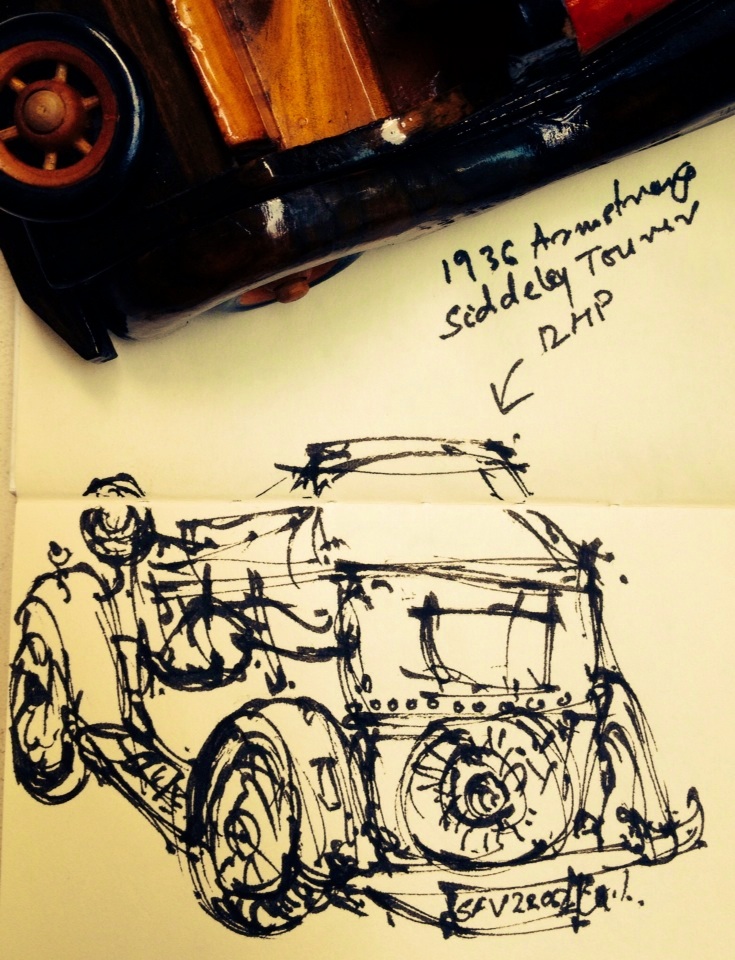
What a joy it is to swerve and glide the pen, outlining the undulating curves, the sinuous stretches and lithe trails that make the retro bodies of these vintage and classic cars. To pick out few favourites, I try to scan the complete row by walking briskly from one end to another, but stop before a 1936 Armstrong Siddley and gape lasciviously at it before moving on to a 1969 Aston Martin DB6 which gets my pulse racing; then double back to catch the 1973 Volkswagen Beetle Cabriolet that I had missed, turn mushy, slowly tear away and forge ahead till the end with many such intermittent stops.
V4I am spurred on to get all 50 cars down in my sketchbook, but my hands don’t move fast enough, in fact they turn clammy when I panic about the lack of enough time, my perspective goes awry, too many people block the view, pushing and shoving and then comes the rain – the hard hitting tropical rain that wipes out spectators, dulls the fun and drowns my plan.
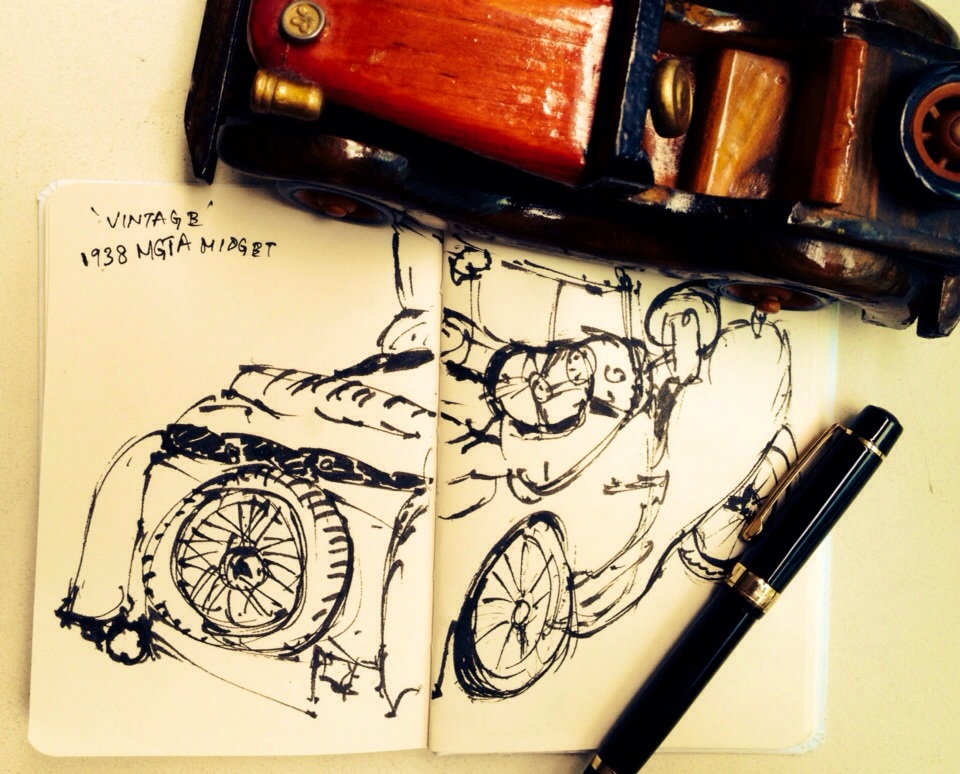
To escape the rain, we climb the sprawling platform and join the car owners now eating lunch out of plastic trays, still posted dutifully behind their vehicles. The rain hardly perturbs their composure. But the inclement weather lets me appreciate the rear of the vehicles which is no less striking than the front.  I take out my tools and resume sketching. Andrew is happy with my pen-and-ink rendition of his bright red 1938 MGTA Midget and flips open his iPad to take a picture. “There’s another one down this line that I own. Want to take a look?”.
V3

Sketching Moscow – Part III

Making travel itineraries for the last five years have led me to a displeasing yet profound axiom. It states that the number of sites and activities that you want to visit or experience in a place will inevitably exceed the number of days that you stipulate for them. Be it 3 days or 3 months, you can never fit in everything you want to see and do. After hours of handwork, persistence and deliberation, you may pat your back on birthing a befitting itinerary, customized to your very needs, but there in it’s shadow will always lurk a nasty ‘waiting list’, of sites that were your second and third choices – those that couldn’t make it to the list but are dangerously sneaky. While you pet and fawn over your prized itinerary, they’ll plot and scheme to wriggle their way in. Most of the times you surrender. Is it worth it? Sometimes it is.

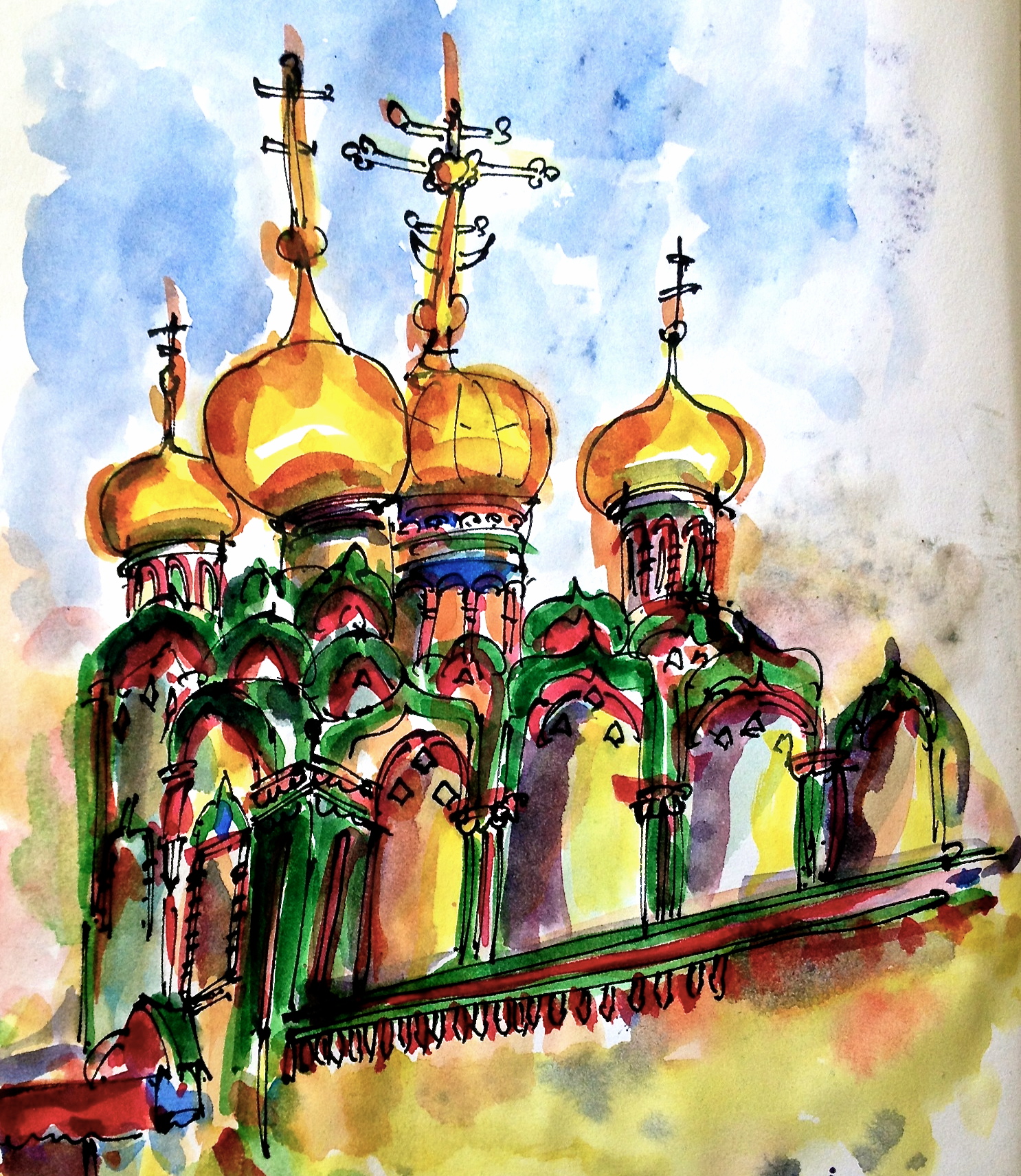
Like in the case of the historic Novodevichy Convent , that wasn’t in our itinerary simply because we didn’t have enough time to fit it in plus it was a bit far off from the cluster of sites we were hanging about. But we squeezed it in, on an early morning even before the ticket counter opened, when the men were still cleaning with huge water hoses, mopping and dusting the place, the gardener was still trimming the bushes and nuns were hurriedly moving in and out of the many churches in the expansive compound, prepping for morning prayer, when people were still walking their dogs along the river outside its red and white fortified walls, and when the air was cool and there was dew on the grass and every tree, when you could still hear the song of the birds piercing the meditative silence, that only such an hour of the day can claim.

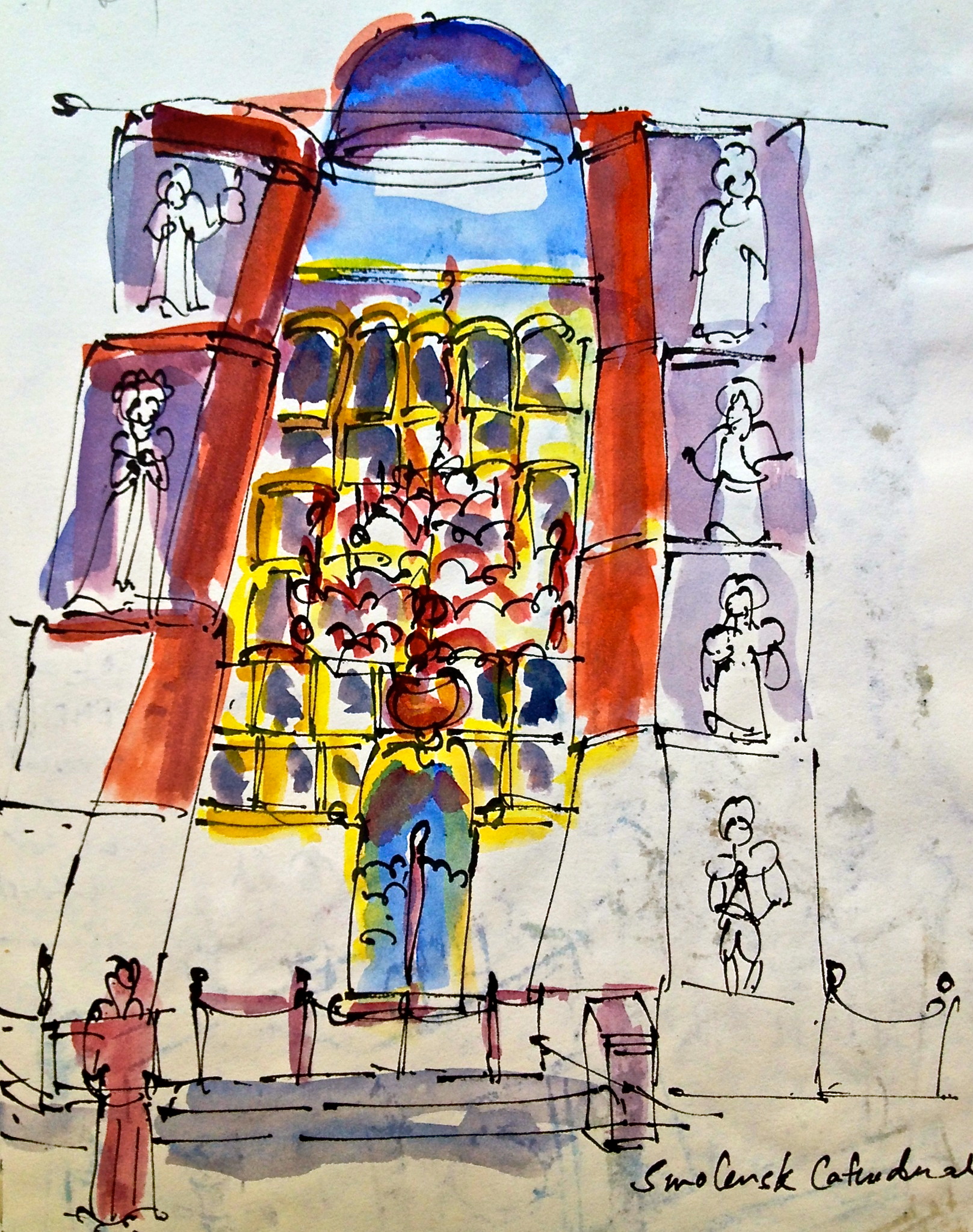
Hands down this is the perfect time to visit because, you have the place to yourself. In an hour or two, the tour buses and tour groups will appear with their guides speaking all at a time and over each other. The transient magic will be lost. While you are allowed to roam inside the fortified compound amid greenery and beautiful golden domed churches free of cost, a ticket worth 250 roubles will gain you entry inside some of these churches, like the breathtaking Smolensky Cathedral (dating back to 1524) and the Assumption Church.

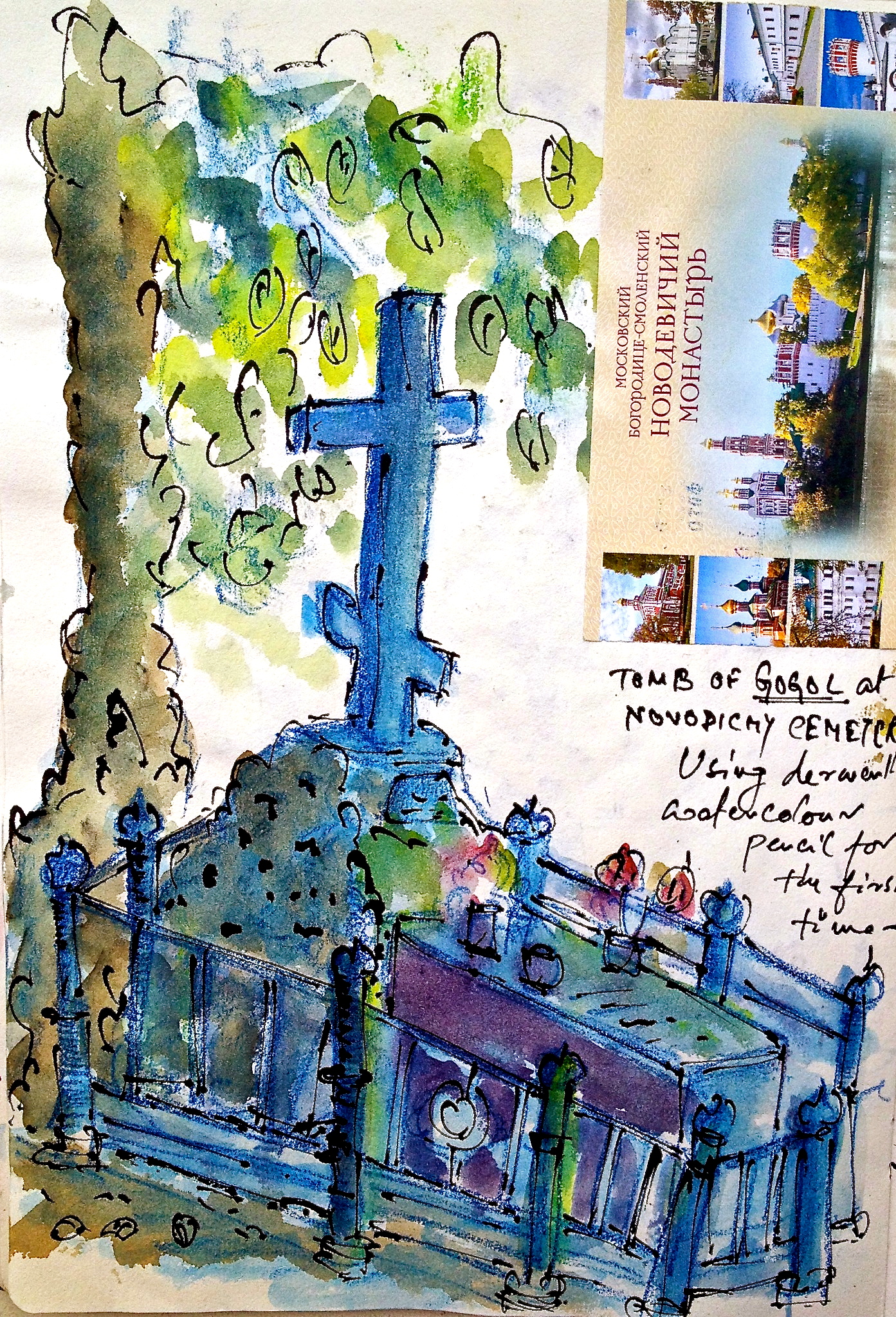
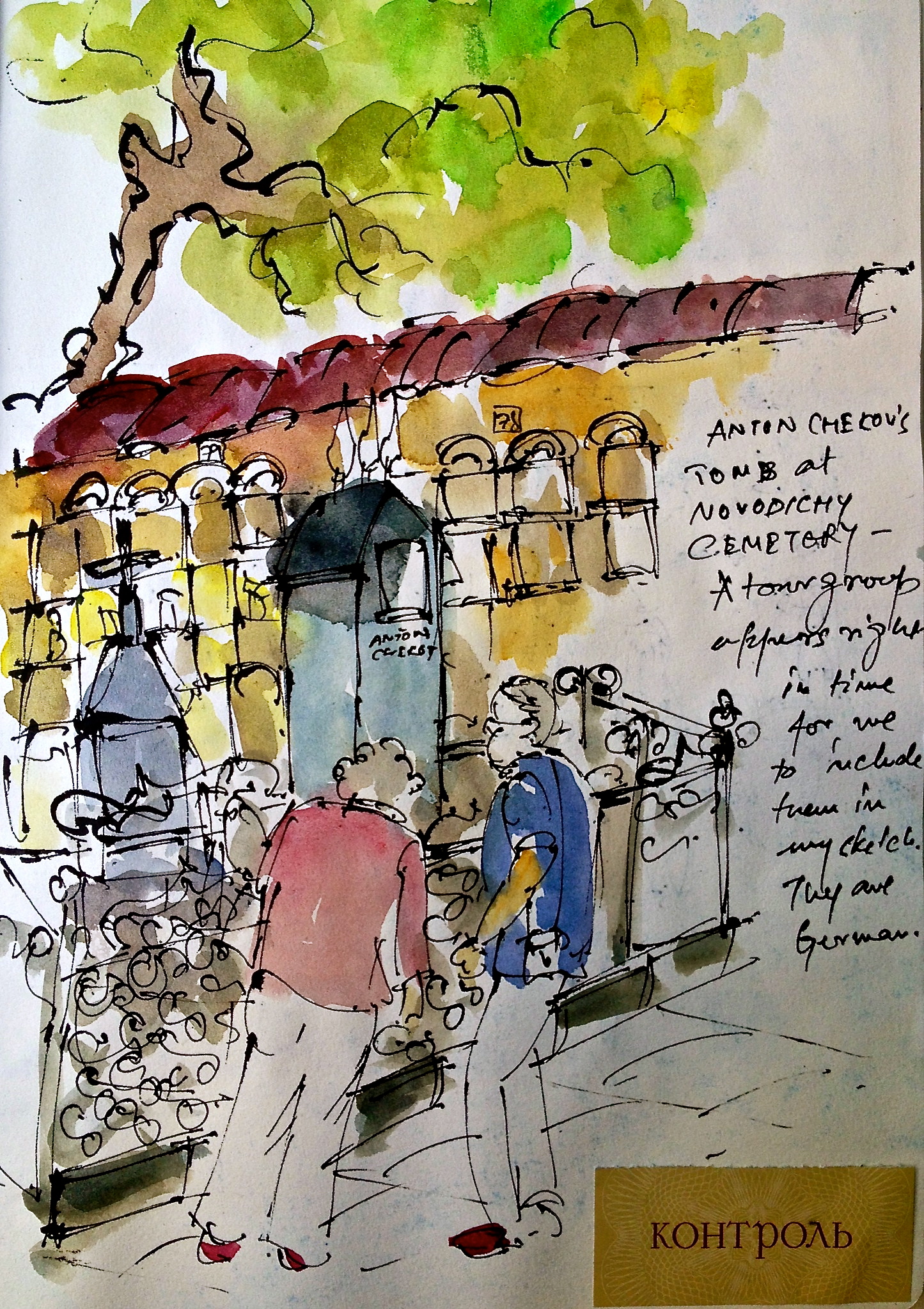
Behind the Cathedral, within ten minutes walking distance is the Novodevichy Cemetery, theTomb of Gogol resting place for Russia’s many stalwarts from different walks of life – poets, playwrights, political leaders, academicians and many more. Admission is free and the absolute lack of English signs turn the grave hunting for Russia’s who’s who into a guessing game bordering on frustration, if you are running on a schedule. After combing through rows upon rows of fascinating stone sculptures decorating the graves – a life size dog resting at his master’s feet, a sensuous ballerina holding a precarious pose, a swan taking flight  – we hunt down the glass covered grave of Tchaikovsky. It’s unpretentious, unseemly modest in comparison to its neighbours. Seeking help from the resident gardener on the grounds, we further hunt down the resting place of Chekov, Bulgakov and Gogol – all impressive in their austere simplicity. Tour guides make hurried stops and even before their patrons can absorb the solemnity of their surroundings, they leave. I take my time and sketch in peace.

What is fascinating and peaceful to one may seem depressing to others. “Excuse me, how do IAnton Chekov's Tomb exit from here?” ask two women. The frown lines on their face give away their distaste for the necropolis. “We don’t like graveyards. Which way is the convent?” We show them the way out, but linger around. The sun has climbed, but the cool serenity of the manicured garden, keeps us comfortable. A forlorn woman dressed in a flowing gown is poised on a gravestone, her head slightly tilted, eyes downcast and with a delicate hand she’s touching her heart.

The sun shines a side of her face, but casts a melancholy shadow on the other. The flowers at her feet have dried and there’s gut-wrenching sadness in her eyes. If she weren’t in stone, I would beseech her with questions. The Cyrillic alphabets at her feet mean nothing to us. I wonder who she was, what was her sorrow and how she passed. Did she leave somebody behind? But, sometimes, knowing less, is feeling a great deal more. Such is the beauty and majesty of the stone sculptures here, that they bring the deceased as close to life as possible to strangers who can’t even read their names. The language of hammers, chisels, rasps and rifflers on these stones transcend the need for anything more comprehensible and for now this seems enough.

Pavillion at Patriarshy PrudyLunching at the exquisite “Pavillion” on wooden chaise set up on a summer patio, overlooking a tree-fringed lake at Patriarshy Prudy (Patriarch’s Ponds) was a fantastic idea. The food is good and a bit expensive, but you’ll lose your heart to the still unchanged 19th century locale – where Michael Bugalov’s The Master and Margarita is also set. The author himself lived nearby and so did many prominent Russian poets, singers, painters, scientists and authors. No wonder the area has been stamped as the cultural heritage of Russia and is protected by the government. While noshing on bread and chicken Kiev, you’d almost feel like floating on water. And if you hint the ducks and the two majestic white swans that you might have something for them to nibble at, they’ll happily glide right to you seat, clacking all the way. Walk around the pond lazily or spend hours sitting on one of the benches beside the ornate lamps, under the cool shade of trees. Feel the breeze on your face, unwind and think nothing.

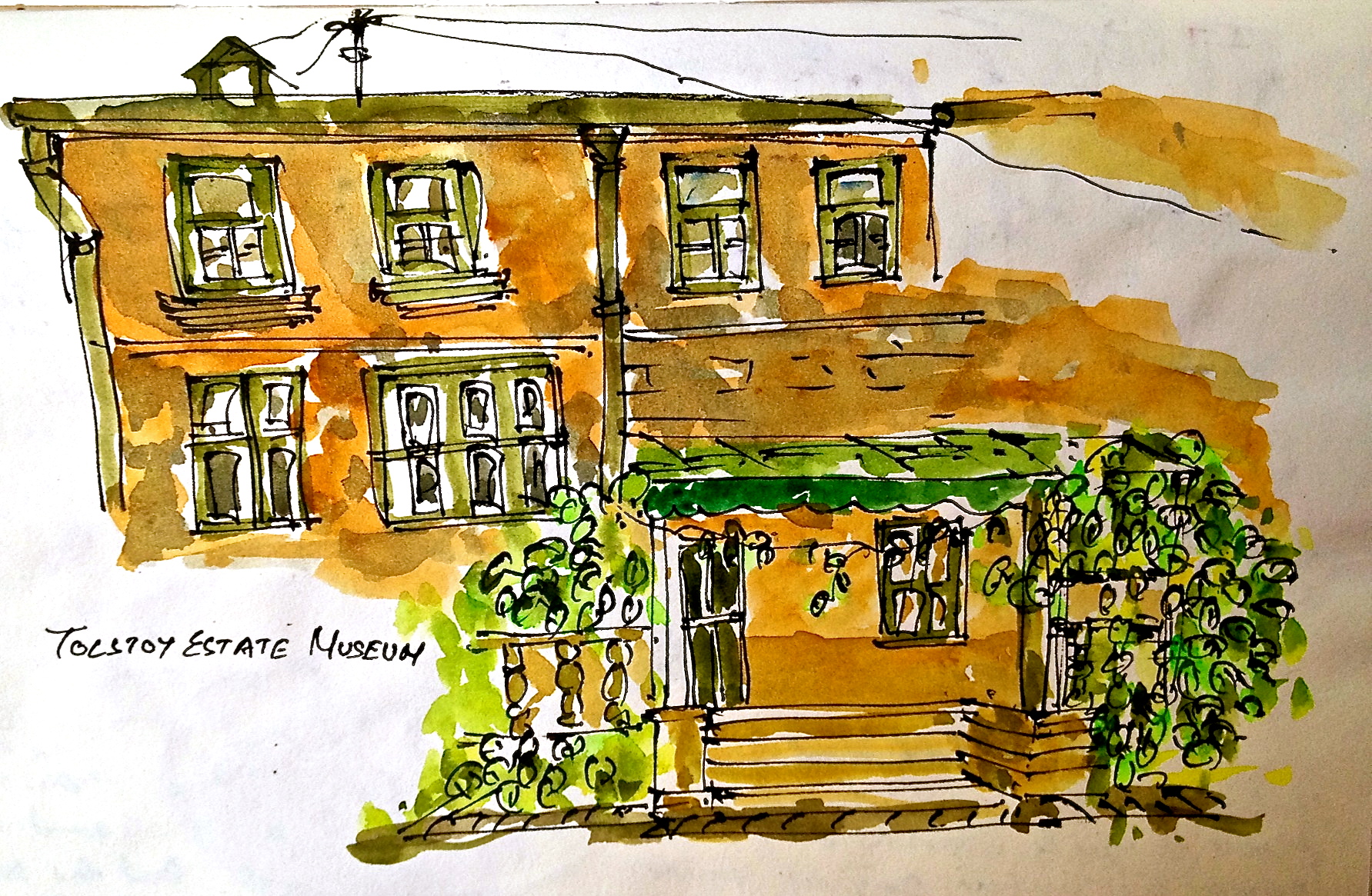
Tolstoy Museum EstateI arrive at the Tolstoy Estate Museum with barely an hour to spare before it’s closed for the day. A handsome yellow ochre house of mediocre size with green windows and a small patio ensconced by ivy, sits amid a small garden with large shady trees. A bottle green picket fence goes round the estate. My mobile phone and hand bag is stowed away before I start touring Tolstoy family’s winter home since 1882.

How does it feel to step inside someone’s private domain? Well, I paid 200 roubles for the privilege and am wearing protective cover over my shoes, but the feeling is that of uneasiness and repressed excitement as if I am about to trespass into private property. But that is a good thing in this context because the 6000 original exhibits of the family has been curated so well that together they lend the house a character that was once its own and get it to tell its story. Short descriptions in English tell you about the display, what the room was used for and stories of their domestic life. The visual imagery is strong and your imagination runs wild. This is how museums should be – not just educational and academic but engaging and inspirational too.

The dishes laid on the dining table where the author had meals with his family, the recreation room where his children played games, the wooden bed where the author and his wife Sofie slept, her desk where she transcribed the author’s manuscripts, the children’s toys splayed on the floor of the nursery, the portraits painted by his eldest daughter adorning the wall, their gowns hanging in their closet with matching shoes, a huge piano standing upon a bear skin in the drawing room and Tolstoy’s study table with his writing paraphernalia and his chair that he trimmed to be closer to the desk (being short-sighted), his clothes, boots, dumbbells, bicycle and such inanimate yet intimate details will get you many folds closer to the author as a man. Later, I sit on one of the benches in the garden and sketch the house. One by one all the visitors leave and I am left with a fidgeting guard with a padlock in his hand, lingering near the gate and staring in my direction. I collect my things and put him out of his misery.

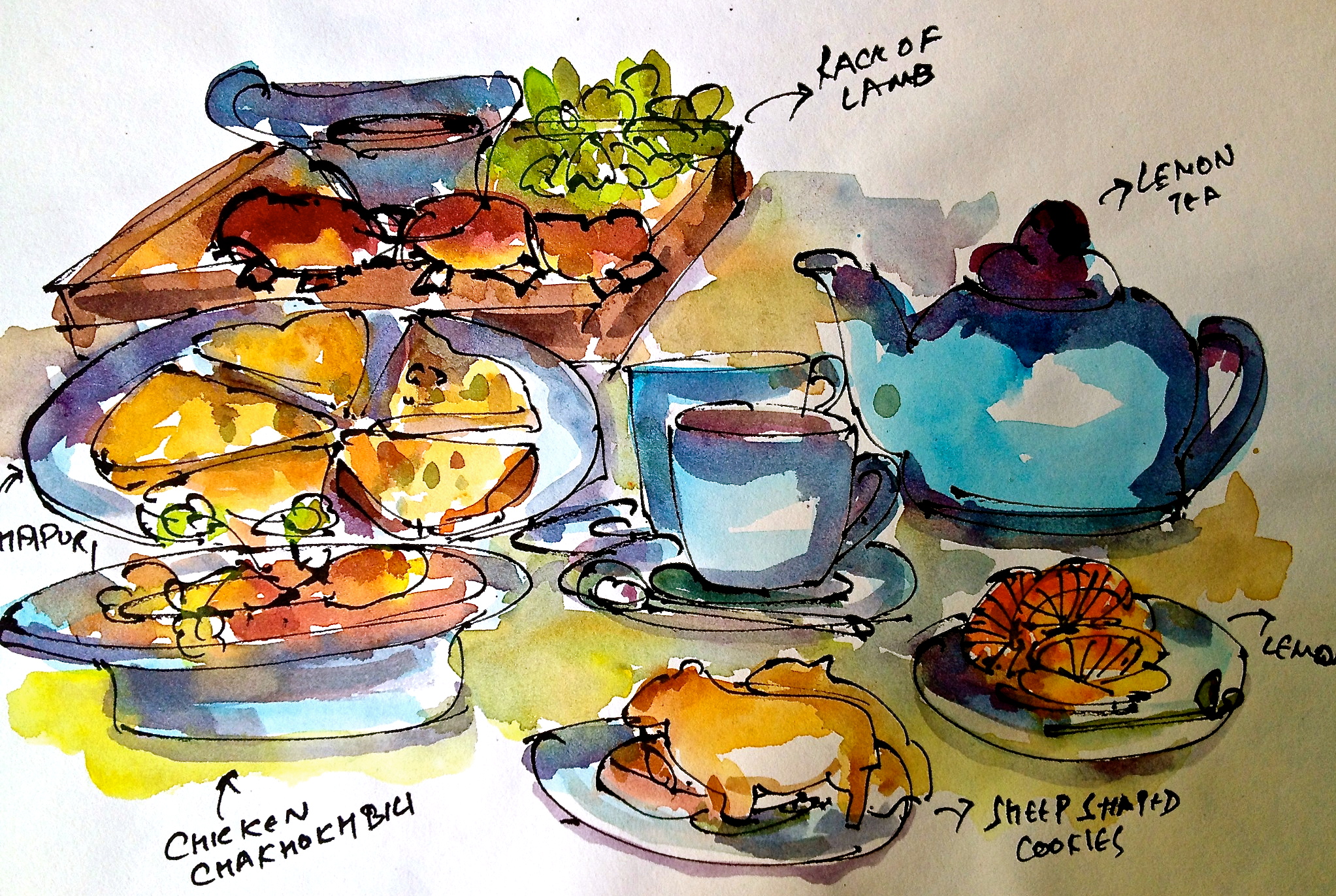
For dinner, we pick Georgian and “Khachapuri” at Bolshoy Gnezdnikovsky per 10,  is perhapsGeorgian Dinner at Khachapuri the most cheerful place to deliver that in a warm, unassuming, homely atmosphere. The strong aroma of fresh coriander wafts out from the spicy yet heartwarming Chicken Chakhokhbili (although later I learn that it has parsley, tarragon, basil and dill as well) – unexpectedly reminiscent of my mother’s Indian curry – and the rack of lamb seems quite contemporary but what surprises us is the addictive Khachapuri – freshly baked cheesy bread or “pizza of the 21st century” as per the cafe’s website! We order lemon tea, munch on the sheep-shaped cookies and head back to the hotel around midnight under a semi-dark summer sky.


Sketching Moscow – Part I

Moscow’s architecture is awe-inspiring, art galleries, resplendent, churches opulent, parks vivacious and metro stations so grand that they have to be seen to be believed. To top it all, the city is big, vast, enormous, sprawling. In short, overwhelming for a first time visitor, who is unaware of its dimensions till she is dwarfed by almost everything around her.
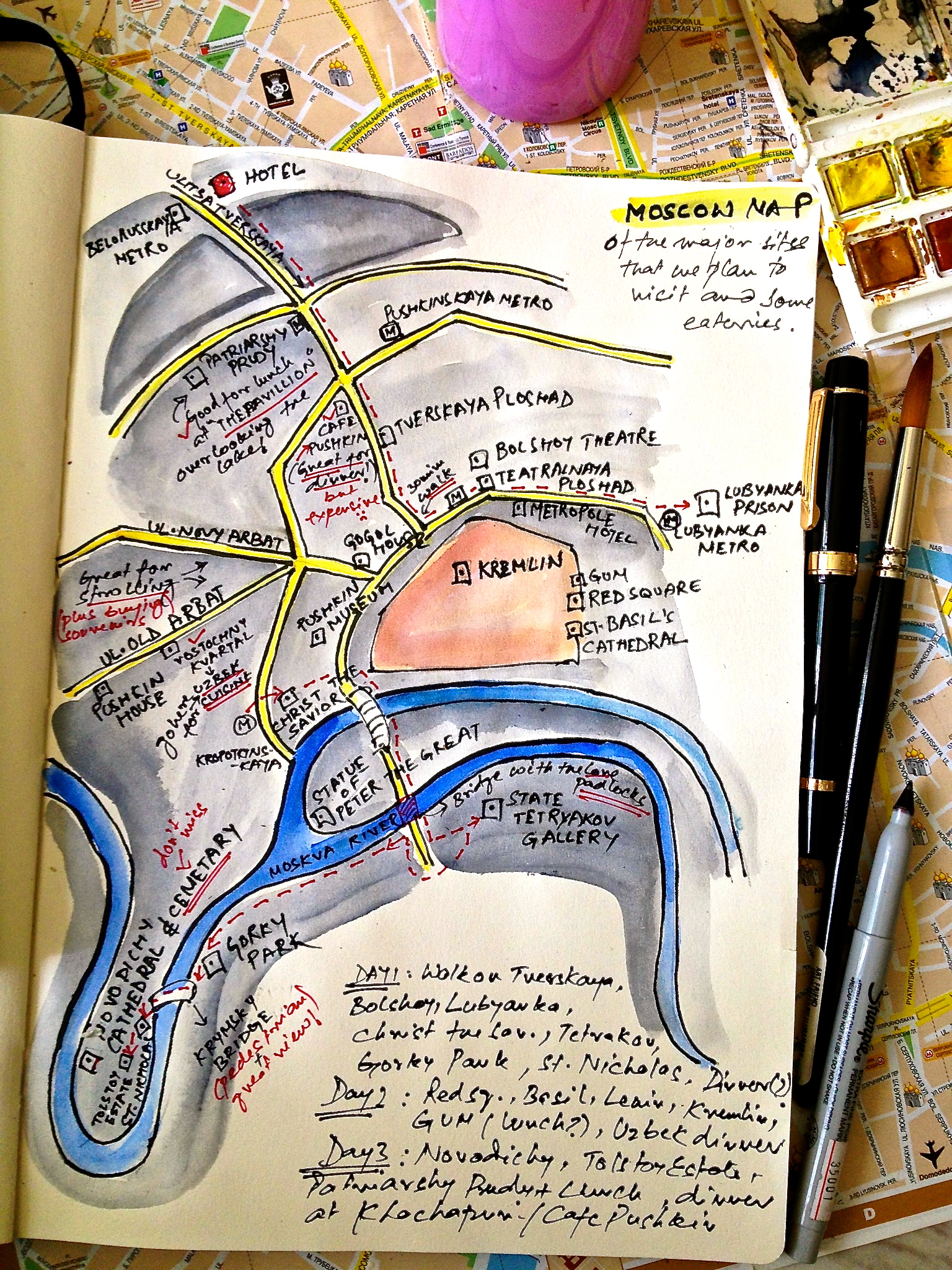
When overwhelmed, draw a map – that’s my advice. It’s therapeutic, it simplifies everything and it gives the control back to you.  I always like to draw myself a rough map of the city I am travelling to, mainly to gauge the location of the sites I’d like to visit and their distance from my hotel. Turns out, if you walk straight on Ulitsa Tverskaya, that hits the red square in a tangent, you are all set to visit the major sights and get a hang of the city on the first day. Passing gigantic buildings, abnormally big arches that gain entry to such buildings, bronze statues and enormous squares like Tverskaya Ploshad, we reach the epicenter – Red square in about thirty minutes from Mariott Tverskaya, which is a hop skip and jump from Belarussky metro station, making it a great choice for lodging in Moscow.
My hand drawn Moscow map for reference

My hand drawn Moscow map for reference

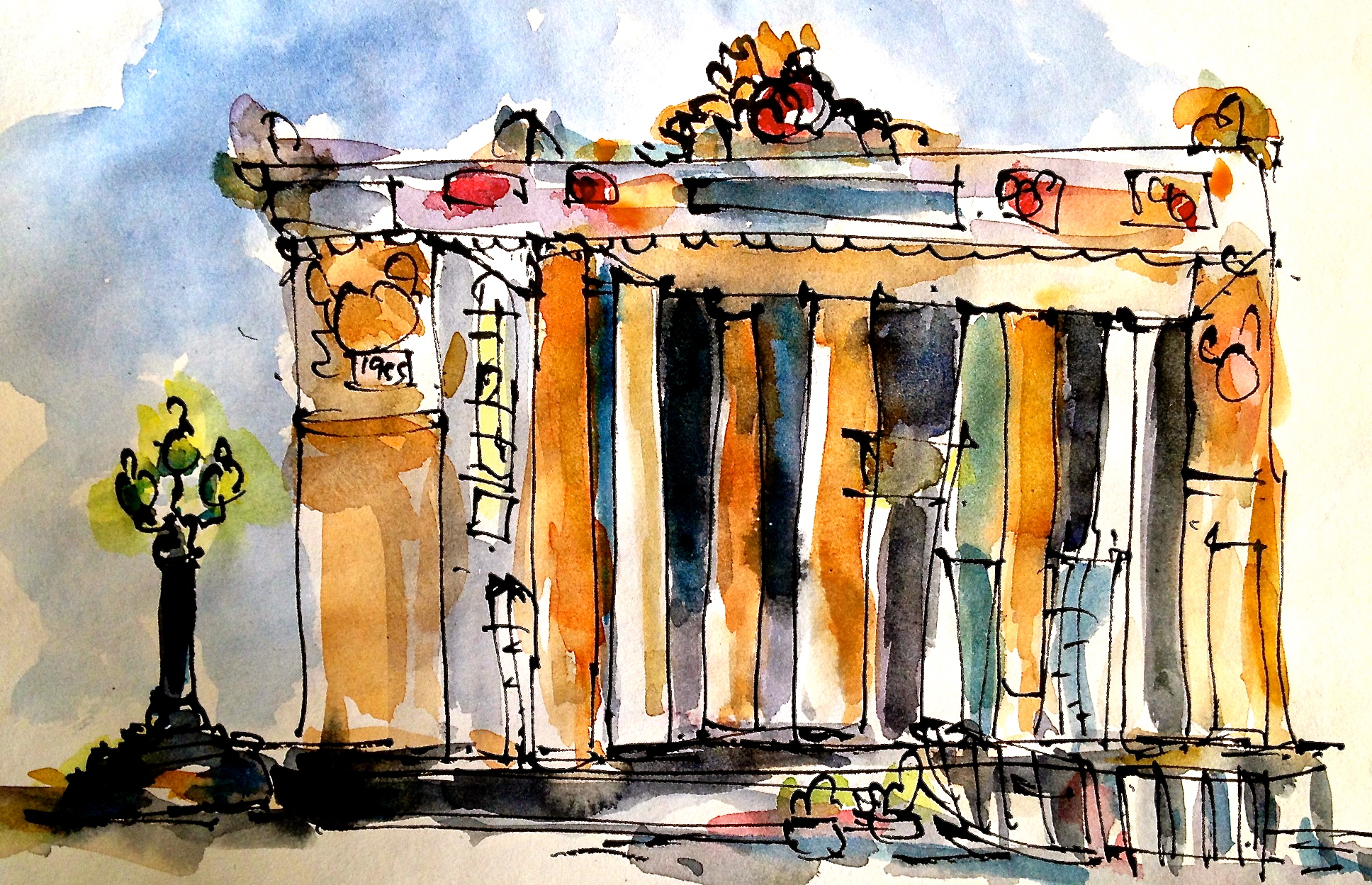
Instead of heading straight, we turn left to view a historic cultural jewel of the 19th century – the Bolshoi Theatre, that has been getting a lot of bad press lately post an acid attack earlier this year, on its ballet director by a hitman hired by one of its dancers. Scandalous inside job maybe, but on the outside, this eight colonnaded opera and ballet theatre with a bronze quadriga looks imposing and shines a golden-yellow in July’s afternoon sun. An expensive six-year overhaul has returned it to its Tsar era splendor. Perched on the wooden benches facing the fountain in front of the theatre, are scores of people, gazing at its majestic beauty. Many take photographs but it’s not easy to fit it in the viewfinder, unless you back up quite a bit.
Not even an hour old in Moscow and I am compelled to pull out my sketchbook.
The famous Bolshoi Theatre

The famous Bolshoi Theatre

Away from the Tverskaya, we keep walking left and cast a passing glance at the diagonally opposite –  luxurious Hotel Metropole and a little ahead, the Lubyanka Building , which served as the headquarters of KGB.

Soon enough, metro travel beckons because in Moscow if you do not want your legs to unscrew and fall off your body from the brutal walking, you will learn to love the underground. And at 30 roubles a ticket, it is quite the value for money considering their grandiose art gallery cum museum cum theatre like look and feel. Try exloring Mayakovskaya, Arbatskaya, Kievskaya, Ploshchad Revolyutsii amongst many others to change your image of subway stations forever.
After a near 2 min decent on the escalator ( as per my stopwatch) into the bosom of mother earth, expect to find yourself amid high arched ceilings, splendid chandeliers, bronze and marble statues, walls and ceilings embellished with exquisite bas reliefs, friezes, stained glass and mosaic paintings. Though station names are in Russian, navigating isn’t difficult as the lines are colour coded and the metro map has the English translation for every station’s name in cyrillic. If confused, just ask a local. They might not speak English, but are very happy to help. When things are lost in translation, good old sign language works like a charm.
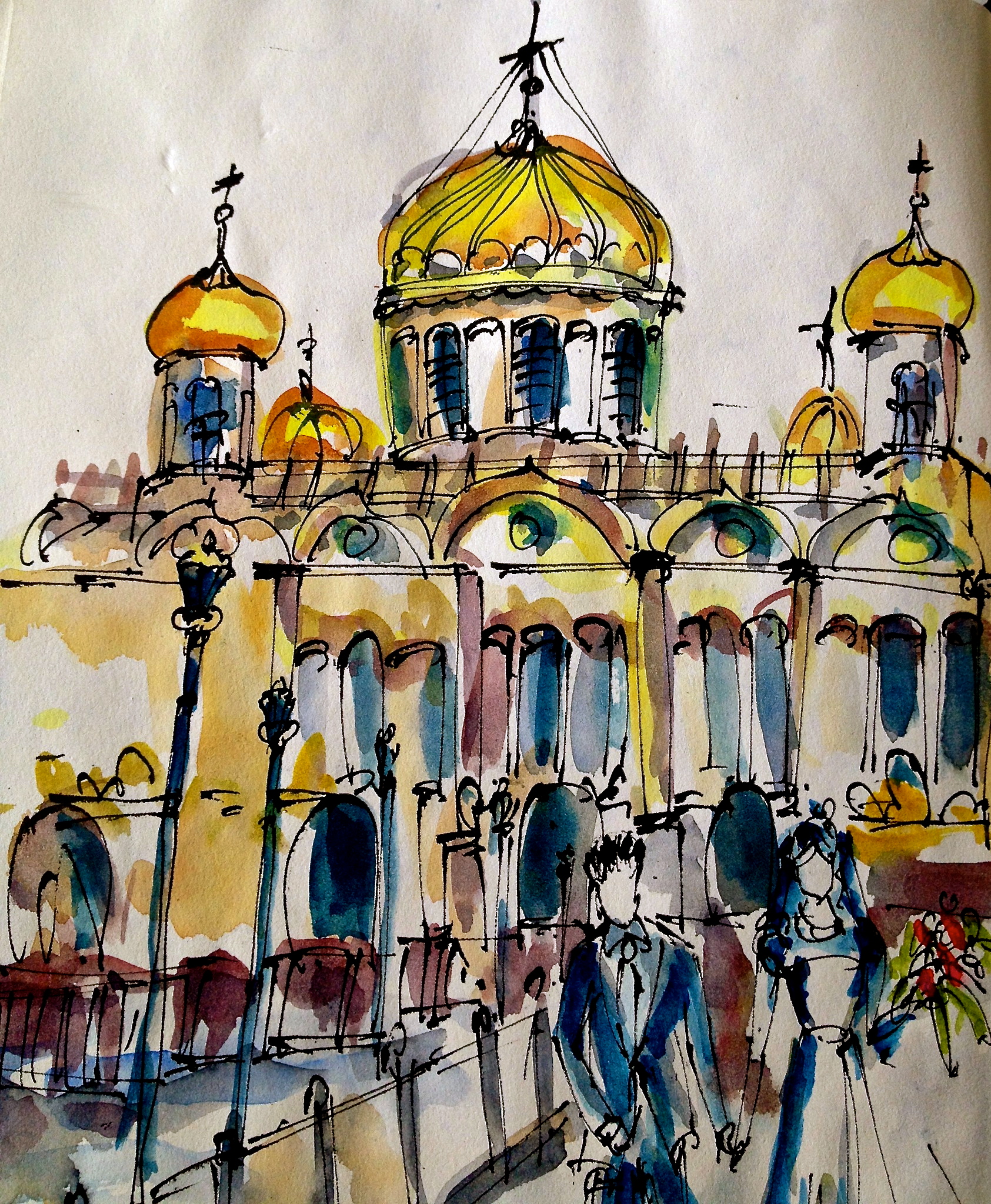
Wedding couples posing in front of Cathedral of Christ the Saviour

Wedding couples posing in front of Cathedral of Christ the Saviour

Taking the metro at ‘Lubyanka’, we emerge at ‘Kropotninskaya’ (3 stops on the Red line) and are instantly rewarded with the splendid view of Cathedral of Christ the Saviour, along the banks of Moskva river. Get one of those chocolate coated vanilla ice creams on stick – the summer totem of Moscow held and licked by every Russian in sight – to celebrate, because you’re now one among the 9 million commuters, who brave Moscow’s metros daily.

I murmur a hesitant ‘Dasvidaniya’ (Goodbye!) to the grim ice cream lady, while walking away and she flashes an iridescent smile – two gold teeth standing amid few rotten ones, glitter in the sun like the onion domes of the cathedral itself. A stretch limousines is parked on the kerb. The bride and the groom step out with flute shaped glasses in hand, toast with champagne and kiss blissfully.

We watch their merry-making and follow them inside the cathedral. If the interiors don’t hold your fancy for long, step out and head to the beautiful footbridge on the other side of the church and start walking away. The further you walk away, more irresistible it looks. Facing the cathedral, you can spot Kremlin on your right and the unmissable giant bronze statue of Peter the Great on your left. If the photographers hanging about the bridal couples and the endless tour groups spare you some space on the bridge, take a picture with the church in the background.
With such visual treats around, who has time for a sit down lunch. We settle for a snack sold by a babushka on the sidewalk. The spread of sandwiches, breads and puff pastries neatly laid out on the table may have been most delectable and the freshest, but if you ask me, it’s hard to choose when you’re clueless about the filling. I turn to the bearded local next to me and ask if he speaks English. “Oh! Yes”. “Can you ask her, what that one is?”. “But I don’t speak Russian”. He is from Berlin. Good to know. We buy our puff anyway. “Enjoy your surprise!” says the Berliner. Tuna and cheese filling was the surprise that we gobbled up before walking into the Tretyakov State Gallery, to enjoy Russian fine arts, including several masterpieces. If you’re fond of landscapes, don’t miss Isaak Levitan’s work.
 
 
Exiting the gallery, you hit Luzhkov bridge over the Vodootvodny Canal, beautiful and teeming

Locks of various shapes and sizes with sometimes names of the couple and dates engraved on them

Locks of various shapes and sizes with sometimes names of the couple and dates engraved on them

with bridal couples engaged in the de rigueur – sipping champagnes, kissing on cue, holding precarious poses for the photographer, flying white doves and fastening love padlocks with their names and vows inscribed. Countless locks in every imaginable colour, shape, sizes (some bigger than my head), hang from the iron trees that were built on the bridge for this very purpose.

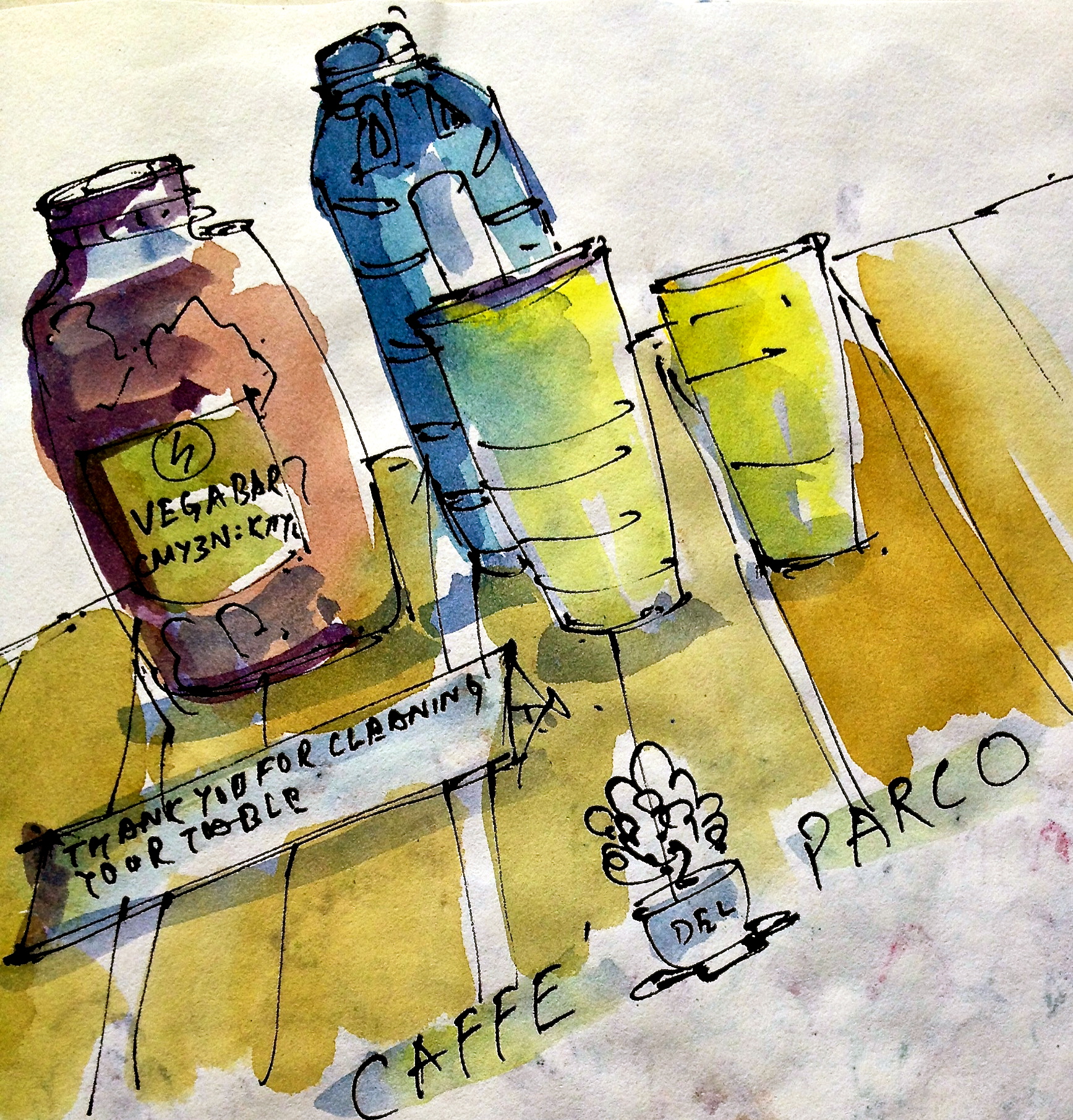
At 8 in the night, the sun doesn’t show any sign of descent. So, we head towards the nearby Gorky Park to unwind but instead make several pit stops in between because what seems right under your nose on the map is actually quite a distance away. Cafe Parco serves us the last item left on their menu – fresh banana and strawberry smoothie in sealed plastic bottles.
Resting our tired legs at Cafe Parco

Sitting on garden chairs and resting our tired legs at Cafe Parco while their music band is getting ready to play.

Nothing under the Moscow banner is ordinary or average in its dimension or architectural style – is the wisdom gained at the end of day one. Standing in front of the massive gate of Gorky park, once again we feel puny, ant-like, inconsequential.
Couldn't resist a 5 min sketch of this imposing gate to enter Gorky Park. isn't it just a park?

Couldn’t resist a 5 min sketch of this imposing gate to enter Gorky Park

Gorky Park

Gorky Park

But the atmosphere is electric. Loud, thumping music is gushing out of a concert in progress. Hundreds of people of all ages are engaged in every kind of sport/recreational activity in this 300 acre park, either playing table tennis, badminton, or riding Segway, rollerblading, bicycling, throwing frisbee, rowing in the lake or just sunbathing.

Children in prams are licking lurid pink cotton candies while their parents are lining up at the ice cream or hotdog counter. The smell of hot corn on the cob slathered with butter and salt gets me brisk walking towards the stall in a blink. Couples and families are lounging on communal bean bags under enormous trees. And right at the center, is a grand musical fountain that’s spraying water to the beats of an orchestra. The sun isn’t going anywhere and Moscow seems golden through my tinted sunglasses.
How do you tear away from all this? We do because, just across Gorky Park, on the other side

Church of St. Nicholas of the Weavers

Church of St. Nicholas of the Weavers

of the river, sits another magnificent church that supposedly rivals St. Basil’s on Red Square in its beauty. Church of St. Nicholas of the Weavers , a late 17th century parish church for a weavers settlement, is a stunner all right with its onion domes and a tented bell tower, but we arrive when the evening service has ended and the church is about to close.

The orthodox priests in somber black cassocks are conferring on the church grounds, women are quickly removing their headscarves and leaving and families are bidding goodbye to each other. I cover my head and manage a quick peek inside the church and a hurried sketch before being ushered out.
Just outside, a signboard says, Leo Tolstoy’s house turned museum is only 400 meters away but we resist the temptation and reward ourselves instead with these juicy chicken shashlik for dinner.
Chicken Shashlik with salad and a truckload of dill

Chicken Shashlik with salad and a truckload of dill

Behind the scenes at a Teochew Opera

“Look, the philosopher is picking his nose again! Make sure you get that in your sketchbook!”, a giggling deity instructs me from her chair, putting down the newspaper she’d been reading. The entire room bursts into laughter.
My timing isn’t perfect though. When I look up, the philosopher has paused his excavation (or perhaps found gold) and gives me a sheepish look. Different people seek different means to calm their nerves before appearing on stage, so I quickly dismiss his antic as a means of personal solace and avert my eyes.
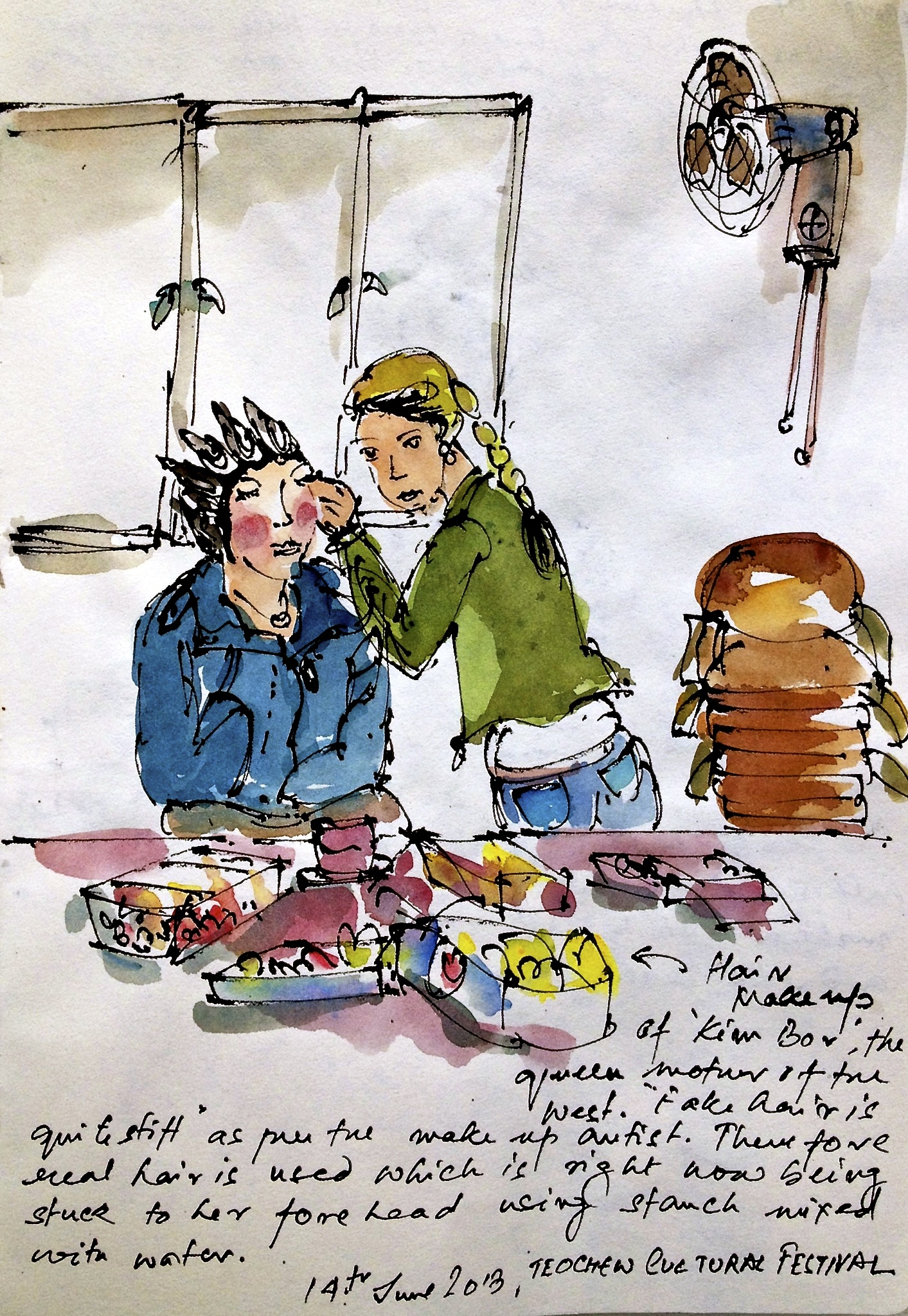
Since 3 in the afternoon, I am at the backstage, observing and recording the hair and make up process of a group of Teochew Opera performers in my sketchbook. In a span of six hours I have watched these 21st century men and women metamorphose bit by bit into ancient Chinese officials, philosophers, scholars, lovers, courtesans and further back in time, into celestial beings such as deities of wealth, success, longevity and such.
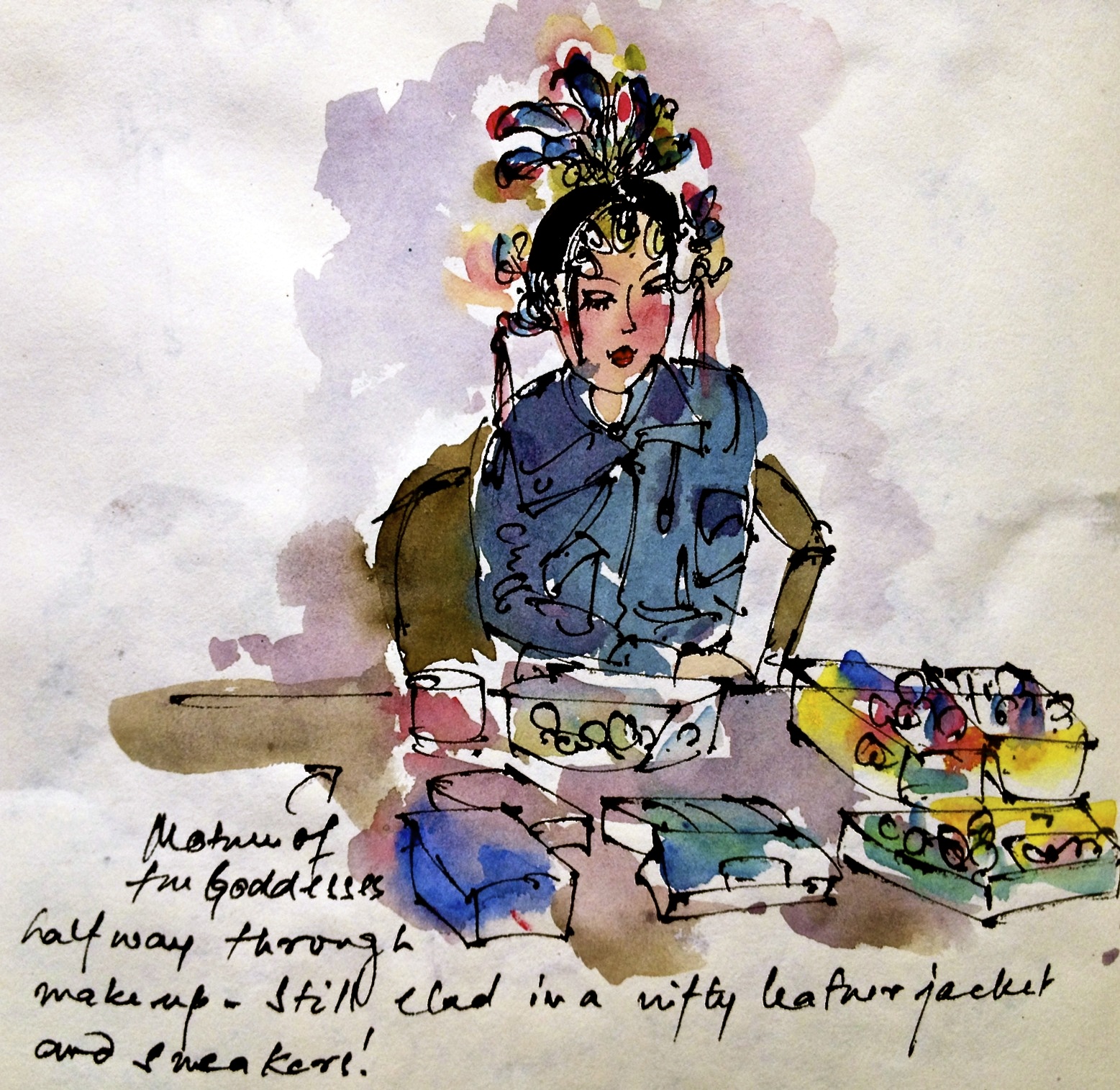
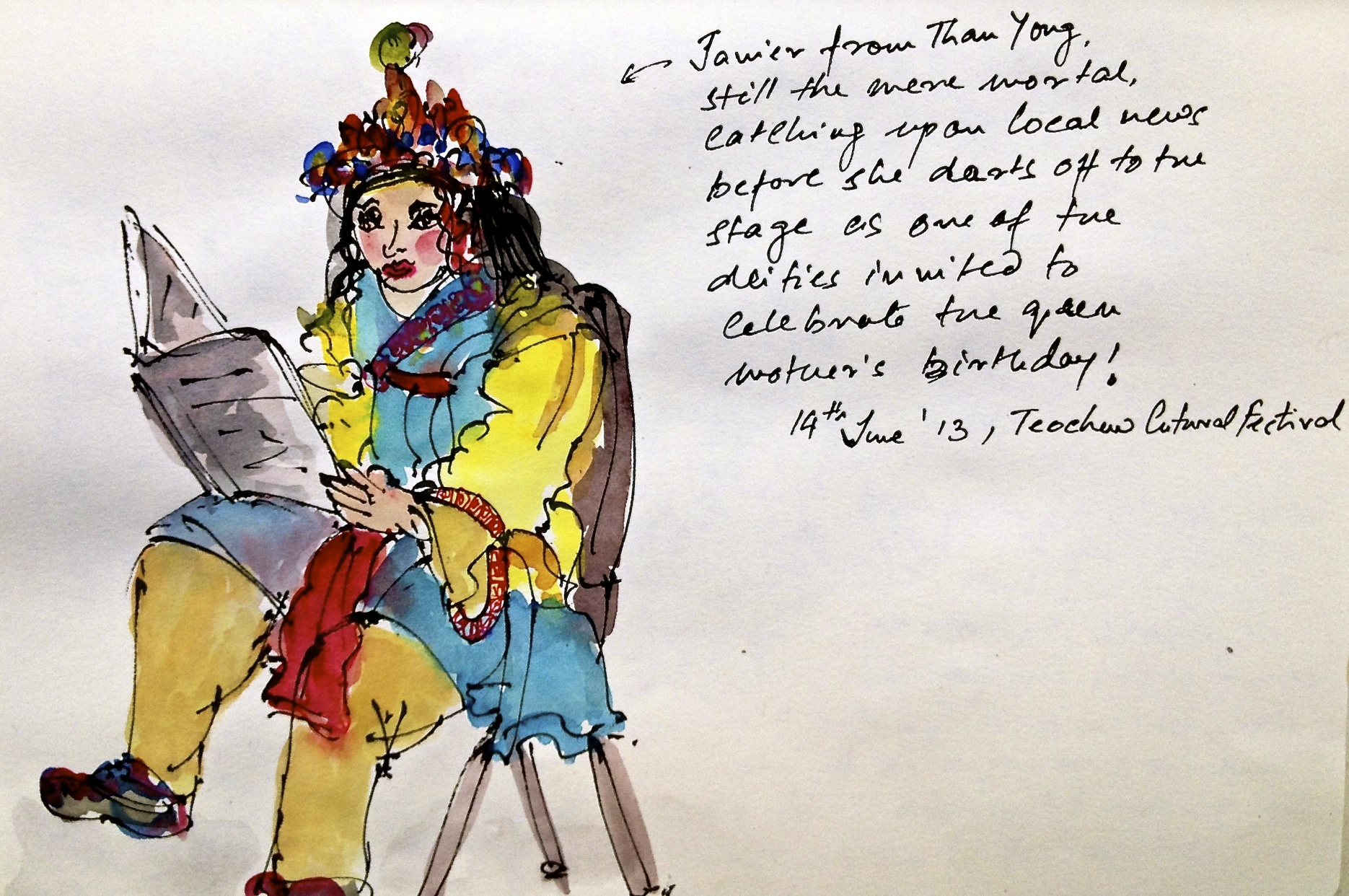
I had arrived to a room full of opera performers scattered at various make up stations. Javier, one of the performers who’d invited me backstage was poised motionless on a chair, while her face was being powdered and eyes shaded with a black pencil. Still clad in pyjamas and sneakers, she was a deity in the making, who’d soon be summoned by Kim Bor – the ‘queen mother of the west’ to celebrate her birthday on stage.
Javier will be playing a deity in the play "A Celestial Birthday"

Javier will be acting as a deity in the play “A Celestial Birthday”

 While Javier was getting ready for Kim Bor’s party, five feet away the queen mother herself was having her hair done. Two hairstylists were folding a bunch of hair strands and sticking them on the birthday girl’s forehead in a semicircle using starch and water. ” It will last for a day, but if I had to make it last longer, I’d mix starch with vinegar. Doesn’t stink and lasts for three days!” said one of the hairstylists expelling her trade secret to me.
I don’t ask her why it needs to last for three days. Do celestial birthdays last that long?
“Also the hair we’re using here is real because false hair is too stiff”, explains another, when she catches me gaping at her make up paraphernalia that has taken up an entire table. Hair of all shapes, sizes and designs from fringes to buns to braids; crowns with exquisite stone settings, necklaces, hairpins, clips, hair bands, hair nets amongst many others lay in neat compartments inside transparent plastic boxes. Four opera groups that are performing today at the ongoing Teochew Cultural Festival, are keeping them on their toes.
Before the performance, I meet with Mr. Lim Chunheng, the events manager to know more about the Teochew people, their culture and more precisely about their opera. Mr Lim starts by pointing out Chaoshan province on the map of China, from where the Teochew people originated, carrying their language, culture and tradition to all the places they emigrated to.
Talking of the Teochew Opera which is a genre of the Chinese opera performed in the Teochew dialect, Mr. Lim says, “This 450 year old art form is beautiful, unique and worth preserving.”
The Teochew Opera was greatly influenced by Nan Xi, an early form of Chinese drama that can be traced back to the Song dynasty in the 12th century AD. Over the years, by integrating Teochew folk music coupled with the unique intonation of the Teochew dialect, Teochew opera evolved as a distinctive art form. Mr. Lim tells me, of the seven characters, the Dan (female) and Chou (clown) roles are the most artistic and well defined in Teochew opera. And the stories evolve around the themes of love, family and ethical relationships.
Kim Bor - The queen mother is getting her hair done

Kim Bor – The queen mother is getting her hair done

“Teochew Opera involves stylised body movements, facial expressions, vocal modulations and many other subtleties that takes time to master”, says Mr. Lim. “Youngsters these days don’t want to put in that much effort in learning an art form. So through cultural festivals like these, we want to create interest and awareness in them about their own heritage.” he adds.

Another deterrent responsible for the dwindling popularity of the Teochew Opera, as Mr. Lim points out, is the Teochew dialect. Though Teochew remains the ancestral language of many Chinese in Singapore, Mandarin is slowly replacing Teochew as their mother tongue, especially among the young population.
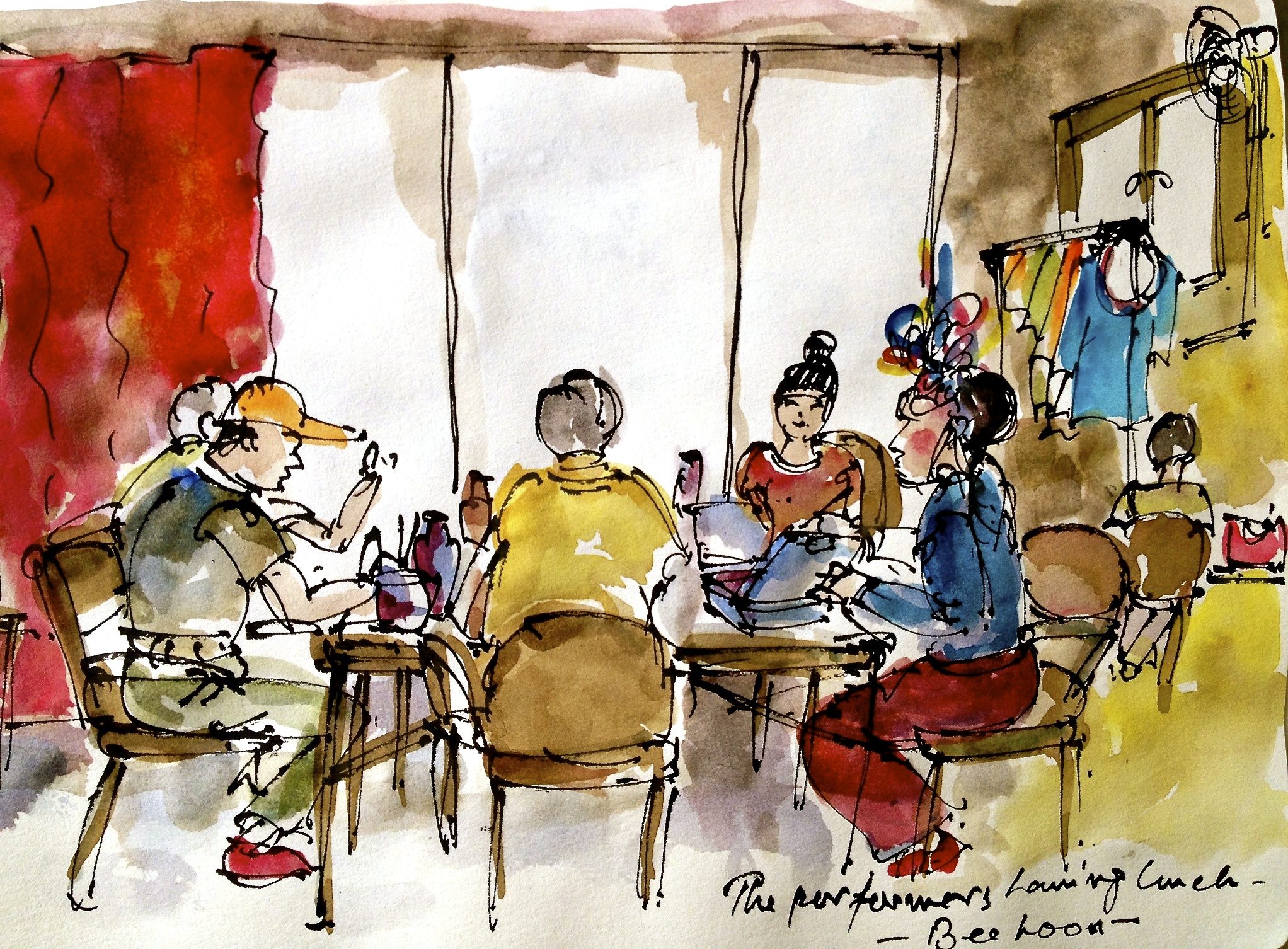
The performers having 'Bee Hoon' for lunch

The performers having ‘Bee Hoon’ for lunch

At the backstage, everything comes to a temporary halt, when lunch arrives in takeaway boxes. Performers, volunteers, makeup artists gather around and fill up on Bee Hoon. The queen mother extracts herself from the hairstylists and joins the group. In the next few hours, tiny microphones are distributed to the performers to be attached to their bodies, flamboyant costumes in the most elegant colours with matching shoes are donned, headgears from small to large, simple to the most exquisite adorn the heads.
One of the deities approaches the hairstylist, holding her head in pain. “Too tight, the headgead’s too tight!”  This headgear like many has two tiny holes on either side and comes with a matching pin as long as a chopstick that is passed from one end to another, through the hair bound in a bun, and wound a couple of times like a screwdriver, till the headgear fits the head snugly. The hairstylist fiddles with the screw and fixes the problem.
Javier catching up on local new before the performance

Javier from Thau Yong Amateur Musical Association, Singapore

As the deadline approaches, performers are getting themselves in the zone.
The queen mother and the scholar’s wife are pacing up and down the room in their flowing costumes; the deities are shaking their heads to check the fit of their headgear or humming quietly with their eyes closed; Javier is reading a newspaper and the scholar is relaxing his vocal chords by breaking into high pitched songs.
The philosopher is digging his nose, but I am not judging.
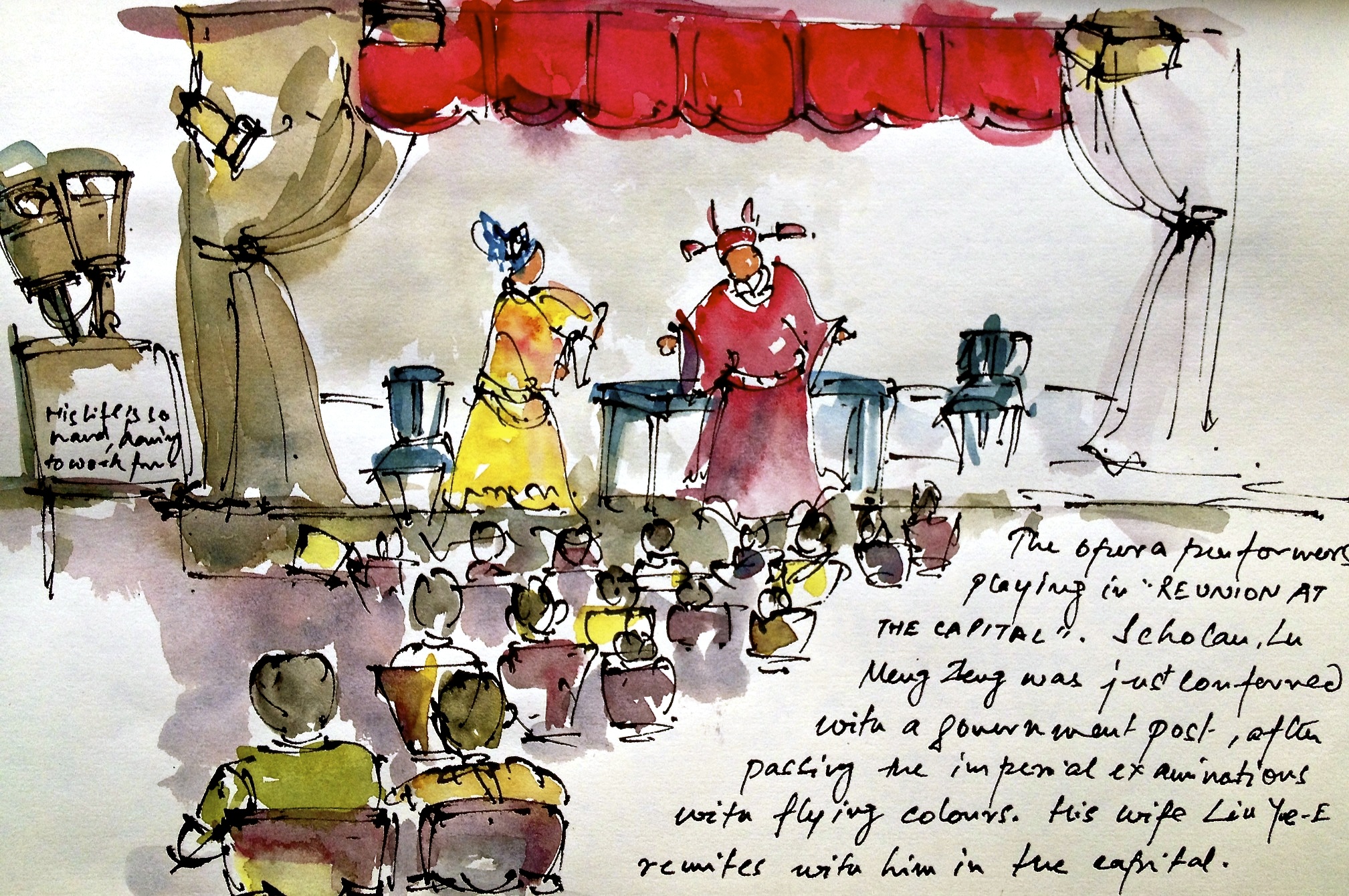
The scholar and his wife perfom in "Reunion at the capital"

The scholar and his wife perfom in “Reunion at the capital”

Have you met MOLLY?

I don’t know how I missed her but I did. Hurrying home from a writing workshop on the other side of the town, there were only two things that occupied my mind at that hour – a satisfying lunch and an even more satisfying nap. Eyes peeled on the road for shady spots and corners to walk by in the blazing afternoon sun, I passed her like a galloping horse with blinkers, till a gang of kids hailing MOLLY’s name in chorus, brushed past me.

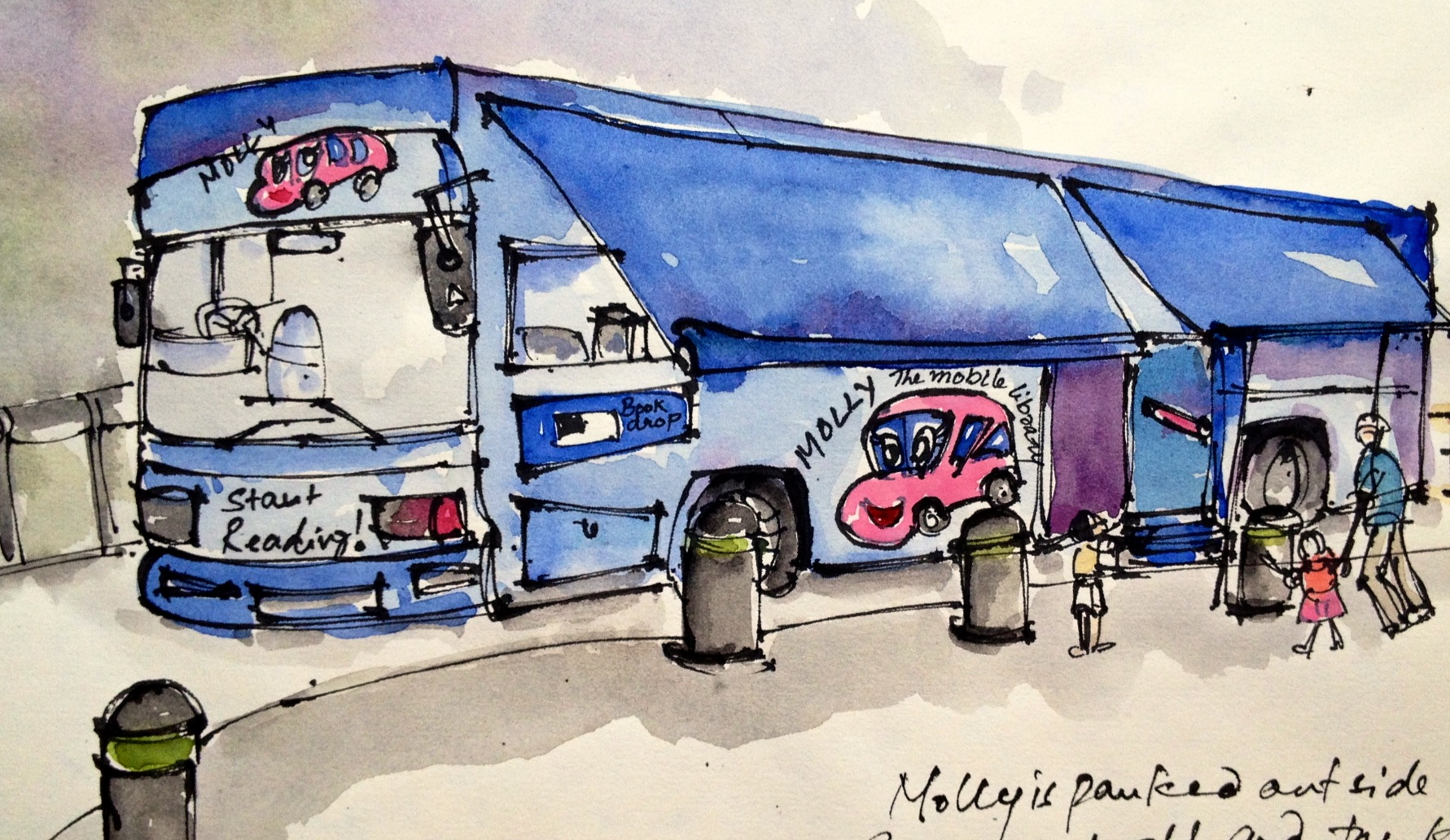
MOLLY parked at United Square Mall

MOLLY parked outside United Square Mall

Turning around, I looked straight into the big fluttering eyes of MOLLY, Singapore’s only mobile library. A refurbished public transport bus with imposing body stats – 11 meters in length, 2.2 meters in width, 2.1 meters in height and 16 tonnes in weight, MOLLY makes quite a statement on the road. Sporting an attractive decal of vibrant blue with animated characters, tiny trees and fluffy clouds drawn across her body, Molly’s visitor profile isn’t worth a guess either.

Parked along the kerb, in front of our neighbourhood mall, the bus’s door is wide open and the retractable awnings are drawn. Molly is open for business and the little ones are pouring in. Some are even returning books at the nifty ‘book-drop’ unit fitted below the bus’s window.

Inside the mobile library

The bus was retrofitted with shelves, airconditioner, generator, electronic borrowing units and such

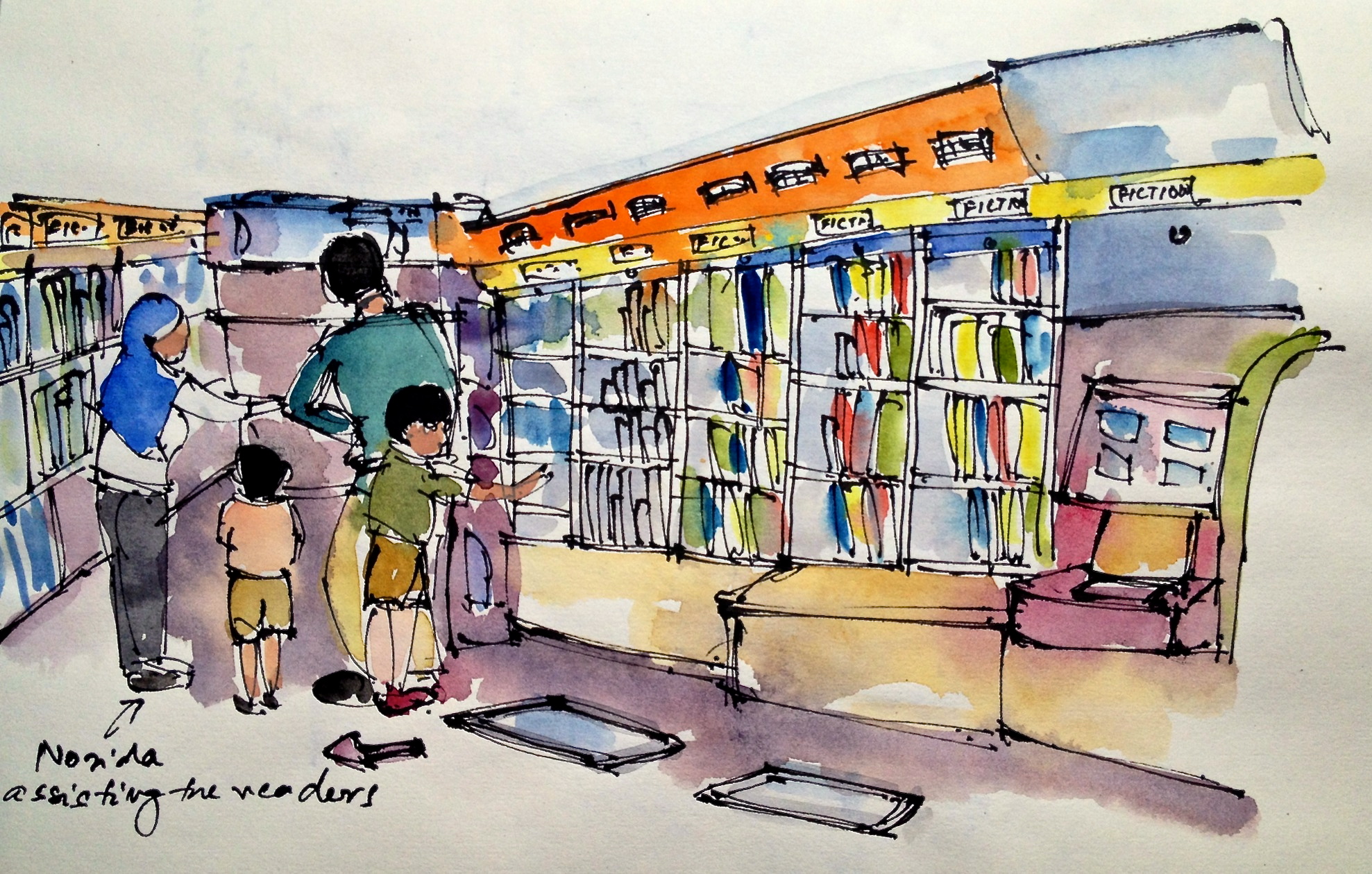
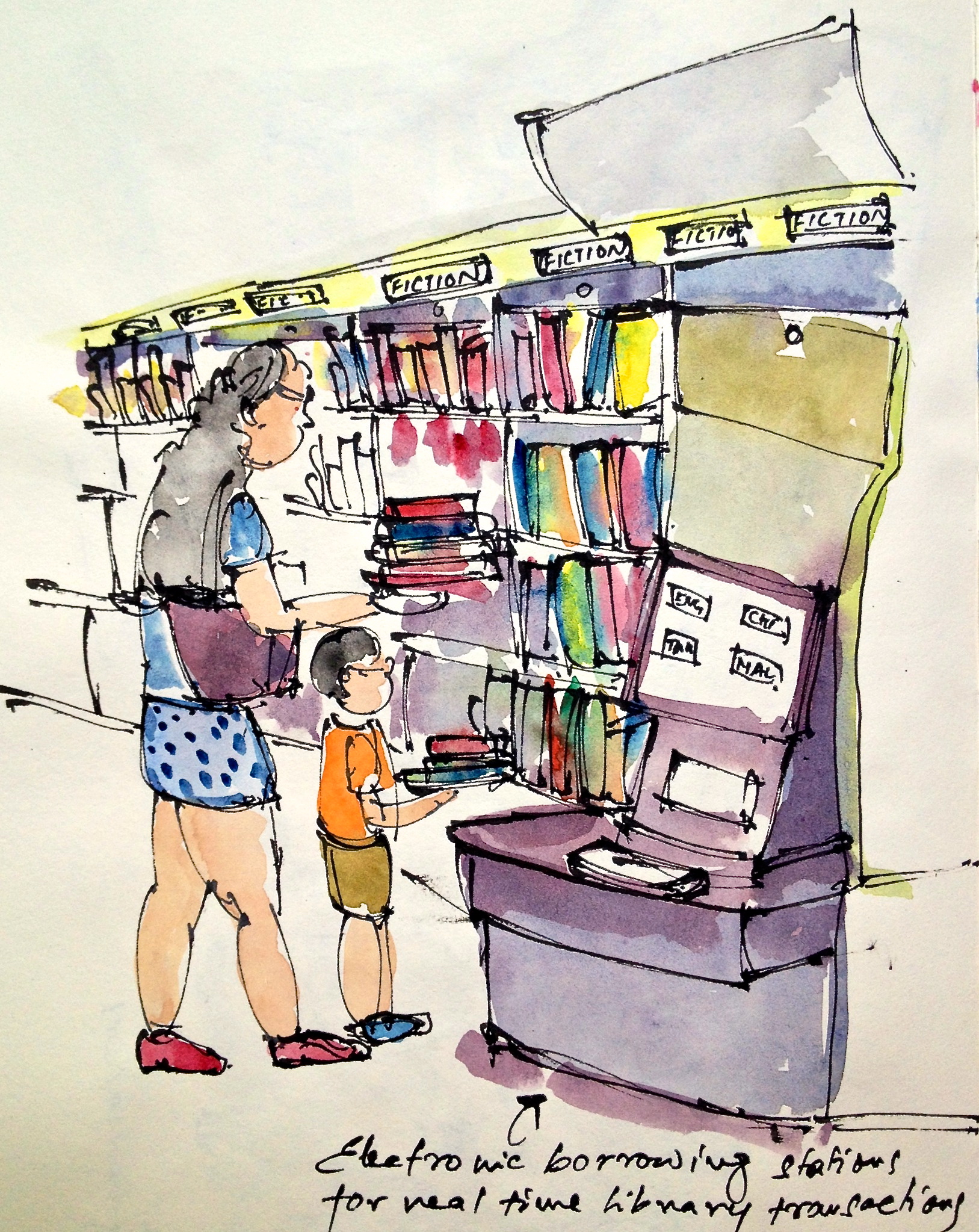
Sandwiched between the eager little readers, I squeeze myself through the door. Housed in a bus it may be, but it’s a library all right. Neat shelves on either side hold about 3000 books, that are grouped by age and labelled as per genre. An electronic book borrowing unit is stationed at the rear end of the bus, where a uniformed library assistant is familiarizing children with the borrowing process and encouraging the curious first timers on board to register themselves as library members.
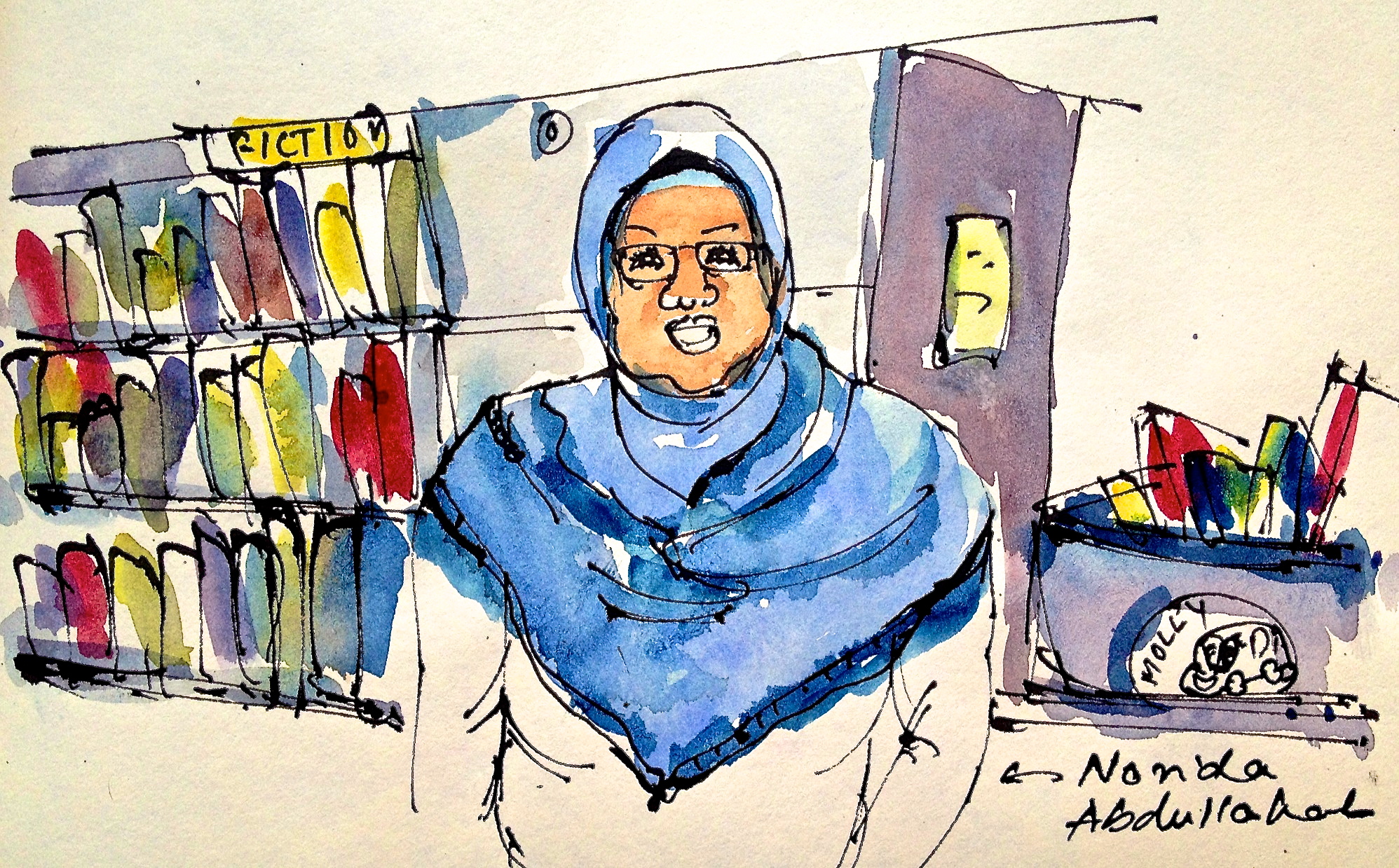
I am the last person in the queue, and with the same tenderness that she was showing the children, this 50 plus years old library assistant Norida Abdullahab, helps me not only borrow the books but renew them as well. ‘So you can use these for an extended period.’ she says, flashing a reassuring smile.

Norida Abdullahab

When I asked Norida’s permission to sketch her, she gave me the cutest expression

Though the passage inbetween the shelves is narrow, the interior is well furnished. Good lighting and air-conditioning make for comfortable browsing and reading . Needless to say, the kids are having a ball.  Some are sitting on their haunches, pulling out one book after another and sifting through them, while others are slouched on the floor, reading meditatively. The shorter ones are begging their mums and dads to be picked up, so they can reach a higher shelf.

“How about Emperor’s new clothes?”, suggests a mother. Or “City mouse and country mouse? That sounds interesting!”, coaxes another, whose girls are sitting around a pile of fairytales. It’s harder than it looks to convince their little minds.

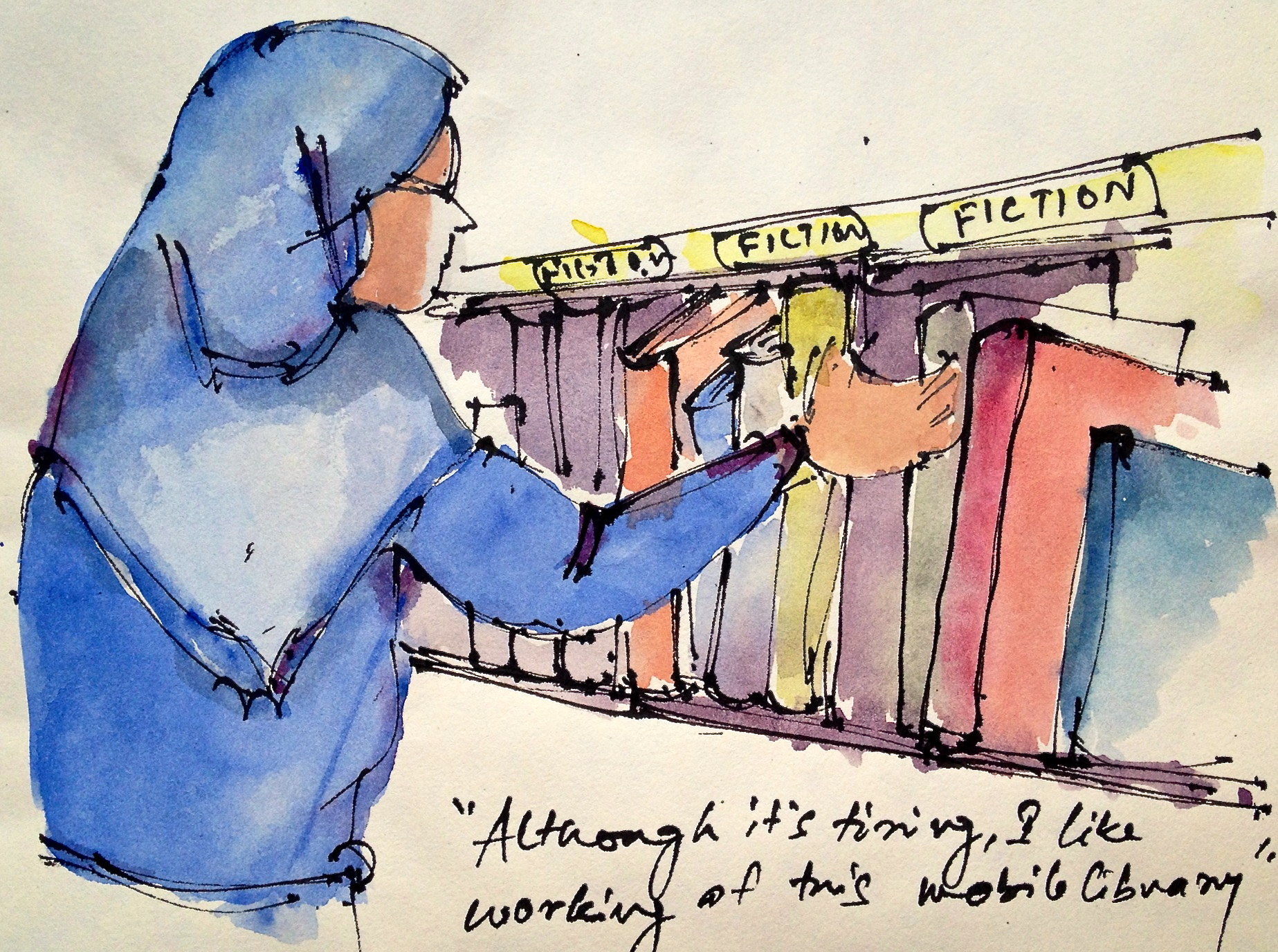
'Although it's tiring, I love working at this mobile library'

‘Although it’s tiring, I like working at this mobile library’

Norida is picking up the books from the floor and putting them back on the shelves. “Although tiring, I like working at this mobile library.’ she says. MOLLY has been her workplace for the last seven months. “I have worked at the National Library for 16 years and only recently did I request for a transfer” she adds.

The mobile library has two teams with 3 members each –  two library assistants and a group leader – visiting various locations on the island. Norida points out the printed schedules on the wall, with names of 8 locations each, to be covered on the following Saturdays and Sundays.

“Every second Saturday of the month, we visit these public venues. But that’s not our main job.” she says. On weekdays, throughout the year, MOLLY visits schools for the underprivileged. “Like schools for children with intellectual and physical disabilities, autistic children, deaf and dumb children, children with down’s syndrome to name a few.” explains Norida. “Since they can’t come to us, we go to them.”

I learn from her that, MOLLY is a 5 year old endeavour of the National Library Board of Singapore to make library services more inclusive and accessible to all, especially the undeserved community, so they too can discover the joys of reading.

Looking at the gleeful children lined at the borrowing station balancing piles of books, waiting for their turn, I feel comforted and happy thinking whether privileged or otherwise, this outreach activity of simply promoting the use of a public library at this tender age, so they become active users in the long run and use public libraries as a part of their lifelong learning journey, bears more value today than ever, specially in the context of kids growing up in a digital age with no dearth of multimedia at their disposal.

Electronic borrowing stations inside the mobile library

Children are familiarized with the electronic borrowing stations inside the mobile library

A mother asks Norida to help her locate books for children at level 3. “Boy or a girl?” she asks, springing right into action. ‘Girl’. “Well, then she might like these.”, says the library assistant, handing her few carefully selected options. Norida not only has sound knowledge of the library’s collection but she also provides customised recommendation to every reader requesting her assistance.

Turning back to me, she says, “I love my job at the library, but I always wanted to go out and make a difference, instead of being stationed at one place.” Reaching books to those with limited or no access to a library on a mobile bus, has fulfilled both her wishes. This is the reason she voluntarily requested for a transfer, after a decade and a half of service at a public library.

‘I love bonding with children, you know. I am also a grandmother of three.”

People watching and more coffee chronicles

Working as a freelancer from the confines of ones home isn’t as palatable as the images it may conjure. Besides a disciplined work environment – which needs to be strictly self imposed by freelancers – you miss out on the day to day office camaraderie, the human connection, the collective sense of belonging to a place.

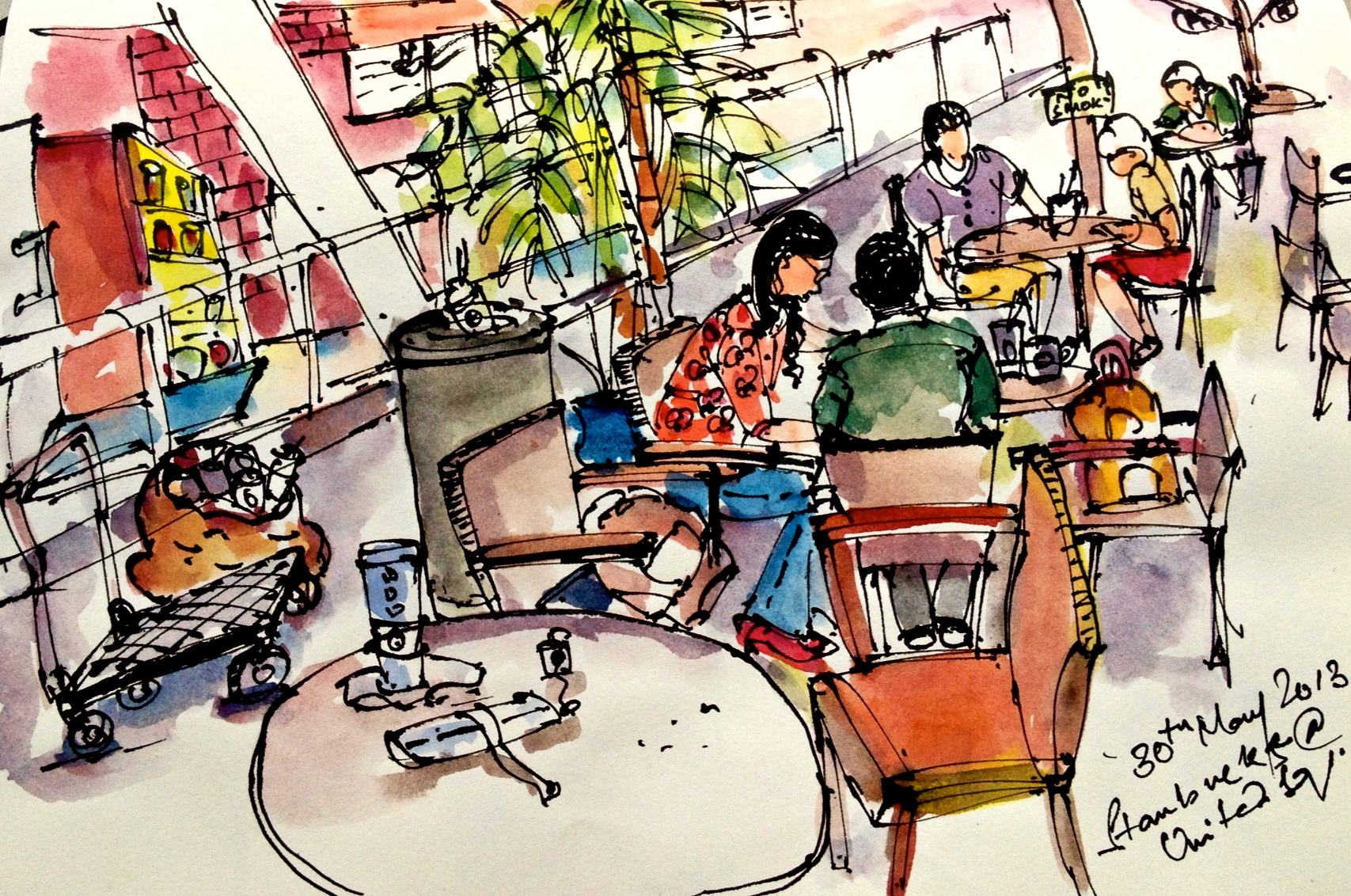
A starbucks outlet

While not contesting on the shade of the grass on either side, when I find the scales tipping in other’s favour i.e  when I start feeling cooped up and lonely, I simply carry my work, 5 mins from my house, to the nearest coffee shop, where I get people to sit around me while minding their own business, listen to pleasant music and have access to air-conditioning, wifi and plug points.

To my surprise and delight, there is no dearth of the like minded, so much so that between 9 to 5, it is hard to find a place.

There are official meetings presided by dapper looking men and women over cappuccino and cookies. And these madams and sirs care to perch their prissy bottoms only on the plush leather sofas with handrest (also the most coveted in the entire cafe) by the windows with the lovely view. If this coincides your entry, it pays to linger around, as they usually leave as soon as they finish their drink or their talking.

School kids working on their assignments

School kids working on their assignments

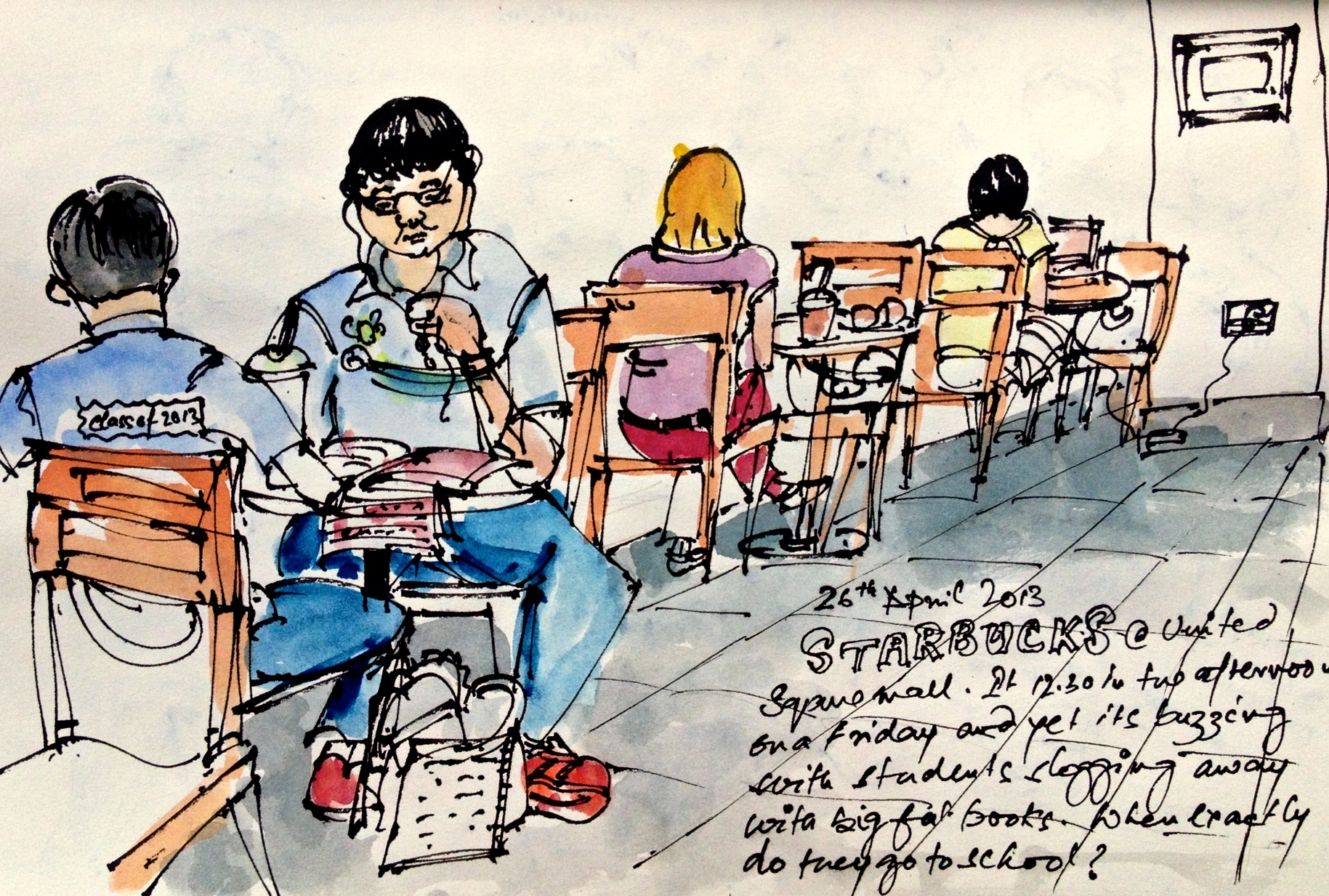
But the same theory is redundant when it comes to the cafe’s biggest headcount – the scraggy school kids finishing assignments over a glass of plain water and maybe, just maybe a tall sized green tea frappe that was finished eons ago and has the frothy bits left at the bottom. Now, they cost the cafe, the entire upper and lower deck with high stools and convenient plug points.

And they also kind of live here, only getting up for toilet and food breaks (which is usually a packet of chips).  While away which sometimes is for an hour, their personal laptops in dayglo covers, scribbled notebooks, stationaries, chargers, headphones, snacks, wet wipes and sweatshirts scattered on the table will stand sentry. Yes, it’s Singapore, nothing gets stolen but avoid this zone like plague, if you wish to be seated in this lifetime.

More students

More students

Then there are the moms. All kinds of moms. The ones feeding chocolate fudge cake to their  primary schoolers sitting upright (only at the behest of mommy), and doing their home works; and the ones with toddlers learning to use cutlery and making a gruesome mess by repeatedly stabbing the delicate chicken puff, while their eyes are peeled on the iPad; and lastly the pregnant ones with a wailing brat in tow, struggling to get a heaving stroller (from the weight of groceries) inside the cafe door with one hand and shoving the pacifier into the child’s mouth with another .

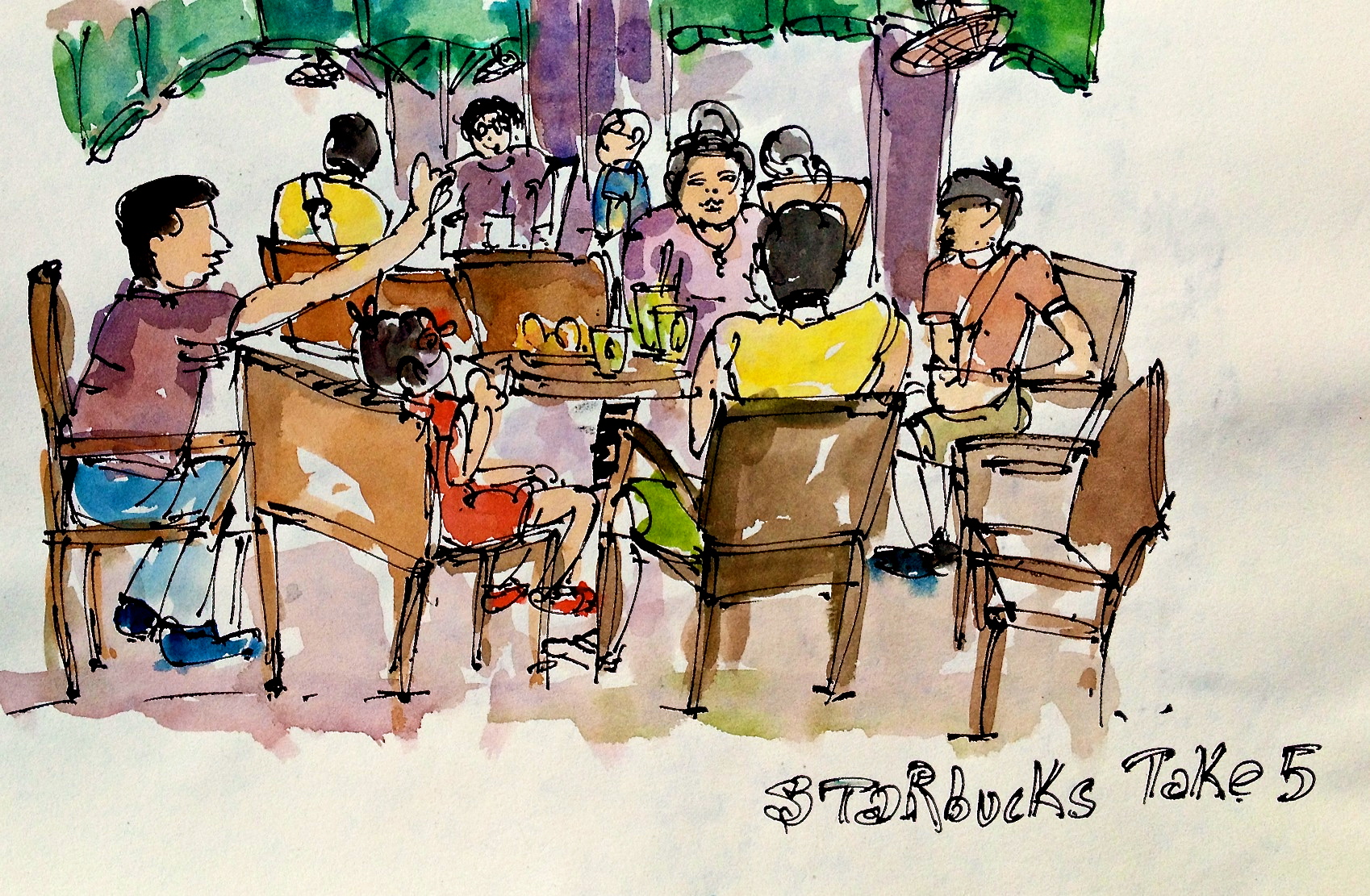
Al fresco seating at the cafe

Al fresco seating at the cafe

Moms populate the cafe’s alfresco seating so their kids can run around and chase pigeons, when they can tear away from their wondrous gadgets. If you’ve been around for a while like me, you’ll know – smaller the kid, battier is the mother, and the fidgety she gets, higher is the probability of finding a seat. So hover like a bee over a bed of flowers. Your luck might just turn.
The rest belong to the mixed bag, where taking your chances could be be a bit hit and miss. Like the older school kids in uniforms caught in between school and private tuitions or college goers, congregation of elderly people or maids on their off days. They could leave in an hour or lounge for half a day. I’d play it by the ear.

Possibly a fashion designer

Possibly a fashion designer

But if you are desperate for a seat and nothing else has been working, you might want to sneak up on those sitting all by themselves – alone with their coffee and reading a book/newspaper or updating their blog or looking at Google maps. Most of the time, they get bored with themselves too easily and leave. Jump right in.

Saving the best for the last because you spot this kind only if you are alert and have been paying attention – the kind that rolls in, does their business and leaves. Pin your hopes on anybody without a laptop. Or without a smartphone, but that’s asking too much in Singapore.
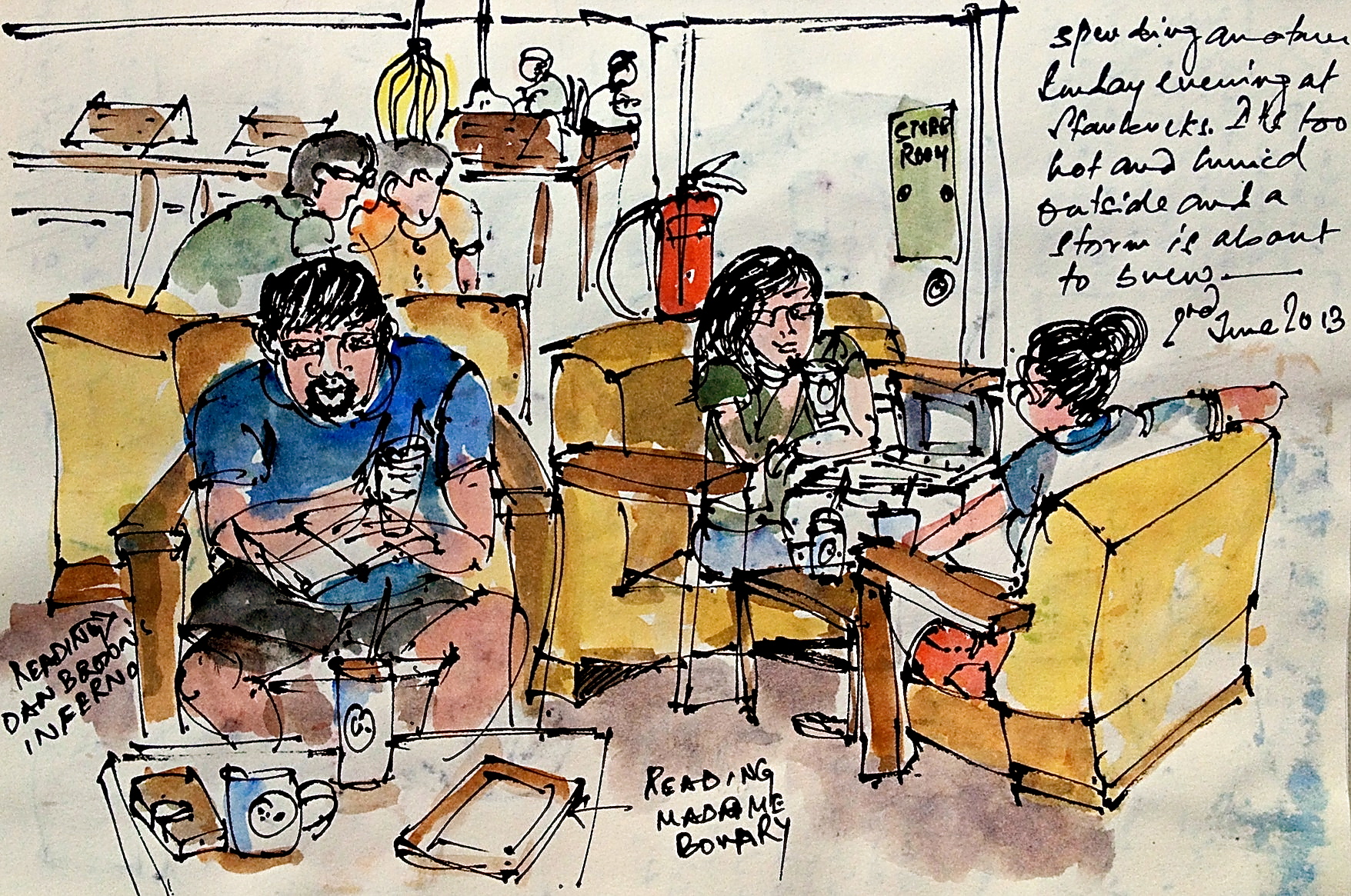
An evening at Starucks

An evening at Starbucks

Watch out for people with big shopping bags, or those with dogs, or those taking quick interviews ( I’ve been witness to many job interviews over coffee – lasts as long as the drink), making a hurried presentation, mulling over houses with property agents or bickering like the two local film producers I came across, trying to prove whose job sucked more. I could swear, their heated debate rose to a crescendo but cut out as soon as the last drop of coffee trickled down their throat. After which they left and I moved in.

It is within this group that, if you are lucky, you get a seat that isn’t already choped – a typical Singaporean phenomenon of reserving seats by placing a harmless tissue or hasn’t been pooped upon by one of the three notorious pigeons that pick at the leftovers.

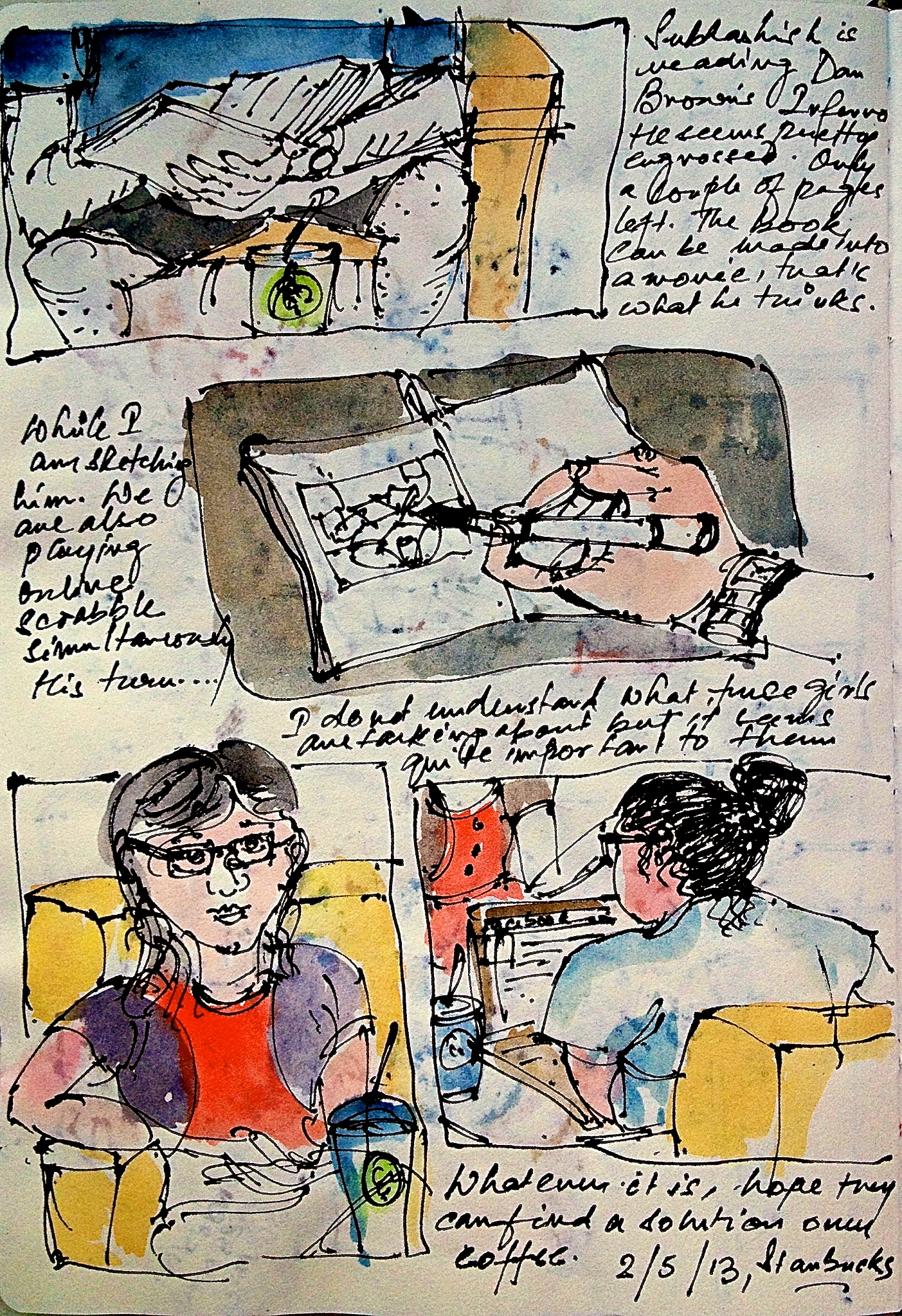
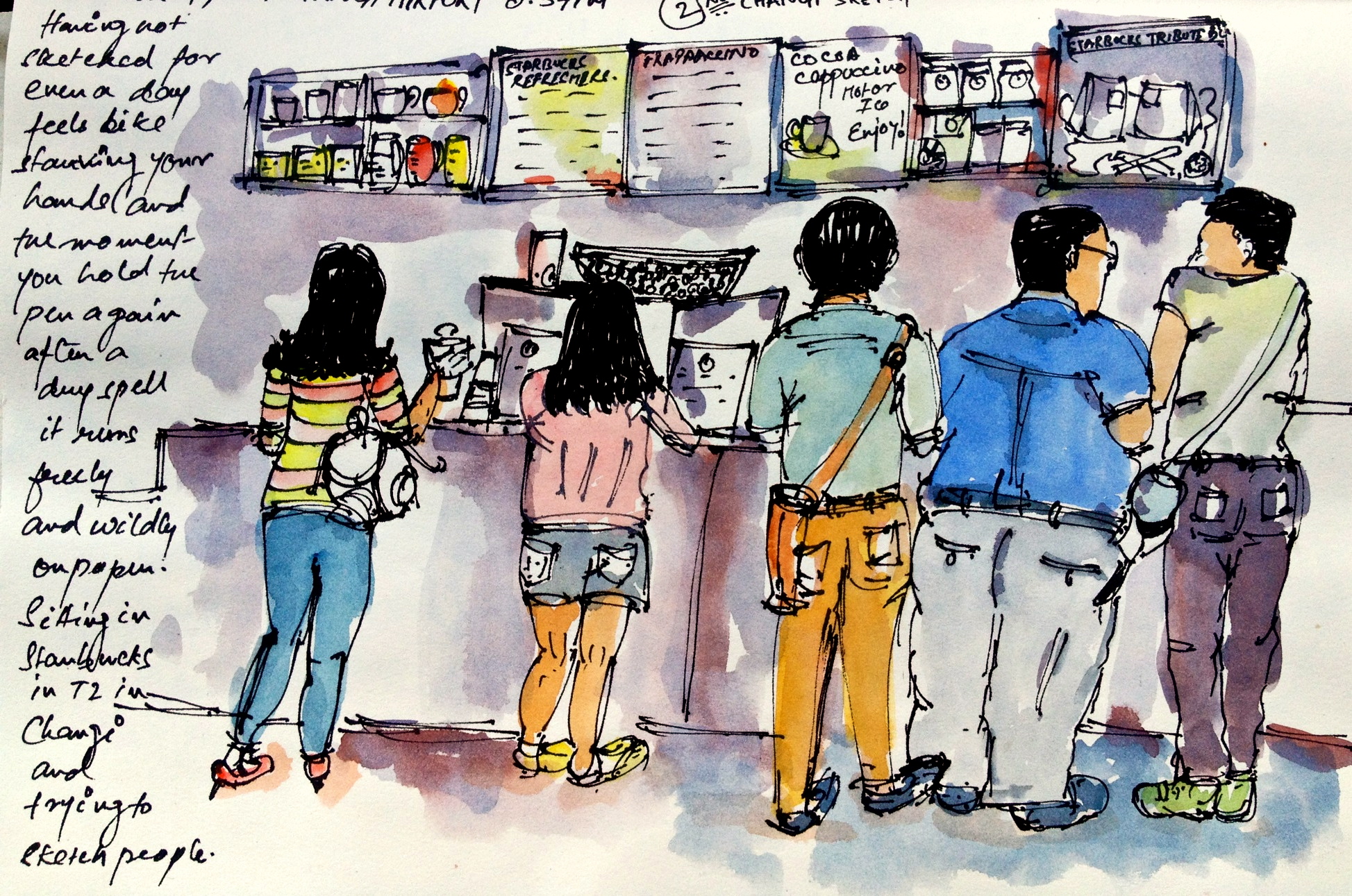
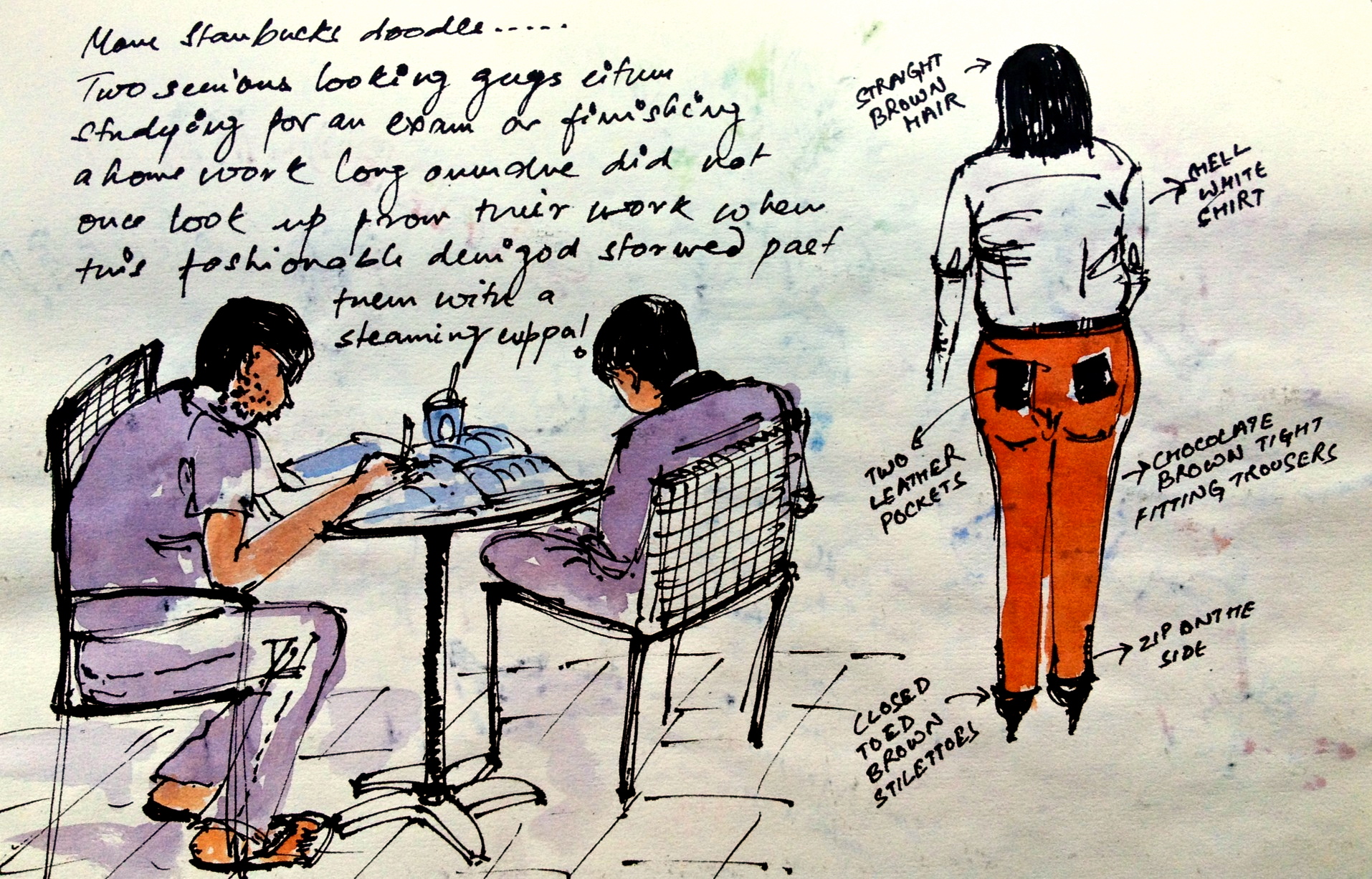
I have honed my seat grabbing skills over three years of Starbucks patronage at my neighbouring outlet where I’ve worked, planned vacations, played scrabble, finished several tomes and drank gallons of coffee and tea. And only recently, have I started sketching and it isn’t surprising that in my 90 page sketchbook, which I finished recently, there are more than twenty sketches done at this location of the same individuals, groups and clusters I talk about. I observed them only because I sketched them.
This is why I accompany my stories with hand
drawn sketches instead of photographs. More than any other medium, sketching requires complete immersion of senses, gets you to pay attention and slow down.
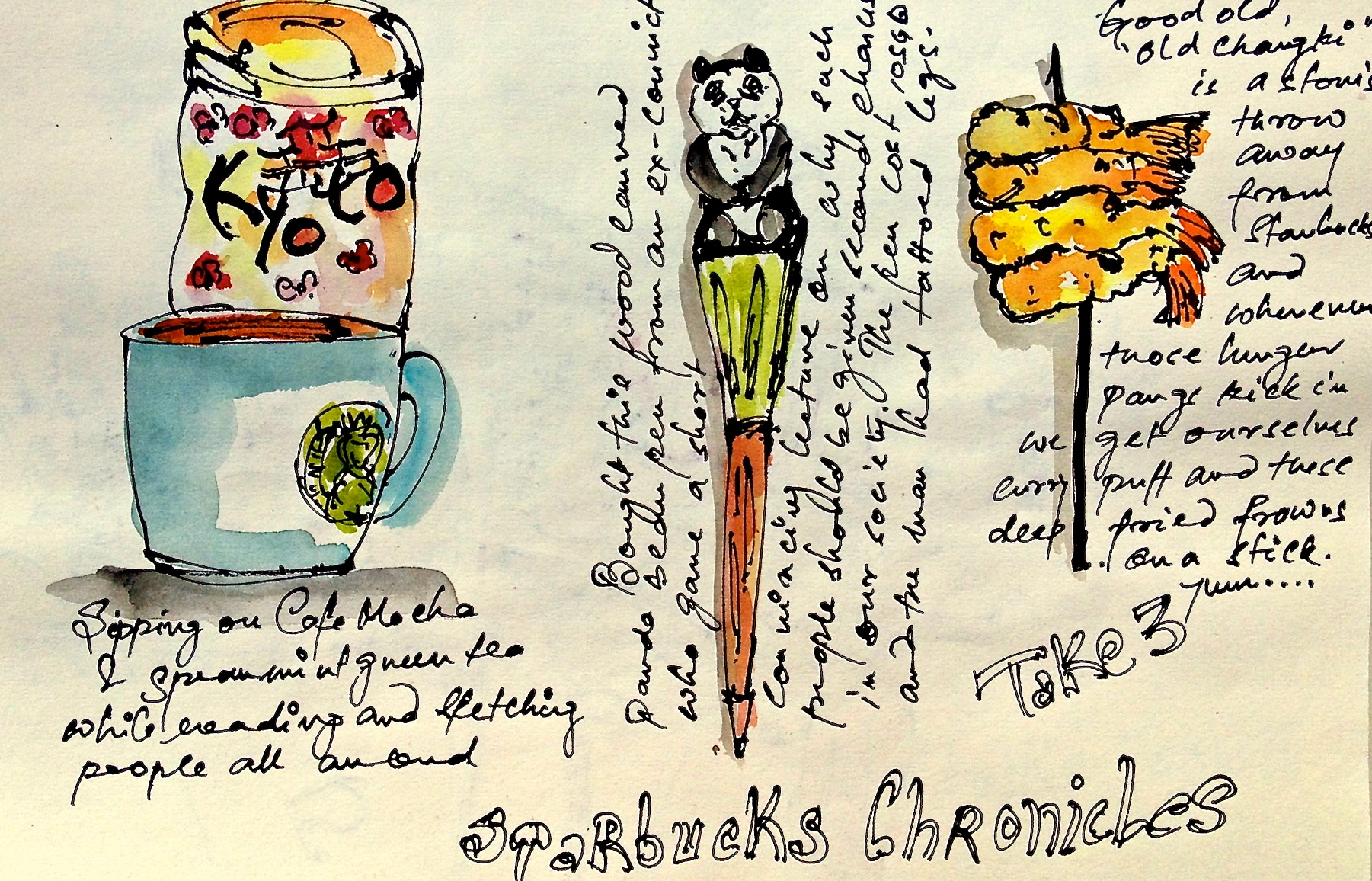
Any sketch when looked at several days or months later, evokes the moment, in its tiniest details.  Like this hand carved wooden panda bear pen that was sold to me at the cafe by an ex-convict with heavily tattooed legs.
Hand carved panda pen sold by an ex-convict

Hand carved panda bear pen sold by an ex-convict

The opening line of his very impressive speech, that led to the sale was, ” Do you believe in second chances?”.  Cheesy, yes? But the sketch helped me pin that memory down.