Tag Archives: Singapore

Why I didn’t bake the cake..

Every year, on my husband’s birthday I prepare an elaborate meal that I am really proud of, and a very basic chocolate cake that somehow scrapes by. Now I am not much of a baker and it’s a breeze to order a fancy, much superior cake from the store. But I don’t do the obvious, however tempting that is. There’s an undeniable masochistic pleasure in attempting something I am averse to for someone I care about! Hence the arduous whipping and whirling.

This year however, my conviction was intercepted. Gifts were wrapped, the meal was prepped and planned, the dessert was setting in the refrigerator and I almost had the cake in the bag. That’s when I heard about the monthly urban sketching event occurring at and around one of the grandest buildings of Singapore – Raffles Hotel. Hanging out with fifty art enthusiasts sketching, sharing ideas, getting inspired or solitary whipping and whirling in the kitchen? Filling juicy double spreads in my Moleskine or watching an egg and flour concoction rise? Easy right?

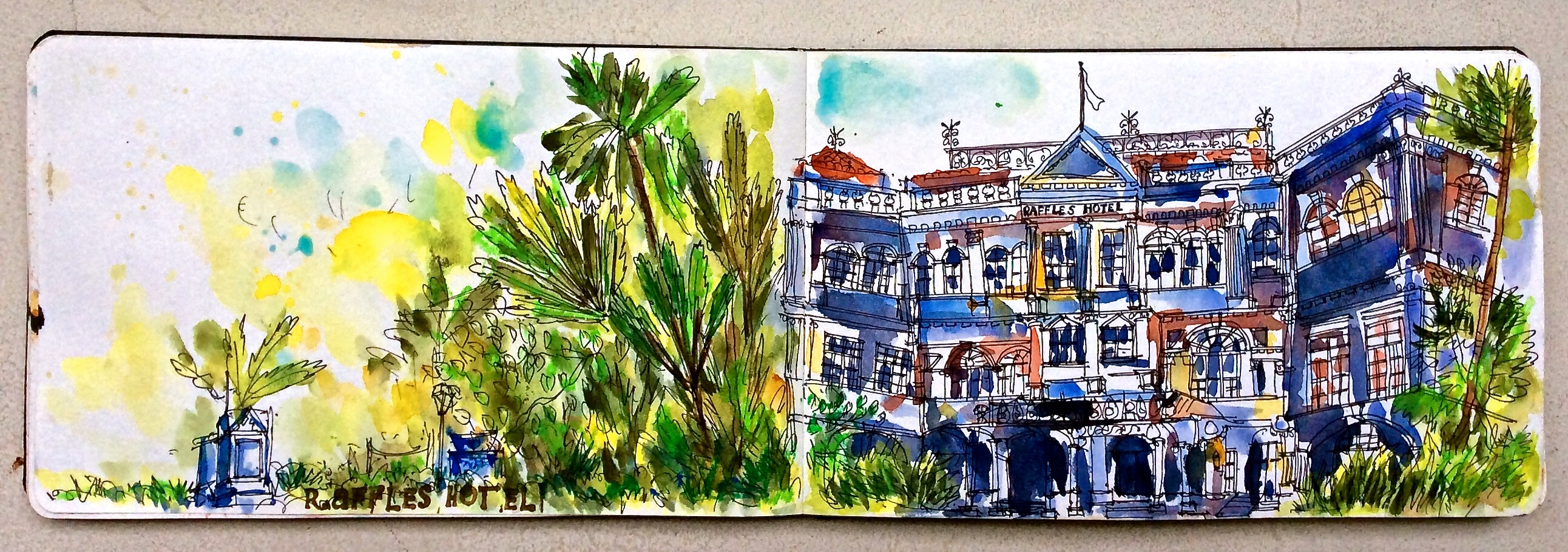
Raffles Hotel

Raffles Hotel sketched from the front

The grandeur of hotel’s colonial architecture matched with the placid greenery of the travellers palms and sweet scented frangipanis, still harks back to the romance of 19th and 20th century travel when writers, historians, explorers and sojourners showed up in their schooners, eager to ‘discover’ the exotic East and booked their stay at this place.

A beautifully curated in-house museum, which unfortunately is closed now, housed vivid memorabilia of the yesteryears – handwritten postcards, luggage labels, old photographs, guidebooks, hotel brochures, advertisements, posters that gave visitors a glimpse into the lives of the boarders who romped around these corridors, waltzed in the ballroom, nursed tall glasses of Singapore Sling in the Long Bar and wrote passionately (Hint: Somerset Maugham) in the tranquility of the outdoor verandas overlooking the Palm Court.

Amid the modern landscape – which has changed heaps since 1887 when Raffles Hotel was established – this little oasis on Beach Road looks like a stubborn time capsule. It is this incongruity that excites me every time I walk into the property past the tall liveried Sikh guards manning it’s doors since the days of yore. Over the years, land reclamation has pushed the waterfront further away and instead of jinrikshaws and hackney carriages, fancy cars are pull up the driveway.

Plonked on a sidewalk, I sketch this scene for over an hour, losing myself in the immense neo-Renaissance architectural details that doesn’t meet the eye when you look at the facade but magically unveil when you try to capture on paper. The Sikh guard came over twice to check my progress.

Seah Street

Seah Street

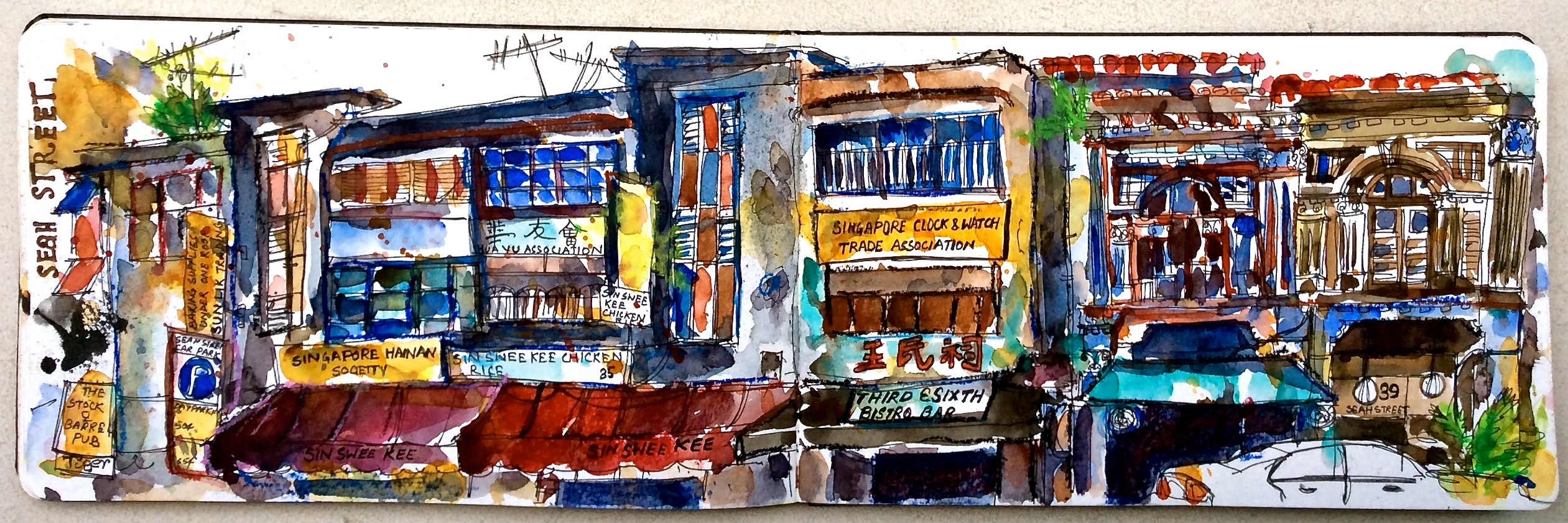
Seah Street adjoining Raffles hotel is the example of a typical Singaporean street that I love to sketch because of its potent mishmash of extremes. The architecture segues from Straits Baroque to Art Decco, the businesses range from hipster pubs and bistro bars to pedestrian chicken rice stalls, punctuated with old Chinese clan associations and trade centers, all in one row, cheek by jowl, sharing walls, awnings, parking space and history.

The street itself was named after the prominent Seah family. Eu Chin Seah an immigrant from South China was a wealthy merchant ( he made a fortune in gambier and pepper plantations and was called the ‘King of Gambier’) and a leader of the Chinese community in 19th century Singapore. So were his sons Seah Liang Seah and Seah Peck Seah, who also have streets named after them. What’s interesting further is that the three parallel streets in the Bras Basah area : Middle Road, Purvis Street and Seah Street used to be the original settlement site for the Hainanese immigrants (The ‘Singapore Hainan Society’ sign board that’s to the left bottom of my sketch on Seah St hints at this) and were known as Hainan First Street, Hainan Second Street and Hainan Third Street.

Considering that the Hainanese were mainly employed in the service industry (in local hotels, restaurants, bars and bakeries as cooks and domestic servants) it isn’t surprising that the famous ‘Singapore Sling’ birthed at the hands of Ngian Tong Boon, a Hainanese bartender working at Raffles Hotel in 1915. See the blatant red awnings of Sin Swee Kee Chicken Rice stall in my sketch? Well, they house the famous chicken rice, that was first adapted to its current form by Wong Yi Yuan a Hainanese immigrant and later popularised by his apprentice Mok Fu Swee, through these restaurants.

Besides witnessing layers of history, what drives me to capture such streets in my sketchbook is their dynamism, their ever changing, continuously morphing nature. If you’ve lived in Singapore you’d know what’s here on this street today won’t necessarily be there tomorrow. One of the most common sights on the road I believe is the large moving truck! At least, when this scenery changes and it will I’m positive, my Moleskine will bear testimony to a time gone by.

For now, it justifies my skipping an yearly ritual. My husband understands.


The Art of Living Alone

My husband’s in India attending a family crisis and I am suddenly, without warning all by myself in our apartment. It may sound ludicrous (to me it did when I hit this realisation) that I may be a loner, but I do not like to be lonely. I may be cooped up in my room but I need to sense the existence of life in my vicinity. The faint sound of TV, the tinkering of glasses coming from the kitchen, a pack of chips popped open, a vile sneeze from an allergic reaction, courtesy the man I live with – well, cumulatively they work in keeping me sane and ticking. The point is I don’t need someone to talk, smile, be nice to me all the time but if they can somehow compile and compress themselves into a continuous background noise, I would get through my day just fine.

Without this background noise – the rustling and ruffling, swaying and swishing- when I am truly hopelessly undeniably alone, I feel awkward. With myself. It is as if the seamless conversation that we have with ourselves in our mind, the one that gives us direction throughout the day – get up, brush your teeth, clean the house, make coffee, hit the shower, exercise, start working, take a break, go for a walk and so on – is replaced with radio silence. And this silence is frazzling.

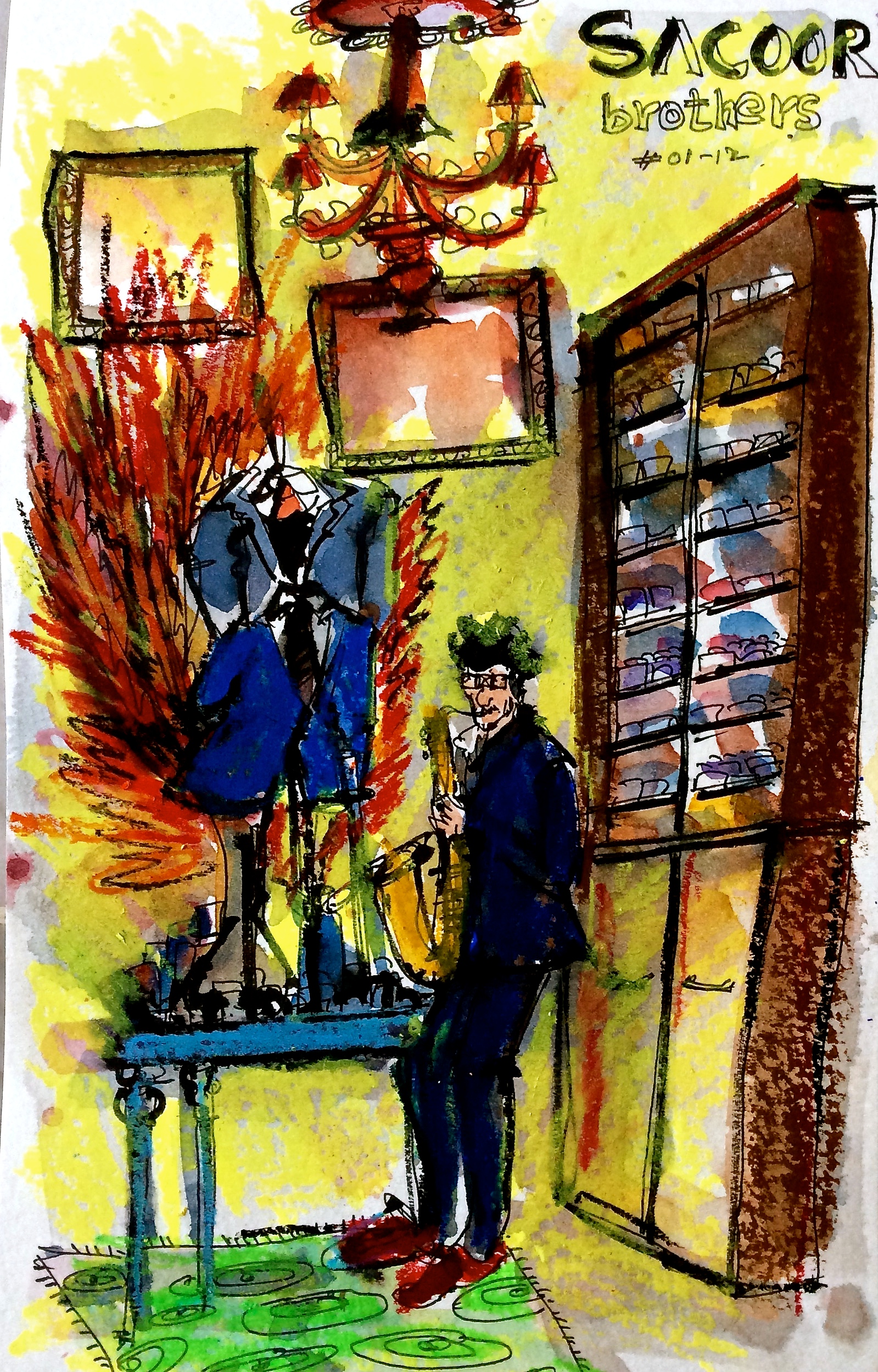
This guy in a dapper blue suit was playing amazing music at the store. He was so still that I thought he was a mannequin and had to really look hard to find the source of the music.

This guy in a dapper blue suit was playing the saxophone at the store entrance. He was so still that I thought the figure was a mannequin and had to really look hard to find the source of that amazing music.

To restore sanity in such trying times I baby sit myself. The job is difficult and thankless but someone’s gotta do it! It’s more like having to engage a whiny hyperactive toddler for a long period of time and not getting paid for the effort. ‘But if you are a bit patient, tad creative and intermittently forgiving, you may sail through this period of absence of your loved one’ proclaims my inner guru. ‘Ommm’ I say and get cracking.

First up is to keep my task list full. Activities are lined up back to back because no task equals prospective moping. In between there’s allowance for breaks to do what the heart fancies – watch TV, eat ice-cream from the tub, go shopping. When I dragged myself to Raffles City Mall the other day, I found an amazing Jazz musician in a dapper suit parked right outside a lifestyle store, making wonderful music. The blues melted away. I stood there listening as long as he played and sketched along. The colours were added at home much later. The fiery red and the garish yellow chaotically dumped over spindly lines mirrored my mental state. The sublimity of the evening had subsided and the restlessness was coming back. I didn’t like the outcome but it was cathartic so I let it be.

Chicken Noodle soup with  mushrooms at You and Mee

Mee Ayam – Dry Noodle with chicken and mushrooms. This is my favourite at You and Mee and also the cheapest most comforting dish I’ve tasted in Singapore.

Cooking for self is another bugaboo during such times, especially when you’ve been programmed to always consider what the other person likes to eat. So instead of flipping out, I simply eat out. But, I choose carefully. The more inconspicuous (bordering on invisible) I can be at a place, the better it seems. Happy couples, chatting gaily in the glow of candlelight, leisurely pouring wine into each other’s glasses are red flags. So are friends huddled at a table celebrating birthdays in their singsong voices. Lonely office guy with droopy shoulders hunched over his bowl of soup or jaded single mother force feeding her rebellious child, well, they work perfectly as my comrades-in-gastronomy. Two nights ago, I walked into You and Mee – an unpretentious hole in the wall noodle shop in my neighbourhood with bare walls, functional long wooden tables and stools – and had a 5$ dinner with a similar crew of discontents. Felt right at the time.

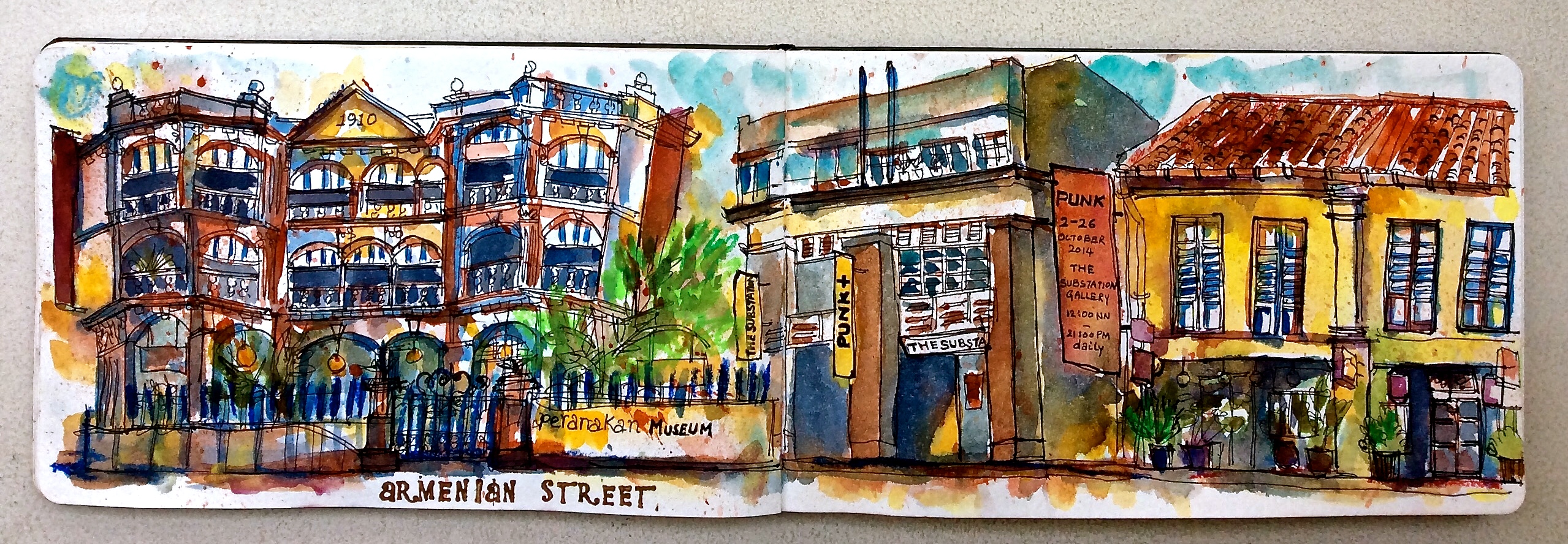
Peranakan museum , The substation and True Blue restaurant, all on Armenian Street

Peranakan museum , The substation and True Blue restaurant, all on Armenian Street

Five days, ‘x’ hours and ‘x’ minutes have passed since I’ve been on my own ( The ‘x’ represents my disinclination to sound desperate). But things are getting better. I am getting a hang of this. The voice is whimpering its way back. It sent me into the kitchen last night. I whipped up roasted chicken breast and paired it with warm fluffy couscous. It also sent me to a museum yesterday. I spent an entire Sunday afternoon learning about the richness of Peranakan culture and came back with a double spread sketch and a great mood. Maybe tomorrow I’ll go to the library and later eat at a nice chirpy cafe nearby.

Maybe I’m going to be just fine.


Boat Quay and a bit more

Last weekend the urban sketchers of Singapore, which I am a member of, chose Boat Quay (a popular tourist destination!) – a river embankment that curves around the shoreline of the north and south sides of the Singapore River – as their sketching venue. Before I describe what met my eyes, let me take you back in time. Like hundred and fifty years back.  By this time, swamp covered Singapore once infested with wild animals, dense forests, pirates, and the Malayan Temenggung had been ‘found’ by 38 year old Raffles (in 1918), it’s allegiance shifted to the crown and it’s fate as a free trading post and deep water harbour for British merchant fleets in the Mallacca Straits had been sealed.

The settlement had developed considerably – forests had been cleared, hills flattenned, muddy pools and swampy ground levelled off, lands auctioned to build houses, business and residential quarters laid out, fundamental laws such as prohibition of gambling put down. Palatial hotels and European bunglows of the traders were lining the shore, while the locals – mostly Chinese and Arabs settled on the left bank of the Singapore river. Nutmeg, pepper, gambier, cocoa nut plantations, were starting to prosper, attracting merchants and traders from far and wide to the shores of Singapore.

Frank Vincent, a traveler describes the scene while approaching the dock in Singapore, upon his visit in 1871, “Like Malacca,very little of the town or city of Singapore appears from the sea…We steam past two or three war vessels, two telegraph steamers(which are only awaiting orders from London to commence laying a a wire from here to Hong Kong), and by some thirty or forty merchant ships of all nations to our anchorage in the crescent-shaped roadstead about a mile from town. We engage a Malay prow to take us ashore, and are landed near Hotel d’Europe, to which our good captain has recommended us”. 

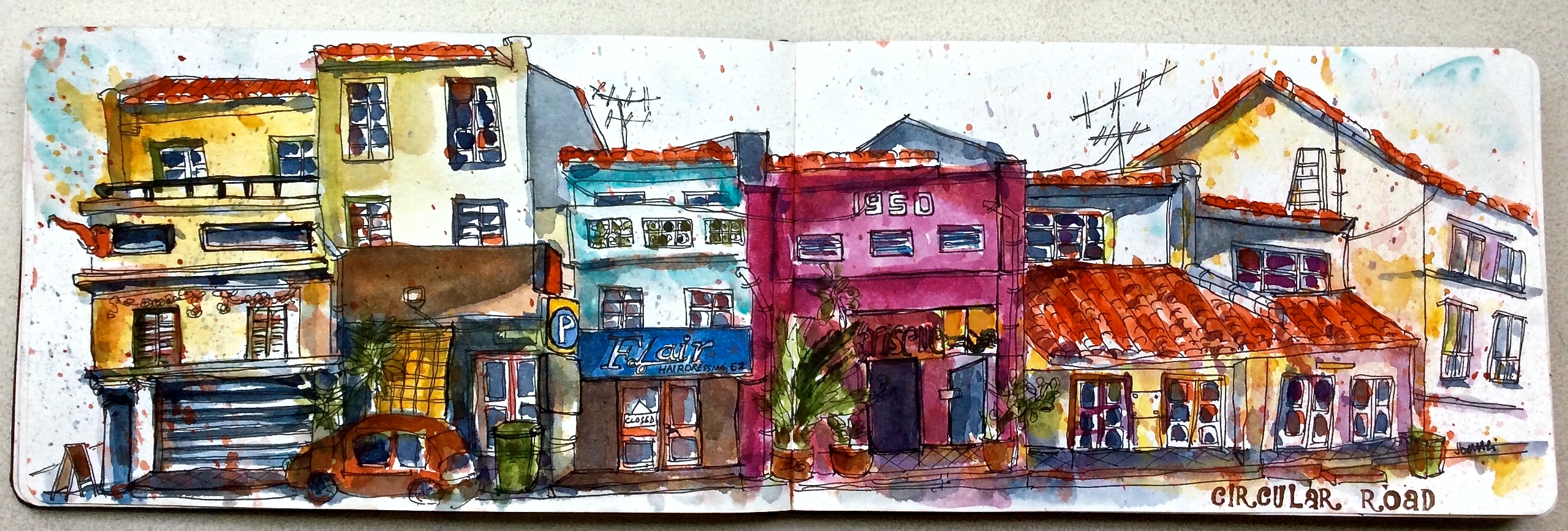
Circular Road, Boat Quay

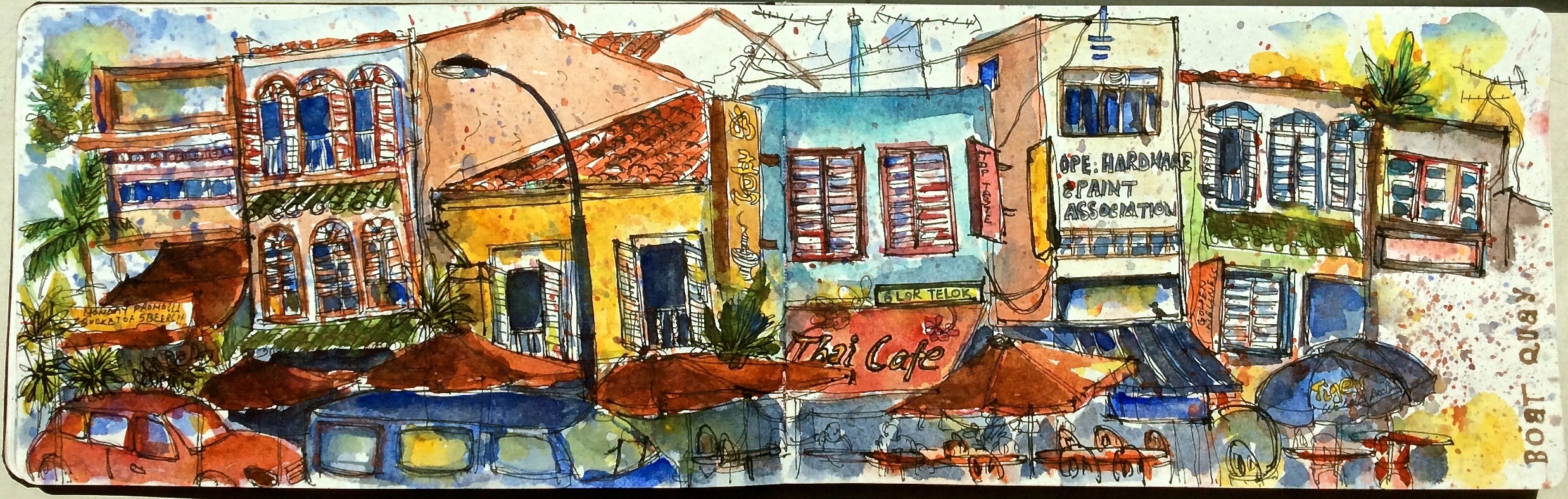
Circular Road, Boat Quay / Once again the mishmash of acrchitectural style of the shophouses and businesses they house today is so interesting – (from L to R) a Japanese restaurant, an office, a hairdressing salon named “Flair”, a night club named Kriselle and more offices.

The ‘crescent-shaped roadstead’ that Vincent mentions in this narrative could very likely be the Boat Quay, we were documenting in our sketchbooks for three hours last Saturday. The Chinese likened the concave shape of the dock to the ‘belly of the carp’ which they believe is auspicious for business. And so it was. While the north bank was reserved for government buildings, the south bank prospered as the commercial hub (this port was one of the most important in the British Empire, specially after the opening of Suez canal in 1869) lined with gowdowns, warehouses, merchant offices, shops of shipwrights and ship chandlers. There is no Hotel d’ Europe though, which used to be a stone’s throw away on the north bank and have since been replaced with the Supreme Court.

If you were a 19th century traveler like Vincent, driving by Boat Quay in a hackney carraige ($5 a day for a pair or $3 for one horse!), or a British clerk hurrying to his downtown trading office in a jinrickshaw (3 cents for half a mile for one passenger), you’d find the river bank teeming with bumboats / sampans (Chinese sailing boats), cheek by jowl, gently bobbing with the ebb and flow of the waves.  A constant drone of human limbs stretching, lifting, scurrying across gangplanks would drive your gaze to the scores of swarthy men with taut leathery skin loading and unloading gunnysacks of cargo on their arched backs in the scorching equatorial heat. What remains unchanged even today is perhaps the weather.

Many original buildings have been preserved, but instead of stale smelling gowdowns, you have access to crispy fish and chips and chilled beer. These grand dames of the past now work as pubs, restaurants and night clubs. Commanding skyscrapers form the backdrop in place of ‘a fine view of the straits, the large island of Bintang (visible) in the distance and the Chinese junks and foreign shipping in the harbour‘ as described by Vincent from his luxury hotel.

Besides sketchwalking, a significant part of the weekend was spent at my husband’s office. He had to clear some pending work and I decided to accompany with a plan in mind. This is how it took shape :

Sketches of some random desks. I was interested in clutter and my husband's desk was a disappointment in this regard. I was so amused by the props at each desk - teddy bears, dinosaur, a pig (??!!) that grunts when you press its belly. Unbeknowst the owner of the pig, I had by fun.

Sketches of some random desks. I was interested in clutter and my husband’s desk was a disappointment in this regard. I was so amused by the toy props at each desk – teddy bears, a dinosaur and tiny soldiers, a pig (??!!) that grunts when you press its belly. Unbeknowst to the owner of that pig, I had my fun.


Out and about

I am enamoured with Singapore’s shop houses.  It’s official. These picturesque palimpsests of the past have been recorded in my sketchbook so many times that I can draw them to a tee even if someone blindfolded me and trussed me up in a cupboard.

Club Street

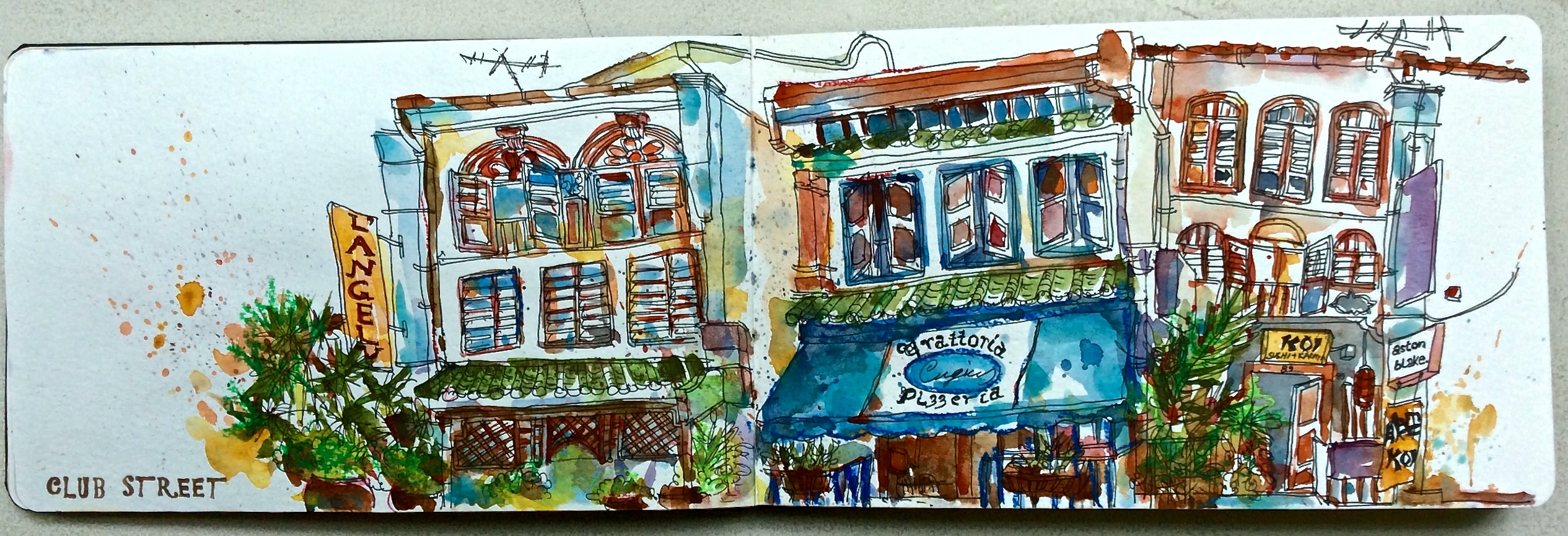
The shophouses have remained but clearly the businesses have changed. Sketched at Club Street

To the untrained eye, most shophouses may look alike, but if you’re the curious and observant kind, you’d know that’s hardly the case. Their purpose as residential and commercial establishments may have remained unaltered, but the architecture of these two, sometimes three storied narrow facade terrace houses continuously evolved from the 1840s to 1960s, when they monopolised the cityscape of Singapore.

Pre 20th century shophouses were functional and austere – low two storey buildings with one or two louvered windows with hardly any embellishment on the facade. Chinese-Baroque style from 1900 to 1940s, saw extensive use of decorative mouldings, pilasters, carved wood-work and imported glazed tiles on the facade, representing the fusion of Eastern and Western architectural styles and giving great aesthetic pleasure even today when you look at their refurbished selves. Moving forward, heavily ornamental gave way to simplified and streamlined.

Boat Quay

Such an amazing potpourri of architectural styles seen at Boat Quay

Designers and builders began combining ornately carved transoms and colourful tiles with Art Deco elements such as cross-braced glass window panels and geometric balustrade designs, finally joining the Art Decco bandwagon in 1930s and continuing till the 60s. Stepped pediment with a flag post is a typical giveaway of this stye. Modern shophouses of 1950 – 60s, were plain and unadorned except for a concrete fin air vent perhaps, thus coming full circle in terms of design simplicity.

All this may seem very textual, but what thrills me is to be able to catch these nuances of evolution when I am out and about in the city, running errands, going to the library, working at a cafe or sketching. Especially, sketching. Tracing this potpourri of personal taste, temperament and lifestyle of the residents of yesteryears, sometimes on a single street feels like time travel. Every single time.


Date with old Vic

I have a thing for old run down buildings with scraggly facades and chipped paint that have been taken hostage by weeds, arm-twised by thick veiny roots and caked in years of dust and neglect. The cloudy mist of ‘what must have been’ hanging about them is what makes them irresistible.

Perhaps ‘nostalgia’ is what I am really attracted to. But why wouldn’t I be? Globalisation is making our cities across the world increasingly homogenous; multistoried office buildings – lush condominiums – swanky shopping malls – fast food chains and boutique cafes is like a trite formula that’s being slapped across every landscape that’s on the road to modernity.

Knowing about the past is the only way to read the prologue of this story that we are living today, to better understand its character, its provenance so we can connect with it, be aware and be empathetic.

Victoria Theatre and Concert Hall

Victoria Theatre and Concert Hall

Therefore when opportunity presents itself, I don’t miss out on exploring anything that has the word ‘heritage’ on its radar, which Singapore has plenty but one needs to be alert coz the glitz of the present kind of obliterates the grime of the past. Just as the majestic Victoria Theatre and Concert Hall in Singapore’s civic district, which I knew nothing about until it was opened to the public for two days offering a sneek peak after four years of restoration and refurbishment.

If that isn’t motivation enough to visit then how does free guided tours of this 152 year old grand dame sound? I registered myself for the 2:30 pm tour pronto. We were given tiny blue stickers with the timing inked on it, for identification. You know you have a great deal, when your tourguide turns out to be better than the one money could buy! She was a storyteller all right. Standing in the middle of the sunlit atrium, right below the clock tower, her painted fingernails pointed at the two walls on either side of us. ‘See the difference in architecture?” We did. The wall on the left had plain looking pre-cast concrete panels. The wall on the right was ornate, decorative and much more pleasing to the eye. If one was a plain unembellished uniform, the other was a flowing victorian ball gown.
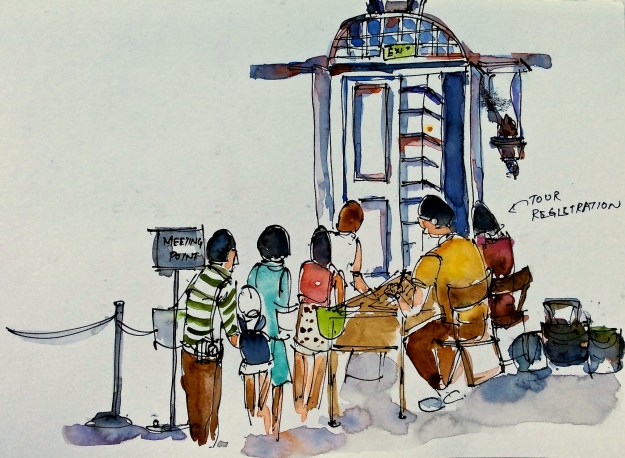
Registration desk

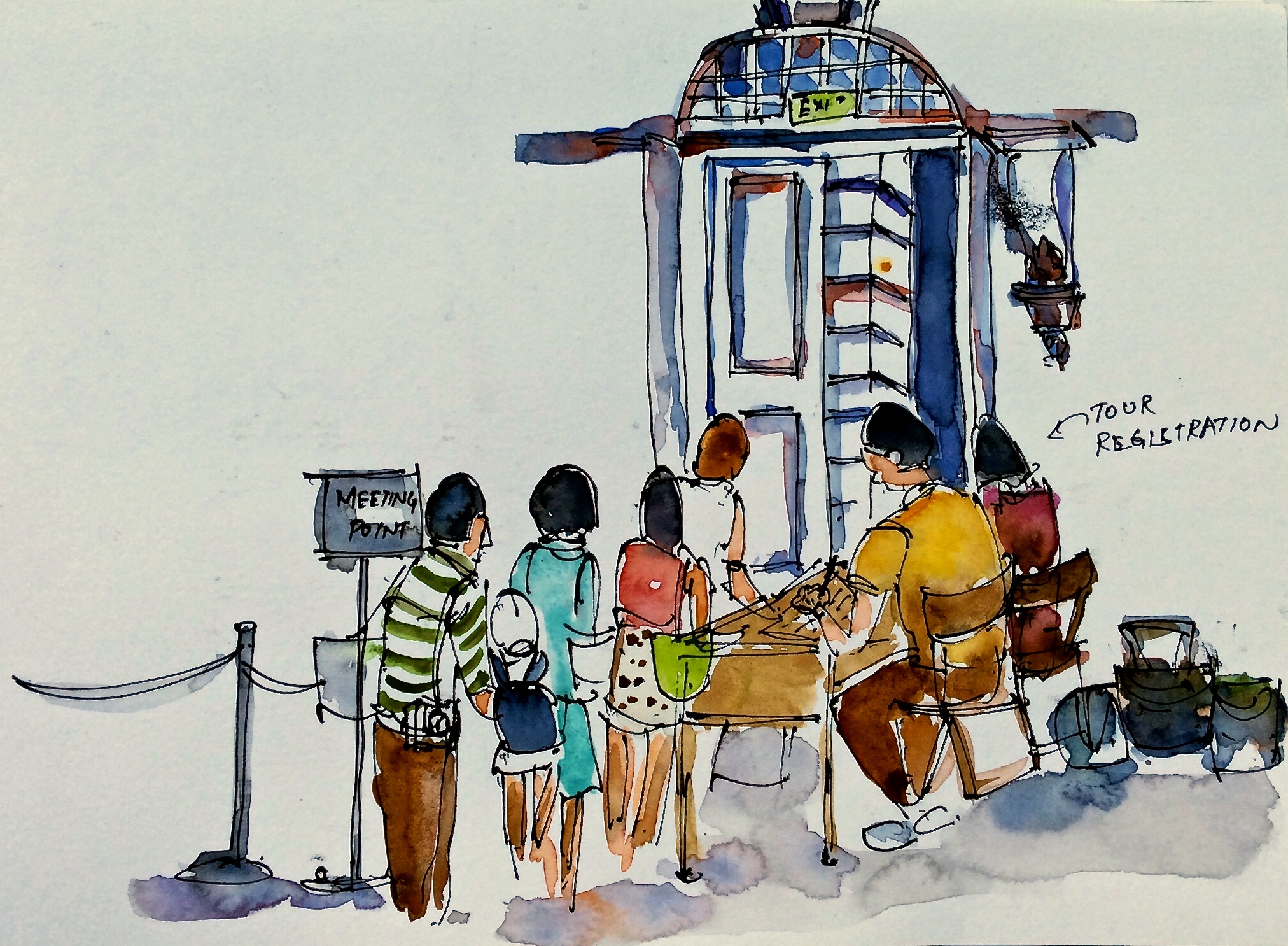
Registration desk

‘Well, these walls belong to two different buildings, built during different periods, and later linked together with the clock tower above’. There was a prolonged ‘ohhhhh’ in the crowd at the evident revelation which wasn’t so evident in the beginning. The concrete panels on the left belong to the Town Hall or Victoria Theatre as it was renamed later and was built in 1862. Victoria Memorial Hall, built in 1905, on the right display an architectural style called ‘Victorian Rivivalism’.

‘Notice the floral patterns, Italianate windows, Baroque volutes and rusticated columns’, she said, while stammering on r-u-s-t-i-c-a-t-e-d. Amid the floral festoons on the wall, she pointed out the letters V, R and I, representing Victoria Regina Imperatrix. While the town hall was built to carry out administrative duties and entertainment activities ( it had meeting rooms and offices on the second floor and a theatre on the ground floor), Victoria Memorial  Hall was built ‘To commemorate the Long and Glorious reign of Her Late  Majesty Victoria’ (as written on the foundation plaque)  after her passing in 1901. Interestingly, though the two buildings were built 40 years apart, their facades were unified in such a way that it’s impossible to detect any difference from outside.
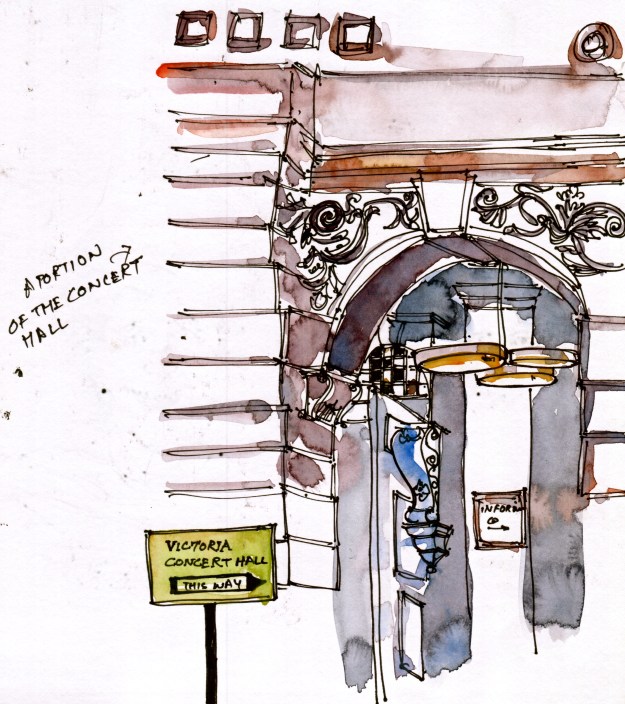
A portion of the Victoria Concert Hall

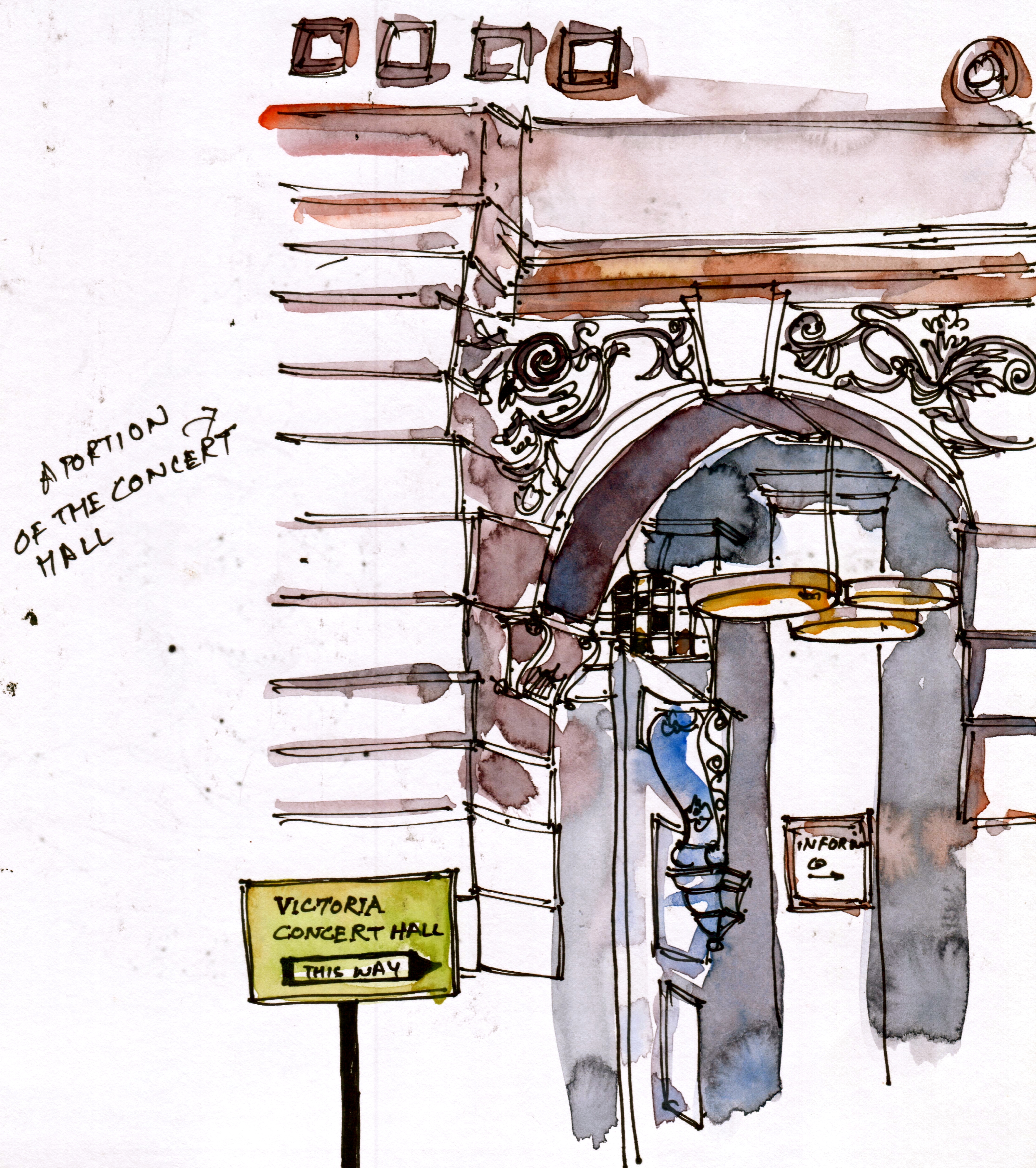
A portion of the Victoria Concert Hall

With this bit of orientation, we were led outside to admire the facade. ‘It was built in the Neo-Palladian style (plain exteriors based on rules of proportion contrasted with righly decorated interiors), as are many colonial buildings in Singapore.’ says our guide. ‘ Look at the columns – if they have scrolls they are Ionic, if they have leaves, they are Corinthian, if they are plain, they are Doric’, she offered. Once again the letters V R I make an appearance on the facade of the Memorial Hall. We squinted our eyes to block the sun when she pointed towards the pediment which used to have a bass relief of the British Coat of Arms, but was later replaced in 1959 with the Singapore coat of arms.

Someone asked if the clock affixed to the clock tower still works. ‘Doesn’t it?’ countered our guide with a poker face. We collectively turned our gaze to the 54-meter clock tower with a  copper dome and a crown on top (the crown was removed earlier and now restored back) from 1906. It was completed an year after the Victoria Memorial Hall was erected. ‘Does anybody know why?” No one volunteered. Or maybe somebody did mutter something about a ‘delay’, which our guide picked up at once and said ‘Yes, due to the delay in donation of the clock itself by Straits Trading Company(incorporated in 1887 as a tin smelting company). The company is still in operation, you know. It is right behind those tall multistoried buildings’, she said, pointing north-east of the Raffles statue. The clock chimed in agreement. “There you go! Guess, it works!” she said gleefully before turning around to face Raffles again, or rather his back.
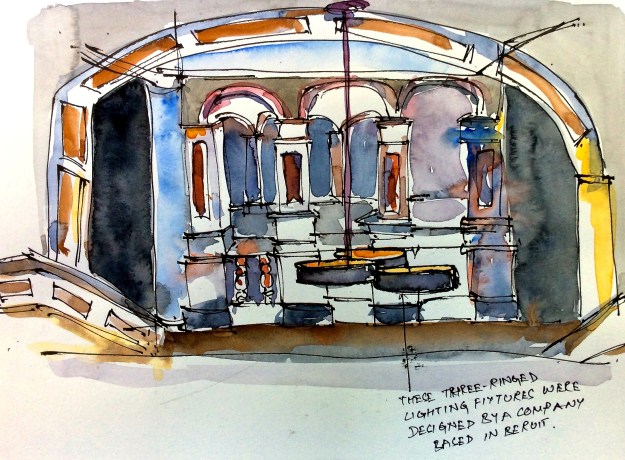
Sketched from the marble Staircase of Victoria Concert Hall

Sketched from the marble Staircase of Victoria Concert Hall

We turned around with her. ‘Now this is black Raffles…’ she said pointing to the bronze statue of Singapore’s founder, standing on that column since 1919 (in celebration of the 100th birth anniversary of Singapore, the statue was relocated here from Padang), sombre, arms folded, balancing his weight on one leg and the other casually put forth. ‘..Who can say, where is the white Raffles?’ We’ve all seen the white Raffles by the Singapore river, erected at his landing site. ‘Okay that was easy. Now, look at his foot. What is Raffles standing on?’ Raffles right foot was indeed resting on a parchment. After a rehersed moment of silence meant to heighten the suspense, the answer  – ‘Map of British Malaya’ was revealed.

We were then led inside to wander the halls of the Memorial Hall, briefly stopping in front of two bronze plaques (one dedicated to the memory of those killed during the mutiny in Singapore in Feb 1915 and the other the foundation stone laid by Sir Frank Athelstan Swettenham, Governor of Straits Settlement on 9th August 1902), and a bust of Cecil Clementi, a popular governor of Singapore. ‘ This man is very important in Singapore’s history. He was effective in quelling the Chinese Secret societies in Singapore’. (During the colonial rule, Chinese Secret Socities were considered a threat to the law and order of Singapore; they were associated with violence, extortion and vice).

Spiral Staircase

Spiral Staircase

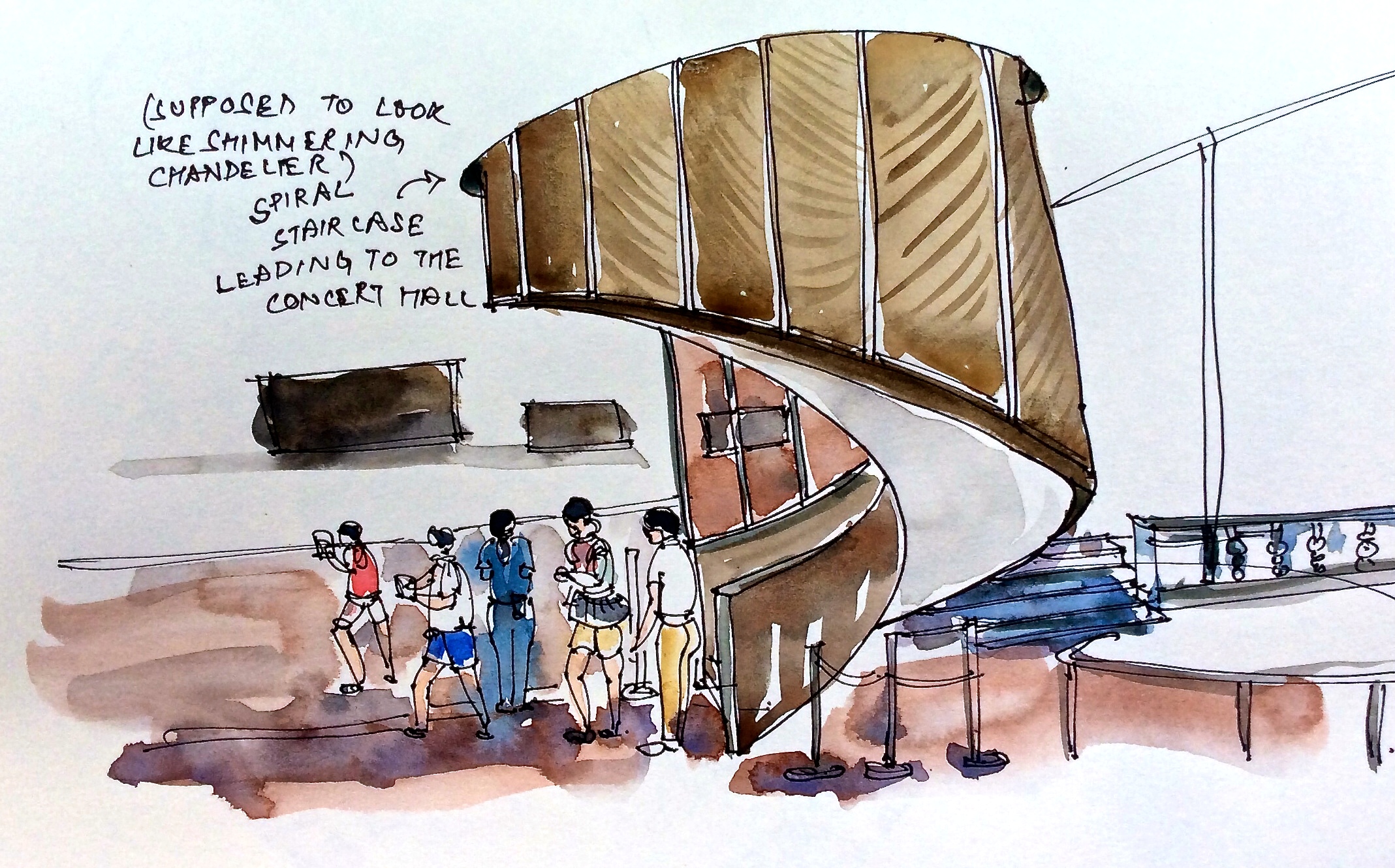
Leaving Clementi, we climb up a flight of marble stairs to find an interesting fixture – a spiral staircase leading to the concert hall. ‘Can anybody tell me what the architect designed it to resemble?’ A raised hand said – ‘Organ pipe’ .  Though she was given credit for imagination, the correct answer was – a shimmering white-silver chandelier. We were advised to look at it from outside after dark to corroborate this fact.

‘During second world war, the Victoria Theatre and Memorial Hall escaped destruction’ continued our guide. It was used as a hospital and housed survivors of Japanese airraids. Later during the Japanese Occupation it became a cultural center for the Japanese and many shows were performed here. ‘Did you know in 1947, this place held a mass trial of Japanese prisoners in public?’  Few nodded. ‘How do you expect the public to react during such trials? she asked, looking at each one us in the eye. ‘Cry for blood’ said a middle aged gentleman in yellow hat getting a bit worked up. His wife agreed.

‘Well, on the contrary, the spectators were very well behaved.’  our guide answered with a calming smile.

Much later while browsing through the information kiosks, I read this vivid first hand account of the trial narrated by a former teacher of Anglo-Chinese Continuation School named Chan Kwee Sung. He says, “A mass trial was held in public at the Victoria Memorial Hall. It was…very well attended every day – The Japanese prisoners were made to sit facing the spectators on a platform on the dias, where the tribunal was. All the witnesses took stand; they gave the testimony in their own dialect. There were interpretations, and there were microphones all around the hall..One would have expected cursing, booing and jeering but there was none of that. (The) spectators (were) quite well-behaved, even when the prisoners were conducted in and out of the hall.”

Back on the tour, pop quiz wasn’t over. ‘A very important political event took place in this building. Any idea what it might be?’ Almost everyone knew that the People’s Action Party (PAP) held its inaugural meeting here in 1954. The information kiosk had a black and white photograph of a young Lee Kuan Yew addressing the meeting.

$158 million and four years of renovation and refurbishment has brought old Vic up to speed with contemporary standards. New spaces have been added such as changing rooms, loading bay; the central atrium has been openend up. ‘The Concert Hall’s balcony has been made smaller and higher so that the acoustics won’t be compromised for the people sitting below’ said our guide. ‘But all this meant sacrificing the seating capacity. From around 900 to 600 seats (883 to 673 to be exact) now..”

Someone asked if the tour would take us inside the concert halls. ‘Unfortunately not! There are shows going on today, for free. Do take out time to experience one. The stage has curved acrylic panels hung by cables from above to diffuse and reflect the sound”. The lady who asked the question was still bummed – ‘I thought exporing the interiors of the concert hall was part of this tour’. But our guide went on spewing out more information – “…the Grand Klais pipe organ has be beautifully restored by its original German manufacturer. The original St. Clair organ from 1931 was replaced by the fully mechanical Klais organ in 1984..”.
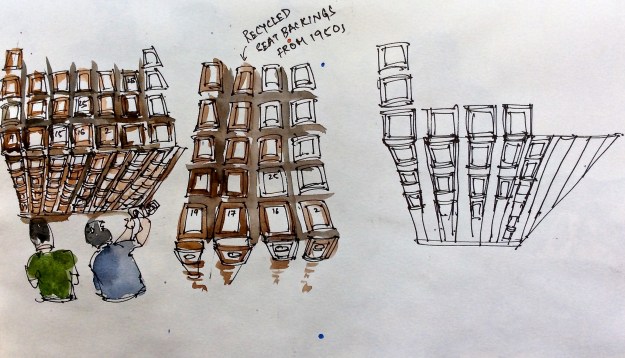
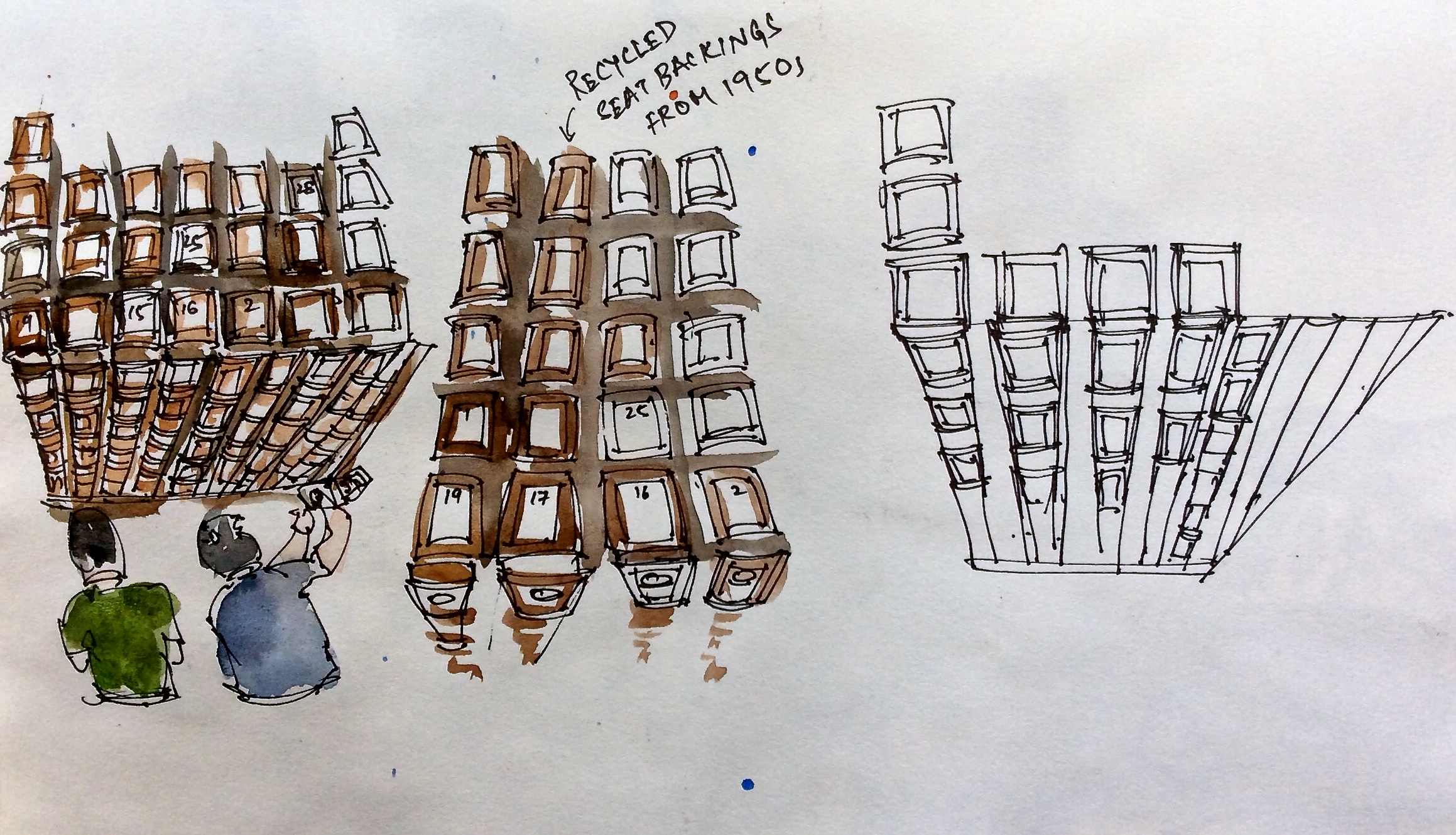
The Theatre foyer made out of recycled seat covers from1950s

The Theatre foyer walls are covered with recycled seat backings from1950s

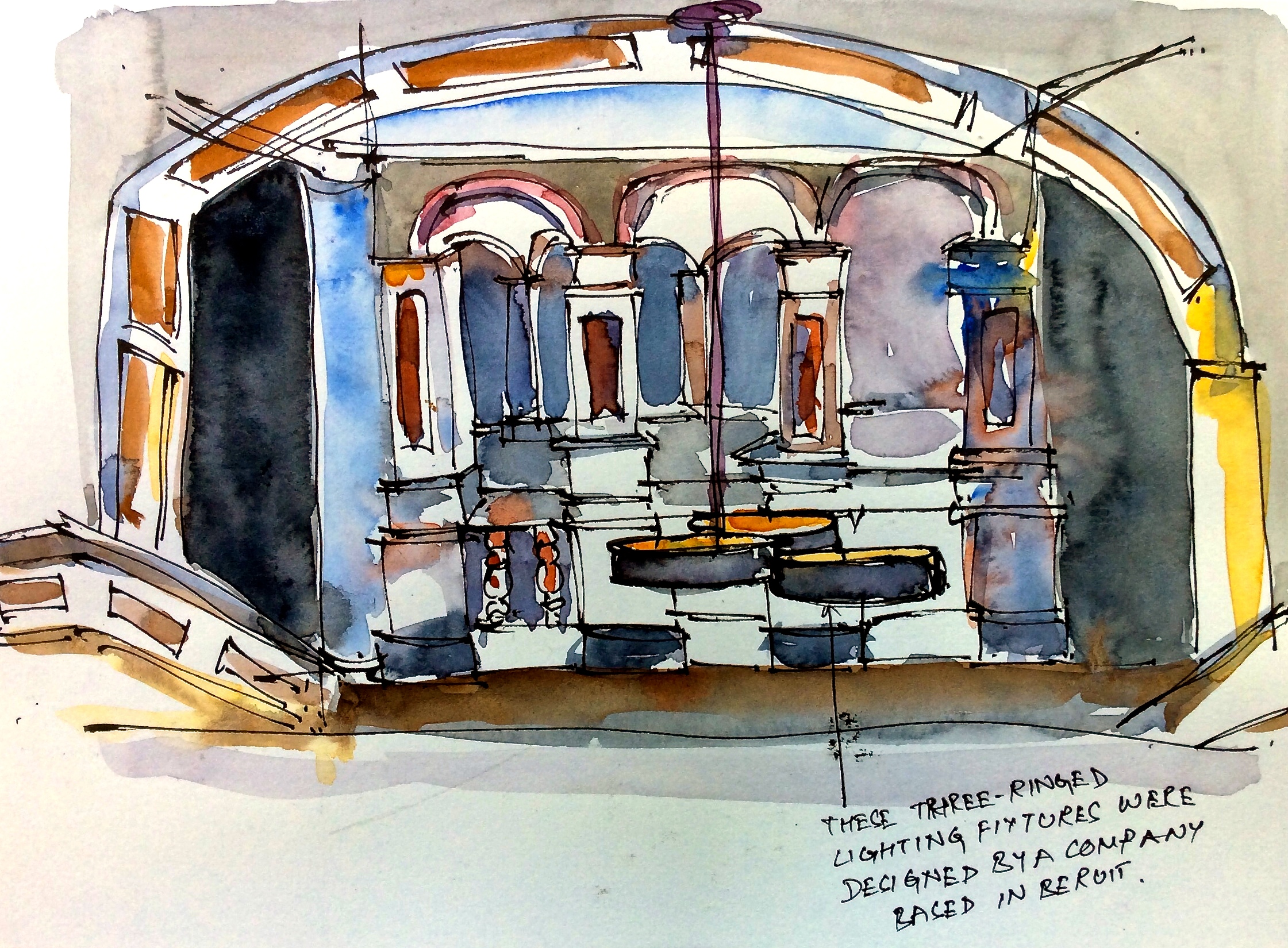
Ducking the crowd spilling out of the concert halls ( yes! free shows), we walked over to the Victoria Theatre side to admire another ingenious creation of the architect – a rehearsal room for musicians that looks like a hanging rhubik cube made up of chocolate bars. ‘Who can say what these are?’ The hint was ‘something recycled’. But even that didn’t work because – 3cm thick timber seat backings from the 1950s theatre chairs – would’ve been pretty hard to guess.

Besides its role as a performing arts center, Victoria Theatre and Memorial Hall functioned as a community space, where important events such as weddings and exhibitions took place. ‘My memory of this place is from the time when I participated in a Malay dance sequence here’, said our guide reminiscing at the end of our tour. ‘Do any of you have memories of this place? We are looking for memories.’

There was indeed an irememberVictoria collection booth in the Victoria Concert Hall, behind the tour registration desk, where you could drop your ‘Victoria story’ of first dates, backstage jitters, mass weddings from the 1950s into the collective pool of memories associated with this grand dame of Singapore. Millions of dollars may have given Old Vic a facelift, but its the memories that’ll bring her to life. Guess, I am not the only one attracted to nostalgia.


Guess who was in Singapore?

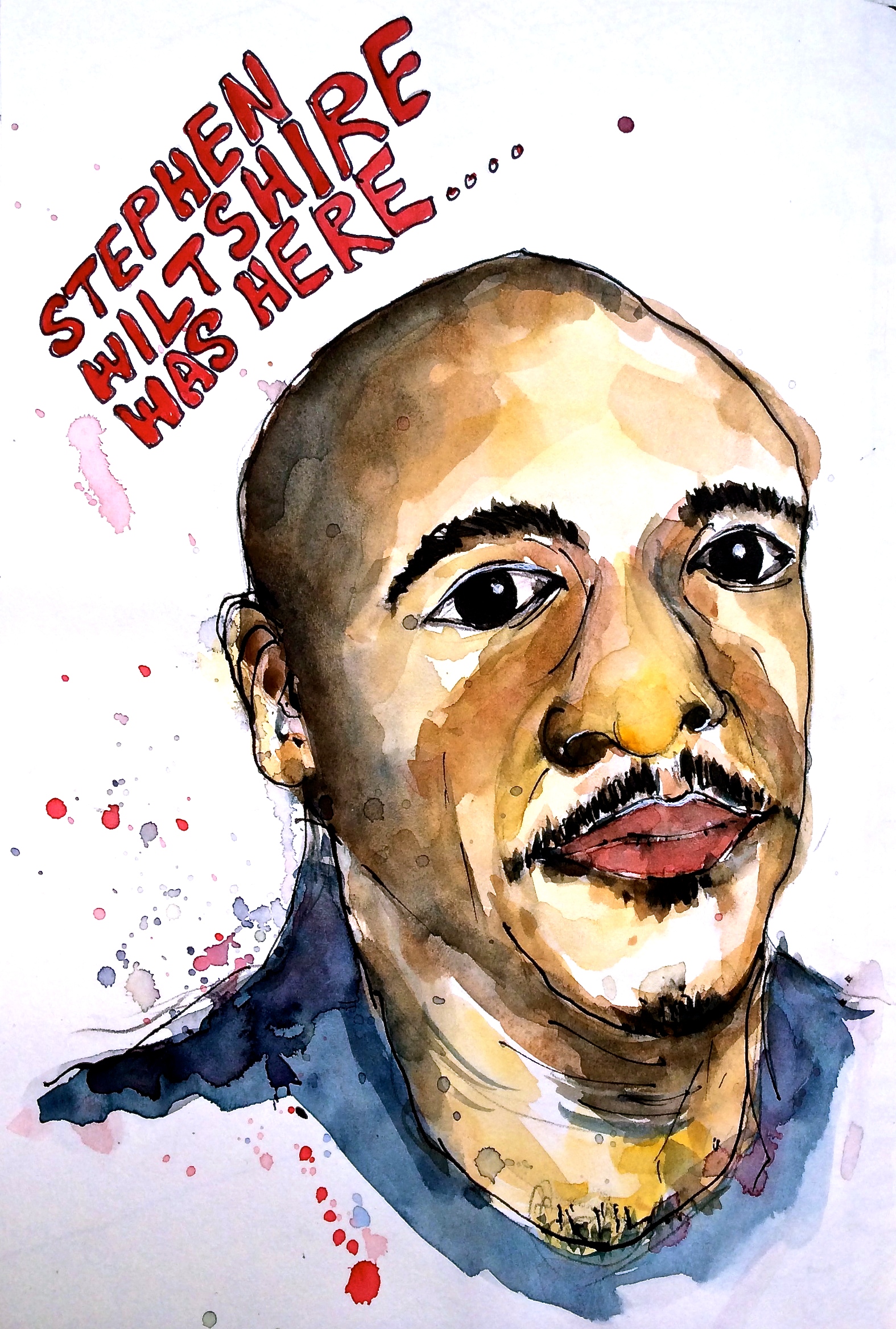
Stephen Wiltshire!

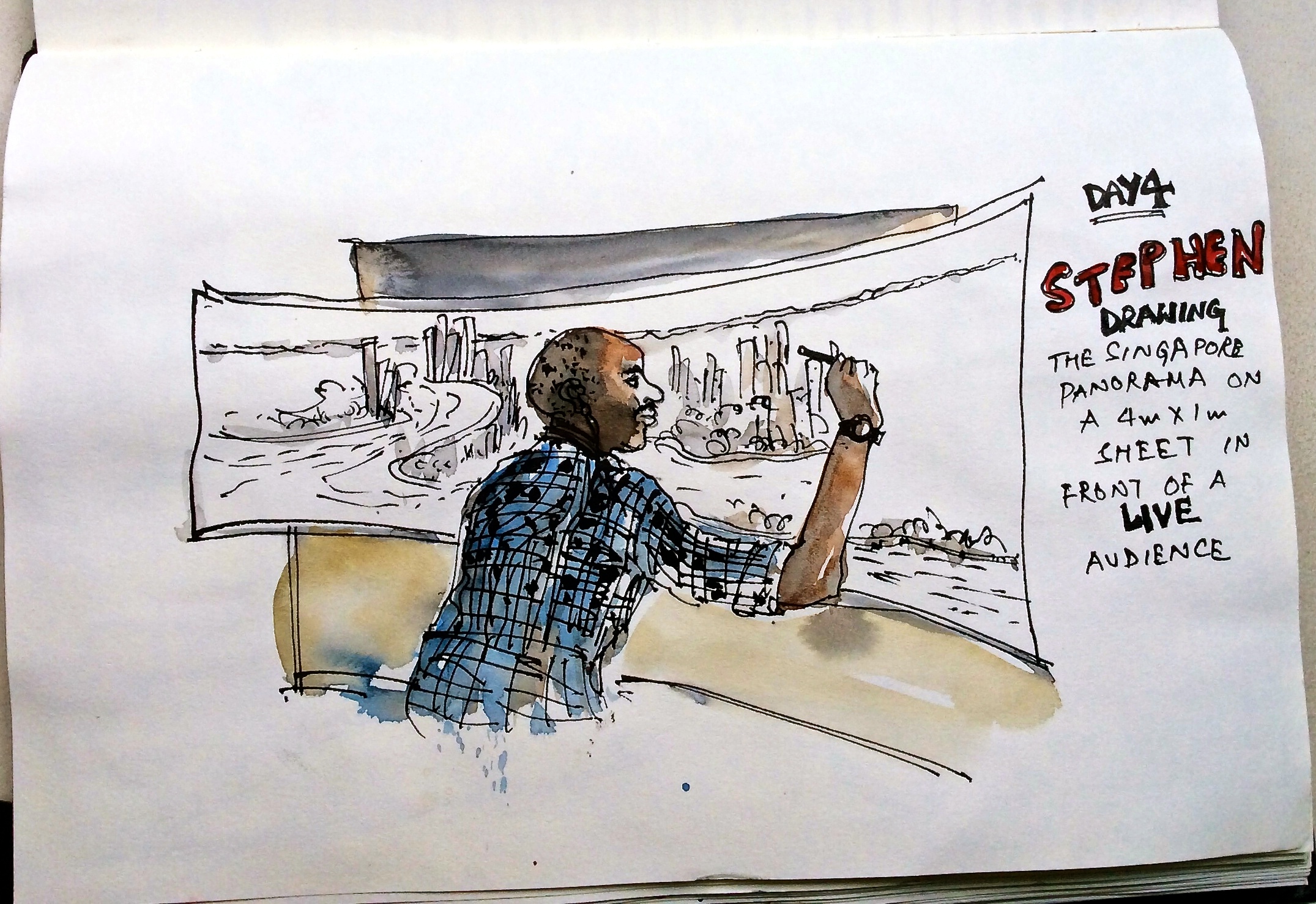
Or the human camera as people like to call him. On the occasion of Singapore’s 50th birthday next year, this British savant, also an architectural illustrator was invited to work his magic, a.k.a sketch the Singapore panorama on a 4m x 1m sheet of paper over 5 days, from memory – which was made during an hour long helicopter ride viewing the skyline.

This intensive drawing didn’t happen from the comfort of a private studio but live in front of an overwhelming audience of veteran fans –  admirers who knew of his work and came to support, on the spot converts – those who read about him in the newspaper and came to douse their curiosity and lastly clueless saunterers – flittering shoppers (the event was held at the atrium of a shopping mall on orchard road) who came to check out what the fuss was about, lingered and took abundant photos.

Stephen Wiltshire was diagnosed with Autism when he was just three.

Stephen Wiltshire was diagnosed with Autism when he was just three and is known for his ability to draw astounding cityscapes from memory

Stephen was propped up on a dais from 10am till 5pm, working nonchalantly with music plugged into his ears, while the crowd hung on every stroke that he pulled out from that brilliant mind of his. With hundreds of eyes watching anybody would deflect, but not this guy. He couldn’t have cared less – zilch performance anxiety. He was in the zone, doing his thing without a worry in the world. Right in front of the dais were a set of chairs where his sister was seated along with art school students who were sketching Stephen sketching Singapore. Photographers were tirelessly clicking the same static subjects from various angles – the students, Stephen, and the crowd which was huddled right outside the cordoned off area, containing the dais and the chairs.

The Human Camera

The Human Camera

About quarter to 5, Stephen would check his watch and start wrapping up. He would then get off from his bar stool, fresh as a daisy, wave to the crowd that would start clapping and hooting, even to those cheering from the floors above and then sign autographs and smile for selfies.

I am not good at battling crowds, so I didn’t indulge in either. Instead, I took pleasure in the second best – observing the ecstasy on the face of every admirer who had his or her brief moment with the world’s ‘human camera’. It was quite the thing!

Coffee with kids in tow? Maybe!

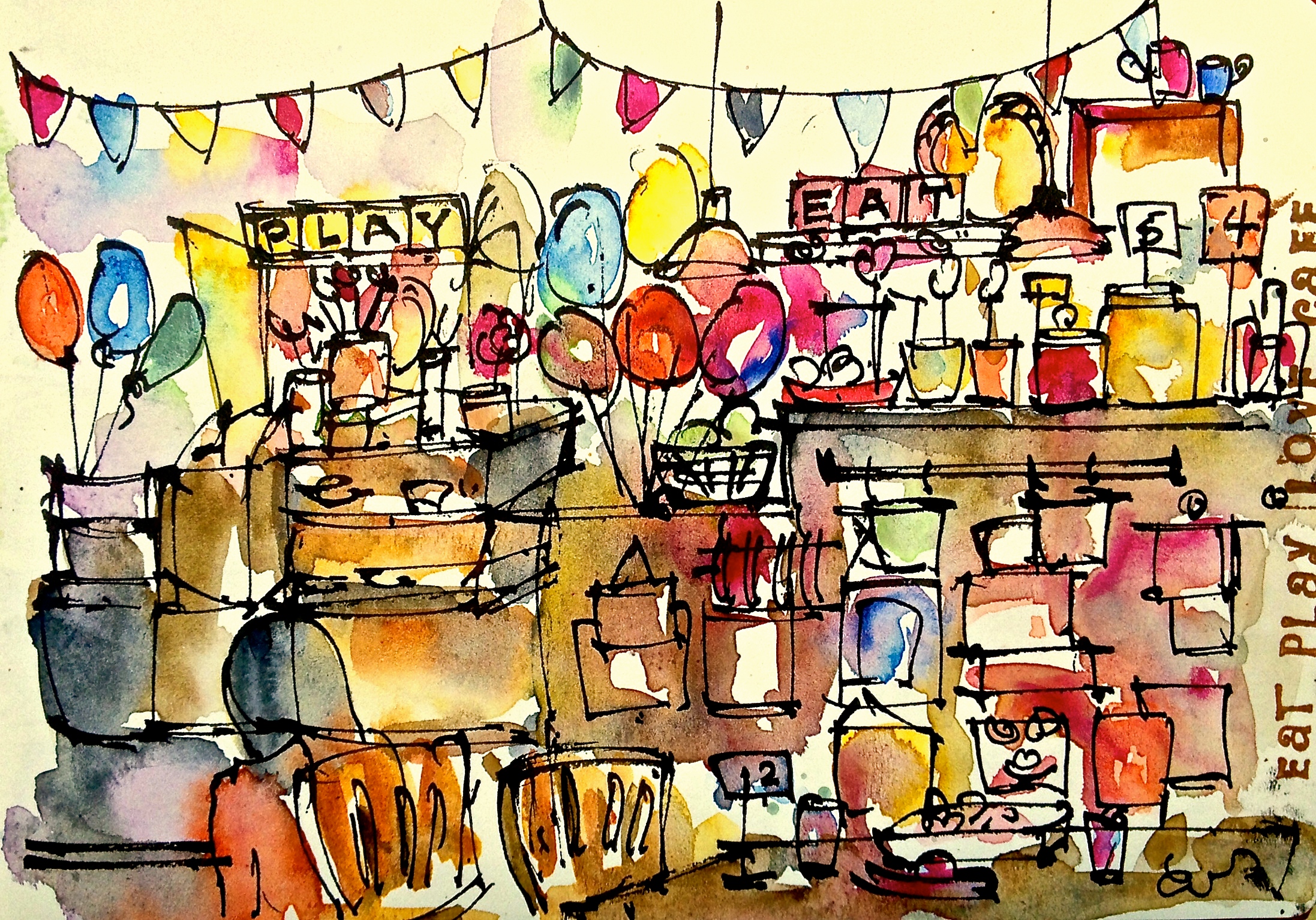
Eat Play Love Cafe

I have always been amused by the predicament of folks visiting cafes with small kids. Unless the child is tiny enough to be strapped to a stroller with a pacifier inside its mouth – basically tied and gagged – parents have a problem. Okay, not so much a problem, but a challenge, a herculean task, of engaging a pint sized energy ball with the attention span of a hummingbird such that it is sedentary, at least for a little while so they can sip at their drinks and let their sleep deprived minds wander.

Now, if there are pigeons in the vicinity of the cafe, which is quite common in Singapore, that is good news, not for everybody though. These urban birds are the least flighty and the most purposeful creatures I have come across on this island. They have adapted surprisingly well with the country’s economic boom and change in lifestyle. Instead of gouging out worms from the soil (which is so last century!) they swoop down on molten chocolate cakes or puff pastries lying in front of unsuspecting patrons and parade in between tables, hawk-eyed, puff-chested and taut-bodied, without a tinge of remorse.

And it is this sight of pigeons marching on the tarmac, that holds an universal appeal to kids across the world. They would tear away from protective arms, squeal in ecstacy and scuttle after the birds, who are surprisingly unflustered, till they are about to be stepped on, which is when they spread their wings and fly few meters away only to be chased again. This hobnobbing can continue for hours, giving enough time and space for the guardians to ‘keep calm and enjoy their drink’.

However, if thou cannot spoteth pigeons, do not despair. I have also watched anguished parents slowly relinquish their grip on electronic tablets or smartphones and surrendering them to tiny hands that urgently tap away at them for hours on end. So there is that. Another trade-off for solitude and a cup of coffee.

Some make their kids carry homework or sketchbooks to cafes. But that doesn’t quite cut it. While you sit back, relax and are about to zone out with the steaming cuppa, the last thing you need is to be badgered for help in Math or to be asked what crayon to use to paint the hut. This is also when the spouse flashes the ‘I told you so’ look.

With a thriving cafe culture in the country, new cafes sprouting like mushrooms, and Time Out featuring yet another list of ‘best cafes on the island’, I was surprised some entrepreneurial 20-something-Melbourne returned-grad student hadn’t thought of catering to this niche already. With a book cafe (“a book themed cafe that offers a relaxed ambience and casual dining”) and even a cat cafe (‘we strive to give you the perfect combination of cats, coffee, tea and pastries‘) around, it seemed such an oversight. Untill one day I stepped inside ‘Eat Play Love’ on 28 Aliwal Street.

Eat Play Love

For S$5, kids get 2 hours of unlimited access to Eat Play Love cafe’s collection of crafts

From the taxi’s window, this calm cerulean blue space, fitted with wooden hand painted furniture and vintage signages, barrage of colourful crafts, toys and knick knacks looked especially eye catching. Once inside, prepare to be drowned in the cacophony of gleeful kids huddled at a crafts table – playing, painting, sketching, sticking, cutting, wrapping and what not, all by themselves. Their guardians have the peaceful look of a Zen monk. Life’s sorted.

However, if you’re there minus the bambino, well, a slightly uncomfortable feeling akin to showing up for class without books, may tug at your sleeve. Obviously, you cannot share or borrow these metaphorical books! But thankfully the cafe has enough room for you to slink away from the hubbub, grab a table by the window, sip a latte or aromatic tea infusion, read a book, paint and chit chat with your spouse.


Weekend morning trip to a bookstore

I have seen people queuing up for croissants and baguettes outside bakeries on a weekend morning, or waiting for breakfast at cafes after walking their dogs or heading to yoga classes with a lurid pink mat under their arms, but I’ve never spotted people huddling outside a bookstore, checking their watch, waiting for it to open its doors.

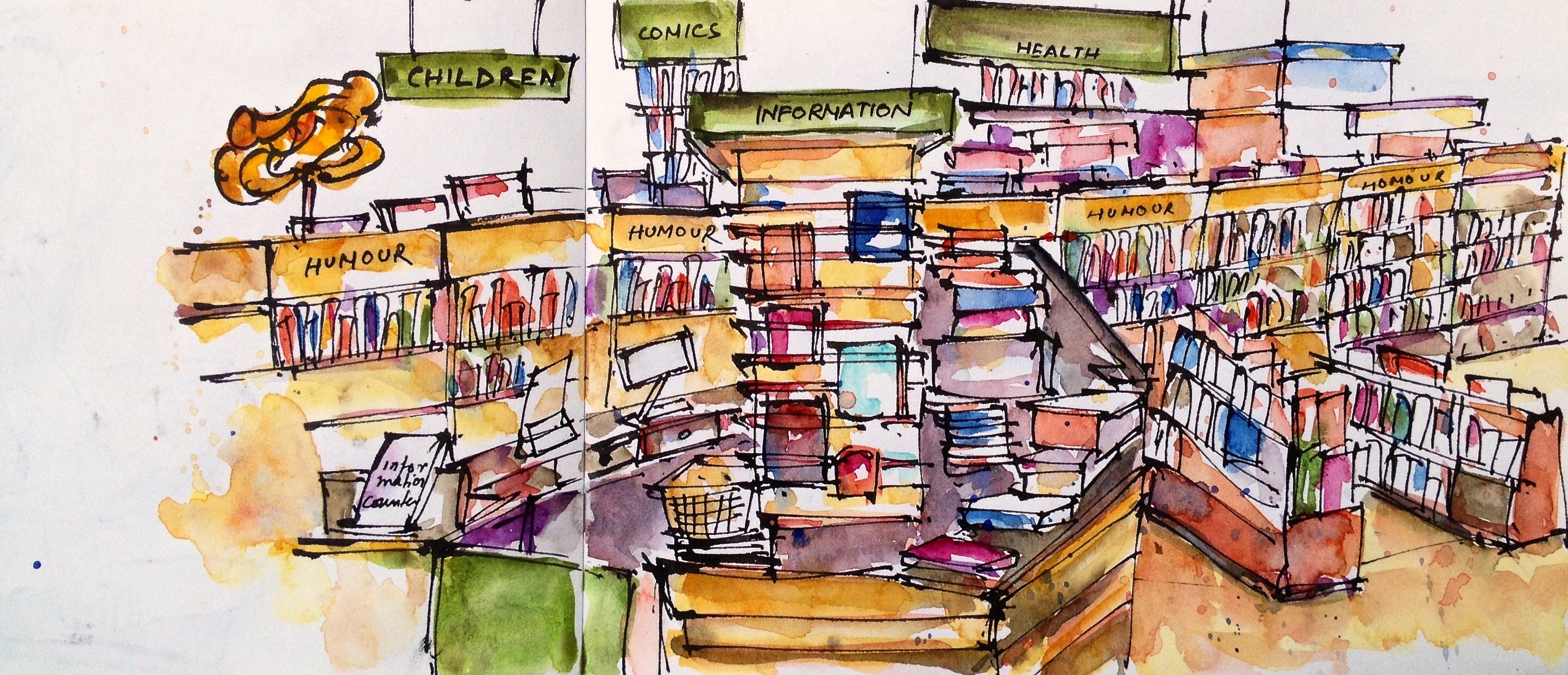
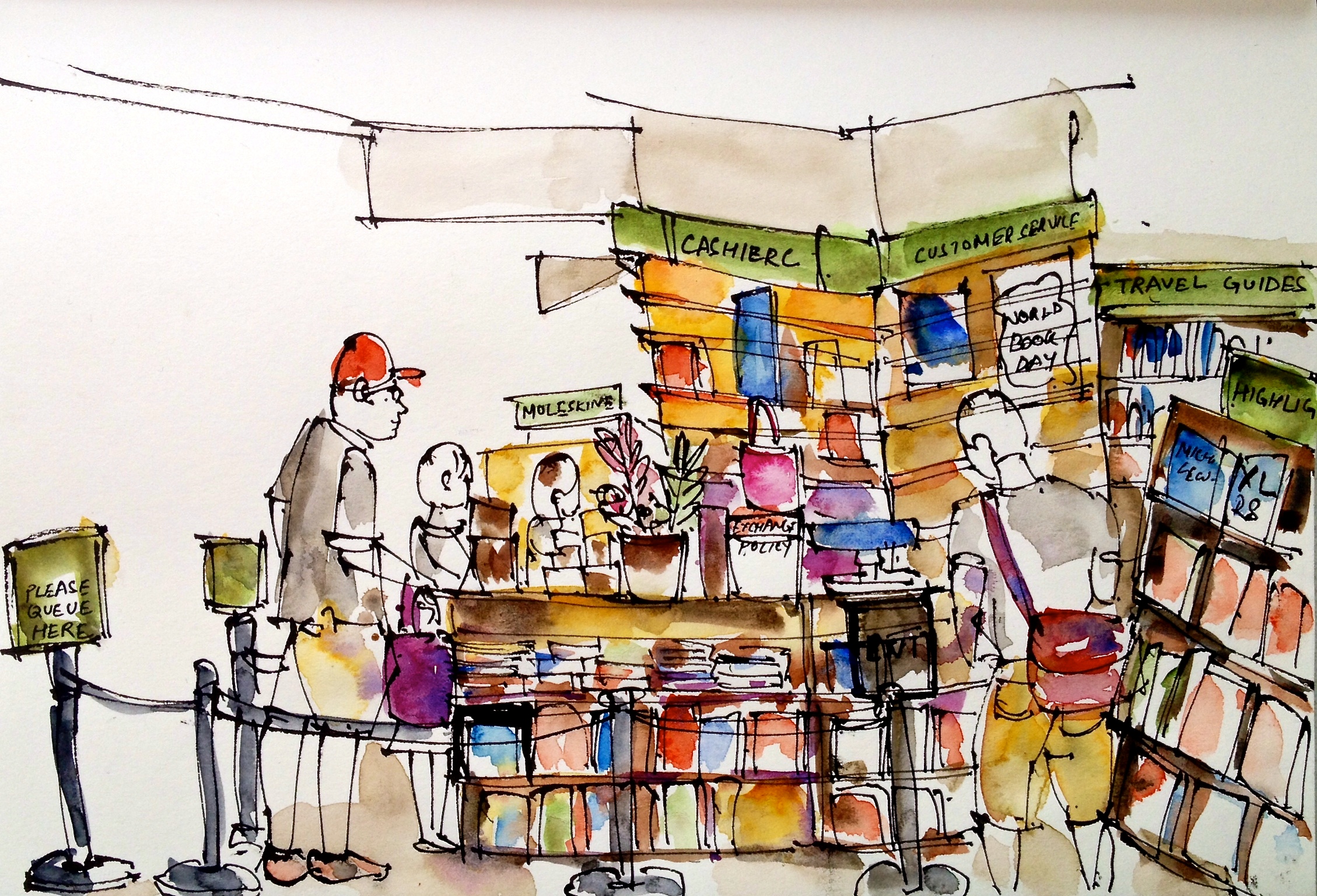
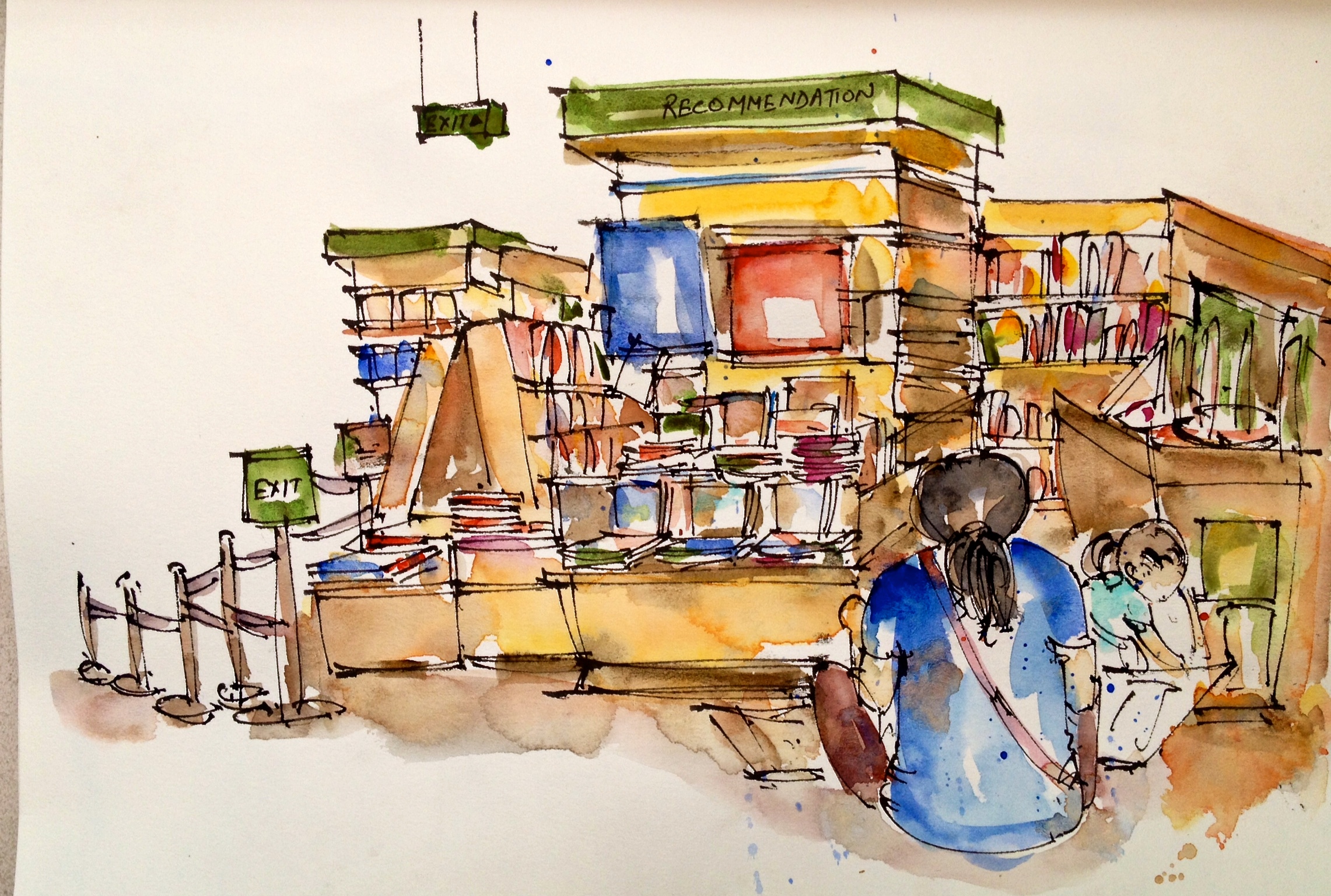
These people are my idols, my brothers (or sisters) in arms. I could have been any one of them or will be when my love for books trumps my desire to sleep-in on weekend morning. But today I am here with a different motive. Urban Sketchers Singapore have been allowed to invade the 43,000 sq feet space of Kinokuniya’s flagship store at Ngee Ann City for 3 hours. Why the privilege? Because the store is moving out and when it does, our sketches will serve as sentimental memorabilia.

Now before you start brooding and beating your chest in agony, Kino is not vamoosing for good. It is just moving to the floor above, which – here comes the caveat – will be a smaller space. So if anything, you should be worried about the possible downsizing of your favourite section.

As for me, I am rapidly using my Kino gift cards to buy more books to propitiate the mighty book goddess, praying that my favourite Art and Design section remains forever bountiful. Add to that the travel literatures and also the cookbooks. And the classics.


The books were calling my name, especially the art & design section. It was very hard to concentrate.

The books were calling my name, especially those from the ‘art & design’ section, right behind me. It was very hard to concentrate.

In the age of small screens, it is reassuring to see people buy the real thing.

In the age of small screens, it is reassuring to see people buy the real thing.

Thumbs up for this mother (also an urban sketcher) who brought her munchkin to a bookshop early morning.

Thumbs up for this mother (also an urban sketcher) who brought her munchkin to a bookshop early morning.

Ignoring the resounding book pleas and sketching more shelves. I am a saint!

Ignoring the resounding book pleas and sketching more shelves. I am a saint!

Skewer-y Thaipusam

“I am Karna”, said a voice on my right. Since I didn’t look up from my sketchbook, he said, “You know Karna, the warrior prince from Mahabharata? ”. When I am sketching in crowded public spaces, I am used to people peering over me, breathing over my neck, appraising my work like art connoisseurs, pointing cameras to my face, nudging friends to take a look, but rarely does one talk to me while I am working, except slipping in a few words of encouragement when they leave, to which I nod or smile in bashful acknowledgement.

 
But not Karna, the warrior prince from Mahabharata. He wanted to butt right in.
 
Thaipusam celebrations in Singapore

Thaipusam celebrations in Singapore

 
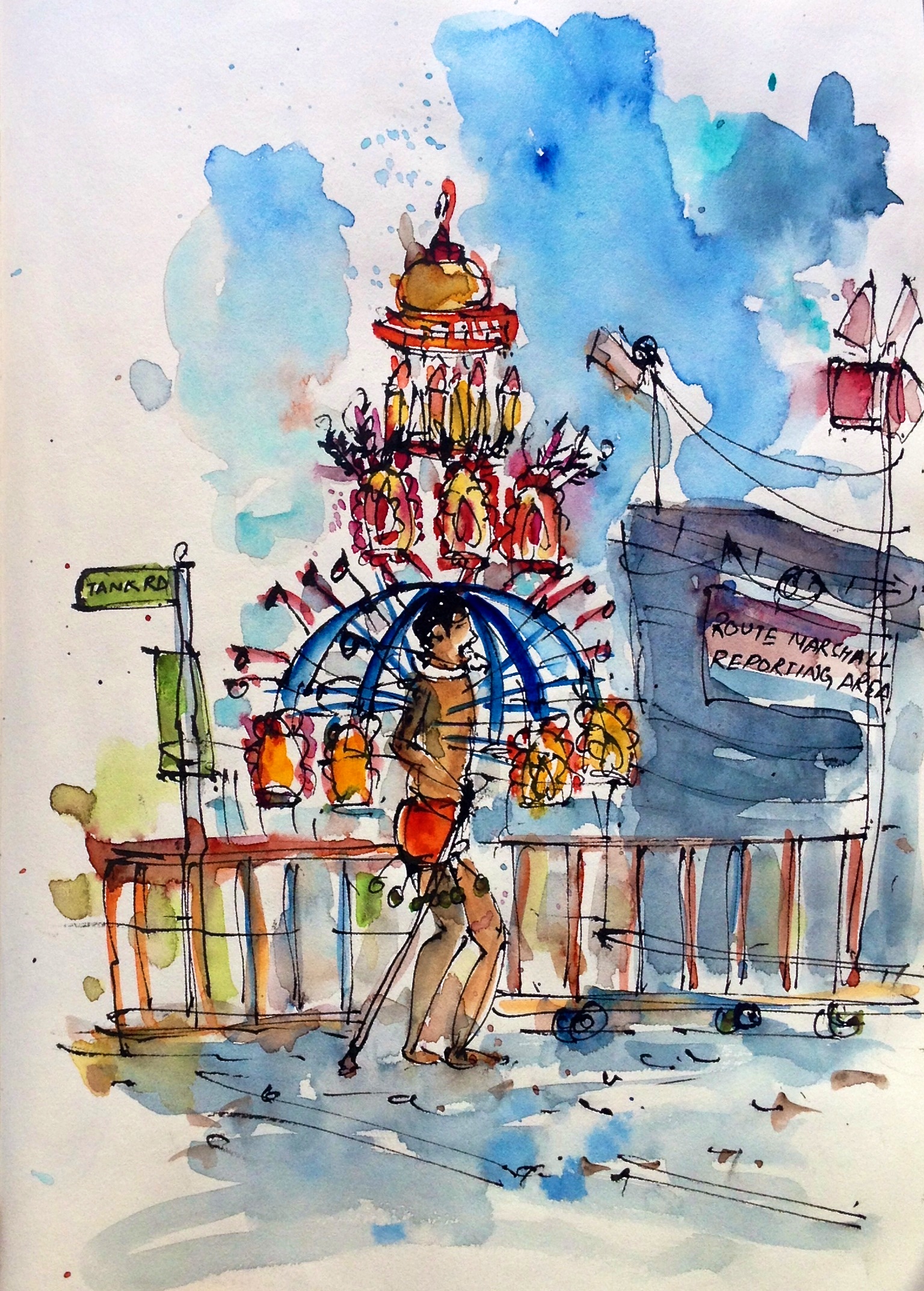
His gigantic frame in an untucked white pinstripe shirt and loose trousers leaned against the yellow barricade and faced me. A mop of dark curls, slick and shining with oil was pushed back; round dancing eyes like two pingpong balls smiled under the shade of bushy eyebrows and an inch wide moustache revealed the largest, whitest pearls I had seen in a long time.  ’The skill you have there’, he said pointing to my sketches and folding his hands and looking heavenwards, ‘is God’s gift’. He scrunched up his eyebrows such that the long tilak on his forehead disappeared between the folds. First time in my four year stay in Singapore, when I finally mustered the courage to watch Thaipusam – a Hindu festival celebrated by Tamils by honouring Lord Murugan –  up close, I was victim of small talk.
 
Thaipusam in progress

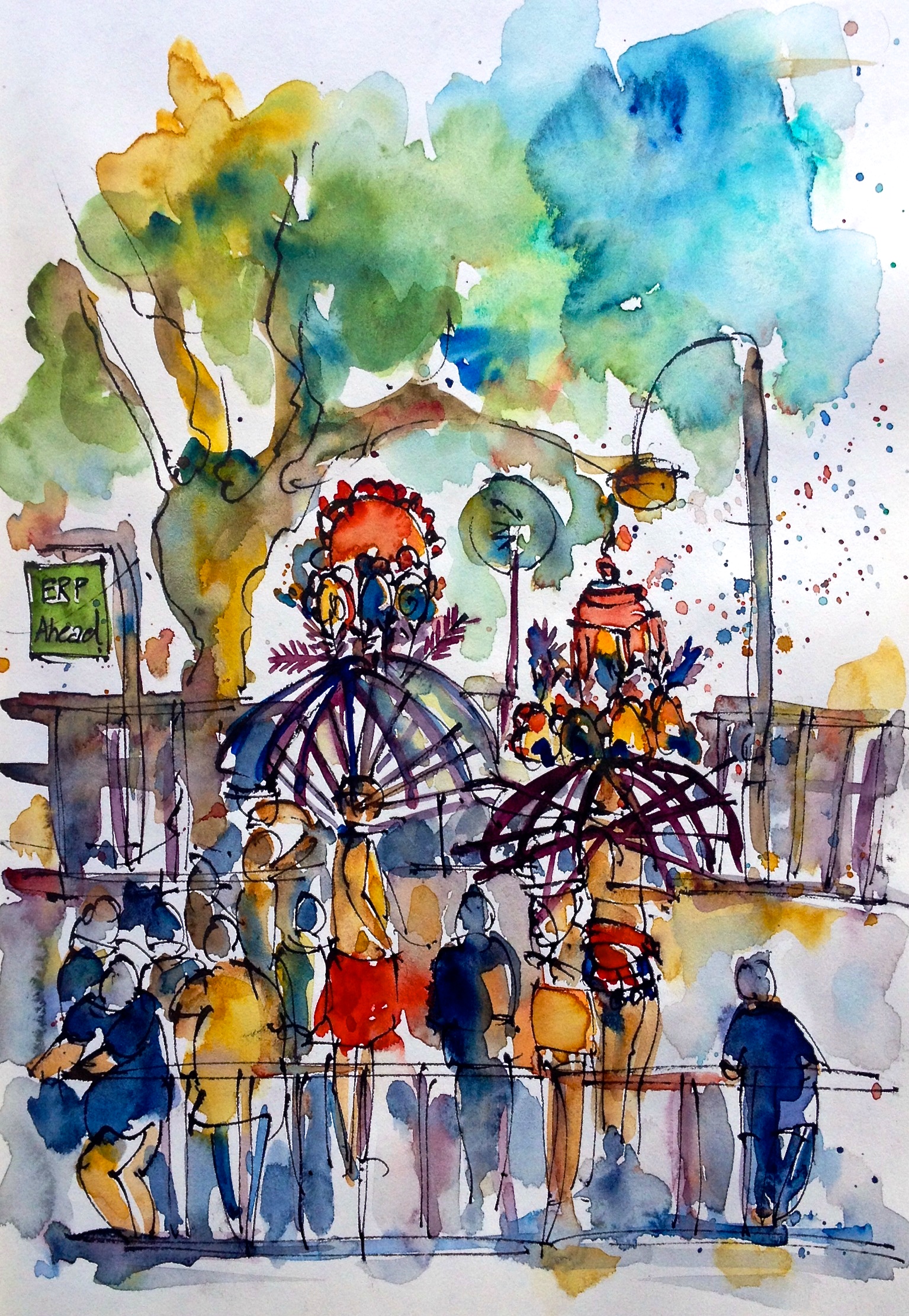
The kavadi bearing men are bare chested, bare footed and wear yellow, orange or red loincloths

 
But, when you’re on foreign soil and want to make sense of the place, it isn’t a bad idea to indulge local voices to tell you their stories, from their perspective, laced with their sentiments. I didn’t want to kill the story yet, if there was one. So waving at the pilgrims, I asked Karna, a question that was on the top of my mind, “Aren’t they in pain?”.  There was no blood, it was hard to tell.
 
 
“When you fast and pray for 48 days, your body is prepared to endure such pain”, said Karna,  slightly irked at the mushy overtones. But for the uninitiated, Thaipusam is extreme. Thaipusam isn’t for the faint hearted. Even the befuddled spectator needs to keep her nerves. The sight of these men, regular men – perhaps one of them is your office colleague, your school teacher, a neighbourhood grocer – turn into a pincushion overnight, with scores of metal skewers fastened to their chest and back, one going right through the cheek or tongue, a gigantic, elaborately decorated canopy balanced on the head will elicit the question I just asked.
 
 
But bearing a kavadi or physical burden by undertaking such painful ventures is how one expresses gratitude to Lord Murugan, the god of war and victory. “In return the god, protects you from misfortune.” says Karna.  As each devotee passed by, I searched his eyes for signs of exhaustion, discomfort, resignation. All I got was a misplaced sense of calm.
 
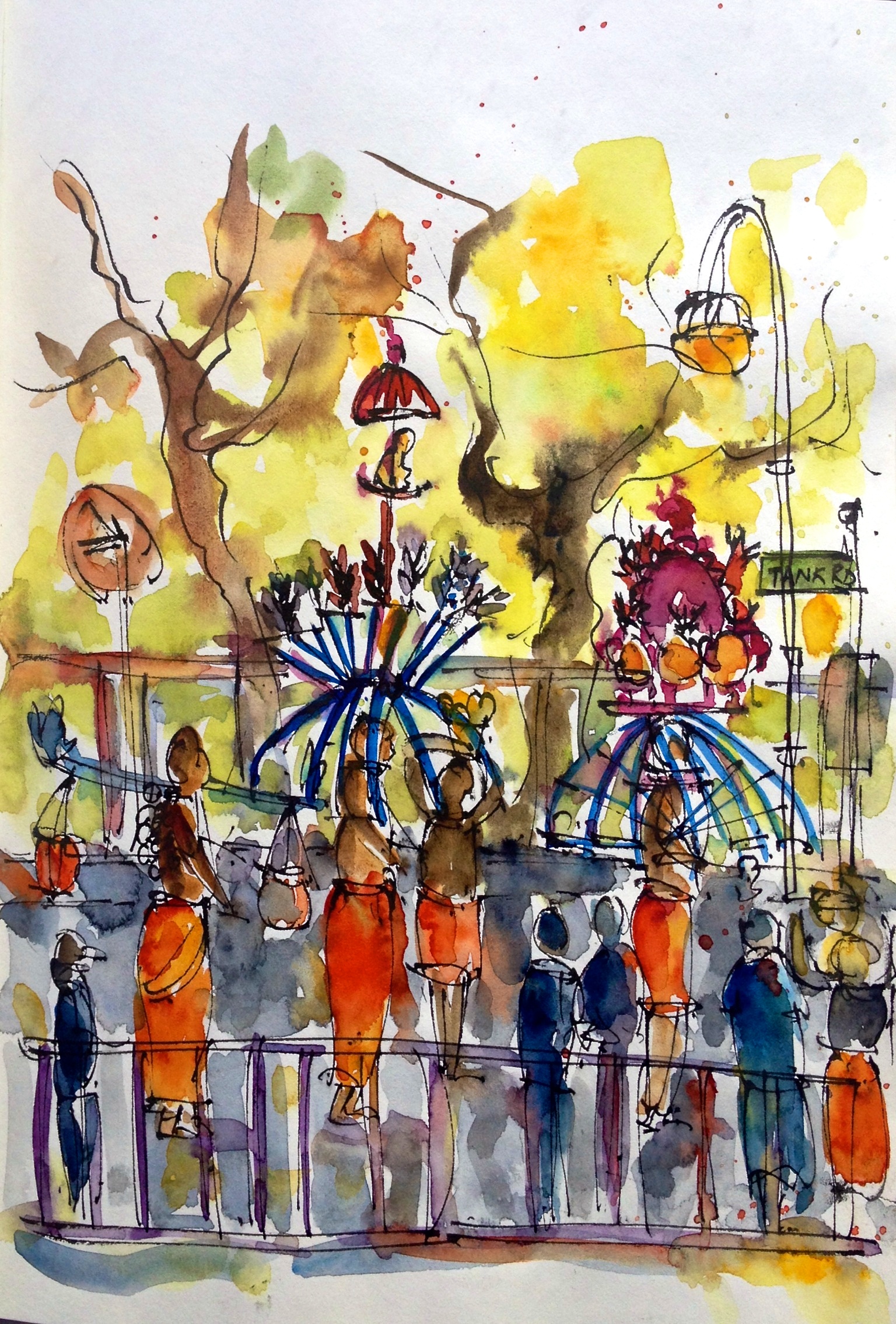
Devotees approaching Tank Road

Devotees approaching Tank Road and the supporters are cheering them on, singing religious songs and clapping

I had joined the procession midway on foot from Dhoby Ghaut station, and reached Tank Road, where they were slowing their march and queuing up to enter the Sri Thendayuthapani Temple, which would terminate their 4.5 km trek from Sri Srinivasa Perumal Temple in Little India. Canary yellow barricades had been laid on roads directing the devotees and separating them from the curious spectators, omnipresent photographers and culture-shocked tourists. Volunteers were directing people at road crossings with urgency and handing out water in plastic cups and food from capacious tents pitched along the road, to exhausted participants and their families who were walking with them, cheering them on, singing religious hymns to drum beats. The police were calm and observant from their posts.
 
Close-up of a Thaipusam participant

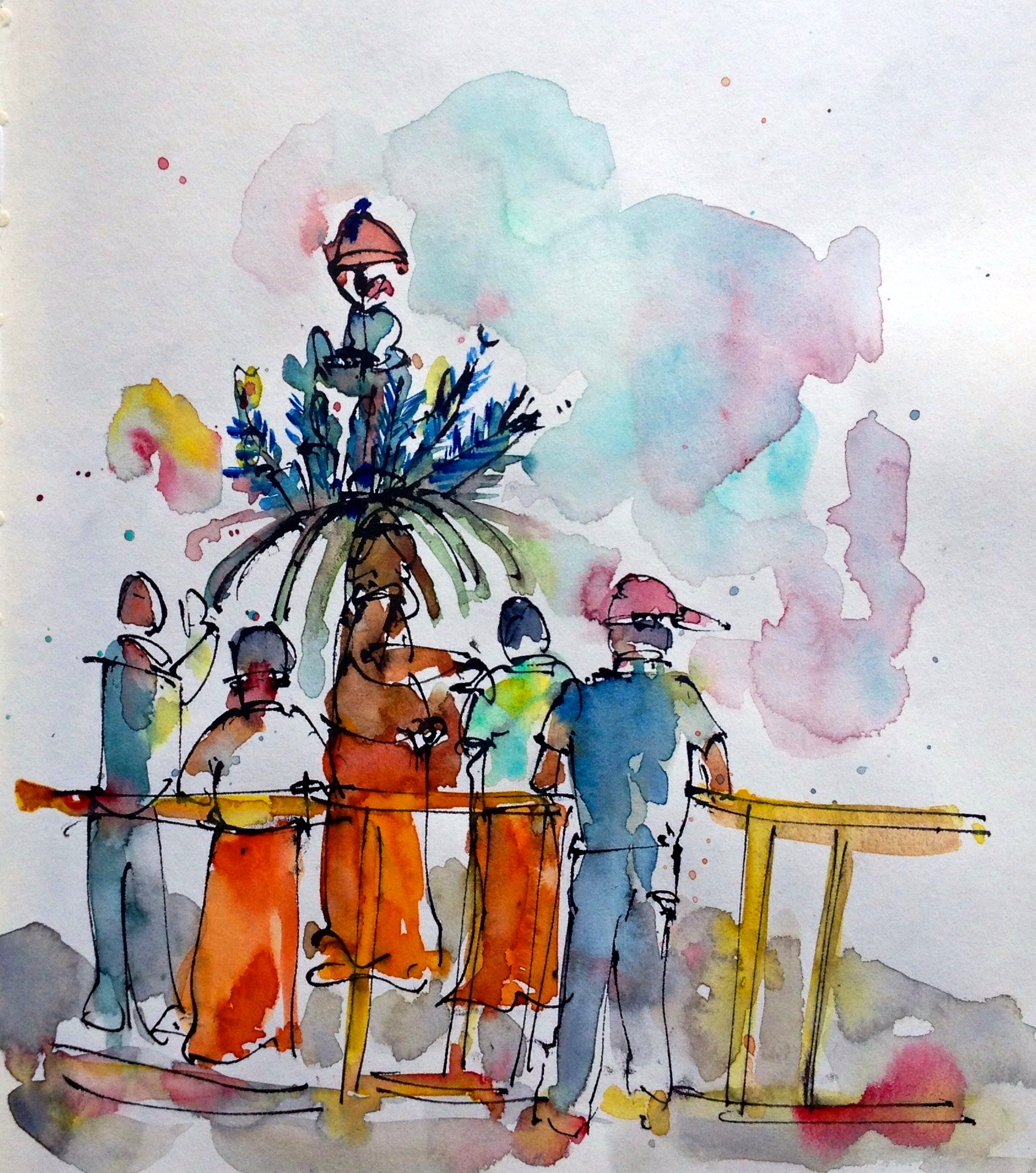
Some kavadis are flower and peacock feather embellished wooden structures with arched metal frames that are supported by skewers hooked to the chest and back of the bearers.

 
‘It wasn’t like this before, you know’, said Karna, when a group of devotees slowed before us, offering a close up. A bunch of supporters, perhaps friends and relatives circled a thickly skewered and canopied man and broke into a perky devotional song, clapping their hands animatedly. The man started swinging and swaying to the chants along with his kavadi. The ankle bells tied to his feet tinkled. The energy was palpable. I don’t understand a word of Tamil but my feet didn’t need to. They were tapping on their own.
 
“Even a few years ago, there was much greater fanfare and spirit; now there are too many restrictions on what you can and cannot do”, said Karna, reminiscing. “ The music used to be so loud, it would ring in your ears long after you left.”
 
Thaipusam in progress

A kavadi bearer, swinging to the beat of drums

I was frantically sketching, trying to capture the guy with at least three dozen lemons hooked to his back, quickly outlining the exhausted drummers catching a breather and getting the many kavadi bearers balancing a gigantic mass of flowers, peacock feathers, folded metals and sharp skewers down on paper. The jubilant yet awestruck crowd guarding the fanfare made the scene complete. There was almost a kilometre long wait to enter the temple and at having their subjects come to a halt, the photographers went delirious.
 
Kavadi bearing devotee swinging to the drum beats

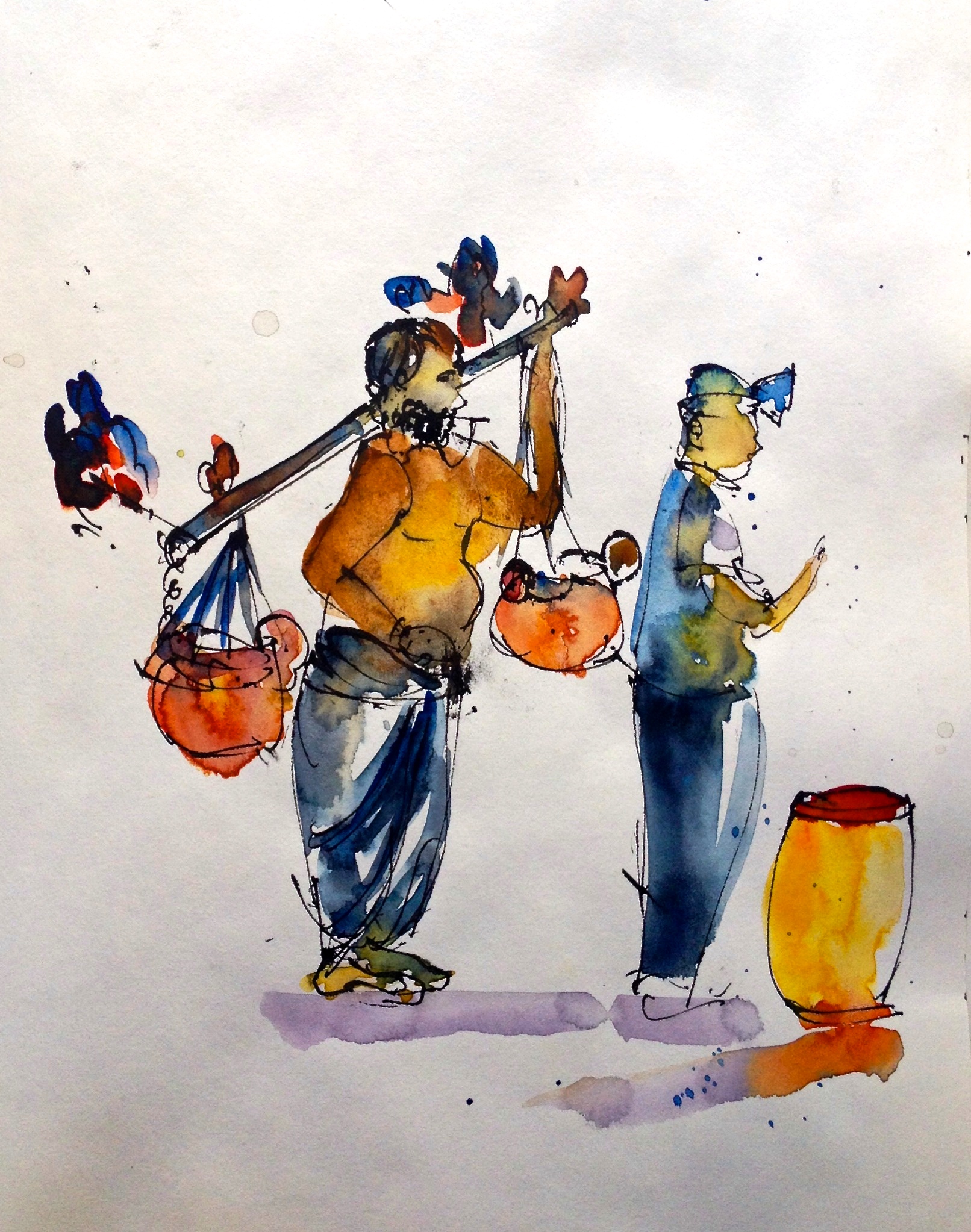
A not-so-extreme kavadi of milk pots balanced on a wooden rod. He still has his tongue pierced.

Few steps away from the temple door, decorated with banana leaves, a pilgrim was approaching with his kavadi on two wheels. It looked like a wooden toy chariot. The steel skewers hooked to his back flexed under the load and stretched his skin, while he negotiated a bump on the uneven stretch. Standing on the sides, we clenched our fists and held our breath. The remaining few steps would end his arduous yet spiritual journey. He tilted his head, arched his back and pumped his chest. Then he pulled hard. The sidekicks cheered him as loudly as they could, their heave-hos bold and distinct, but the kavadi slumped back. Others glided past him with no trouble. Some people have a bumpy ride till the end. Or perhaps he’d asked for a much bigger favour.
 
The pilgrims entering Sri Thendayuthapani Temple to offer their kavadis to Lord Murugan

The pilgrims entering Sri Thendayuthapani Temple to offer their kavadis to Lord Murugan and end their arduous trek

 
Pilgrims exiting the temple, freshly relieved from their kavadis, seemed visibly transformed – smiling and spirited – with only red holes on their body – that they were now proudly flaunting as a proof of their penance.
 
Karna didn’t accompany me till the end. In fact, midway through our conversation, he abruptly shook hands, wished me luck and left me alone to experience the festival and make my own stories. When I reached home, the songs, the chanting, the drum beats and fervent clapping were still ringing in my ears. I think Karna would’ve approved.

Jones the bugger

Jones is not a bugger. He’s a grocer. Well, I don’t know who exactly he or she is per se but the black and white sign hanging at the cheerful, laid back cafe filled up to the brim with people, caught in the post Christmas and pre-New Year limbo definitely said – Jones the Grocer. Why the insinuation? I’ll come to that.

I was having a perfect day. And by a perfect day anywhere in Singapore, I mean – great weather (of course!) combined with a great location combined with an even greater pursuit. The sun was pinned down by cherubic cotton candy-ish clouds. They wouldn’t purge until late afternoon. It was all sorted. The early morning breeze was refreshingly cool and gentle on the skin but pitiless on the gigantic trees, that seemed to be swinging in response to some invisible political agenda and saying yay or nay.

Pasardina Fine Living

Pasardina Fine Living

And I, who was chuffed at having an otherwise crowded Dempsey Hill – a 1860s military barrack refurbished and rebranded as an entertainment and lifestyle enclave – all to herself, and a handful of other sketchers, was sent volleying towards my loose sheets of handiwork that flew away the second time in the last half hour. I didn’t mind at all.

Plonked on my yellow folding stool and armed with art ammunitions, I faced Pasardina Fine Living at 13 Dempsey Road, one of the lifestyle stores, out of many in this bohemian jungle retreat and was trying to frame the scene in mind before putting down on paper. Should I include the giant rain tree on the right with silver Christmas decorations hanging from it? How about the island with the signboards and a Balinese stone sculpture as a foreground? “Yay or nay?”. Yay said the trees.

If you’ve lived among anorexic concrete and reflective glass high-rises for too long, the architecture out here will seem earthy, extravagantly stretched out and stunted but oh-so pleasing to the senses, as if you’ve just unbuckled a tight leather belt after a heavy meal and let your tummy expand to it’s fullest girth. During military camp days, each building in the barrack was built to accommodate at least 50 soldiers, which explains their dorm-like architecture. Pasardina’s three tiered red tiled roof structure looked spacious and airy with the many windows built for ventilation in a tropical climate. Woody Teak Collection on my left, which I tackle next, is even longer.

Woody Teak House

Pleasant and unhurried as Dempsey Hill was at that hour, I knew the impending weekend rush would reclaim it eventually. Cars, shiny from their wash, were already pulling up into the driveways of cafes and garden restaurants for their morning cuppa and breakfast. Instead of marching soldiers, today we have hyperactive kids spilling out on the expansive tree lined roads in the precinct and upon discovering one thing that Singapore is terribly short of – space – and lots and lots of it, 213 acres to be precise, they start running amok in every direction with wild abandon. I fish out my watercolors and quicken my pace.

When it comes to eating, I have been privy to Dempsey Hill’s chic dining culture being branded as ‘atas’, which in local lingo means snobbish or highbrow. On a previous visit, I was bemused by seven red Ferraris decorating Dempsey’s parking lot, if that’s any indication of the flock visiting this area. But to put things into perspective, a plate of sublime and appropriately filling Fish Croquette Benedict at PS Café, costs a little over 20$, which isn’t unreasonable given the quality and ambience, but is probably six times of what you’d pay at a food court.

Atas or not, we planned on having lunch here because once in this dreamy resort-like enclave, you’d want to stretch your time as much as possible. Plus, PS cafe at 28B Harding Road, has the best truffle fries and has a shaded, partly obscured stone pathway leading to a dining area in a glass gazebo with an open verandah running along it’s side. You are barricaded from all sides by stupendous trees and unhindered vegetation. And above the din of clinking wine glasses and fluttering bus boys, birds sing, cicadas hum and frogs croak. Nowhere in SIngapore did we feel so nestled and cocooned by nature.

Jones the Grocer is where we have the talk

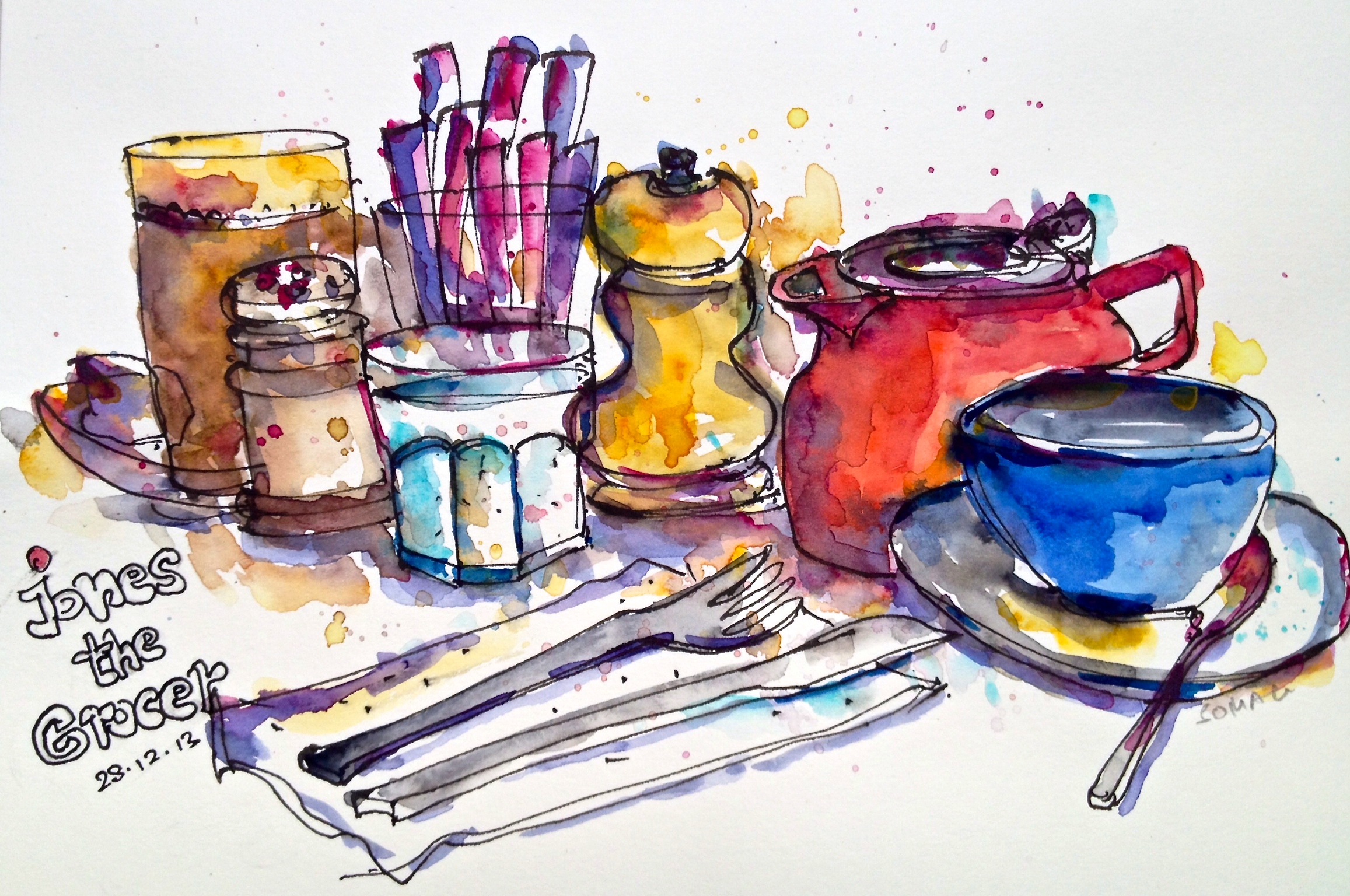
Jones the Grocer

Wouldn’t we linger for a cup of tea or coffee perhaps before leaving? We most definitely would and that brought us to Jones the Grocer at 12 Dempsey Road. I promptly sketched the set up with the red teapot brewing my berries infusion, my husband’s glass of cappuccino with marshmallows, the sugar sachet holder, the salt and peppershaker, which together made a great bunch of props. Like every other barrack building, this too had a cheerful verandah going round it, now fitted with tables, chairs and high stools. To verify, the ‘grocer’ bit I checked the interiors, which along with a seating area and kitchen, had all sorts of pasta, pesto, olive oil, cheese, charcuterie, on shelves and inside temperature, controlled glass case.

Everything was perfect, till we did the thing. The ‘thing’ everybody does before fresh starts, before going on to the next grade, before starting a new job, before upgrading to a new phone, before relocating to a new country, before, like two days before starting a new year – contemplate. And because they are from two different planets, men and women do not contemplate the same way. While one is drawing up mental Excel sheets of current year, last year and the new year’s goals and agendas in tabular form, the other is trying to remember what he had for lunch.  What follows is a game called ‘whose fault is it anyway’.

You mean it’s my fault?

Well, it certainly isn’t mine.

Then whose fault is it?

We never found out. But Jones got unsuspectingly tainted because of a stupid fight.