Tag Archives: drawing

Kindness of Mr. Potato Head

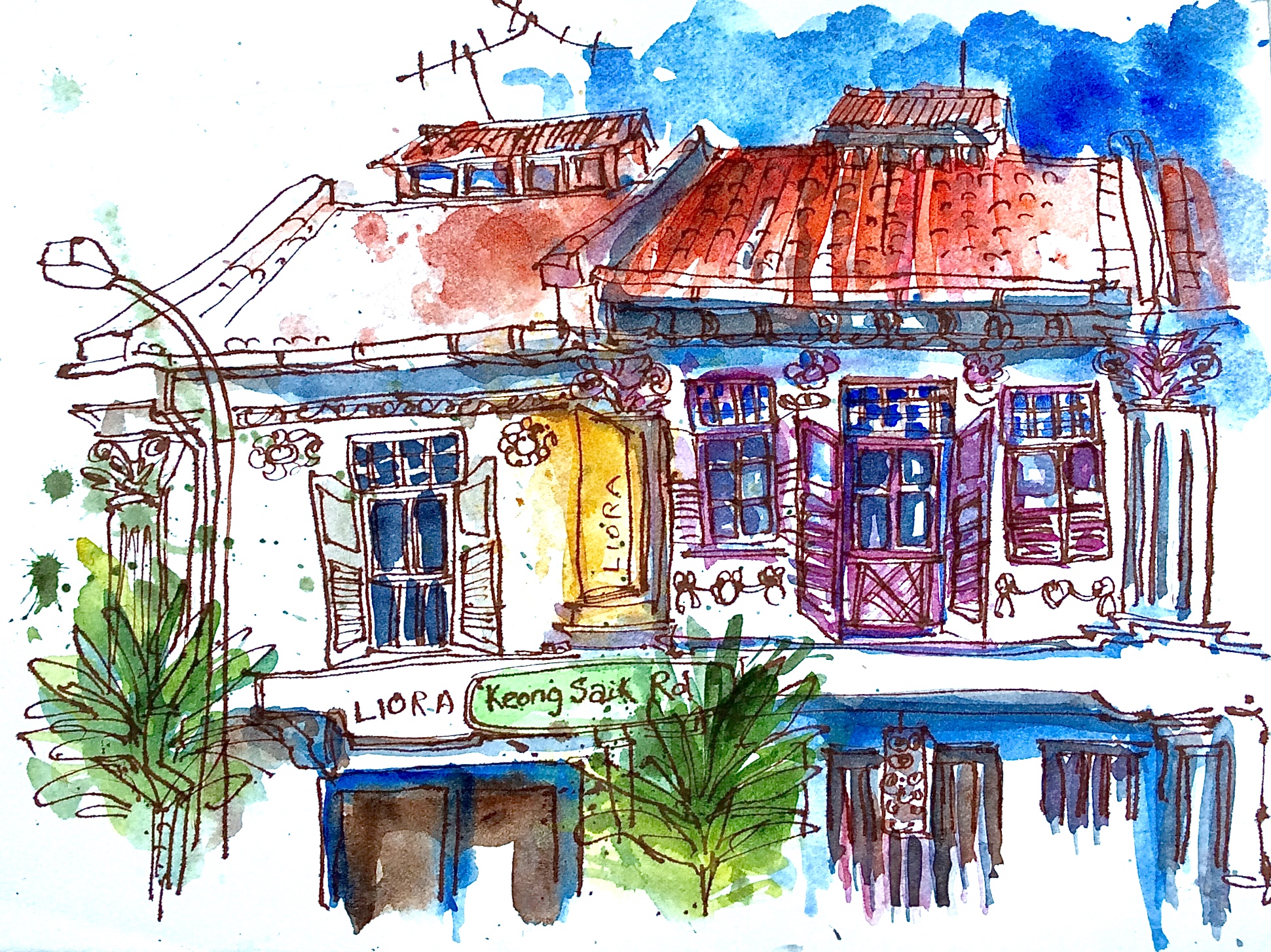
It so happened that on a bright sunny, excruciatingly hot and humid morning, a bunch of sketchers descended on Keong Saik Road and captured the five-footways of its shophouses for three hours of intensive sketching.

Easels were set up, field chairs were pulled out, pigments, palettes, brushes, pens, pencils, charcoal, mounds of Artist grade paper and large plastic mugs of water appeared. Rolls of kitchen towels and packets of tissues were kept by the side. Sunscreen was rubbed, sunglasses were donned and stretchy UV protecting sleeves were worn on arms. Wide brimmed hats and baseball caps crowned every head.

Potato Head Folk

The 1939 Art Deco building with red border on the left houses Potato Head Folk – a burger joint on Keong Saik Road

And while we braved through the day, observing, sketching, painting and spurring each other on beads of sweat trickled down our backs and bloomed on our foreheads. In the absence of breeze, not a single leaf or a strand of hair moved. The air’s oppressive stillness clung the clothes to our bodies, forming dark, damp patches.

But then just as the morning turned into afternoon and became increasingly heavy with languor, respite came.

I was at the intersection of Keong Saik and Teck Lim Road, sketching this iconic pre-war building with bright red borders  when I saw a uniformed staff of Potato Head Folk – a burger joint that replaced the famous 75 year old Tong Ah Eating House- approach us lugging a bucket filled with green glass bottles.

Shophouses along Keong Saik Road

Preserved shophouses along Keong Saik Road – one of the prettiest section of Chinatown, Singapore

“Here, have one”, she said handing me a chilled bottle of mineral water. I may have snatched it and gulped its entire content down my parched throat before thanking her. ‘No worries. My boss saw you’ll sketching in the heat, so he sent these’, she added and moved on to other dehydrated souls.

The weather continued to be gruelling but Mr. Potato Head’s benevolence had already injected vigour into the listless air. We picked up our brushes and marched on.


Allure of the Back Alley

I don’t know about other places but Singapore has one of the most alluring back alleys.

In my five years of life here, I’ve come across some beauties in Tiong Bahru, Geylang, Jalan Besar, Kampong Glam, Joo Chiat and Bras Basah. There must be countless more in many other neighbourhoods waiting to be noticed, admired, talked of, written about by some passersby who’s using it as a short cut to the next parallel road or to the car park this very moment. I hope he’d slow down and look around.

I know, I’ve always wanted to find a proper excuse to linger in these intimate spaces that have way too much character. Without startling the wayward neighbourhood cat or the dumpster diver, the only way to do this was to sit down and draw this beautiful mess.

Back Lane of Seah Street.  

This is the back lane of Seah Street.  To combat overcrowding, back lanes were retrofitted to already existing shophouses in the early 20th century, to provide access for fire fighting, drainage and ‘scavenging’ – which in this case refers to allowing night soil carriers to collect human waste from each house. Thankfully those days are behind us!

And so I did. As you can see, there’s a lot going on, each element adding to the overall characteristic of this grubby stretch – a large green dumpster, a chipped wooden door, a spiral staircase, air conditioners, ducts, vents,  cables, wires, pipes, switchboards, broken wooden planks, windows, wired fence, tinned roof, tiled roof, a bamboo pole sticking out with wet laundry, cracks, damp stains, spots, litter, cobwebs, weeds and what not. Don’t miss the bright red drum cylinder on the bottom right, used for burning offerings during the hungry ghost festival.

And this is only a small section of the alley that I captured in the 15 minutes I had. There’s so much life in here!

Abeautifully grubby back alley in Geylang

A beautifully grubby back alley in Geylang Serai.

And not all of it is still. While I was here, I met the back alley denizens. They were mostly in uniforms – chefs, cleaners, waiters, drivers, some sitting on their haunches, smoking, others unloading a truck of supplies or sweeping the litter or rushing out of the hot restaurant kitchens to get fresh air. It would’ve been business as usual except I was turning out to be a rather amusing distraction with my yellow stool, sketchbook and all.

At first they ignored me, only stealing furtive glances, but when they saw me staring forlornly at the squalor for a prolonged period, they warmed up.  Each of them came over to chat, but mostly to criticise my work. It seemed like the obvious thing to do. And they were brazenly forthright. Amid snorts, grunts and sterile stares, I may have snagged some approving nods.


Destination or the journey?

Even though I sketch and paint quite often, it’s hard to see progress in every piece I produce. If progress was climbing a flight of stairs, I probably have my grandma’s arthritic knees. It does feel at times that I’m floundering about at the same place creatively. The hard part is to keep going and not relinquish to these soul sucking thoughts. The reward however is that they flee out the window the moment I make something I really like! The belief is reinstated.

But only temporarily. It leaves you too like receding daylight. Before you know, you’re pulling yourself up those metaphorical stairs again.

This below is not an ‘aha!’ painting, but I know I’m going to keep pounding, hammering, moulding, shaping whatever it is I’m creating on paper till I get there. It may take 10 paintings, maybe 20, maybe more to make something that gets the little hairs on my arms to stand up even once.

Seah Street

Seah Street in Singapore

But with both eyes on the destination, what becomes of my journey? An insipid, uninspiring wait for something to happen? The reason one is compelled to make art day after day is because creating something out of nothing is thrilling, inspiring, extremely fulfilling and a lot of fun. It is our impression of what we see and our expression of what we feel. Shouldn’t that be enough? Why guild the lily with expectations of ‘making progress each day’ or ‘reaching transcendence once in a while’ with your art? If anything, these should be byproduct of the journey.

This is what I’m telling myself today.


Trip to the Antipodes series : New Zealand (part I)

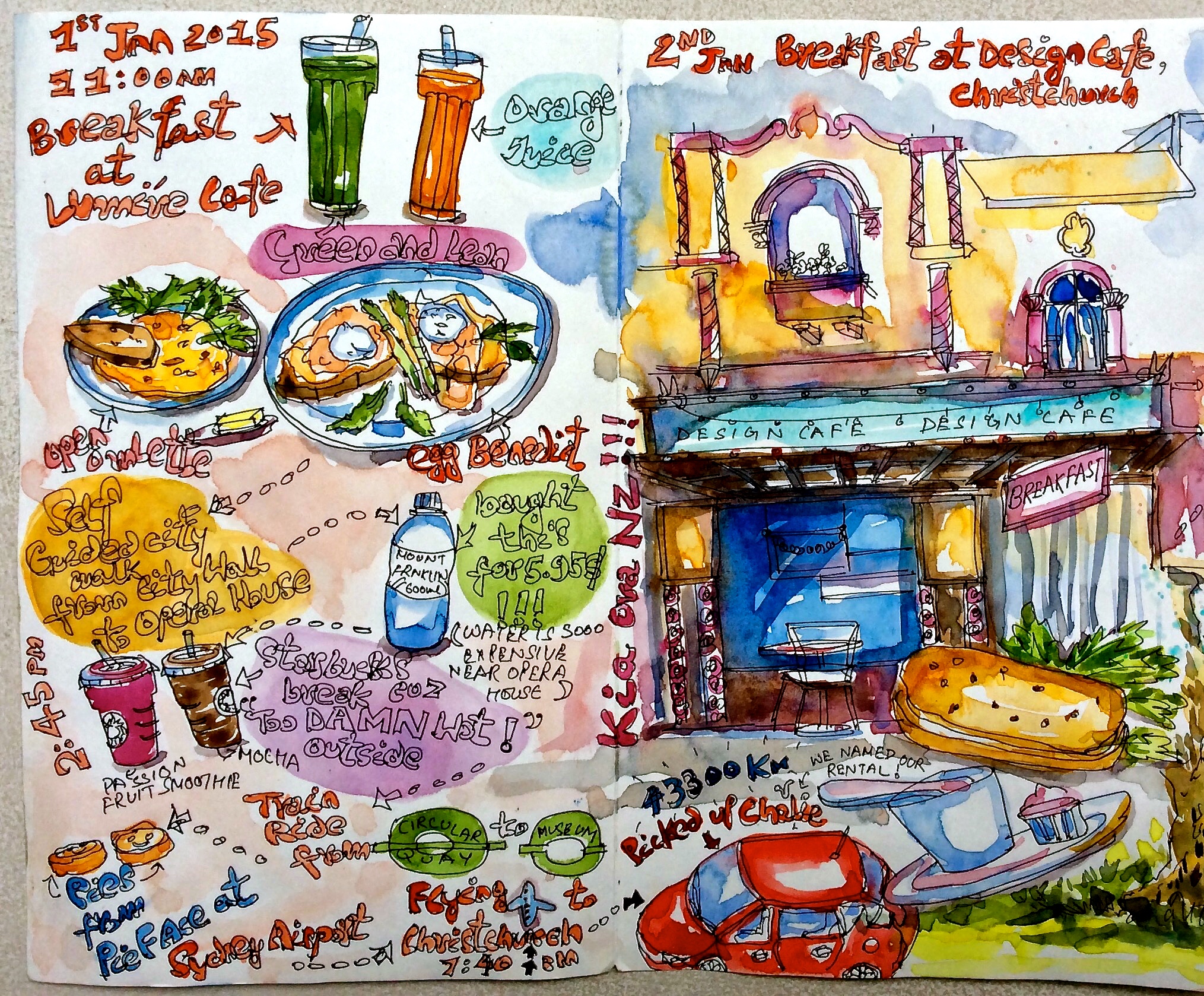
1st January 2015 : Sydney to Christchurch –  As you can see from my sketch I started the year with a tall glass of promising ‘Green and Lean’ juice at Lumiere Cafe on Bourke Street. Five seconds later, a massive portion of Egg Benedict followed. New Year resolutions be damned.

To work that off we voted for a walk from City Hall to Sydney Opera House and see the iconic building one last time. What seemed like a great idea, gradually lost its appeal as the day became hotter. Most shops were closed and there were understandably few people on the streets after last night’s revelries, making our stroll even less fun. The chilled passion fruit smoothie at Starbucks saved me from passing out before the flight.
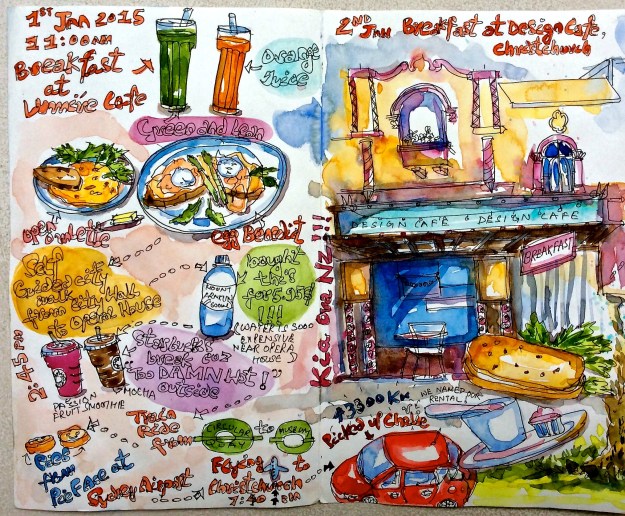
Sydney to Christchurch / 1st Jan : Highlight of the day was picking up Charlie from the airport.

Sydney to Christchurch / 1st Jan : Picking up Charlie from Christchurch airport was the only highlight of the day.

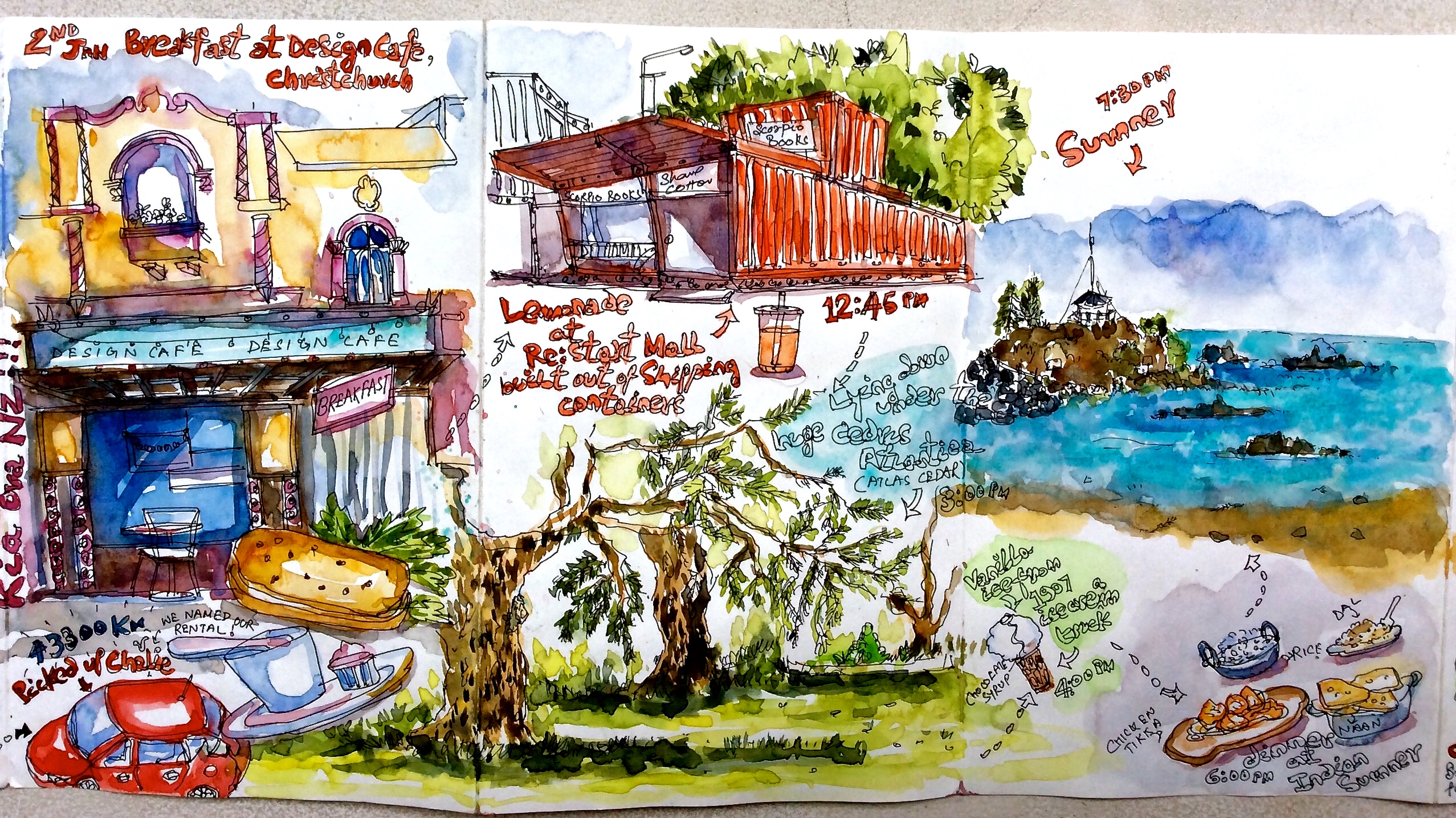
And then – Kia Ora New Zealand! We picked up Charlie, our rental car from Christchurch airport around midnight. John Steinbeck may have something to do with my naming our red Toyota Corolla. Charlie’s Odometer Reading showed : 43300Km at the time of pick up. I kept a record of the readings on my sketchbook to gauge how much we drove each day.

2nd January 2015 : Hanging out in Christchurch –  The scars of the 2011 earthquake, were prominent on Christchurch. Vast spaces lay bare in between buildings. We walked past piles of rubble, damaged structures, collapsed, stripped to the core with iron rods sticking out of them. It was heartbreaking especially the plight of the 100 plus years old Christchurch Cathedral. Outside these cordoned off areas containing the wreckage, the story was one of resilience and hope.

The Re:start mall seemed such a beacon. Everything from food, carpets, sweaters, shoes, clothes, souvenirs and kiwi knick knacks were sold from inside of colourful shipping containers! We shared a bench with a family from Wellington and sipped lemonade right in front of a bright red metal box that had become the home for Scorpio books.
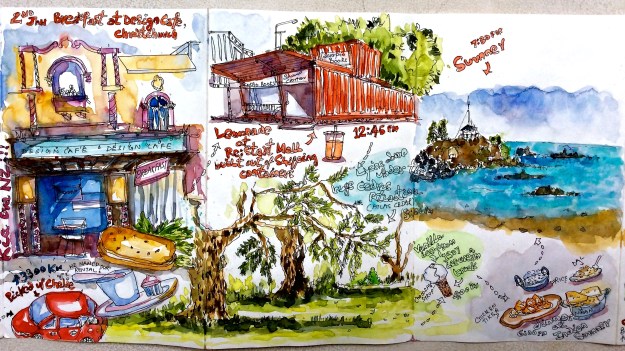
Christchurch / 2nd Jan : We had dinner at Indian Sumner, an Indian restaurant at Sumner. After surviving on Egg Benedict, Fish and Chips, sandwiches, wraps and burgers for days, a slice of home felt heavenly.

Christchurch / 2nd Jan : We had dinner at Indian Sumner, an Indian restaurant at Sumner. After surviving on Egg Benedict, Fish and Chips, sandwiches, wraps and burgers for days, a slice of home felt heavenly.

If there’s one place I’d like to return to in Christchurch, it would be the Risingholme garden, inside the Botanical garden. The serenity of nature, the meditative silence and the feeling of being minuscule, inconsequential amid the giant oaks, cedars, beeches and Spanish chestnut will remain special. I flitted from one tree to another, hugging, smelling, caressing their massive trunks, finally settling under the shade of Cedrus Atlantica, from where this sketch was done.

In the evening, Charlie drove us to Sumner – a pretty seaside suburb of Christchurch, about 12 km away. We watched a dramatic sunset and walked on the long beach in the golden light, listening to waves violently crash against the jagged rocks. It was cold, so we huddled up close to each other and held hands. For a little while, the poignant reminders of a brutal calamity writ large upon Christchurch was forgotten.

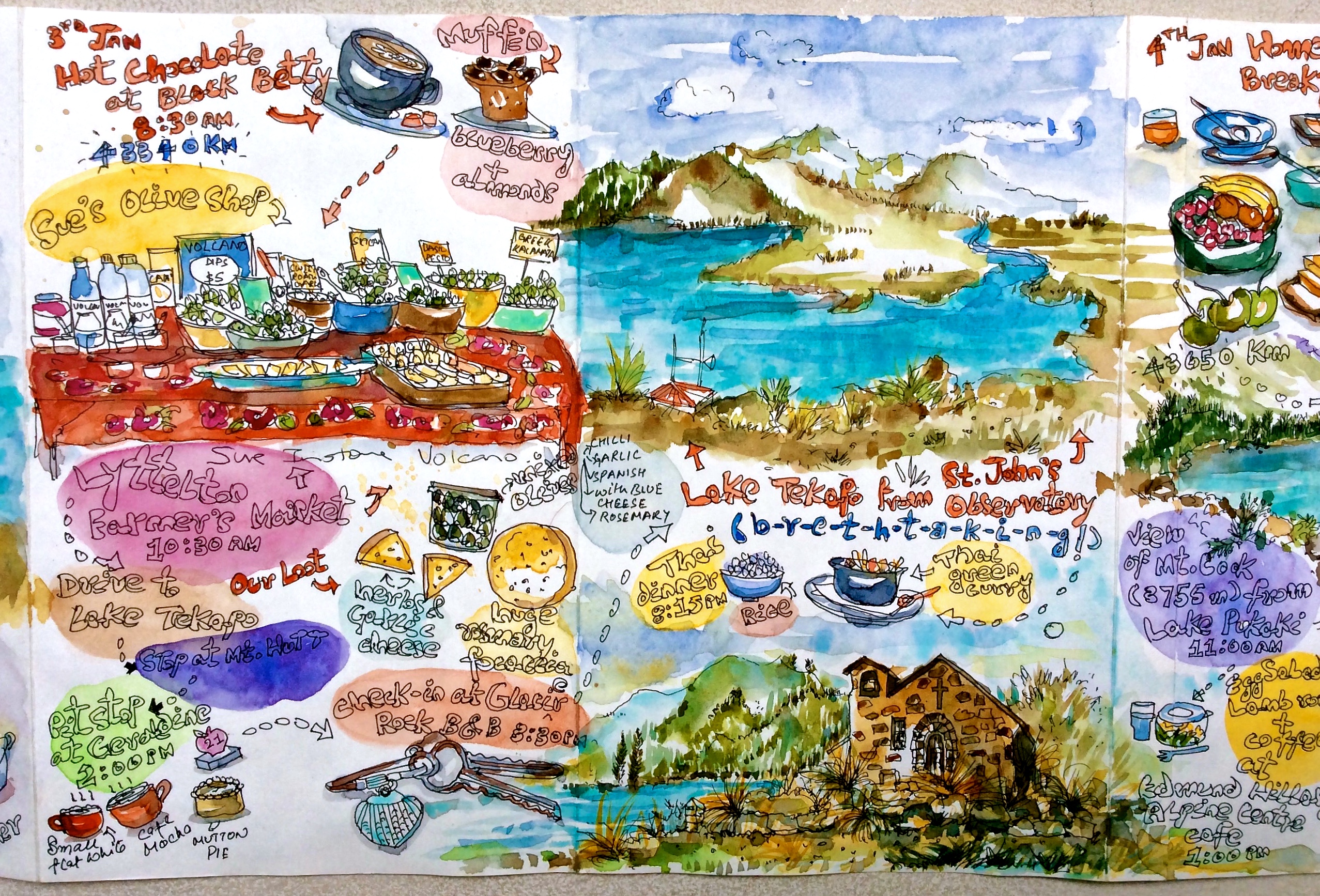
3rd January 2015 : Onwards to Lake Tekapo  – Black Betty, a stone’s throw from Southwark Apartments, was open for business, post new year. We were among the firsts to show up. The gothic accents were interesting but thankfully not overpowering for detractors. The hot chocolate and blueberry muffins lived up to the great reviews.

But we didn’t want to fill up because our next stop was Lyttelton Farmers Market, in the port town of Lyttelton, about 12 Km away. I was so enamoured with Sue’s marinated olives that we spent an inordinate amount of time at her stall. It was very hard to turn away from the rest of her wares – semi-dried tomatoes, dolmades, marinated artichokes, several kinds of dips and hummus – everything fresh, fragrant, glistening and ready to eat! “I used to own a cafe there (apparently the legendary Volcano Cafe)“, she said pointing to her right. Then added “..but after the earthquake destroyed it, I do this.” Sue has developed the volcano brand of delicatessen food that she sells at various farmers markets.  After she helped me pick out 4 different kinds of olives, I sketched her little set up. She graciously signed her name under it, at my request.
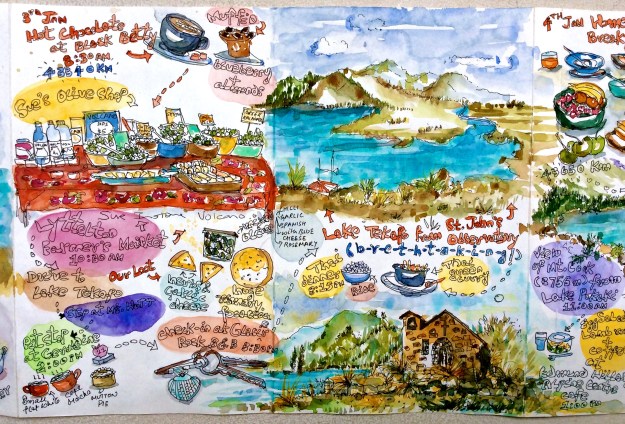
Christchurch to Lake Tekapo / 3rd Jan : We were lucky to be able to experience something as local as a farmer's market at Lyttelton. Meeting the people, chatting with them, hearing their stories and, watching them go about their business trumps any tourist attraction. And sketching is the fastest way to make friends!

Christchurch to Lake Tekapo / 3rd Jan : We were lucky to be able to experience something as local as a farmer’s market at Lyttelton. There were times when I wished I was a local just to be a part of their spirited community. Meeting the residents, chatting with them, hearing their stories and, watching them go about their business trumps any commercial tourist attraction. It felt real and authentic. And sketching seemed like a great way to start conversations and make friends out of strangers!

Walking through the market felt like gatecrashing a private party. ‘How’s your mother doing?’, “You looked great in that bikini the other day”, “Were you out of town?”, “Happy New Year!” were some of the snippets of conversation I heard been exchanged between the bread, mince pie, cheese, sausage, herbs, fruit and vegetable stall owners and their customers.

A band played slow music beside a cafe and the harbour across the street looked beautifully blue. Armed with a gigantic ( about 20cm in diameter) Focaccia bread that took us 5 days to finish, 100 gm each of herb and garlic cheese and my treasured olives, we forged ahead towards our destination.

The first sight of Lake Tekapo had us swooning over its terrific blueness. It was bluer than the bluest blue I had seen. Up at St. John’s Observatory, the air was so clean and transparent that the farthest mountains in the backdrop became visible, forming a soft undulating dark green outline in contrast to the stark and edgy blue foreground. For urban dwellers heavy-handed with photoshop and Instagram filters, this sight would be a revelation.

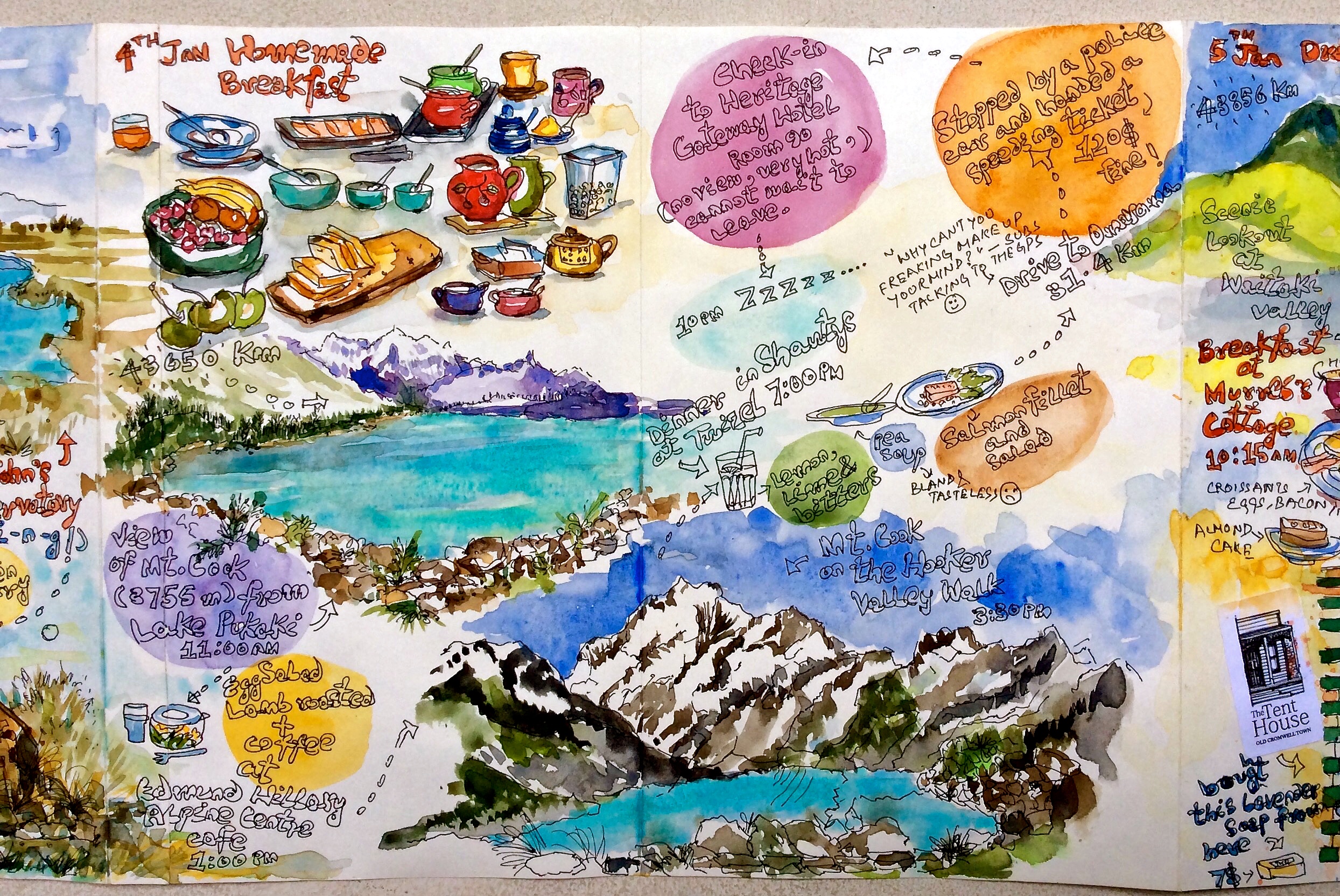
4th January 2015: Mount Cook bound – The owner of Glacier Rock B&B – our fantastic lodging (the view from the patio alone makes it worth the stay) in Lake Tekapo said to us at breakfast, ” I have a feeling that you’ll have a clear view of Mt. Cook today“. Apparently, it isn’t uncommon for the weather to turn without warning and for us that could mean losing our only chance to view the highest peak of New Zealand. Already the radio was abuzz with the news of the three missing mountaineers attempting to scale Mt Cook after the weather deteriorated. I hoped Mrs. MacLaren was right.
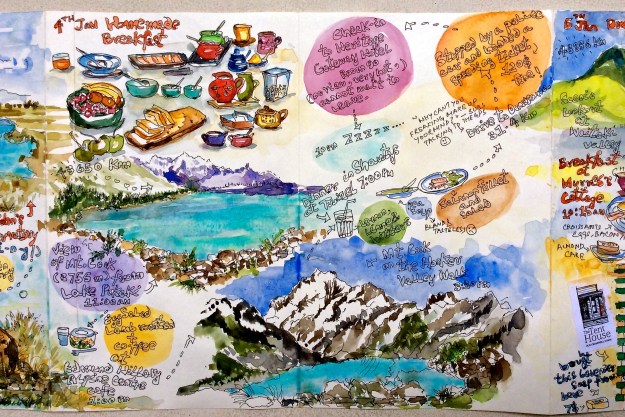
Lake Tekapo - Mount Cook - Omarama / 4th Jan : Peak of the day was dipping my feet in glacial water at the end of Hooker Valley Walk. And the bland under seasoned pea soup I had at Shawtys in Twizel has to be the slump of the day. Yes, it was worse than the 120$ speeding ticket.

Lake Tekapo – Mount Cook – Omarama / 4th Jan : Peak of the day was dipping my feet in glacial water at the end of Hooker Valley Walk. And the bland under seasoned pea soup at Shawtys in Twizel has to be the slump of the day. Yes, it was worse than the 120$ speeding ticket.

After a short stopover at Lake Pukaki, the plan was to drive non stop to Hermitage Hotel, take in the famed view of the mountain from there, then start on the 4hours tiring yet spectacular Hookers Valley Walk that ended at the Hooker glacial lake. But the closer we got to the mountain, more compelled were we to make random roadside stops just to adjust our senses to the beauty unfolding. Unsullied nature at such a grand scale was a lot to take in. It was humbling to stand on that listless road snaking feverishly though a sweeping landscape of massive forbidding mountains surrounding us, rising from the ground like mighty waves.

The day ended at Omarama – the starting point of our ‘gold heritage trail’.

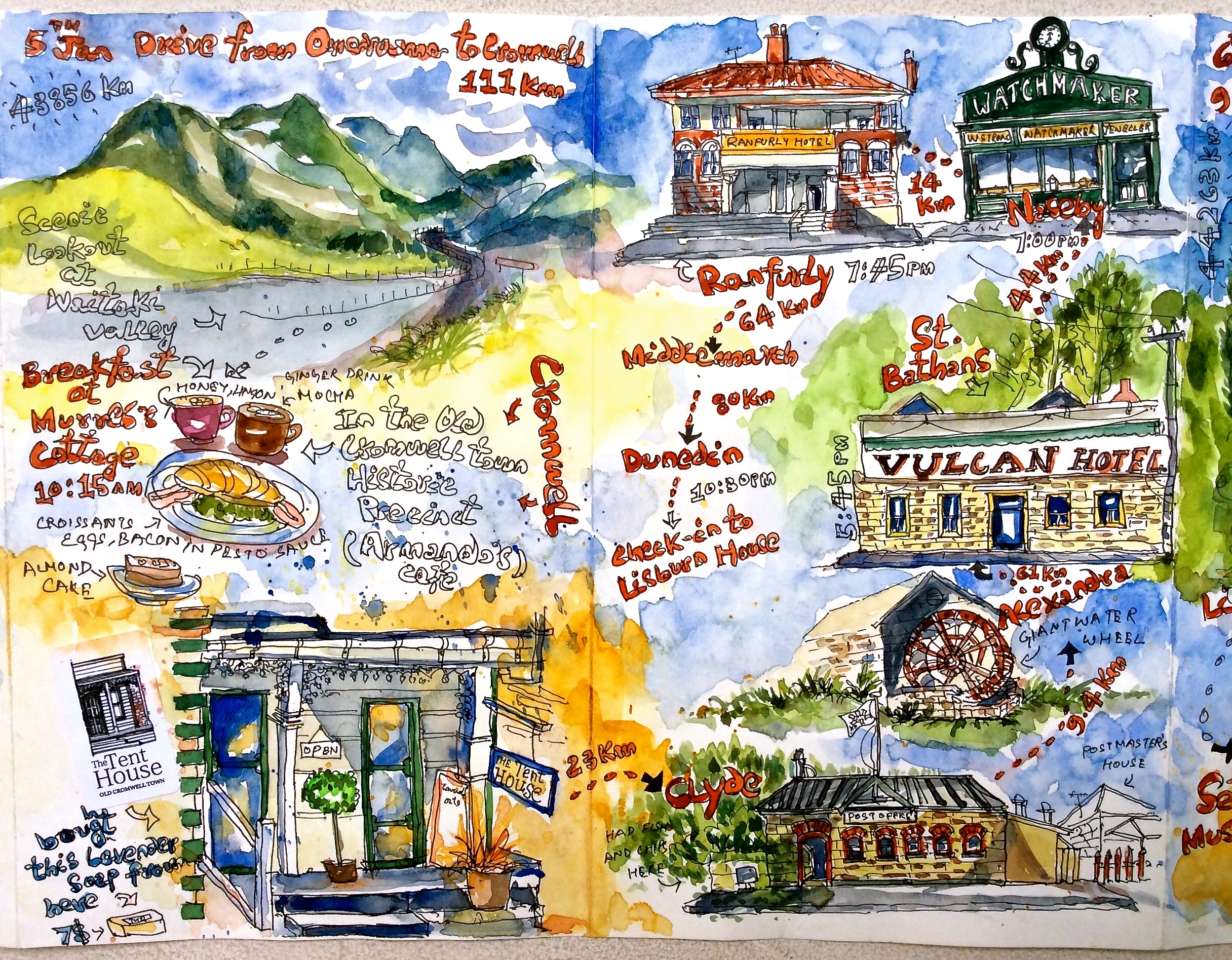
5th January 2015 : A long winded route to Dunedin – There is of course a straightforward and quicker route to Dunedin which we did not take. Relaxing is something we forget to do on holidays. Instead we carved out a day long plan to drive through the preserved goldrush towns of Cromwell, Clyde, Alexandra, St. Bathans, Naseby, Ranfurly, Middlemarch and finally to Dunedin, that claim their origins to the discovery of gold in 1861.
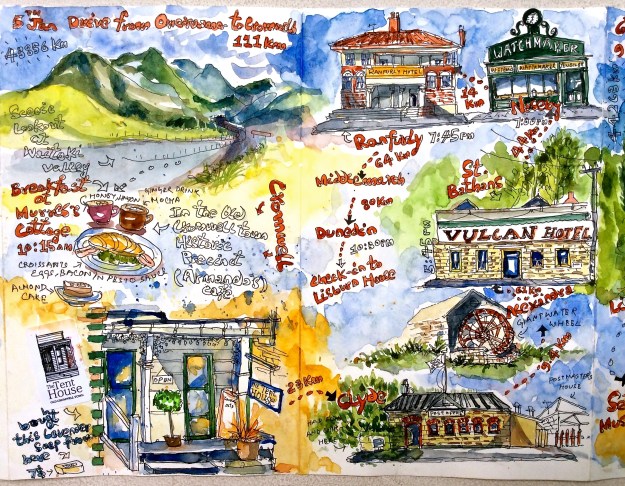
Otago's Gold Heritage Trail/ 5th Jan :  I got myself four souvenirs from this trail - a 'Lavender, Lime and Spice' soap bar from Cromwell, a maori dolphin tail locket made out of bone from Clyde, a tacky fridge magnet from Alexandra, a sticker for my diary from St. Bathans. I cannot bring myself to use the soap. For now it perfumes my study table.

Otago’s Gold Heritage Trail/ 5th Jan : I got myself four souvenirs from this trail and none of them was gold. I picked a ‘Lavender, Lime and Spice’ soap bar from Cromwell, a maori dolphin tail locket made out of bone from Clyde, a tacky fridge magnet from Alexandra and a sticker for my diary from St. Bathans. I cannot bring myself to use the soap. For now it perfumes my study table.

The historic precincts in each of these towns being pedestrian, it’s easy to slip back in time just by walking past the retro architecture. Art galleries, restaurants and cafes are housed in some of these establishments. Some act as museums, some sell handcrafted soaps. But together they exude a cute picture postcard beauty and nostalgic charm that made the detour every bit worthwhile.

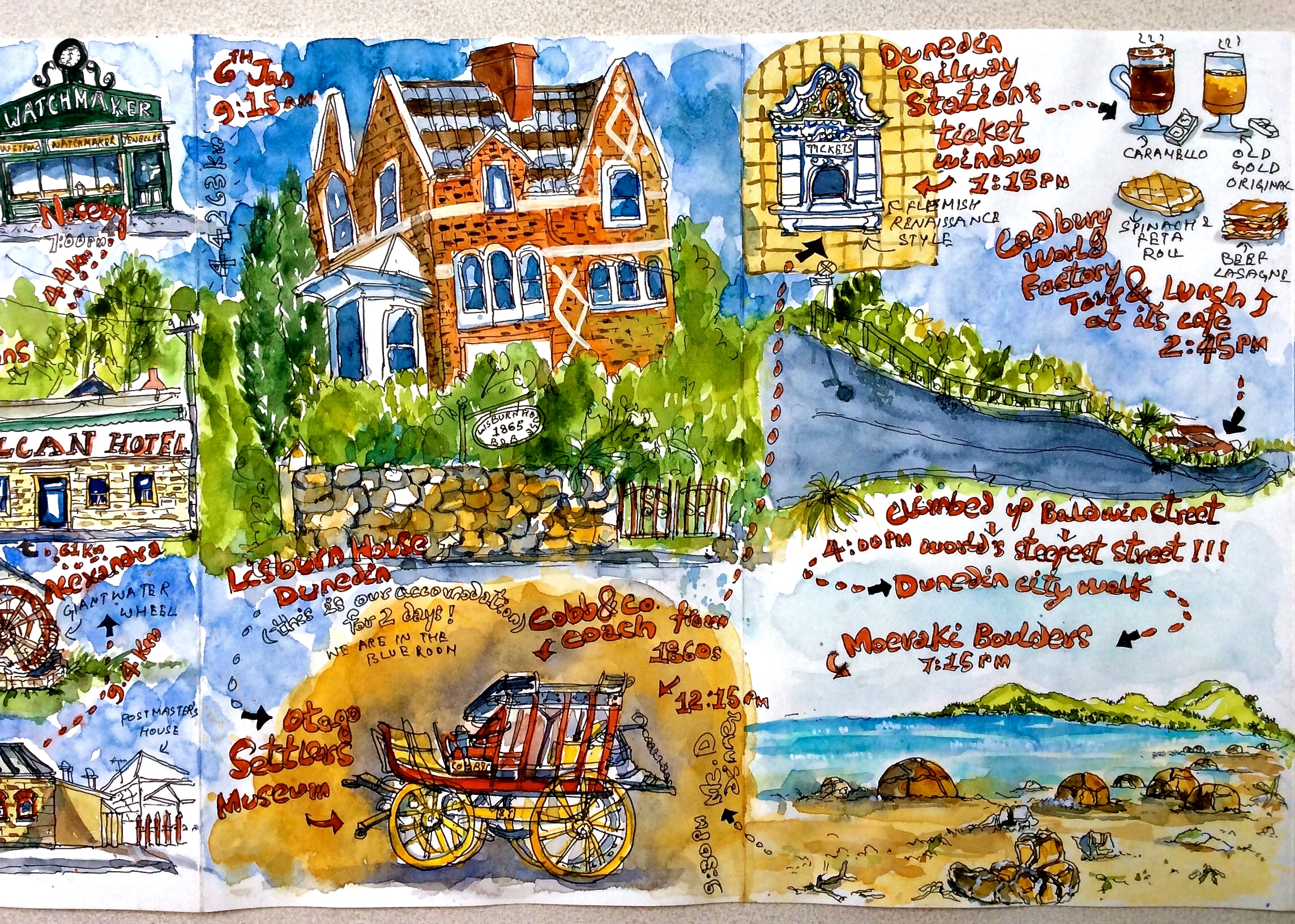
6th January 2015 : Touring Dunedin – Except Omarama, where our lodging didn’t turn out as expected, I did a pretty good job in finding unique accommodations on this tour, the creme de la creme being Lisburn House in Dunedin – a stunning 19th century Victorian property turned into B&B that will feed your fantasy of living as a member of 19th century English nobility.

I spent a ridiculous amount of time at the Otago Settlers Museum. Not because it was hot outside and I needed the shelter, but because it was of the best curated museums I had visited – one of those educational establishments that believes in telling a compelling story through its exhibits, encouraging its viewers to join the dots instead of spoon feeding them.
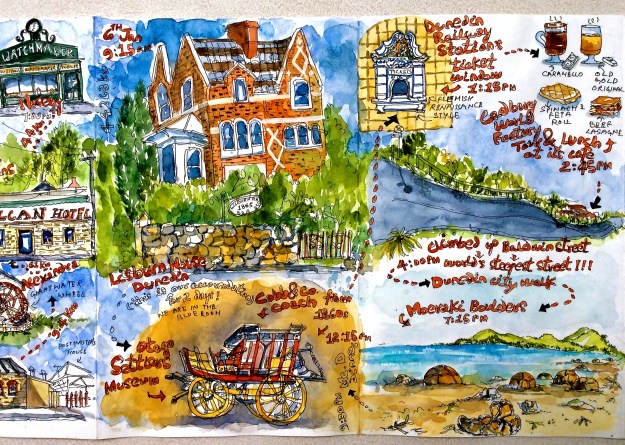
Dunedin / 6th Jan: We woke up in a Victorian dream home, toured a chocolate factory and climbed the world's steepest street, all in one day. Pretty productive, I'd say!

Dunedin / 6th Jan: We woke up in a Victorian dream home, toured a chocolate factory and climbed the world’s steepest street, all in one day. Pretty productive, I’d say!

After romping about the city some more, we drove 70 Km to see an unique geological sight that had intrigued us ever since we saw its pictures. Moeraki Boulders seemed like gigantic concrete cannonballs randomly lying on the beach, some in clusters, some solitary. There were deep cracks all over their surface, like some sort of design. Some boulders were intact, whole – people climbed over them and took pictures, while others lay cracked open like an egg shell, with fragments scattered all over the sand.

At sunset, the tip of the boulders became golden tinged. The waves crashed against their smooth bodies, trying to pull them in, but failing and sliding off the sand around them instead. It was hard to make sense of their existence, but that was a good thing because it’s better to be curious than blasè. Isn’t it why we travel?
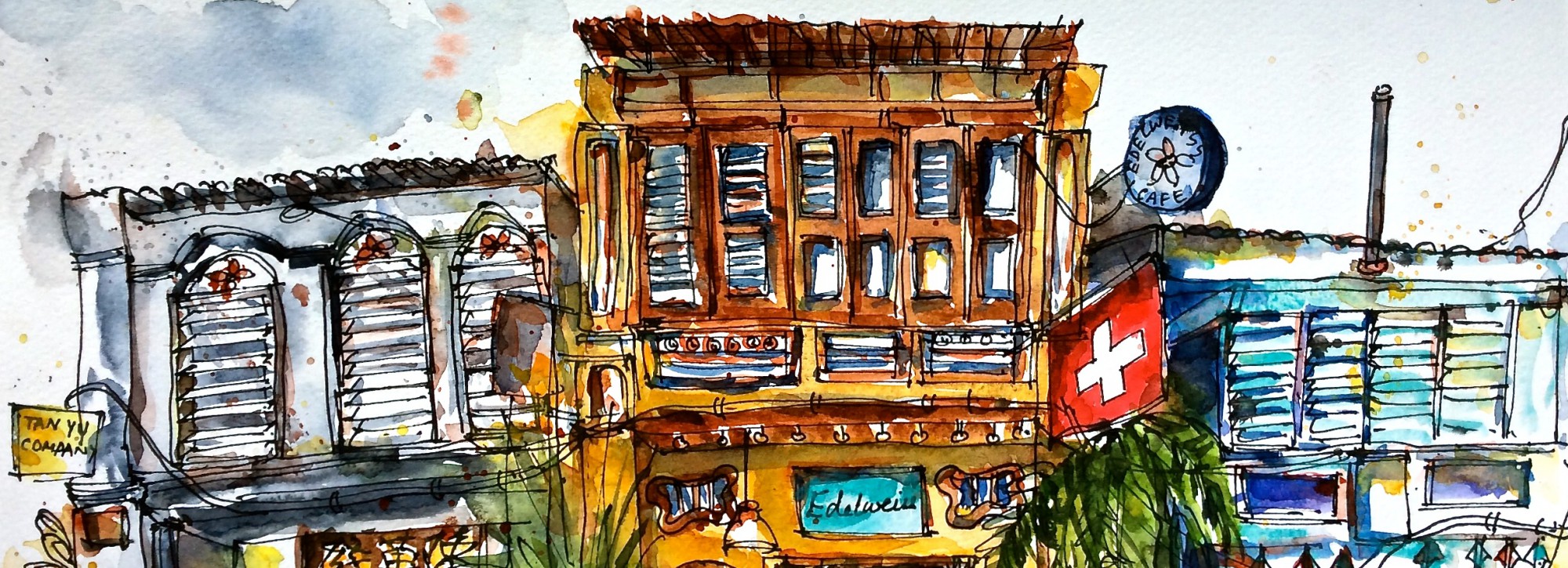


Trip to the Antipodes series : Sydney

30th December 2014 : Melbourne to Sydney –  George’s apartment in Surrey Hills that we found through an intense search on Airbnb, was close to the CBD. Trust me, that is all one needs – an affordable (100 – 150$ over budget is called affordable during this time of the year) place to crash after New Year fireworks. A place that doesn’t wring your pockets dry and is not in the back of beyond taking 5 hours to reach*.

Dumping our luggage in the room, we venture out for sightseeing. Serendipity strikes. Spotting a woman wearing a neon green ‘I’m Free’ lettered T-shirt ( That was Justine, co-founder of I’m free walking tours) circled by about thirty people, right out side QVB, near the talking dog statue, we join her. And what follows is a peek into the city’s history and a walk past Sydney’s major sights described in a fun, extremely informative narrative.

30th December / Sydney: I decided to sketch the opera house today because we didn't know where we would be watching the fireworks from the next day and if I would even get this view or not.

30th December 2014/ Sydney: I decided to sketch the opera house today because we didn’t know where we would be watching the fireworks from the next day and if I would even get this view or not. After the free walking tour of “The Rocks”, we bought a picnic mat and nibbles for the next day and had Fish and Chips dinner on our way back to George’s apartment.

We pass by Martin Place and stop a while to look at the flowers and read the heartwarming messages at the makeshift memorial. The tour ends with a view of the opera house and then the Harbour bridge. Justine dispenses tips on the ‘most ideal free spots to watch the fireworks’ to anyone interested. “Do not go to Circular Quay” she warns. Then adds, ” To find a good spot there, you’ve to reach there at 10 in the morning and wait the entire day in this heat. It’s suicide.”

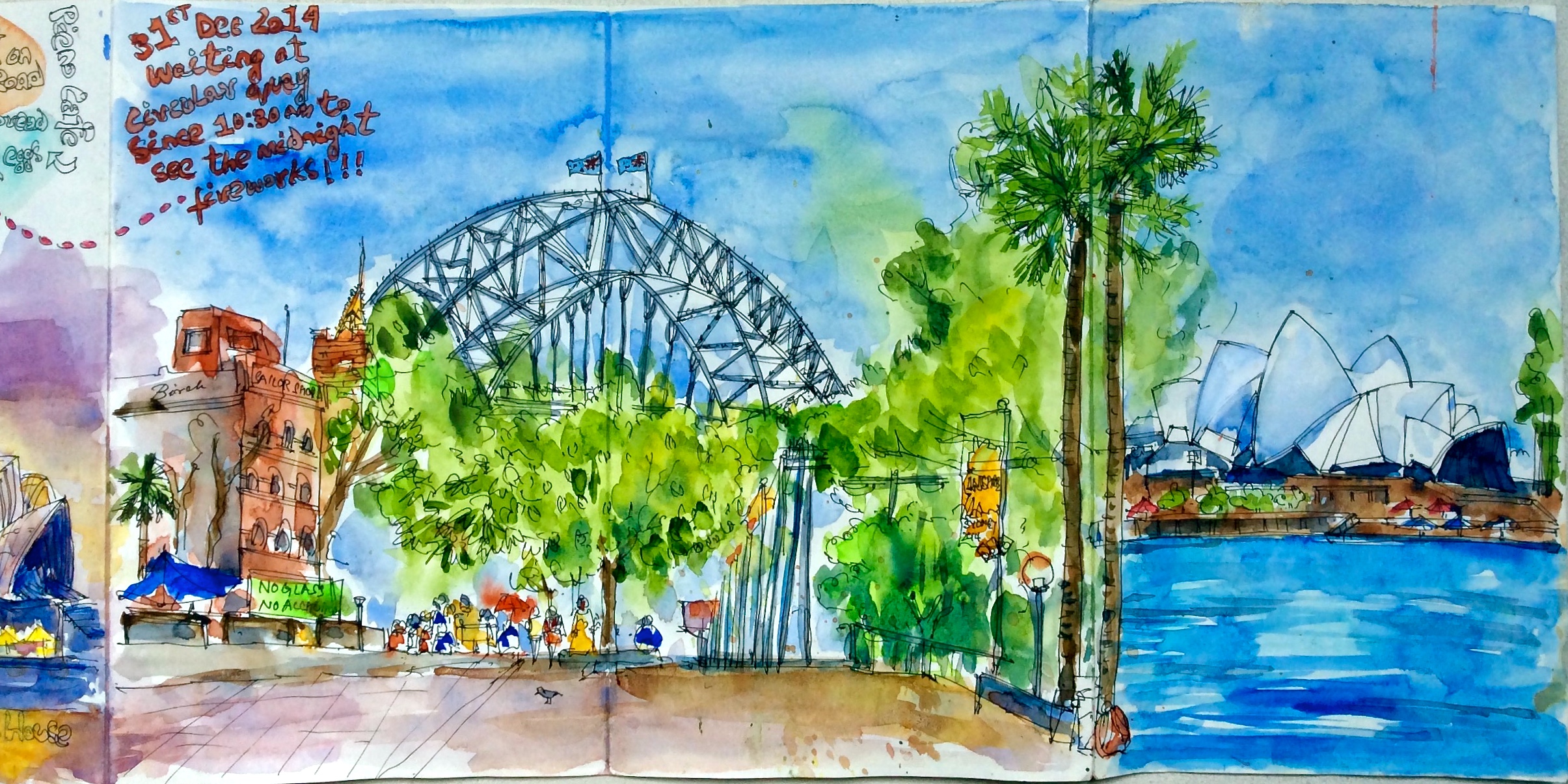
31st December 2014 : The Big Day – We were at Circular Quay at 10 in the morning. The Sydney New Year Eve official website listed several vantage points for watching the fireworks along with their maximum capacities. This place could hold 26,000 people. Of that, twenty six were already here, lying down on their picnic mats, rubbing sunblock. No alcohol or glass was permitted on the premises. Upon finding a great spot** (after active debating), which meant unobstructed view of the Harbour Bridge and the Opera House, we settled down with our stash of nibbles under the hot sun to spend what was left of that year.

Waiting for midnight

31st December 2014 / Sydney – After a hearty breakfast at Pieno Cafe on Crown Street, we walked to Circular Quay at around 10am to see if there’s empty space. There was. So we parked ourselves here till midnight. This was my view for the entire day.

That’s when we saw our neighbours – Megan from Wales and her Portuguese husband Becas. They were back from New Zealand and ending their 25th anniversary celebratory tour with the Sydney fireworks. “How romantic”, we gushed and got talking. There’s only one way to describe the short haired, chubby cheeked Megan. She’s a veritable force of nature that overpowers anybody in her vicinity with love, vivacity, humour and charm.

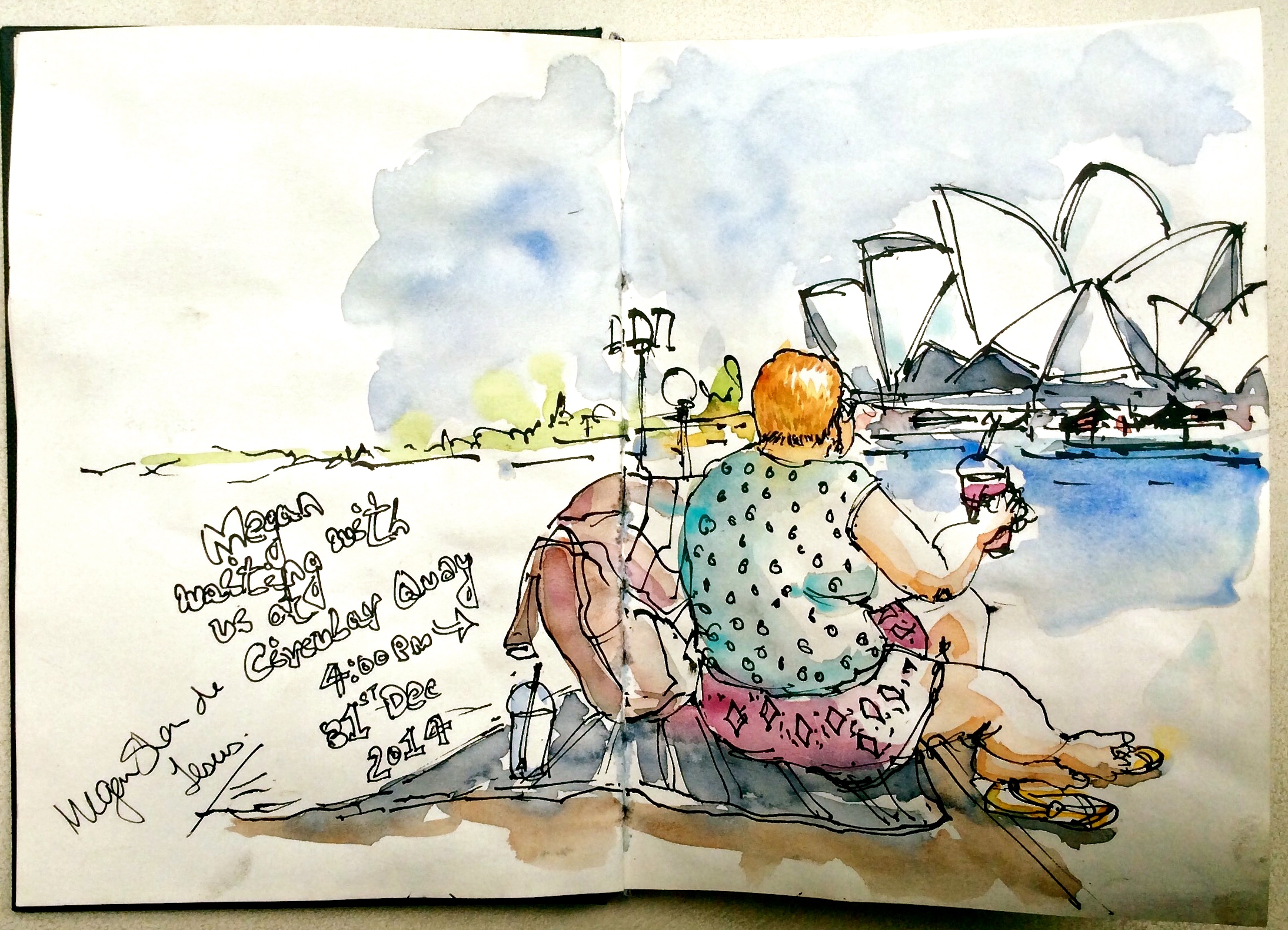
This is Megan. Of course, I had to draw her. I also got her to sign my sketch. Notice her surname - 'Jesus'!

31st Dec 2014, Sydney – This is Megan. Of course, I had to draw her. I also got her to sign my sketch. Notice her surname – ‘Jesus’!

She has a big personality and a bigger heart that constantly expanded to accommodate more people. Megan took us under her wings and every other person who came over to sit near or around her – the Iraqi family from New York, the two pimply German guys who sang – ‘Deutschland über alles’ at every cue, the young Brit couple and the 20-something giggly selfie addicted Belgian girls. She would take turns to chat with each of us and every once in a while, call out a name and ask, “Are you okay?”.

This is Circular Quay at about 4pm. People were taking up the spaces in front of us and were ready with their cameras and tripods for an event that was still 8 hours away.

This is Circular Quay at about 4pm. People were pouring in from all directions and taking up any empty space available. All around, you could see bright ‘2015’ hats wiggling on heads, huge cameras and unwieldy tripods on standby for an event that was still 8 hours away.

As Circular Quay started filling in, the member’s of the Megan club, huddled closer to each other, with its hawk eyed matron at the helm, guarding and protecting our space and precious view. No one could sneak in and block it, although many tried. The picnic mat became her ‘home’ and we were its members who were bound by its rules. Like chanting a Welsh rugby cheer every time Megan felt there was a slump in our energy levels. “Group hug, everyone”, she’d shout and make us stand. We’d feel silly but get up like obedient pupils. Thousands of revellers at Circular Quay would witness us huddled in a circle with arms around each other shouting at the top of our voices, following Megan’s lead.

Megan : Oggy Oggy Oggy!

Us: Oi Oi Oi!

Megan : Oggy Oggy Oggy!

Us : Oi Oi Oi!

Megan : Oggy! ; Us : Oi!

Megan : Oggy! ; Us : Oi!

Megan : Oggy Oggy Oggy!

Us :Oi Oi Oi!

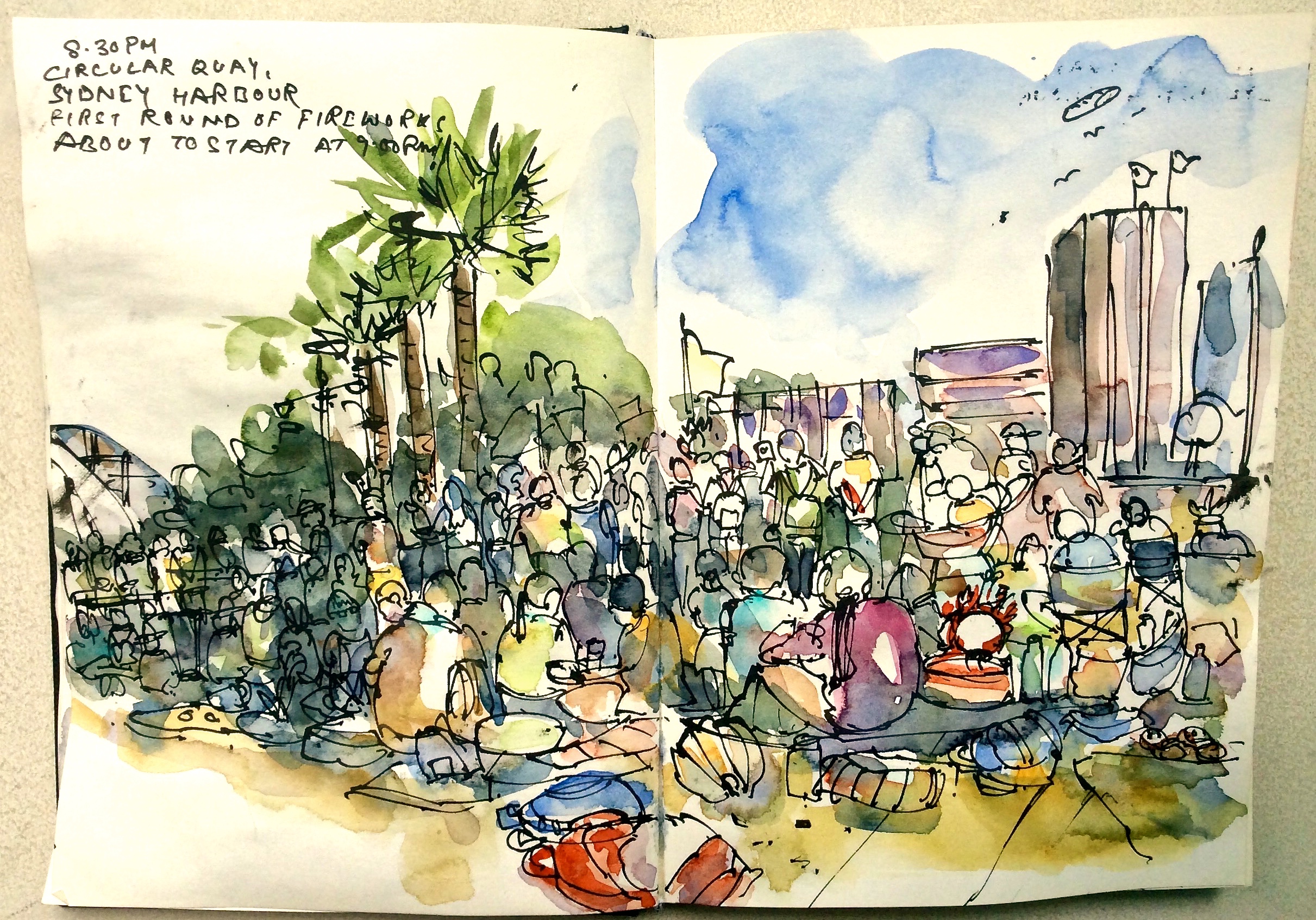
31st December / Sydney - This is how Circular Quay looked like at 8:30pm - sea of revellers. It took my husband 45 mins to go through this crowd to the toilet stalls about 500 meters away and come back. The place had reached its maximum capacity i.e 26000 people.

31st December / Sydney – This is how Circular Quay looked like at 8:30pm – sea of revellers from every country imaginable. It took my husband 45 mins to go through this crowd to the toilet stalls about 500 meters away and come back. “This place has reached its maximum capacity” was being continuously announced. 26000 people had gathered here to welcome the new year and I was one of them.

And just like that, it was midnight. We watched the sky light up our faces in a million ways. This event was in our bucket list for years, at the centre of our itinerary, planned months in advance. It delivered what we’d hoped for, probably more and yet looking back it isn’t the spectacular fireworks that I remember from that day. It’s Megan, and her chants and her made up ‘home’ and ‘family’ that lasted for 14 blissful hours under a punishing sun. Such are the perks of travel.


*Tips for finding an accommodation during Sydney NY fireworks – Unless you’ve booked your accommodation an year ahead to watch the inimitable Sydney fireworks, choices become very limited towards the end of the year. In such cases, book a budget friendly accommodation as close as you can get from the CBD, that offers free cancellation and check back again for better options say two weeks before the new year – you’ll most likely find a decent place. E.g – We used booking.com to block a cancellable hotel in Chatswood, 15 kms from CBD in October and Airbnb to find our accommodation in Surrey Hills, a 15 mins walk from CBD, in the last week of December.

It is highly preferable that you stay within walking distance from CBD – you’ll thank yourself for this prudence when you look at the sea of revellers standing still outside train stations after the fireworks. Though I didn’t find a free spot, but university stays (http://www.universitystays.com.au/) could be an inexpensive and interesting lodging option in Sydney, specially during this time. Lastly, most places mandate a minimum stay of 3 nights – 30th Dec, to 1st Jan. So for easy availability, plan your stay accordingly.

**Tips on finding a good spot to watch Sydney fireworks – Check the New Year’s Eve official website and scout some of the vantage points in person, a day before. Find a place with a good view of both the Opera House and Harbour Bridge. Bring food, drinks, picnic mat, umbrella, sunscreen and anything that will keep you occupied. There are spots that do not allow alcohol and glass – take note of that when choosing. Come early by 10, latest by afternoon. Take it easy, be prepared to spend the whole day. Lastly find Megan. She will get you through the wait.


When you hang out with sketch artists..

a) You always get invited on Sketch dates.

And it’s pure joy. More often than not, the location is exotic and even if it isn’t, you have great company and even if you have great company you aren’t obliged to socialize, make small talk or mingle. Misanthropes fit right in. You get to sit in your own little corner, do your own little thing, talk as much or as little to the next person and it still doesn’t affect your chances of getting invited again.

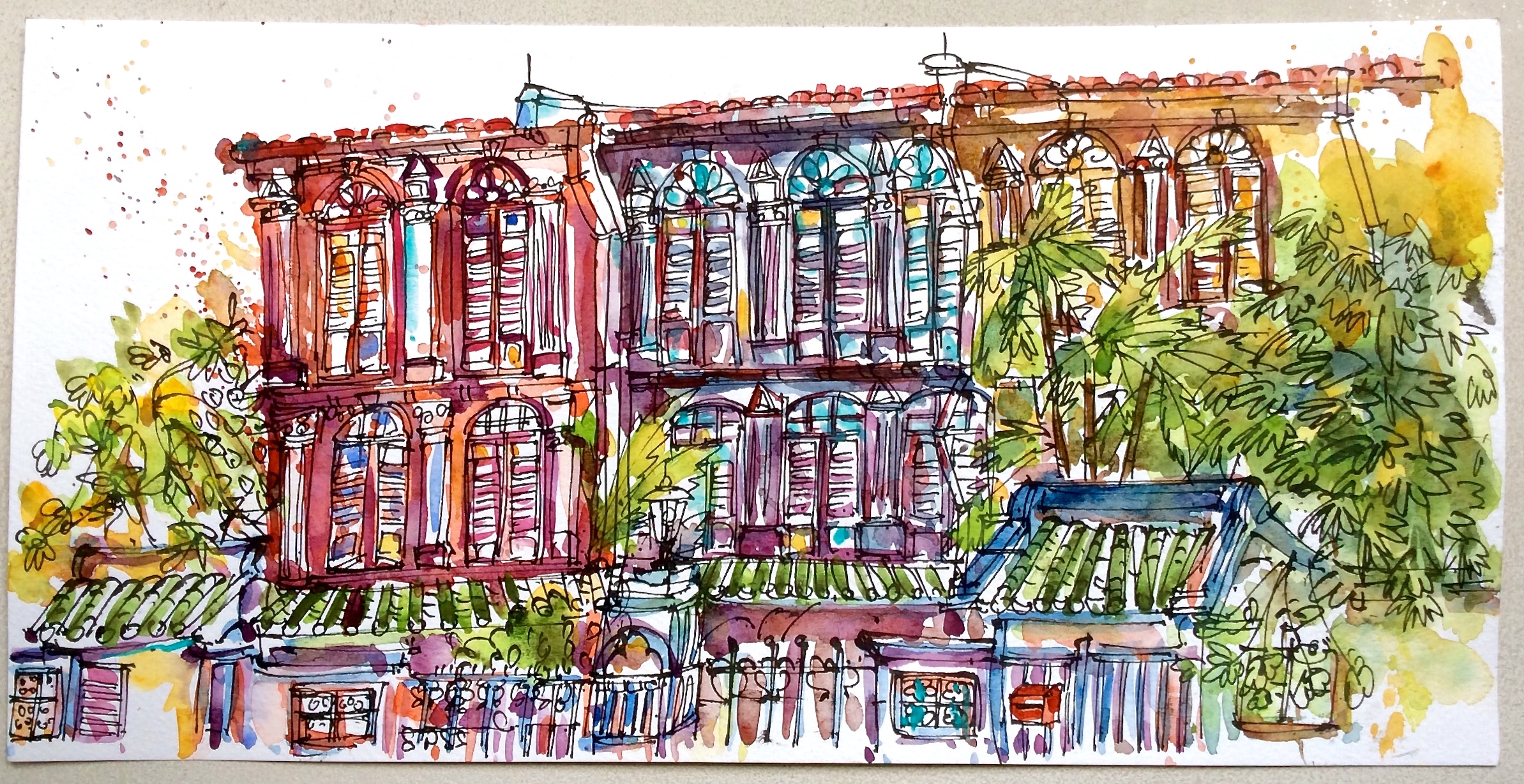
Shophouses at Emerald Hill

Row of terrace houses at Emerald Hill. Tried sketching in a big format – about 40cm x 20cm

Last week’s location was Emerald Hill, right opposite Orchard Central and undoubtedly one of the most accessible and prettiest places in Singapore with rows of exquisitely conserved pre-war terrace houses turned into business establishments and homes. It is really hard to be not inspired here. Even though our path and enthusiasm was marred with a veritable rainstorm  (for it is the wet season) the show went on as you can see from this fruitful harvest! Each one of us left feeling inspired, contended and with promises of future hangouts.

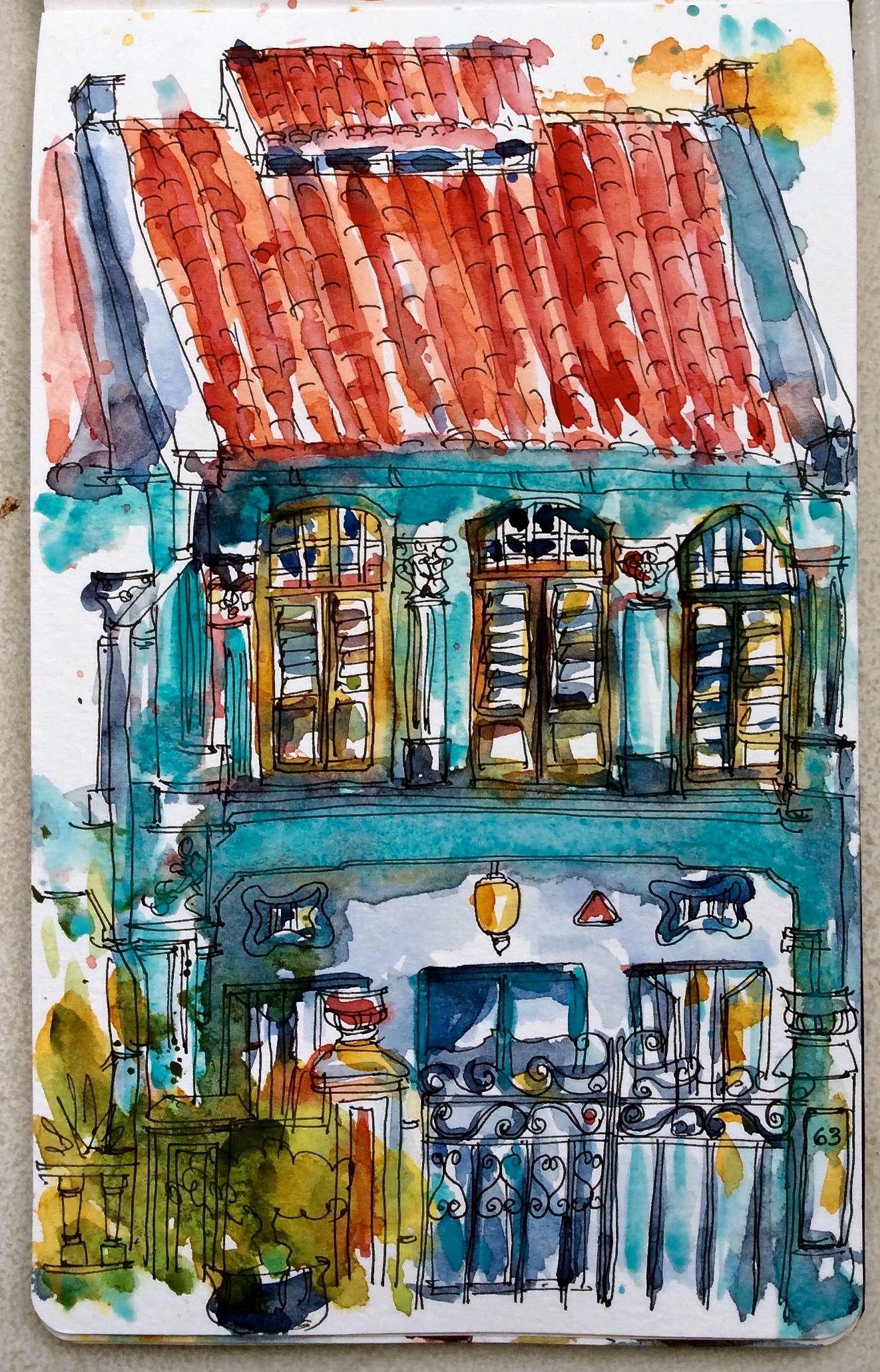
Another Shophouse at Emerald Hill

A dainty blue shophouse at Emerald Hill. This looks really well as my iPad wallpaper!

b) You order food that would render well in a drawing.

Colours, shapes, sizes take precedence over taste. And most importantly, right after the food arrives at your table and the tantalising smell starts flirting with your senses, you are able to exercise monastic restraint in choosing the fork over the pencil and an inimitable ambition to finish sketching before the food gets cold and/or your dining companion starts fidgeting.

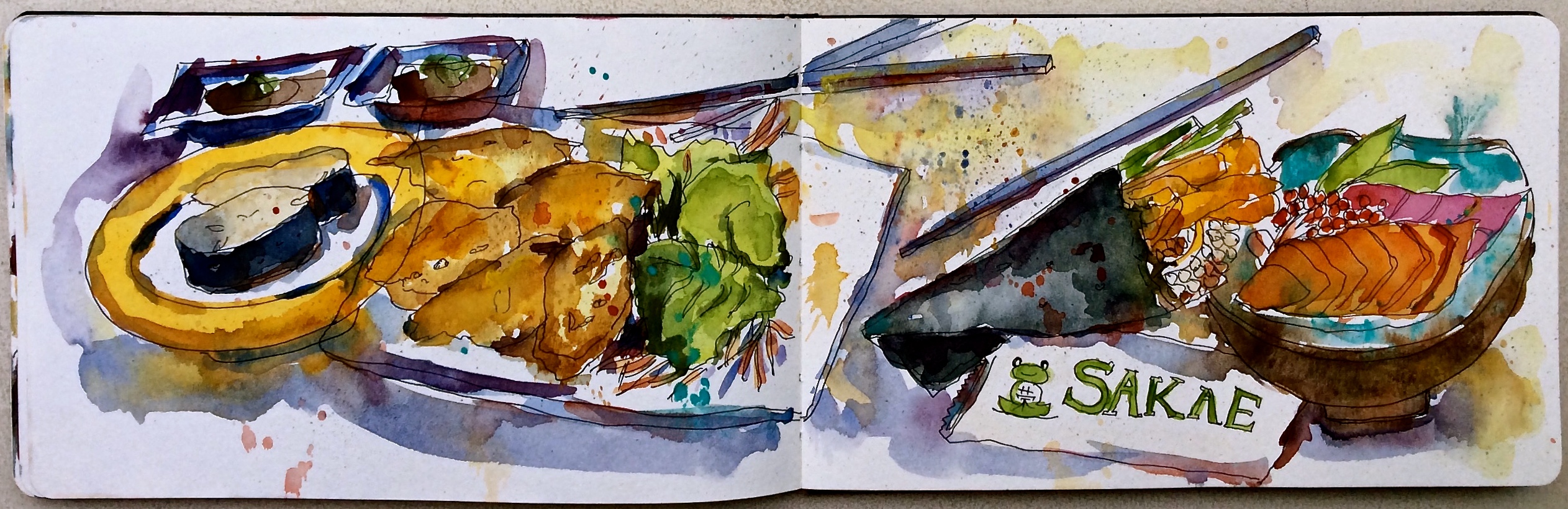
Lunch at Sakae Sushi

Lunch at Sakae Sushi

After my sketcher friend finished placing her order at Sakae Sushi, she turned to me and brightly declared, “The Salmon and Tuna sashimi..aren’t they colourful?…I ordered these, coz they’d look wonderful in our sketchbooks”. I might have teared up a little.

c) You get programmed to see ‘interesting’ things wherever you go, in the most unassuming places and at all possible times and want to document that.

And in doing so, with practice, you become a chronic chronicler with benefits aplenty. When you start documenting something, you are forced to slow down and observe more. You become mindful of every moment. You learn to live in the present. This may seem like bumper sticker wisdom but actually has much longer shelf life and is a widely practiced philosophy even. Peter Matthiessen in his book Snow Leopard, says, ‘..the courage-to-be, right here, right now and nowhere else, is precisely what Zen,..demands : eat when you eat, sleep when you sleep!”

Drinking Honey lemon Juice at Toast Box

Drinking Honey lemon Juice at Toast Box

Only because I was with a sketch artist, did I take away time from my honey lemon juice to join her in drawing this bunch of vintage items exhibited at Toast Box – a ‘reflection of coffee shops in the 60s and 70s’ – as part of their decor. I walked away knowing every item on those two shelves and the ones I liked the most – the palm sized TV and a pair of antique looking (or antique) binoculars. Probably this information won’t serve me a great purpose but when I was there, sketching, I wasn’t thinking of checking my phone, answering emails or figuring what to cook for dinner. I was involved and emotionally invested in what I was doing. It seemed like a therapeutic exercise in mindfulness and left me richer than anyone walking off with just the taste of that overly sweet honey lemon drink.


Boat Quay and a bit more

Last weekend the urban sketchers of Singapore, which I am a member of, chose Boat Quay (a popular tourist destination!) – a river embankment that curves around the shoreline of the north and south sides of the Singapore River – as their sketching venue. Before I describe what met my eyes, let me take you back in time. Like hundred and fifty years back.  By this time, swamp covered Singapore once infested with wild animals, dense forests, pirates, and the Malayan Temenggung had been ‘found’ by 38 year old Raffles (in 1918), it’s allegiance shifted to the crown and it’s fate as a free trading post and deep water harbour for British merchant fleets in the Mallacca Straits had been sealed.

The settlement had developed considerably – forests had been cleared, hills flattenned, muddy pools and swampy ground levelled off, lands auctioned to build houses, business and residential quarters laid out, fundamental laws such as prohibition of gambling put down. Palatial hotels and European bunglows of the traders were lining the shore, while the locals – mostly Chinese and Arabs settled on the left bank of the Singapore river. Nutmeg, pepper, gambier, cocoa nut plantations, were starting to prosper, attracting merchants and traders from far and wide to the shores of Singapore.

Frank Vincent, a traveler describes the scene while approaching the dock in Singapore, upon his visit in 1871, “Like Malacca,very little of the town or city of Singapore appears from the sea…We steam past two or three war vessels, two telegraph steamers(which are only awaiting orders from London to commence laying a a wire from here to Hong Kong), and by some thirty or forty merchant ships of all nations to our anchorage in the crescent-shaped roadstead about a mile from town. We engage a Malay prow to take us ashore, and are landed near Hotel d’Europe, to which our good captain has recommended us”. 

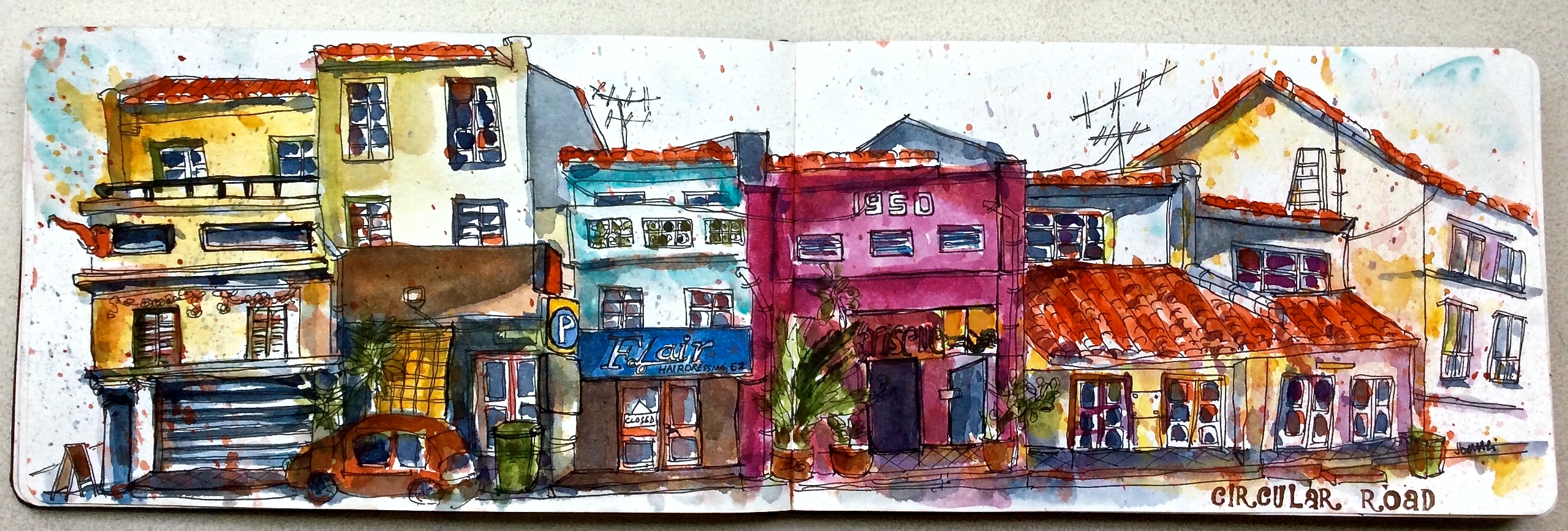
Circular Road, Boat Quay

Circular Road, Boat Quay / Once again the mishmash of acrchitectural style of the shophouses and businesses they house today is so interesting – (from L to R) a Japanese restaurant, an office, a hairdressing salon named “Flair”, a night club named Kriselle and more offices.

The ‘crescent-shaped roadstead’ that Vincent mentions in this narrative could very likely be the Boat Quay, we were documenting in our sketchbooks for three hours last Saturday. The Chinese likened the concave shape of the dock to the ‘belly of the carp’ which they believe is auspicious for business. And so it was. While the north bank was reserved for government buildings, the south bank prospered as the commercial hub (this port was one of the most important in the British Empire, specially after the opening of Suez canal in 1869) lined with gowdowns, warehouses, merchant offices, shops of shipwrights and ship chandlers. There is no Hotel d’ Europe though, which used to be a stone’s throw away on the north bank and have since been replaced with the Supreme Court.

If you were a 19th century traveler like Vincent, driving by Boat Quay in a hackney carraige ($5 a day for a pair or $3 for one horse!), or a British clerk hurrying to his downtown trading office in a jinrickshaw (3 cents for half a mile for one passenger), you’d find the river bank teeming with bumboats / sampans (Chinese sailing boats), cheek by jowl, gently bobbing with the ebb and flow of the waves.  A constant drone of human limbs stretching, lifting, scurrying across gangplanks would drive your gaze to the scores of swarthy men with taut leathery skin loading and unloading gunnysacks of cargo on their arched backs in the scorching equatorial heat. What remains unchanged even today is perhaps the weather.

Many original buildings have been preserved, but instead of stale smelling gowdowns, you have access to crispy fish and chips and chilled beer. These grand dames of the past now work as pubs, restaurants and night clubs. Commanding skyscrapers form the backdrop in place of ‘a fine view of the straits, the large island of Bintang (visible) in the distance and the Chinese junks and foreign shipping in the harbour‘ as described by Vincent from his luxury hotel.

Besides sketchwalking, a significant part of the weekend was spent at my husband’s office. He had to clear some pending work and I decided to accompany with a plan in mind. This is how it took shape :

Sketches of some random desks. I was interested in clutter and my husband's desk was a disappointment in this regard. I was so amused by the props at each desk - teddy bears, dinosaur, a pig (??!!) that grunts when you press its belly. Unbeknowst the owner of the pig, I had by fun.

Sketches of some random desks. I was interested in clutter and my husband’s desk was a disappointment in this regard. I was so amused by the toy props at each desk – teddy bears, a dinosaur and tiny soldiers, a pig (??!!) that grunts when you press its belly. Unbeknowst to the owner of that pig, I had my fun.


Behind the scenes at a Teochew Opera

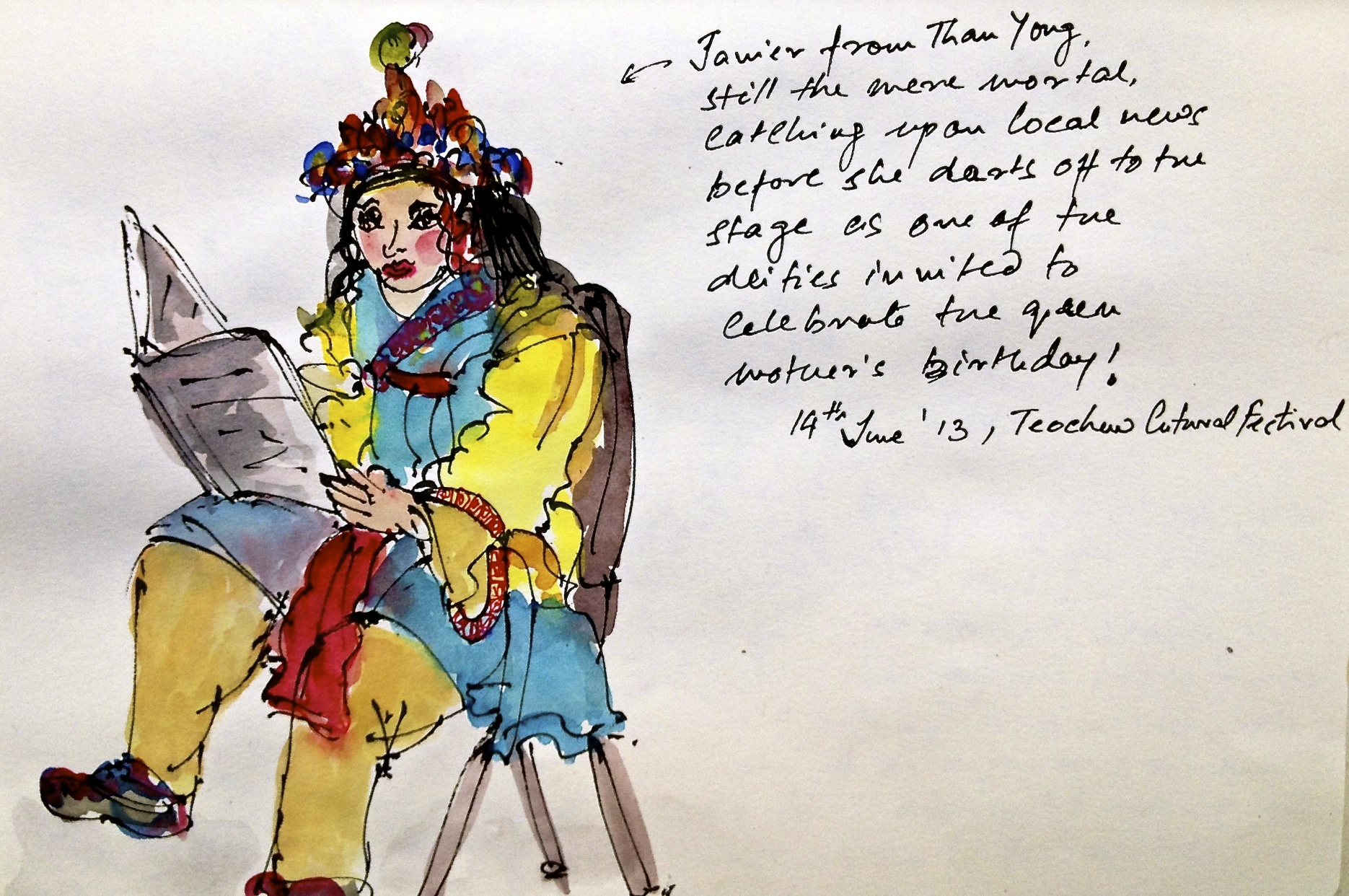
“Look, the philosopher is picking his nose again! Make sure you get that in your sketchbook!”, a giggling deity instructs me from her chair, putting down the newspaper she’d been reading. The entire room bursts into laughter.
My timing isn’t perfect though. When I look up, the philosopher has paused his excavation (or perhaps found gold) and gives me a sheepish look. Different people seek different means to calm their nerves before appearing on stage, so I quickly dismiss his antic as a means of personal solace and avert my eyes.
Since 3 in the afternoon, I am at the backstage, observing and recording the hair and make up process of a group of Teochew Opera performers in my sketchbook. In a span of six hours I have watched these 21st century men and women metamorphose bit by bit into ancient Chinese officials, philosophers, scholars, lovers, courtesans and further back in time, into celestial beings such as deities of wealth, success, longevity and such.
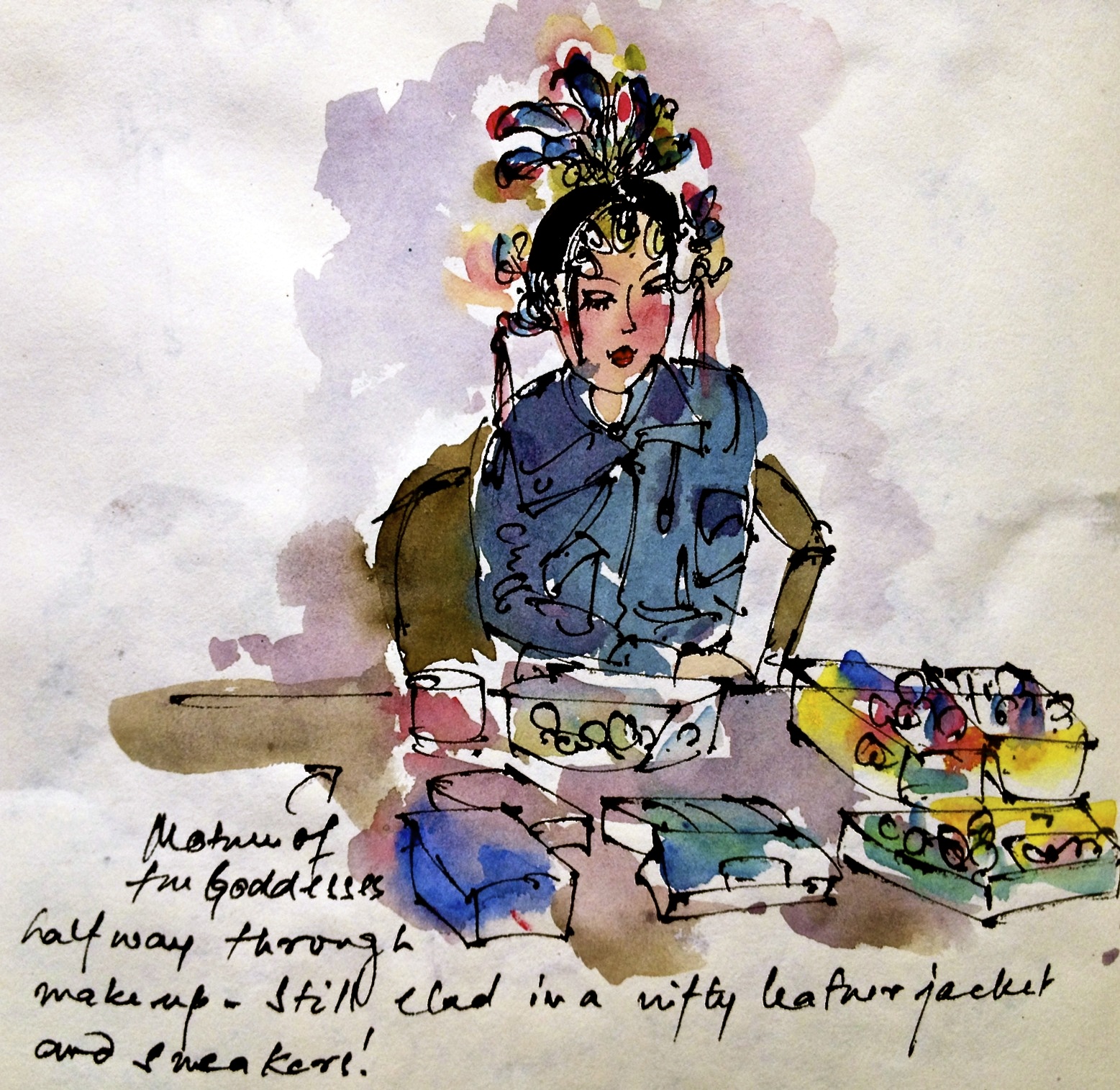
I had arrived to a room full of opera performers scattered at various make up stations. Javier, one of the performers who’d invited me backstage was poised motionless on a chair, while her face was being powdered and eyes shaded with a black pencil. Still clad in pyjamas and sneakers, she was a deity in the making, who’d soon be summoned by Kim Bor – the ‘queen mother of the west’ to celebrate her birthday on stage.
Javier will be playing a deity in the play "A Celestial Birthday"

Javier will be acting as a deity in the play “A Celestial Birthday”

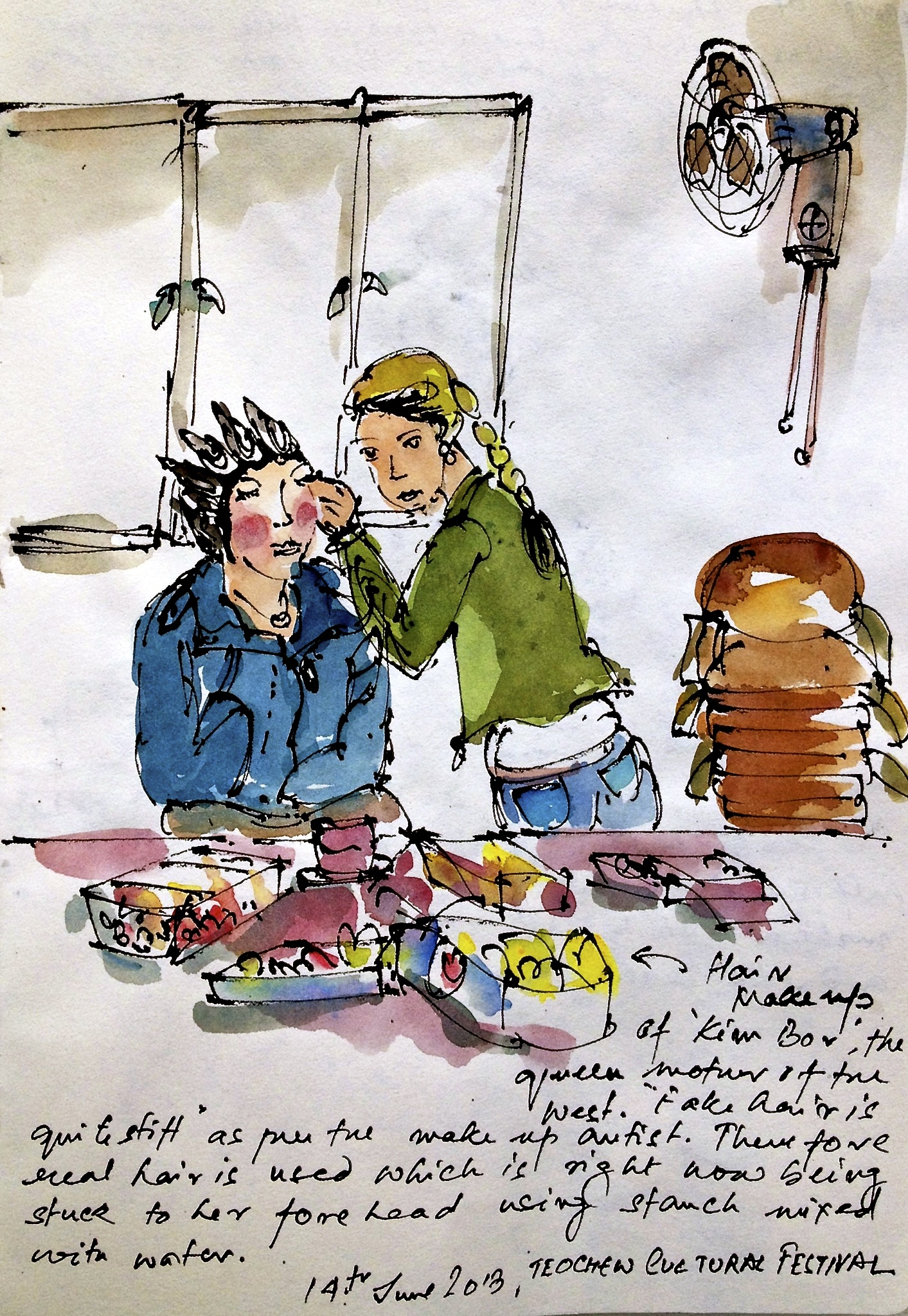
 While Javier was getting ready for Kim Bor’s party, five feet away the queen mother herself was having her hair done. Two hairstylists were folding a bunch of hair strands and sticking them on the birthday girl’s forehead in a semicircle using starch and water. ” It will last for a day, but if I had to make it last longer, I’d mix starch with vinegar. Doesn’t stink and lasts for three days!” said one of the hairstylists expelling her trade secret to me.
I don’t ask her why it needs to last for three days. Do celestial birthdays last that long?
“Also the hair we’re using here is real because false hair is too stiff”, explains another, when she catches me gaping at her make up paraphernalia that has taken up an entire table. Hair of all shapes, sizes and designs from fringes to buns to braids; crowns with exquisite stone settings, necklaces, hairpins, clips, hair bands, hair nets amongst many others lay in neat compartments inside transparent plastic boxes. Four opera groups that are performing today at the ongoing Teochew Cultural Festival, are keeping them on their toes.
Before the performance, I meet with Mr. Lim Chunheng, the events manager to know more about the Teochew people, their culture and more precisely about their opera. Mr Lim starts by pointing out Chaoshan province on the map of China, from where the Teochew people originated, carrying their language, culture and tradition to all the places they emigrated to.
Talking of the Teochew Opera which is a genre of the Chinese opera performed in the Teochew dialect, Mr. Lim says, “This 450 year old art form is beautiful, unique and worth preserving.”
The Teochew Opera was greatly influenced by Nan Xi, an early form of Chinese drama that can be traced back to the Song dynasty in the 12th century AD. Over the years, by integrating Teochew folk music coupled with the unique intonation of the Teochew dialect, Teochew opera evolved as a distinctive art form. Mr. Lim tells me, of the seven characters, the Dan (female) and Chou (clown) roles are the most artistic and well defined in Teochew opera. And the stories evolve around the themes of love, family and ethical relationships.
Kim Bor - The queen mother is getting her hair done

Kim Bor – The queen mother is getting her hair done

“Teochew Opera involves stylised body movements, facial expressions, vocal modulations and many other subtleties that takes time to master”, says Mr. Lim. “Youngsters these days don’t want to put in that much effort in learning an art form. So through cultural festivals like these, we want to create interest and awareness in them about their own heritage.” he adds.

Another deterrent responsible for the dwindling popularity of the Teochew Opera, as Mr. Lim points out, is the Teochew dialect. Though Teochew remains the ancestral language of many Chinese in Singapore, Mandarin is slowly replacing Teochew as their mother tongue, especially among the young population.
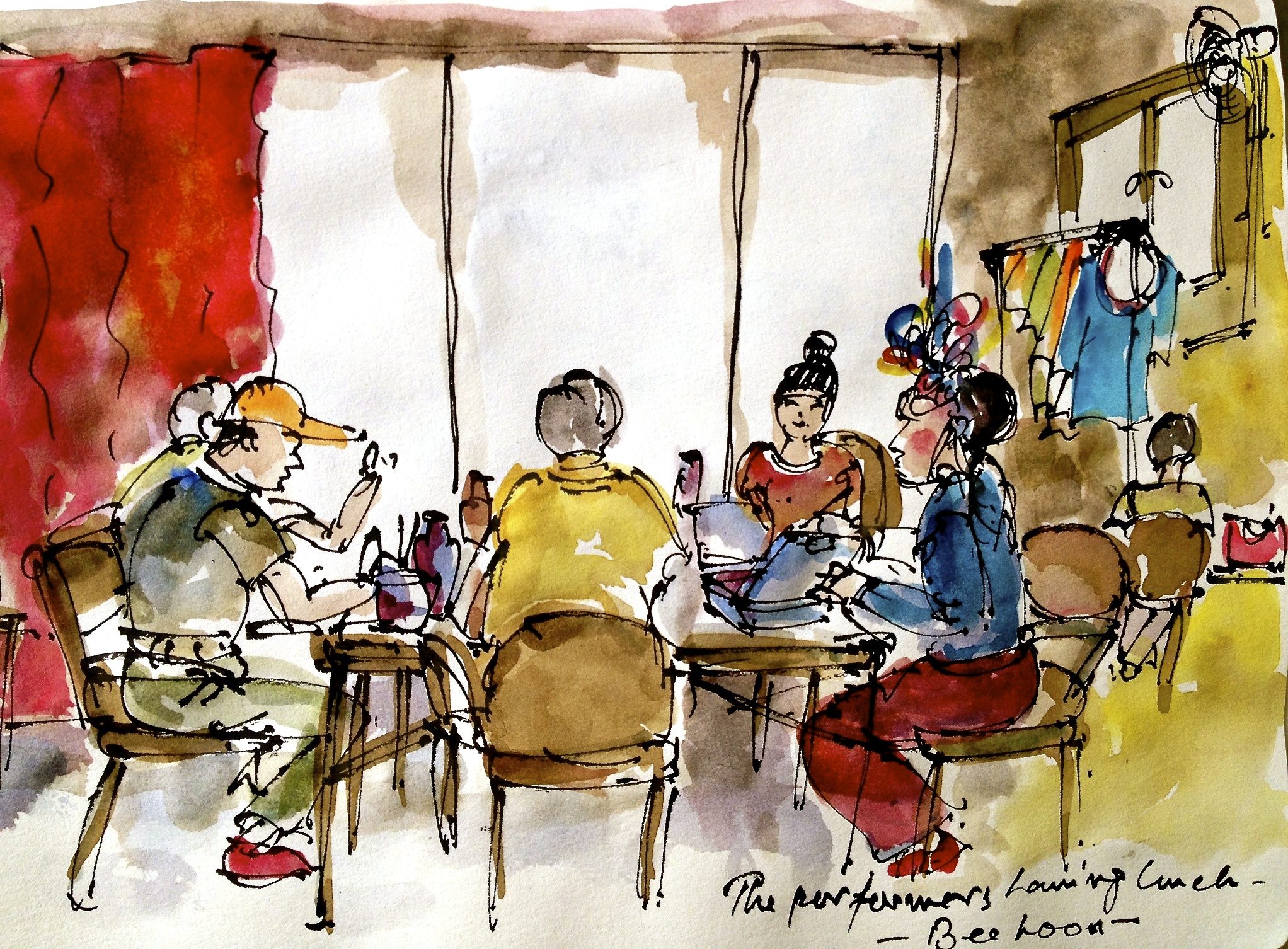
The performers having 'Bee Hoon' for lunch

The performers having ‘Bee Hoon’ for lunch

At the backstage, everything comes to a temporary halt, when lunch arrives in takeaway boxes. Performers, volunteers, makeup artists gather around and fill up on Bee Hoon. The queen mother extracts herself from the hairstylists and joins the group. In the next few hours, tiny microphones are distributed to the performers to be attached to their bodies, flamboyant costumes in the most elegant colours with matching shoes are donned, headgears from small to large, simple to the most exquisite adorn the heads.
One of the deities approaches the hairstylist, holding her head in pain. “Too tight, the headgead’s too tight!”  This headgear like many has two tiny holes on either side and comes with a matching pin as long as a chopstick that is passed from one end to another, through the hair bound in a bun, and wound a couple of times like a screwdriver, till the headgear fits the head snugly. The hairstylist fiddles with the screw and fixes the problem.
Javier catching up on local new before the performance

Javier from Thau Yong Amateur Musical Association, Singapore

As the deadline approaches, performers are getting themselves in the zone.
The queen mother and the scholar’s wife are pacing up and down the room in their flowing costumes; the deities are shaking their heads to check the fit of their headgear or humming quietly with their eyes closed; Javier is reading a newspaper and the scholar is relaxing his vocal chords by breaking into high pitched songs.
The philosopher is digging his nose, but I am not judging.
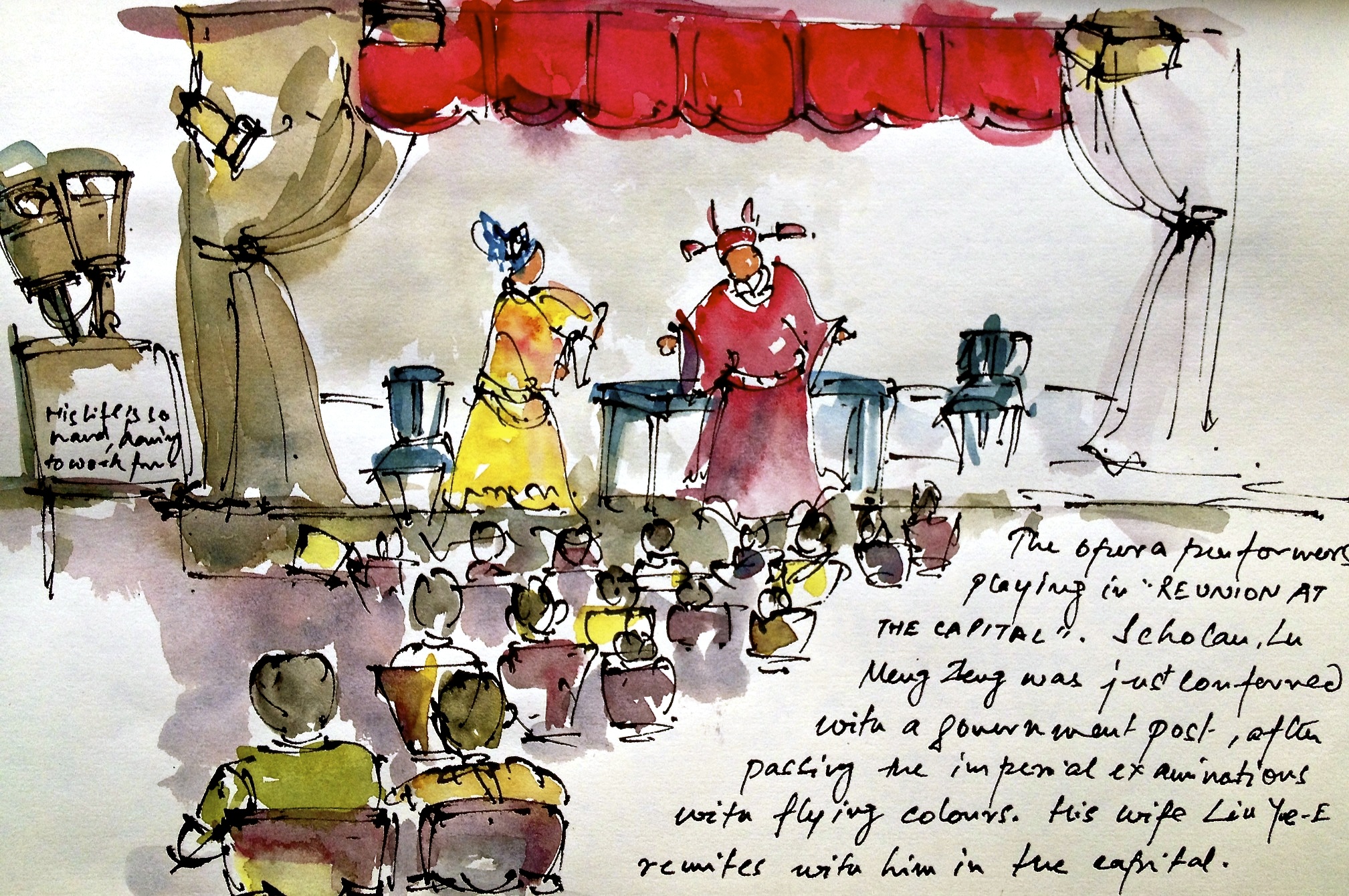
The scholar and his wife perfom in "Reunion at the capital"

The scholar and his wife perfom in “Reunion at the capital”

Have you met MOLLY?

I don’t know how I missed her but I did. Hurrying home from a writing workshop on the other side of the town, there were only two things that occupied my mind at that hour – a satisfying lunch and an even more satisfying nap. Eyes peeled on the road for shady spots and corners to walk by in the blazing afternoon sun, I passed her like a galloping horse with blinkers, till a gang of kids hailing MOLLY’s name in chorus, brushed past me.

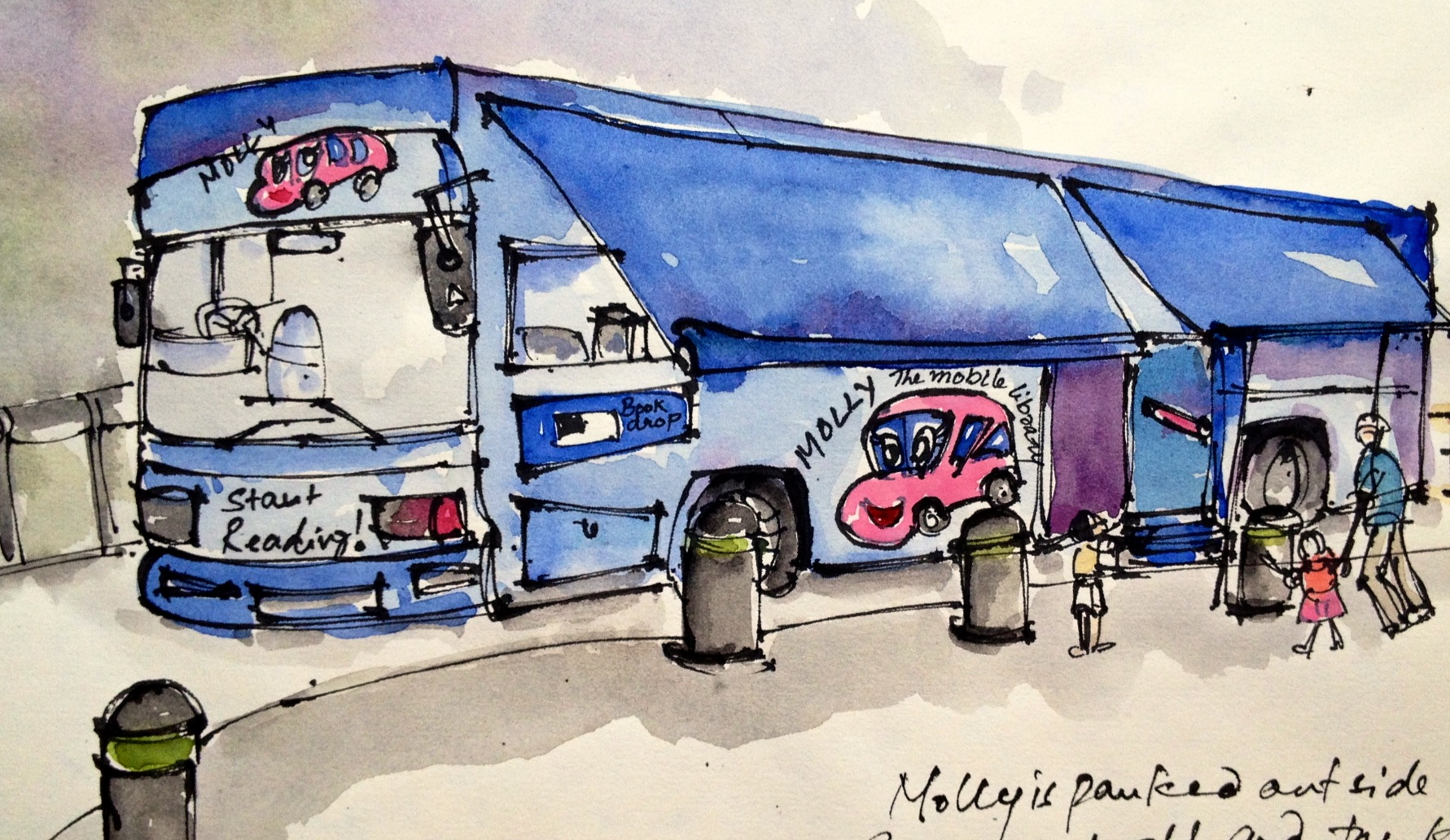
MOLLY parked at United Square Mall

MOLLY parked outside United Square Mall

Turning around, I looked straight into the big fluttering eyes of MOLLY, Singapore’s only mobile library. A refurbished public transport bus with imposing body stats – 11 meters in length, 2.2 meters in width, 2.1 meters in height and 16 tonnes in weight, MOLLY makes quite a statement on the road. Sporting an attractive decal of vibrant blue with animated characters, tiny trees and fluffy clouds drawn across her body, Molly’s visitor profile isn’t worth a guess either.

Parked along the kerb, in front of our neighbourhood mall, the bus’s door is wide open and the retractable awnings are drawn. Molly is open for business and the little ones are pouring in. Some are even returning books at the nifty ‘book-drop’ unit fitted below the bus’s window.

Inside the mobile library

The bus was retrofitted with shelves, airconditioner, generator, electronic borrowing units and such

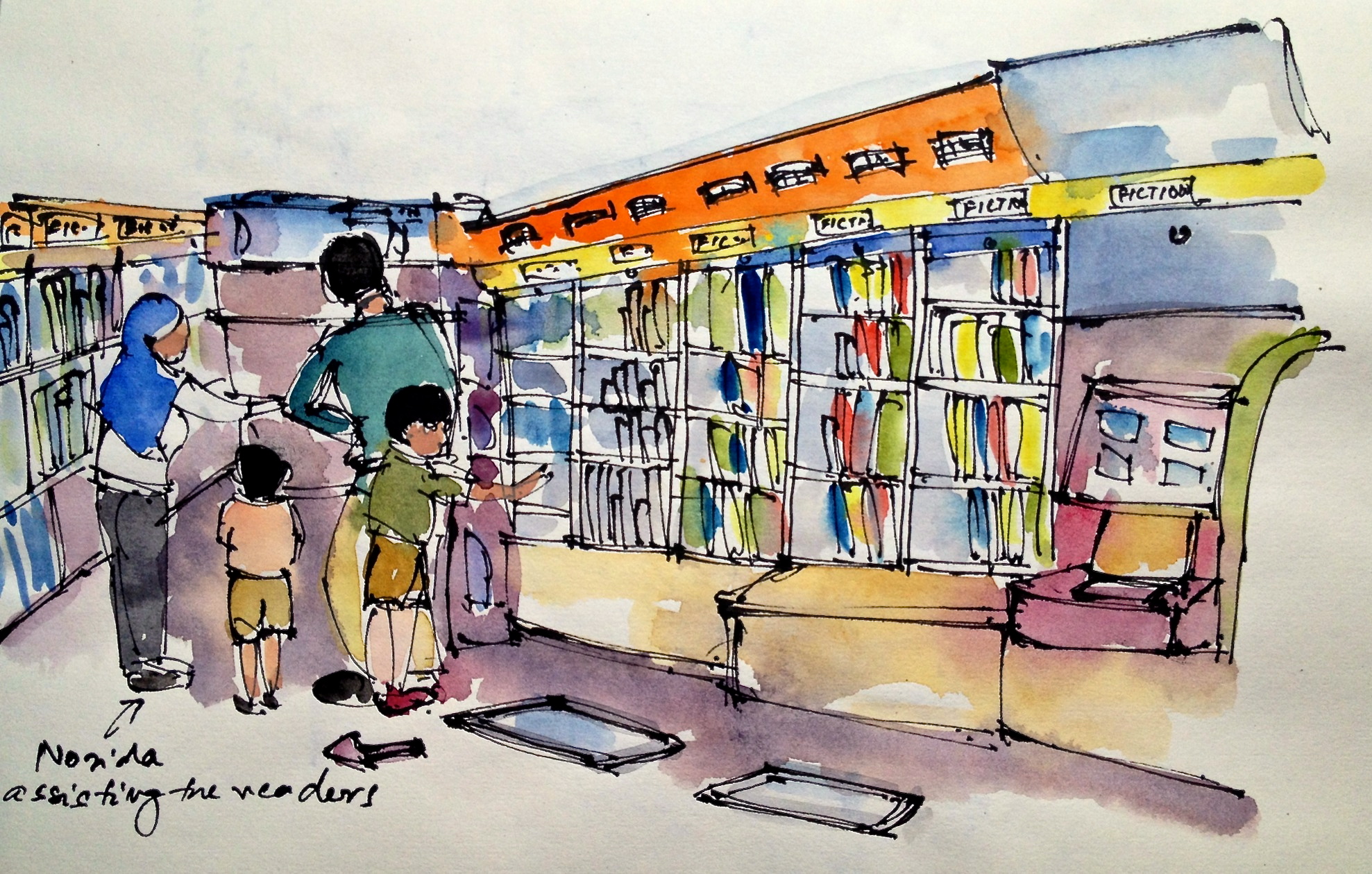
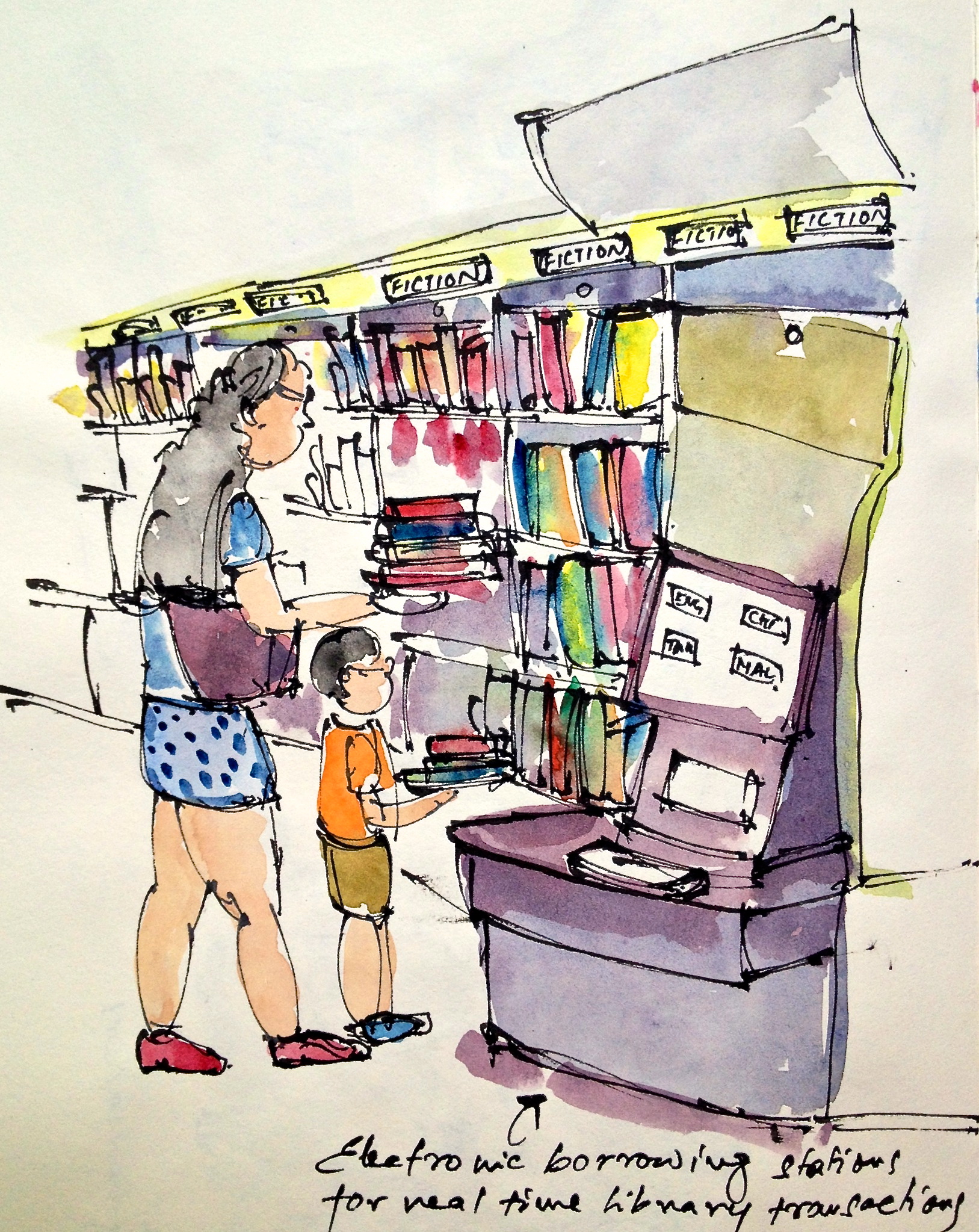
Sandwiched between the eager little readers, I squeeze myself through the door. Housed in a bus it may be, but it’s a library all right. Neat shelves on either side hold about 3000 books, that are grouped by age and labelled as per genre. An electronic book borrowing unit is stationed at the rear end of the bus, where a uniformed library assistant is familiarizing children with the borrowing process and encouraging the curious first timers on board to register themselves as library members.

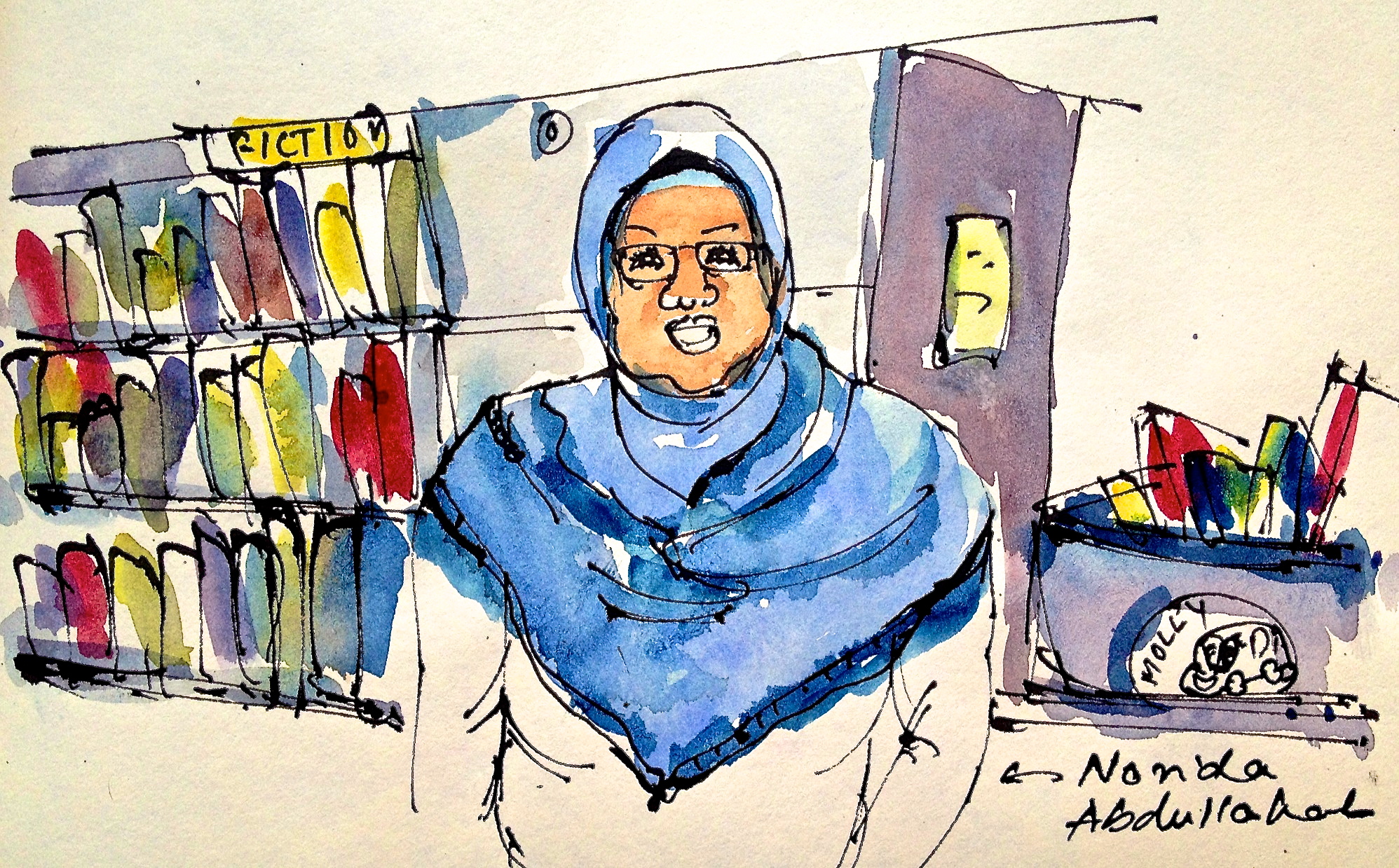
I am the last person in the queue, and with the same tenderness that she was showing the children, this 50 plus years old library assistant Norida Abdullahab, helps me not only borrow the books but renew them as well. ‘So you can use these for an extended period.’ she says, flashing a reassuring smile.

Norida Abdullahab

When I asked Norida’s permission to sketch her, she gave me the cutest expression

Though the passage inbetween the shelves is narrow, the interior is well furnished. Good lighting and air-conditioning make for comfortable browsing and reading . Needless to say, the kids are having a ball.  Some are sitting on their haunches, pulling out one book after another and sifting through them, while others are slouched on the floor, reading meditatively. The shorter ones are begging their mums and dads to be picked up, so they can reach a higher shelf.

“How about Emperor’s new clothes?”, suggests a mother. Or “City mouse and country mouse? That sounds interesting!”, coaxes another, whose girls are sitting around a pile of fairytales. It’s harder than it looks to convince their little minds.

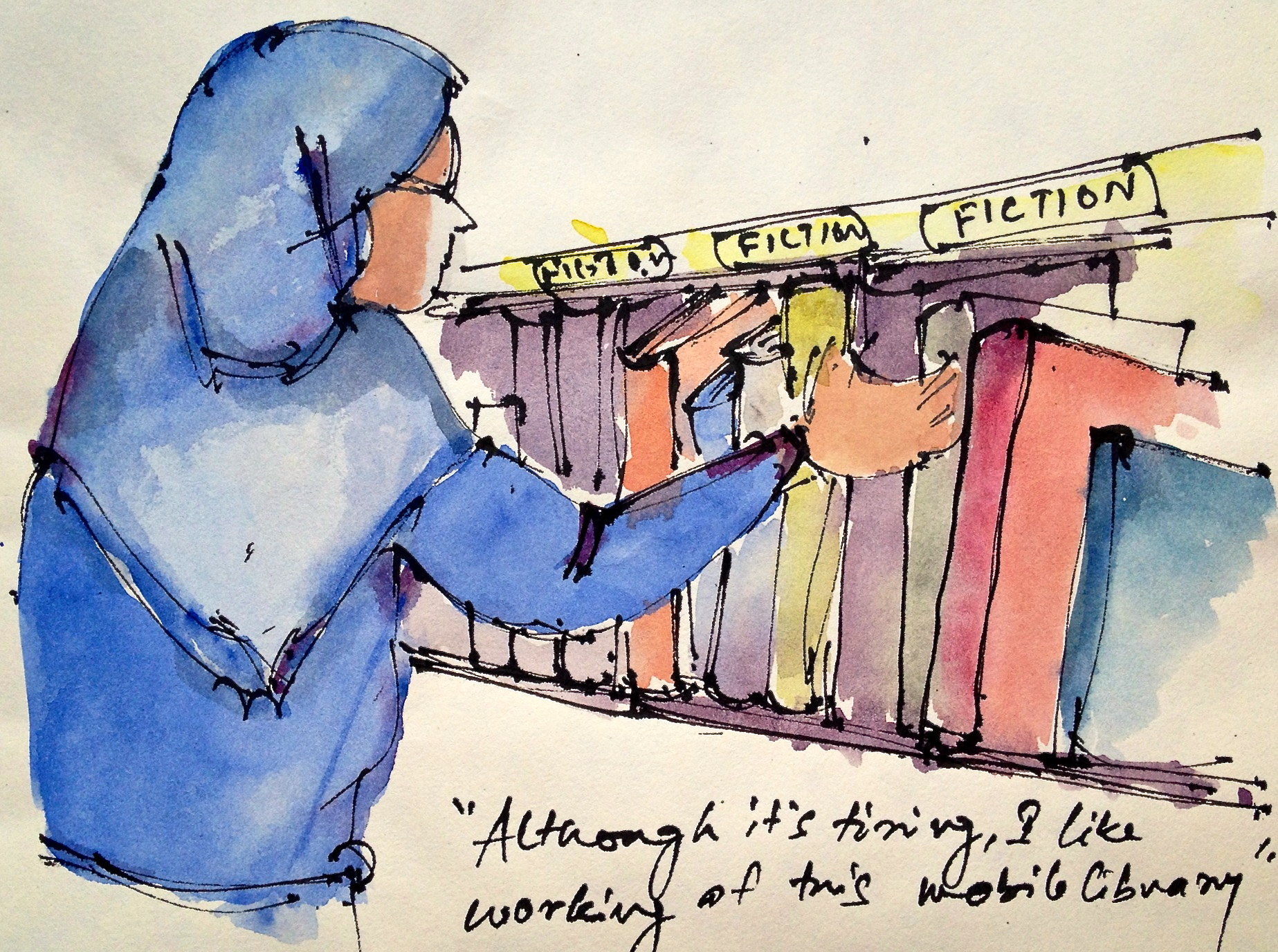
'Although it's tiring, I love working at this mobile library'

‘Although it’s tiring, I like working at this mobile library’

Norida is picking up the books from the floor and putting them back on the shelves. “Although tiring, I like working at this mobile library.’ she says. MOLLY has been her workplace for the last seven months. “I have worked at the National Library for 16 years and only recently did I request for a transfer” she adds.

The mobile library has two teams with 3 members each –  two library assistants and a group leader – visiting various locations on the island. Norida points out the printed schedules on the wall, with names of 8 locations each, to be covered on the following Saturdays and Sundays.

“Every second Saturday of the month, we visit these public venues. But that’s not our main job.” she says. On weekdays, throughout the year, MOLLY visits schools for the underprivileged. “Like schools for children with intellectual and physical disabilities, autistic children, deaf and dumb children, children with down’s syndrome to name a few.” explains Norida. “Since they can’t come to us, we go to them.”

I learn from her that, MOLLY is a 5 year old endeavour of the National Library Board of Singapore to make library services more inclusive and accessible to all, especially the undeserved community, so they too can discover the joys of reading.

Looking at the gleeful children lined at the borrowing station balancing piles of books, waiting for their turn, I feel comforted and happy thinking whether privileged or otherwise, this outreach activity of simply promoting the use of a public library at this tender age, so they become active users in the long run and use public libraries as a part of their lifelong learning journey, bears more value today than ever, specially in the context of kids growing up in a digital age with no dearth of multimedia at their disposal.

Electronic borrowing stations inside the mobile library

Children are familiarized with the electronic borrowing stations inside the mobile library

A mother asks Norida to help her locate books for children at level 3. “Boy or a girl?” she asks, springing right into action. ‘Girl’. “Well, then she might like these.”, says the library assistant, handing her few carefully selected options. Norida not only has sound knowledge of the library’s collection but she also provides customised recommendation to every reader requesting her assistance.

Turning back to me, she says, “I love my job at the library, but I always wanted to go out and make a difference, instead of being stationed at one place.” Reaching books to those with limited or no access to a library on a mobile bus, has fulfilled both her wishes. This is the reason she voluntarily requested for a transfer, after a decade and a half of service at a public library.

‘I love bonding with children, you know. I am also a grandmother of three.”

People watching and more coffee chronicles

Working as a freelancer from the confines of ones home isn’t as palatable as the images it may conjure. Besides a disciplined work environment – which needs to be strictly self imposed by freelancers – you miss out on the day to day office camaraderie, the human connection, the collective sense of belonging to a place.

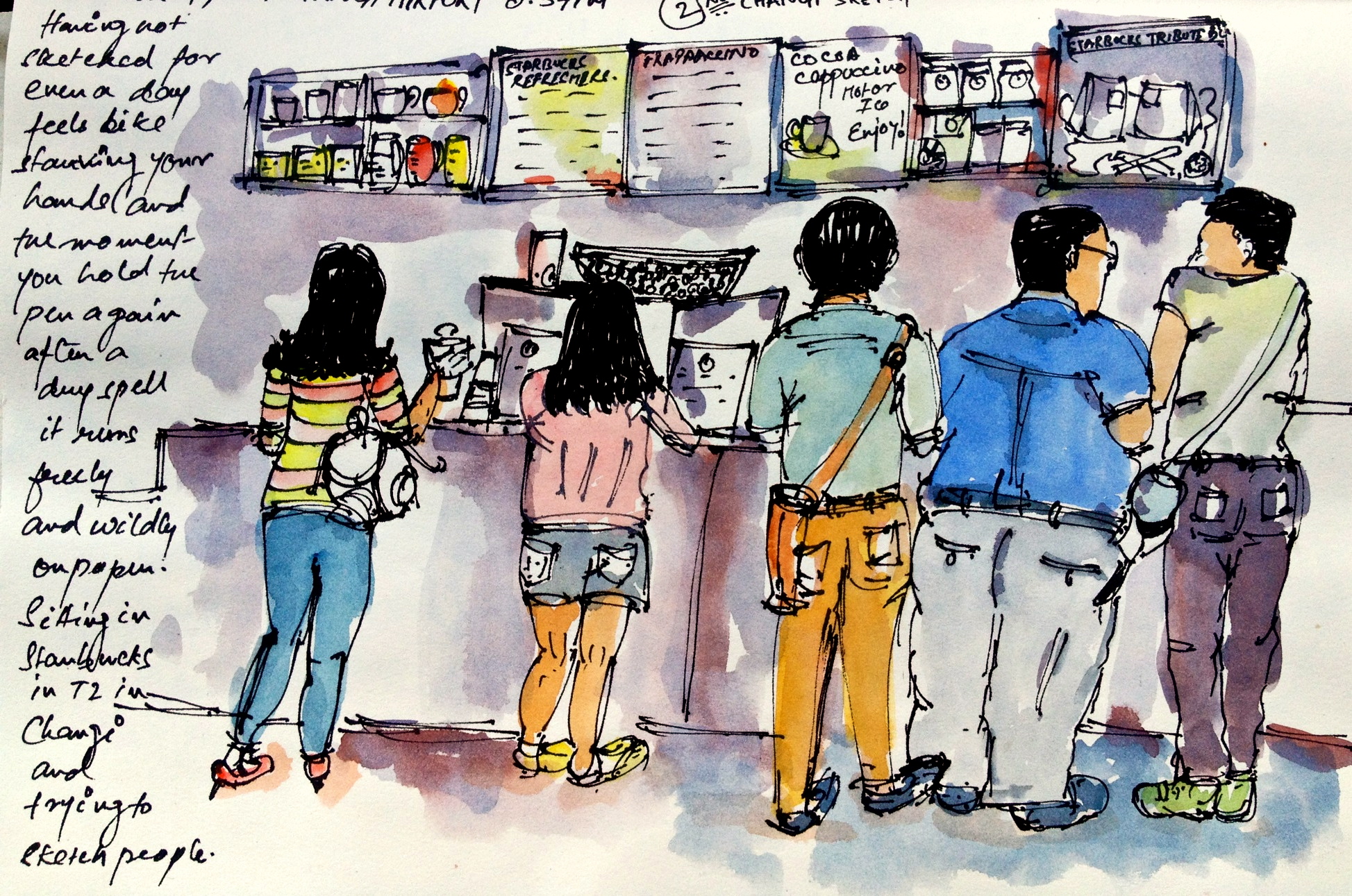
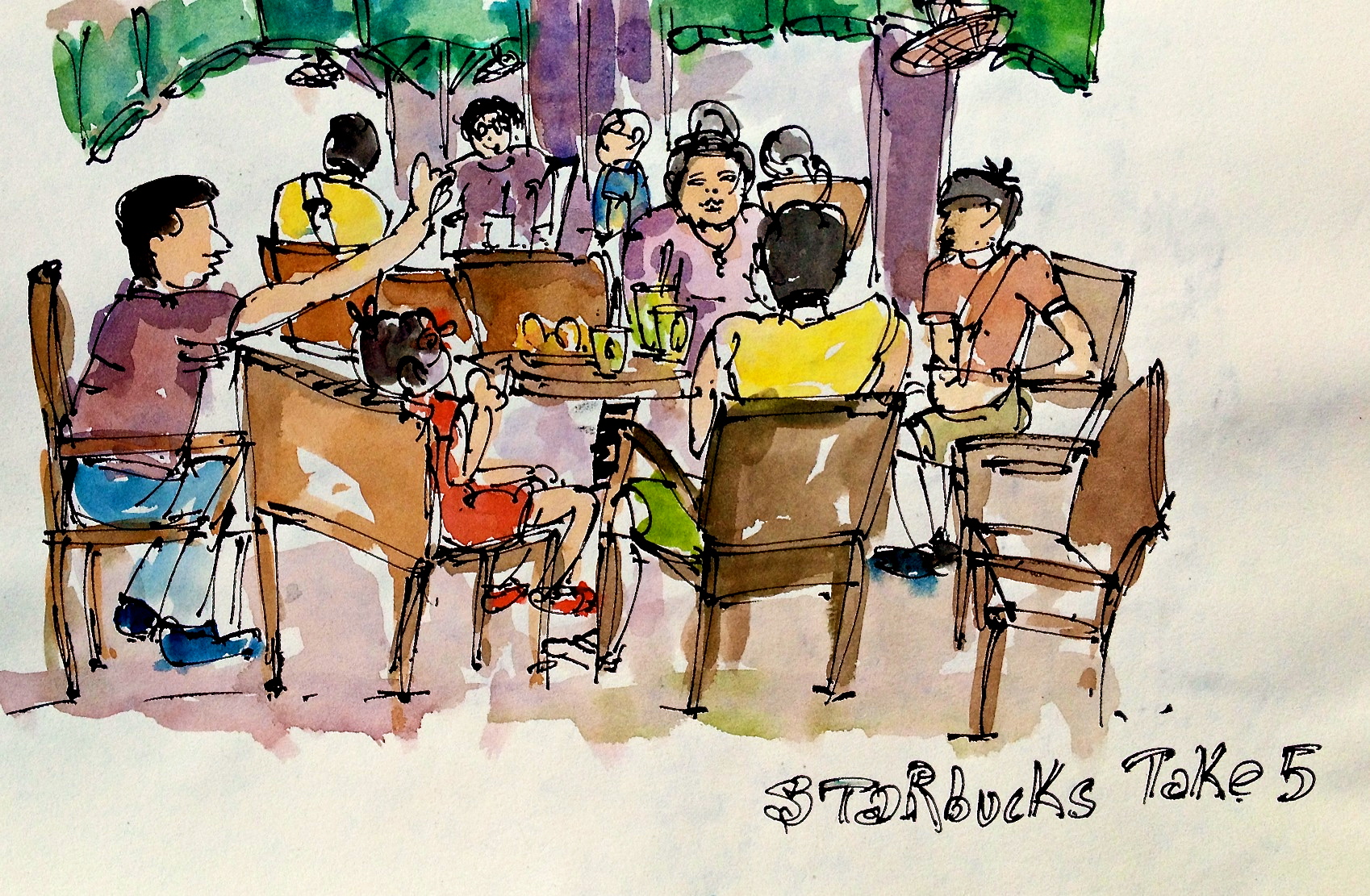
A starbucks outlet

While not contesting on the shade of the grass on either side, when I find the scales tipping in other’s favour i.e  when I start feeling cooped up and lonely, I simply carry my work, 5 mins from my house, to the nearest coffee shop, where I get people to sit around me while minding their own business, listen to pleasant music and have access to air-conditioning, wifi and plug points.

To my surprise and delight, there is no dearth of the like minded, so much so that between 9 to 5, it is hard to find a place.

There are official meetings presided by dapper looking men and women over cappuccino and cookies. And these madams and sirs care to perch their prissy bottoms only on the plush leather sofas with handrest (also the most coveted in the entire cafe) by the windows with the lovely view. If this coincides your entry, it pays to linger around, as they usually leave as soon as they finish their drink or their talking.

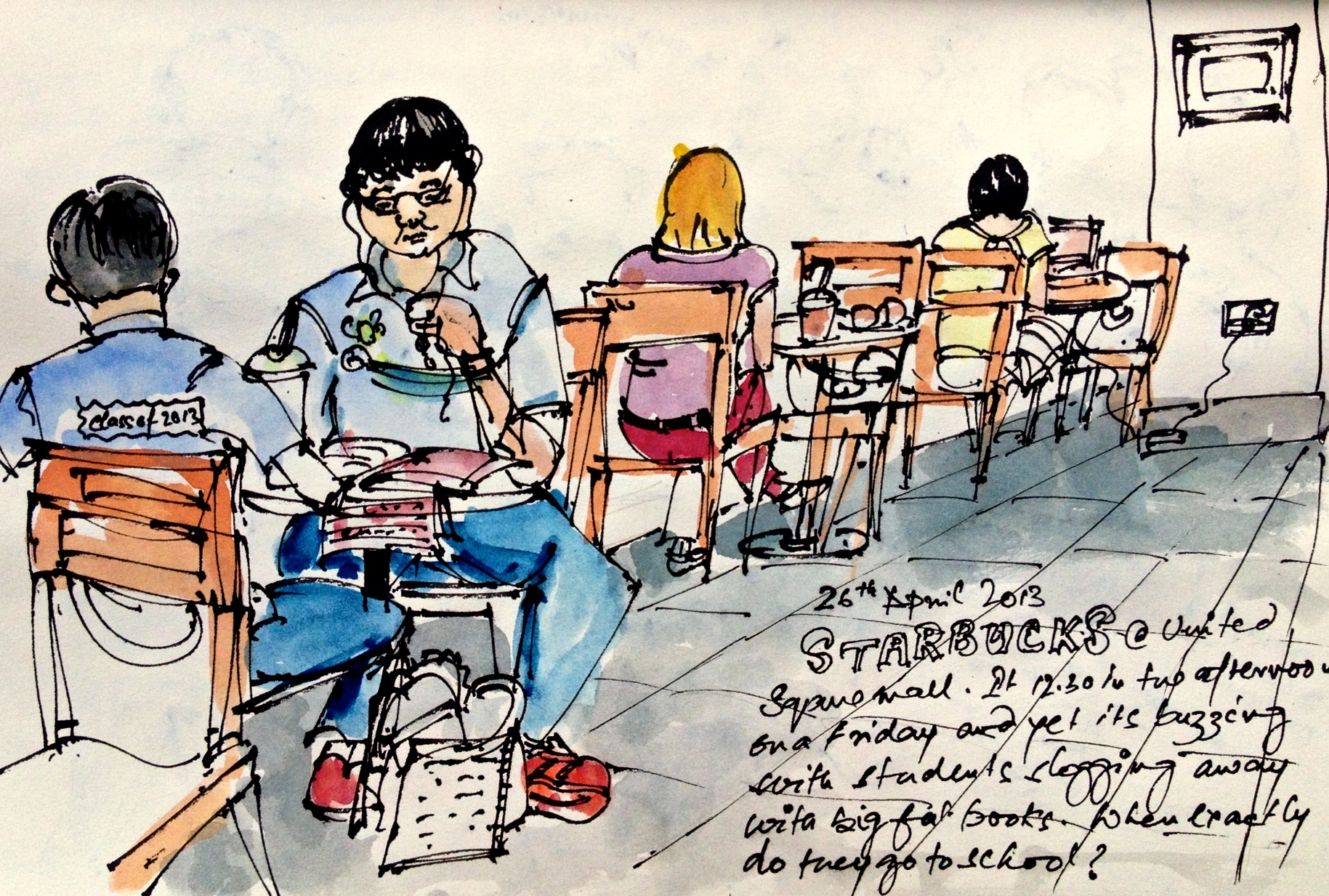
School kids working on their assignments

School kids working on their assignments

But the same theory is redundant when it comes to the cafe’s biggest headcount – the scraggy school kids finishing assignments over a glass of plain water and maybe, just maybe a tall sized green tea frappe that was finished eons ago and has the frothy bits left at the bottom. Now, they cost the cafe, the entire upper and lower deck with high stools and convenient plug points.

And they also kind of live here, only getting up for toilet and food breaks (which is usually a packet of chips).  While away which sometimes is for an hour, their personal laptops in dayglo covers, scribbled notebooks, stationaries, chargers, headphones, snacks, wet wipes and sweatshirts scattered on the table will stand sentry. Yes, it’s Singapore, nothing gets stolen but avoid this zone like plague, if you wish to be seated in this lifetime.

More students

More students

Then there are the moms. All kinds of moms. The ones feeding chocolate fudge cake to their  primary schoolers sitting upright (only at the behest of mommy), and doing their home works; and the ones with toddlers learning to use cutlery and making a gruesome mess by repeatedly stabbing the delicate chicken puff, while their eyes are peeled on the iPad; and lastly the pregnant ones with a wailing brat in tow, struggling to get a heaving stroller (from the weight of groceries) inside the cafe door with one hand and shoving the pacifier into the child’s mouth with another .

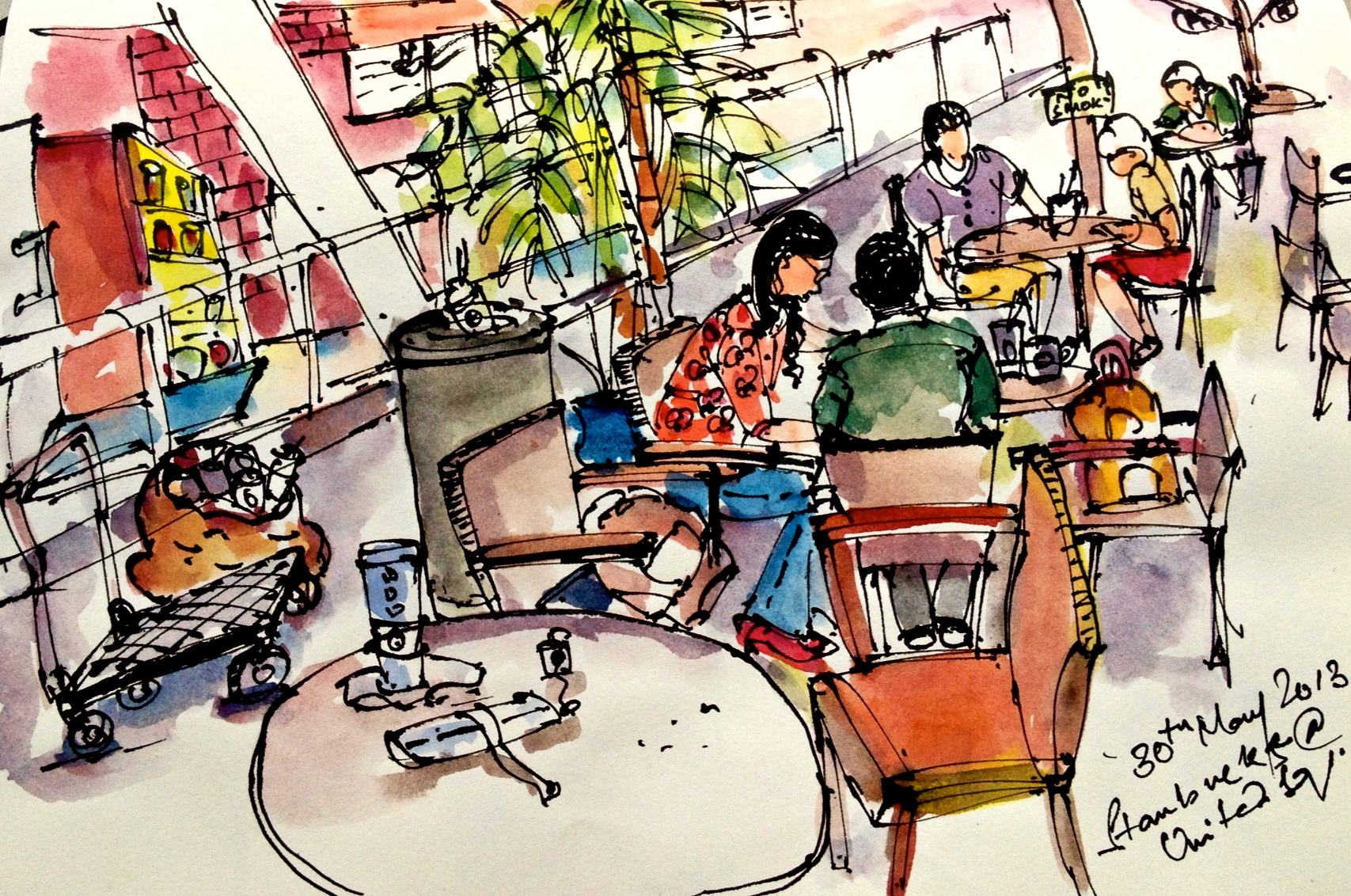
Al fresco seating at the cafe

Al fresco seating at the cafe

Moms populate the cafe’s alfresco seating so their kids can run around and chase pigeons, when they can tear away from their wondrous gadgets. If you’ve been around for a while like me, you’ll know – smaller the kid, battier is the mother, and the fidgety she gets, higher is the probability of finding a seat. So hover like a bee over a bed of flowers. Your luck might just turn.

The rest belong to the mixed bag, where taking your chances could be be a bit hit and miss. Like the older school kids in uniforms caught in between school and private tuitions or college goers, congregation of elderly people or maids on their off days. They could leave in an hour or lounge for half a day. I’d play it by the ear.

Possibly a fashion designer

Possibly a fashion designer

But if you are desperate for a seat and nothing else has been working, you might want to sneak up on those sitting all by themselves – alone with their coffee and reading a book/newspaper or updating their blog or looking at Google maps. Most of the time, they get bored with themselves too easily and leave. Jump right in.

Saving the best for the last because you spot this kind only if you are alert and have been paying attention – the kind that rolls in, does their business and leaves. Pin your hopes on anybody without a laptop. Or without a smartphone, but that’s asking too much in Singapore.
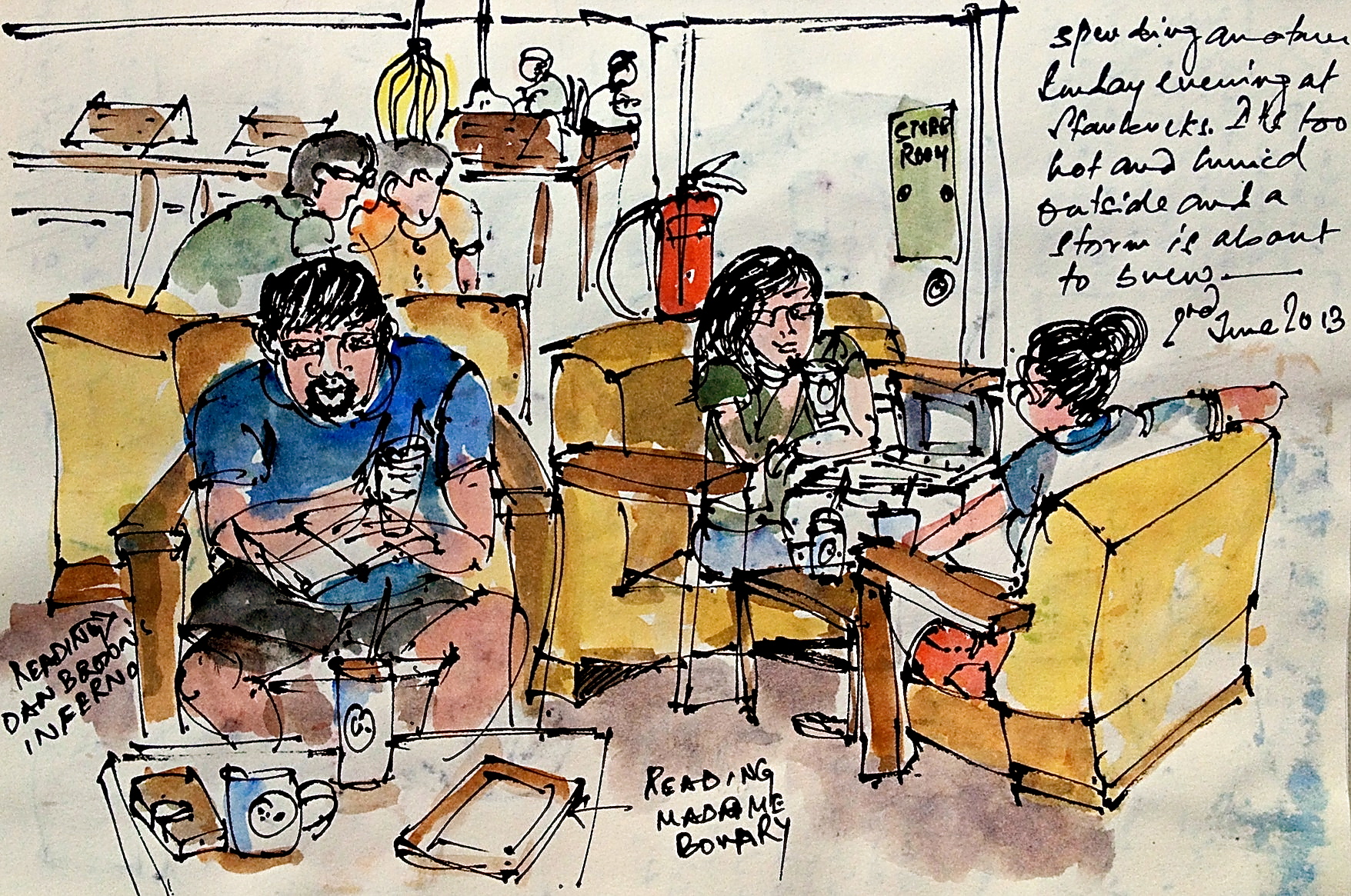
An evening at Starucks

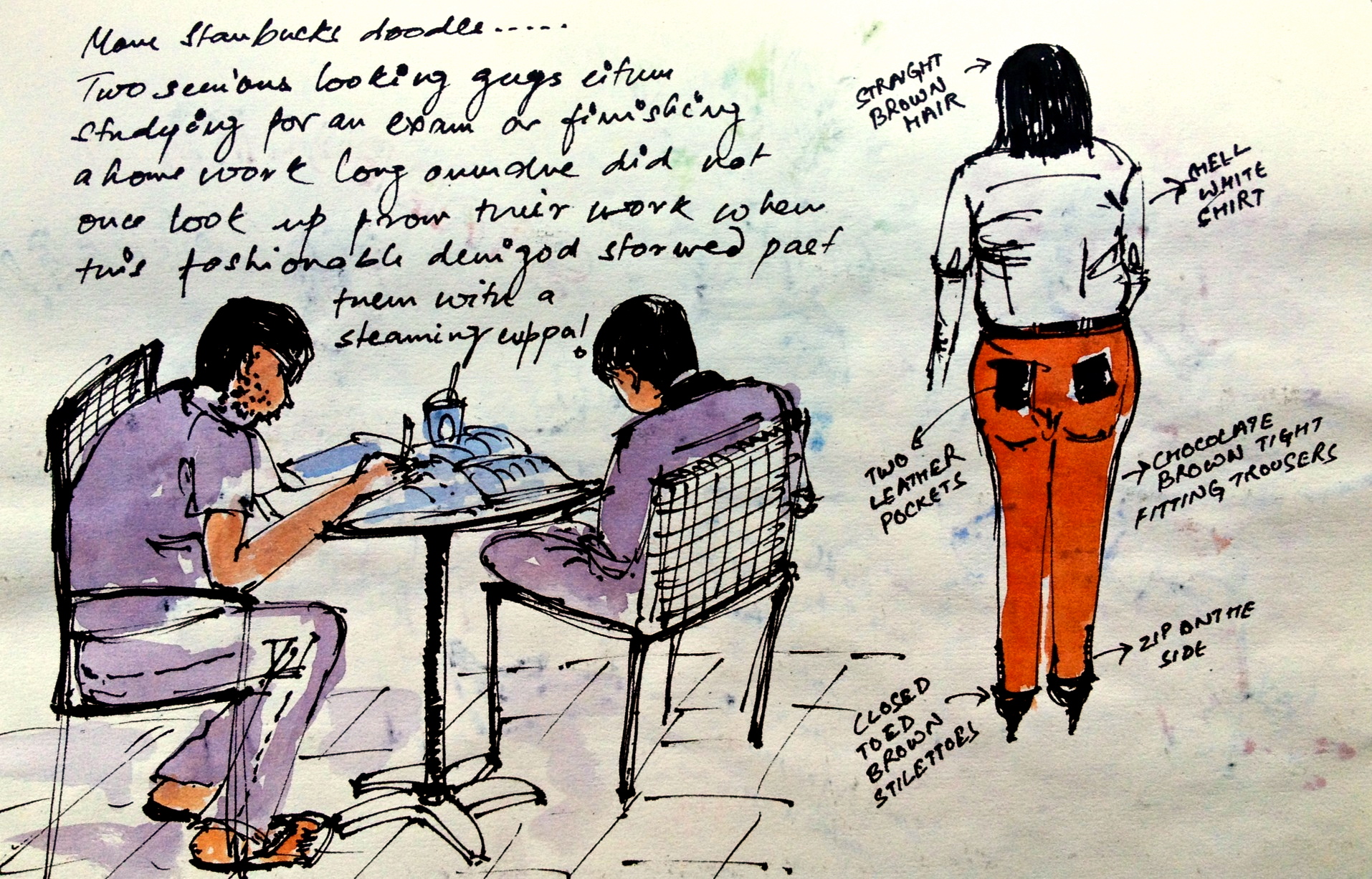
An evening at Starbucks

Watch out for people with big shopping bags, or those with dogs, or those taking quick interviews ( I’ve been witness to many job interviews over coffee – lasts as long as the drink), making a hurried presentation, mulling over houses with property agents or bickering like the two local film producers I came across, trying to prove whose job sucked more. I could swear, their heated debate rose to a crescendo but cut out as soon as the last drop of coffee trickled down their throat. After which they left and I moved in.

It is within this group that, if you are lucky, you get a seat that isn’t already choped – a typical Singaporean phenomenon of reserving seats by placing a harmless tissue or hasn’t been pooped upon by one of the three notorious pigeons that pick at the leftovers.

I have honed my seat grabbing skills over three years of Starbucks patronage at my neighbouring outlet where I’ve worked, planned vacations, played scrabble, finished several tomes and drank gallons of coffee and tea. And only recently, have I started sketching and it isn’t surprising that in my 90 page sketchbook, which I finished recently, there are more than twenty sketches done at this location of the same individuals, groups and clusters I talk about. I observed them only because I sketched them.
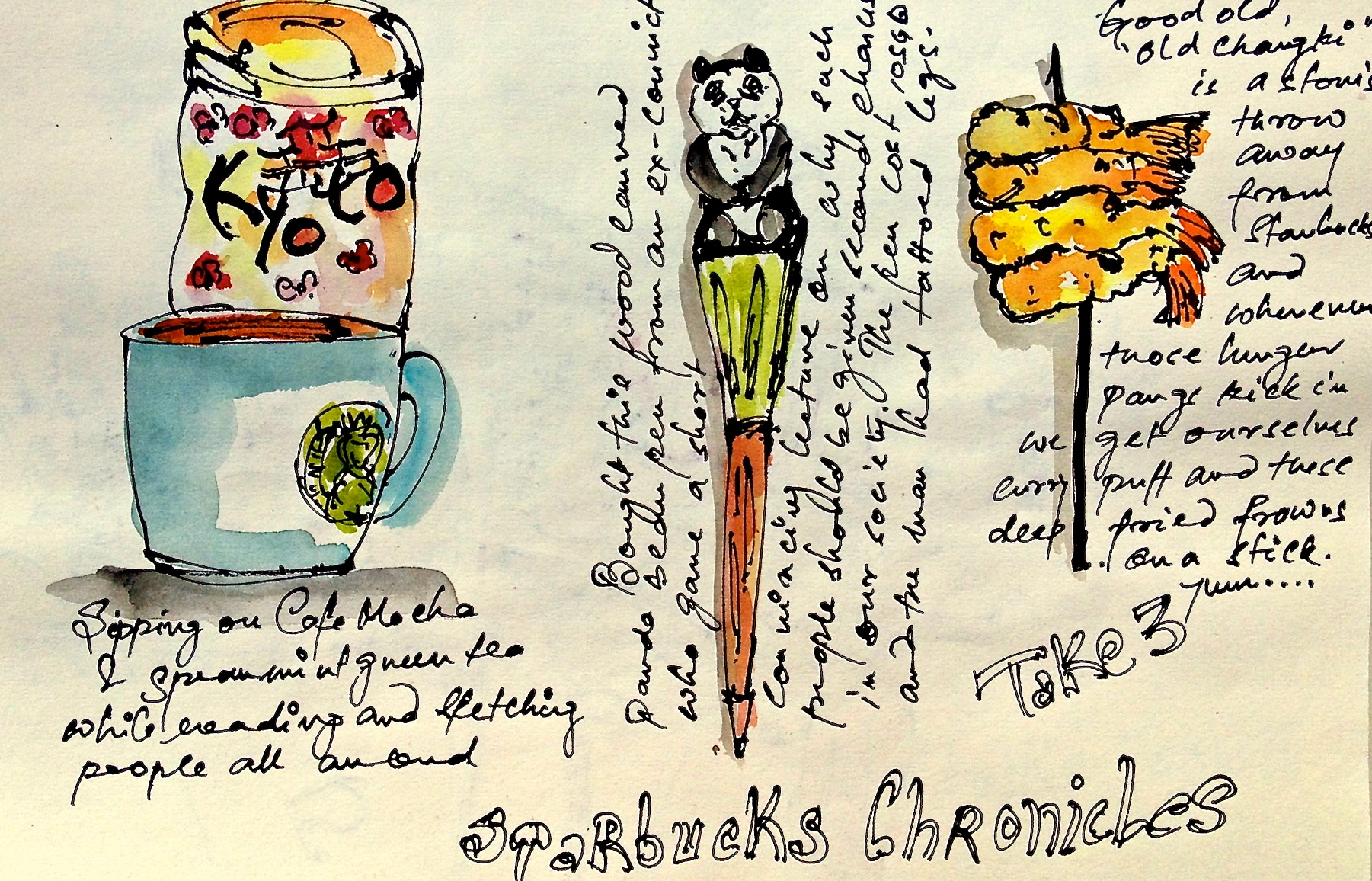
This is why I accompany my stories with hand
drawn sketches instead of photographs. More than any other medium, sketching requires complete immersion of senses, gets you to pay attention and slow down.
Any sketch when looked at several days or months later, evokes the moment, in its tiniest details.  Like this hand carved wooden panda bear pen that was sold to me at the cafe by an ex-convict with heavily tattooed legs.
Hand carved panda pen sold by an ex-convict

Hand carved panda bear pen sold by an ex-convict

The opening line of his very impressive speech, that led to the sale was, ” Do you believe in second chances?”.  Cheesy, yes? But the sketch helped me pin that memory down.