Out and about

I am enamoured with Singapore’s shop houses.  It’s official. These picturesque palimpsests of the past have been recorded in my sketchbook so many times that I can draw them to a tee even if someone blindfolded me and trussed me up in a cupboard.

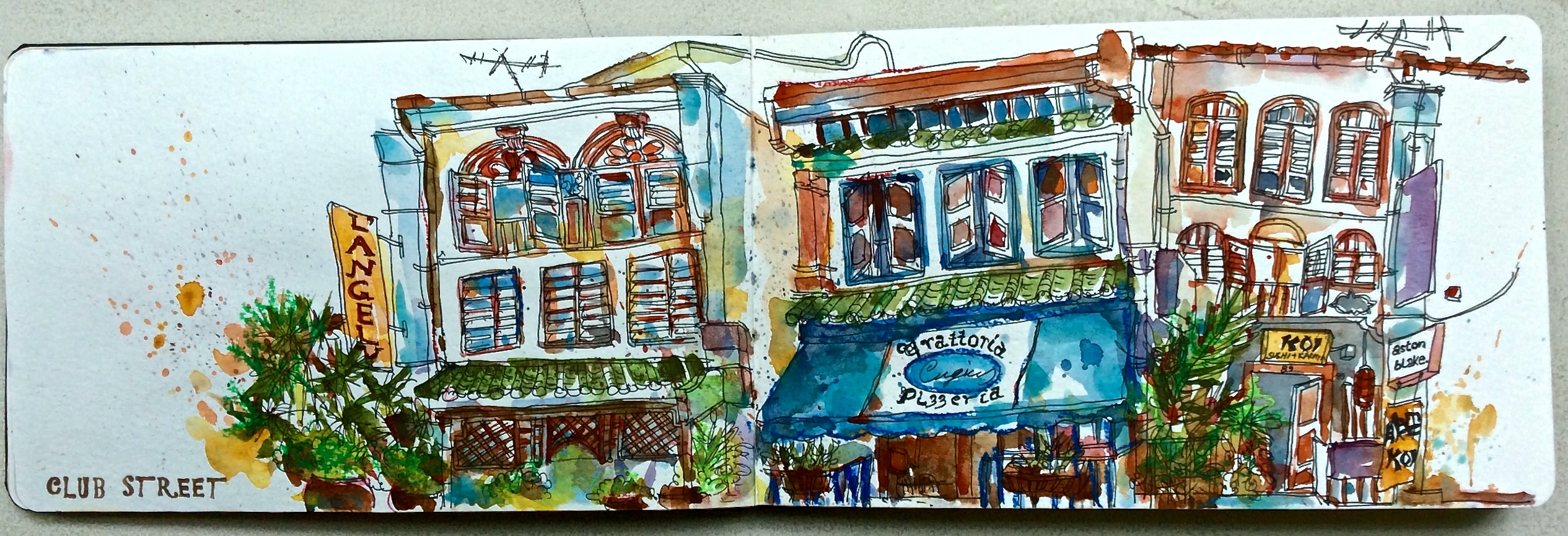
Club Street

The shophouses have remained but clearly the businesses have changed. Sketched at Club Street

To the untrained eye, most shophouses may look alike, but if you’re the curious and observant kind, you’d know that’s hardly the case. Their purpose as residential and commercial establishments may have remained unaltered, but the architecture of these two, sometimes three storied narrow facade terrace houses continuously evolved from the 1840s to 1960s, when they monopolised the cityscape of Singapore.

Pre 20th century shophouses were functional and austere – low two storey buildings with one or two louvered windows with hardly any embellishment on the facade. Chinese-Baroque style from 1900 to 1940s, saw extensive use of decorative mouldings, pilasters, carved wood-work and imported glazed tiles on the facade, representing the fusion of Eastern and Western architectural styles and giving great aesthetic pleasure even today when you look at their refurbished selves. Moving forward, heavily ornamental gave way to simplified and streamlined.

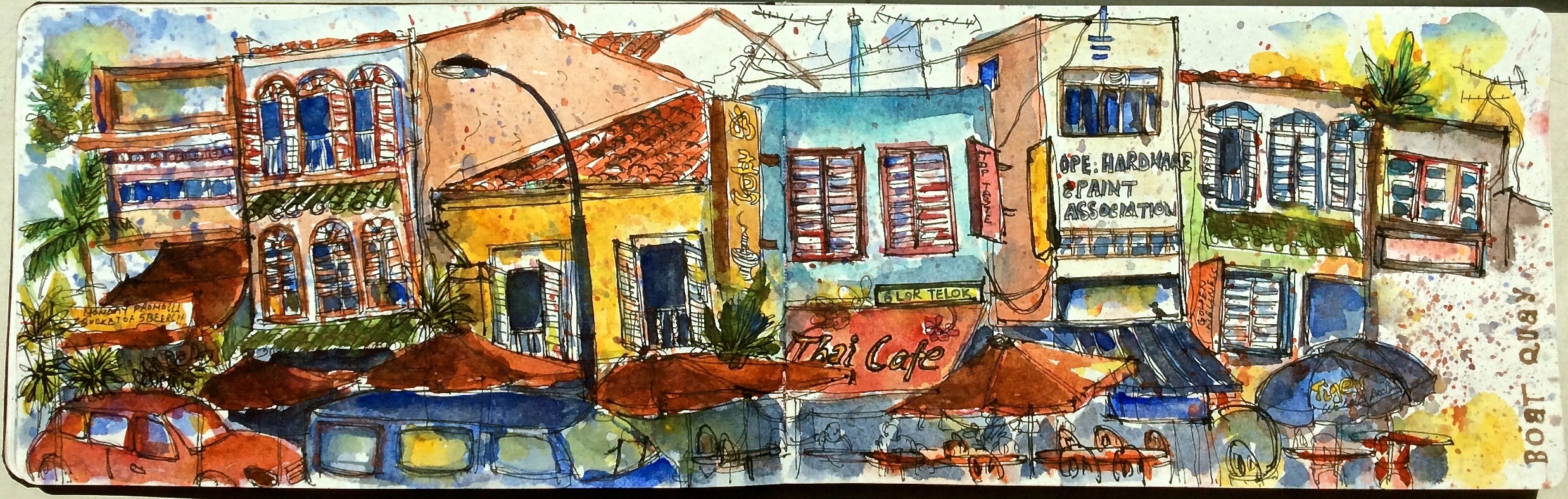
Boat Quay

Such an amazing potpourri of architectural styles seen at Boat Quay

Designers and builders began combining ornately carved transoms and colourful tiles with Art Deco elements such as cross-braced glass window panels and geometric balustrade designs, finally joining the Art Decco bandwagon in 1930s and continuing till the 60s. Stepped pediment with a flag post is a typical giveaway of this stye. Modern shophouses of 1950 – 60s, were plain and unadorned except for a concrete fin air vent perhaps, thus coming full circle in terms of design simplicity.

All this may seem very textual, but what thrills me is to be able to catch these nuances of evolution when I am out and about in the city, running errands, going to the library, working at a cafe or sketching. Especially, sketching. Tracing this potpourri of personal taste, temperament and lifestyle of the residents of yesteryears, sometimes on a single street feels like time travel. Every single time.


He came, He sat, He left

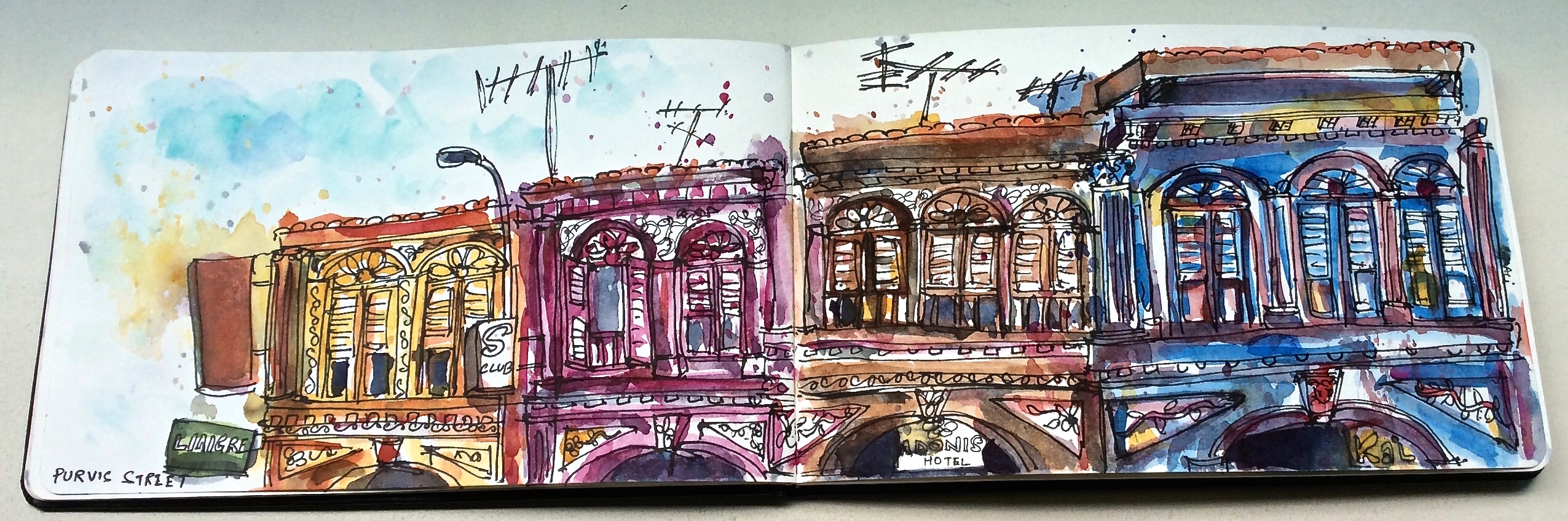
Purvis Street

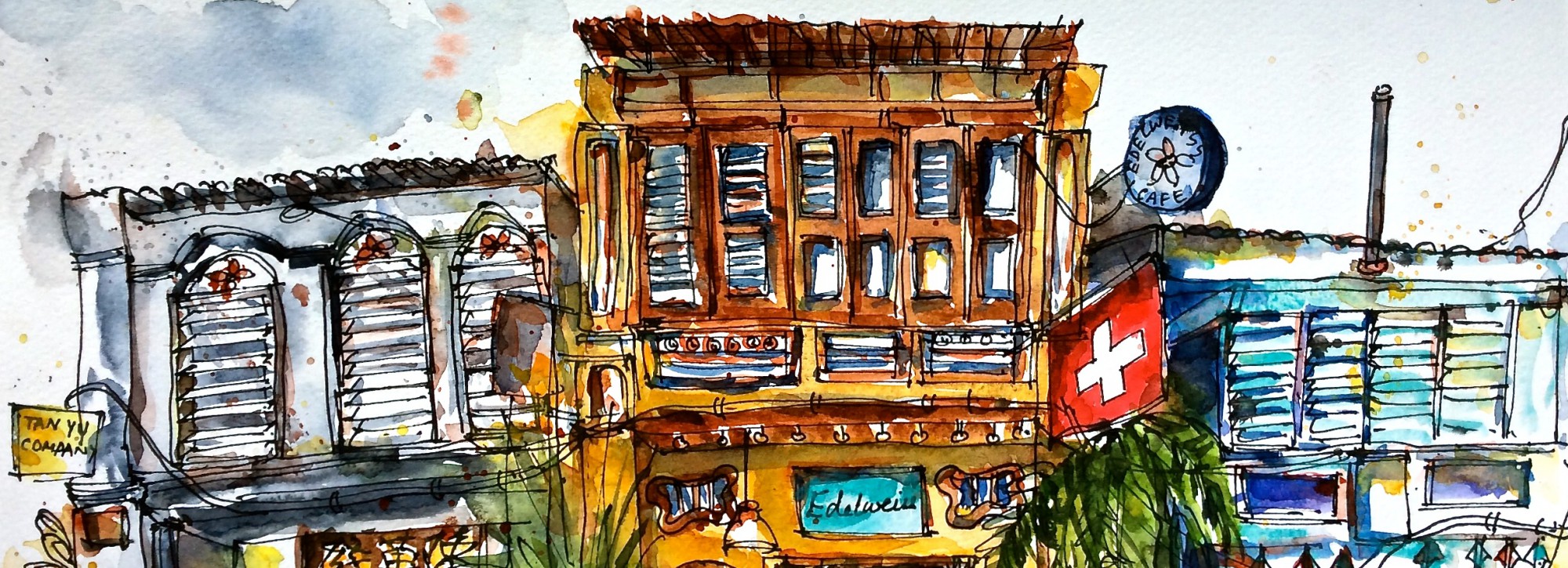
This row of colonial shophouses on Purvis Street was sketched from the Killiney Kopitiam

Everytime I visit the Central Library in Bugis, I drop by Killiney Kopitiam on Purvis Street for a cup of coffee or lime juice. Mostly lime juice, and sometimes french toast with butter and kaya. Parked on Killiney’s functional chairs and tables set on the five-foot way, for less than 2 dollars, I get to brush up on my dolce far niente while enjoying an unobstructed view of a narrow street hosting rows of colonial shophouses on either side. If you discount the fact that these conserved historical relics work as hotels, swanky restaurants, bars, and boutiques in the current scenario (instead of being obliterated, I’d say that’s a good compromise), and just focus on their restored exteriors displaying Chinese Corinthian style* – the facade bejewelled with Chinese symbolic features such as vases of peonies, fire breathing dragons, bat-headed keystones;  colourful louvred windows with fanlight and the wide arched entrances  – you’d know that they’re still a great sight to rest your eyes on in this uniform black and white concrete and steel jungle.

So I come here often. Mostly during late afternoons when we  – the retirees and I – can have the kopitiam to ourselves. From time to time, cheerful flocks of students and suave, important looking  people in dark suits and starched dresses that don’t seem to wrinkle, swing by like migratory birds – always in limbo, sitting alone in a corner, minding their business and never staying too long. Untill the other day, the very subset of this group, approached me from behind in a deep baritone voice – Is somebody sitting there? ‘There’ meant the empty chair opposite me. I was knee deep into this sketch and just waved my hand saying no, without even looking.

‘Well, can I sit there?”. An early 40-ish man of athletic build, with a tapered face sporting long sideburns, slick hair combed back and set in place with hair gel, dressed in a dapper grey pinstriped suit and thick framed glasses was standing in front of me, holding a can of chilled Tiger beer and a pack of cigarettes. I may have mumbled an indecisive ‘sure, go ahead’ out of politeness, because the next moment he was shuffling himself opposite me and putting his knick-knacks on my table. Had he approached few minutes early, this guy – probably on a gluten-free, carb-less, high-protein diet that requires him to eat exactly five and a half times a day in precariously measured quantities – would’ve witnessed me hogging my greasy french toast with a cube of butter in quick mouthfuls. Glad I saved him that image. I moved the empty plate and cutlery by an inch to make room for him, or may have just nudged the plate to give an illusion of my intent as well as re-iterate who’s the first occupant and who’s the ‘tag along’.

He lit his cigarette and was quiet. He may have been staring at my sketch but I didn’t look. I kept drawing thin lines, thick lines, curvy lines, wavy lines, squiggly lines but I didn’t look. I kept looking at the shophouses right past him, across the street for reference but not at him. He cleared his throat and took a long swig of the beer. My peripheral vision figured him shifting in his chair, feeding spiral cigarette smoke to the small potted plants on the steps. I casually swept my eyes across the kopitiam’s corridor to check if the other chairs were taken. None was. Well, what do you want? I screamed. In my mind.

More wavy lines, curvy lines, squiggly lines, this time with greater diligence and feigned honesty. I was like a mean drawing machine working towards an irresistible piece-de-resistance that would somewhow prevent apocalypse.  The weight of the world was on my shoulders. How could I deflect? I dug deeper into my sketchbook and didn’t look up.

He said, ‘Hello’. So I looked up. He was turned away from me, and was balancing his phone between his ear and the shoulder, while his hands caressed the cigarette and thecan of beer. What followed was not one but several calls, one after the other- advising, pleading, negotiating, sweet-talking existing and potential clients on investment opportunities with the bank that employed him and probably helped finance the Armani frames balanced on the bridge of his nose. Talks of floating and fixed interest rates, and millions of dollars escaped his lips in casual banter.  ‘Have a great weekend’. I looked up again. He was still on the phone.

Then just as discreetly as he’d come, he left. I’ve never witnessed anyone leave like that. Effortlessly. Without the sound of footsteps. Like a frightened gazelle. If vanishing into thin air seems hyperbolic, I’d say he glided into thin air – the posture of getting up, adjusting the body and taking the first step to walk off merged into one single mellifluous move, almost like a nubile dancer.

He even took away the acerbic smell of his perfume mingled with the cigarette smoke that I loathed in the beginning but was beginning to disregard.


* I gathered more information about this particular architectural style ( commonly mistaken for Straits Baroque architecture) seen on Purvis street, from an exhaustive exhibition on Shophouses at the URA centre : “Interestingly the working drawings for these twin arcades of two storey shophouses which were designed by Almeida & Kassim for local worthy Seah Peck Seah in 1902, gives no indication as to how the facade was to be ornamented. The elevations simply defined the principle dimensions of the building, but the detailing was left completely blank – no cornice, no architrave (the moulding round the windows), no secondary pilasters, no fluting, not even a keystone, let alone one with a bat’s head on it! Evidently, the style and choice of imagery was left completely to the artisans who carried out the work, who, in this instance, have opted for a remarkable synthesis of Chinese and Baroque aesthetic sensibilities to arrive at a very singular Chinese ‘Corinthian’ style of ornamentation. “

Date with old Vic

I have a thing for old run down buildings with scraggly facades and chipped paint that have been taken hostage by weeds, arm-twised by thick veiny roots and caked in years of dust and neglect. The cloudy mist of ‘what must have been’ hanging about them is what makes them irresistible.

Perhaps ‘nostalgia’ is what I am really attracted to. But why wouldn’t I be? Globalisation is making our cities across the world increasingly homogenous; multistoried office buildings – lush condominiums – swanky shopping malls – fast food chains and boutique cafes is like a trite formula that’s being slapped across every landscape that’s on the road to modernity.

Knowing about the past is the only way to read the prologue of this story that we are living today, to better understand its character, its provenance so we can connect with it, be aware and be empathetic.

Victoria Theatre and Concert Hall

Victoria Theatre and Concert Hall

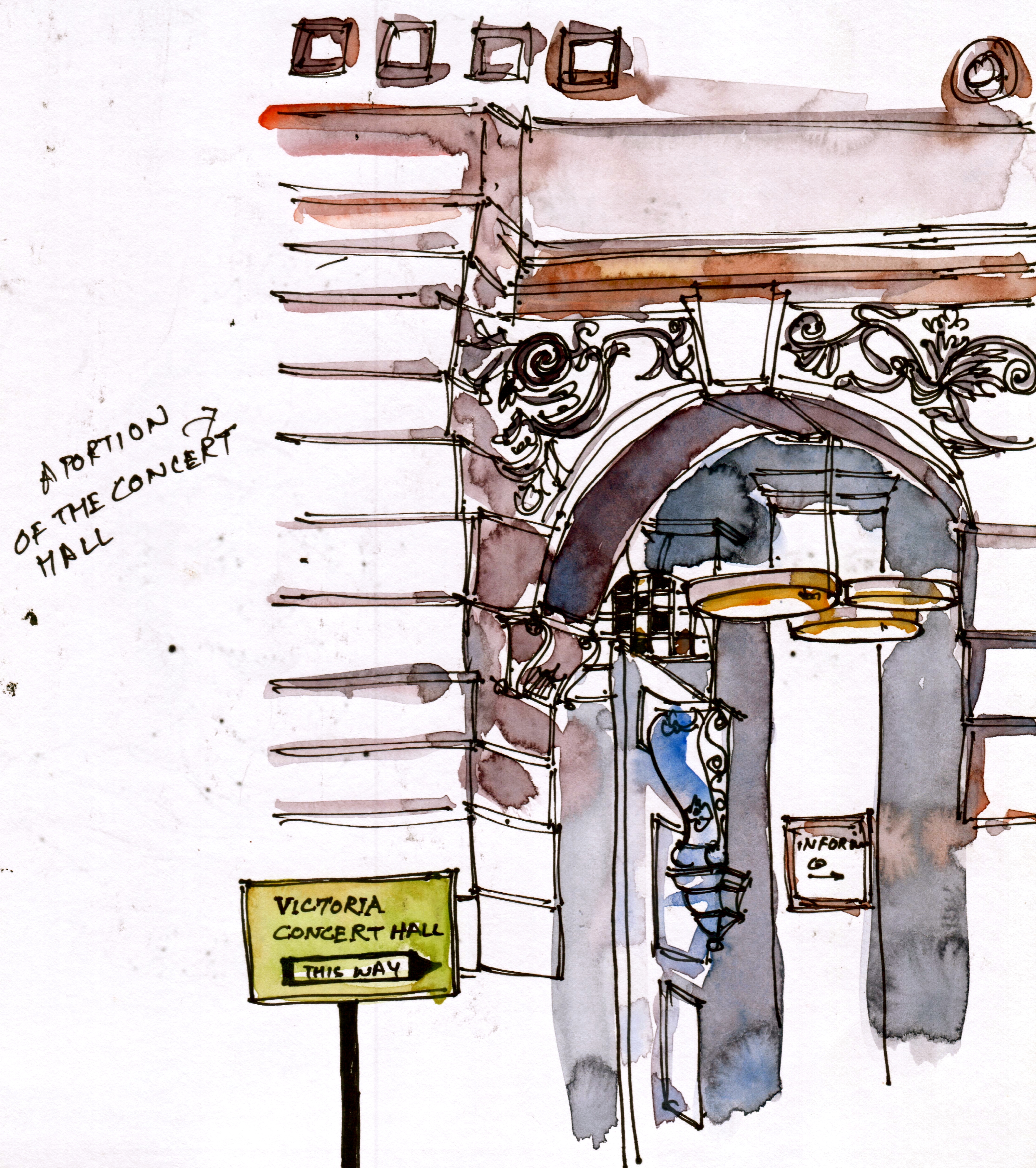
Therefore when opportunity presents itself, I don’t miss out on exploring anything that has the word ‘heritage’ on its radar, which Singapore has plenty but one needs to be alert coz the glitz of the present kind of obliterates the grime of the past. Just as the majestic Victoria Theatre and Concert Hall in Singapore’s civic district, which I knew nothing about until it was opened to the public for two days offering a sneek peak after four years of restoration and refurbishment.

If that isn’t motivation enough to visit then how does free guided tours of this 152 year old grand dame sound? I registered myself for the 2:30 pm tour pronto. We were given tiny blue stickers with the timing inked on it, for identification. You know you have a great deal, when your tourguide turns out to be better than the one money could buy! She was a storyteller all right. Standing in the middle of the sunlit atrium, right below the clock tower, her painted fingernails pointed at the two walls on either side of us. ‘See the difference in architecture?” We did. The wall on the left had plain looking pre-cast concrete panels. The wall on the right was ornate, decorative and much more pleasing to the eye. If one was a plain unembellished uniform, the other was a flowing victorian ball gown.

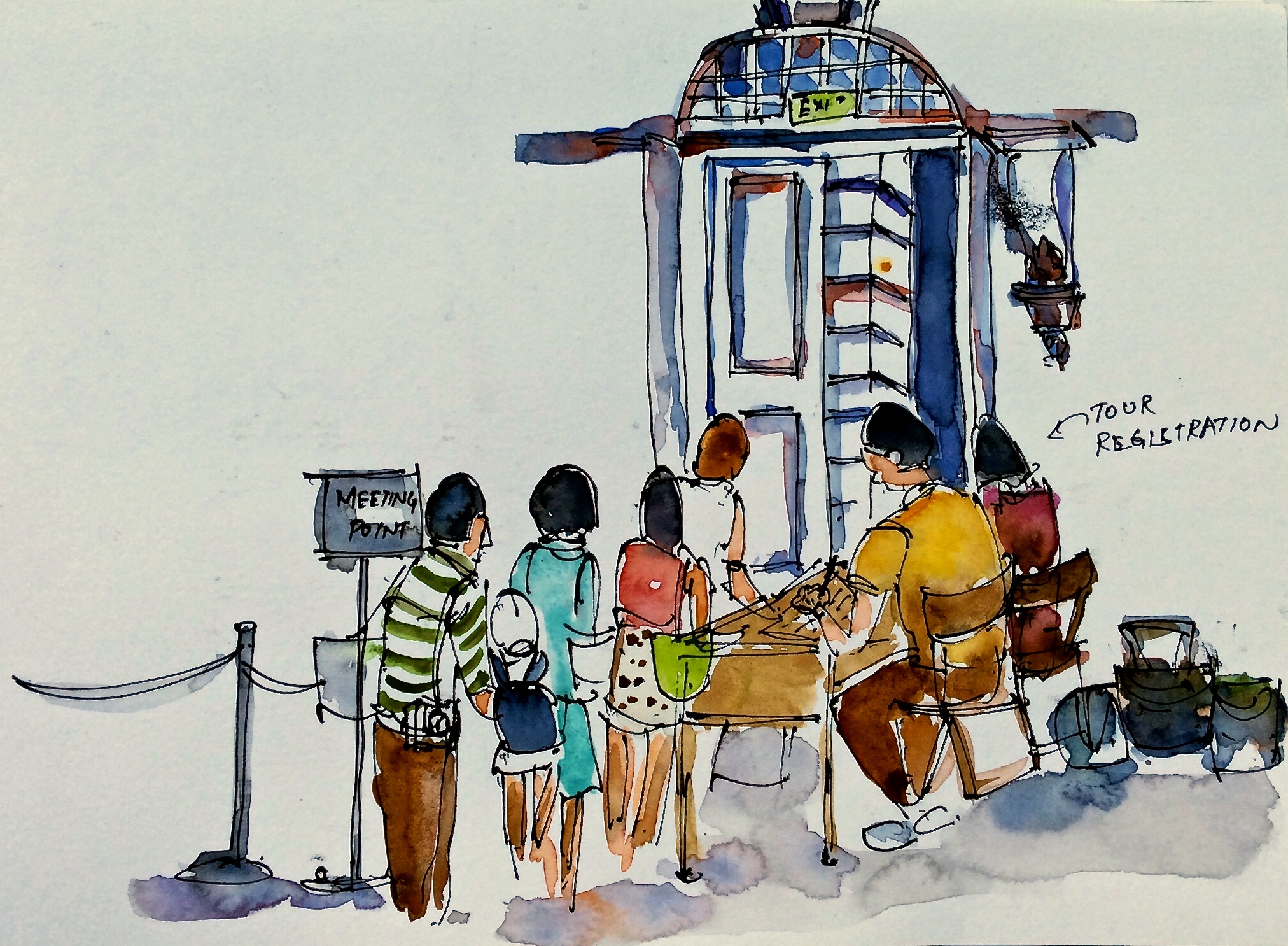
Registration desk

Registration desk

‘Well, these walls belong to two different buildings, built during different periods, and later linked together with the clock tower above’. There was a prolonged ‘ohhhhh’ in the crowd at the evident revelation which wasn’t so evident in the beginning. The concrete panels on the left belong to the Town Hall or Victoria Theatre as it was renamed later and was built in 1862. Victoria Memorial Hall, built in 1905, on the right display an architectural style called ‘Victorian Rivivalism’.

‘Notice the floral patterns, Italianate windows, Baroque volutes and rusticated columns’, she said, while stammering on r-u-s-t-i-c-a-t-e-d. Amid the floral festoons on the wall, she pointed out the letters V, R and I, representing Victoria Regina Imperatrix. While the town hall was built to carry out administrative duties and entertainment activities ( it had meeting rooms and offices on the second floor and a theatre on the ground floor), Victoria Memorial  Hall was built ‘To commemorate the Long and Glorious reign of Her Late  Majesty Victoria’ (as written on the foundation plaque)  after her passing in 1901. Interestingly, though the two buildings were built 40 years apart, their facades were unified in such a way that it’s impossible to detect any difference from outside.

A portion of the Victoria Concert Hall

A portion of the Victoria Concert Hall

With this bit of orientation, we were led outside to admire the facade. ‘It was built in the Neo-Palladian style (plain exteriors based on rules of proportion contrasted with righly decorated interiors), as are many colonial buildings in Singapore.’ says our guide. ‘ Look at the columns – if they have scrolls they are Ionic, if they have leaves, they are Corinthian, if they are plain, they are Doric’, she offered. Once again the letters V R I make an appearance on the facade of the Memorial Hall. We squinted our eyes to block the sun when she pointed towards the pediment which used to have a bass relief of the British Coat of Arms, but was later replaced in 1959 with the Singapore coat of arms.

Someone asked if the clock affixed to the clock tower still works. ‘Doesn’t it?’ countered our guide with a poker face. We collectively turned our gaze to the 54-meter clock tower with a  copper dome and a crown on top (the crown was removed earlier and now restored back) from 1906. It was completed an year after the Victoria Memorial Hall was erected. ‘Does anybody know why?” No one volunteered. Or maybe somebody did mutter something about a ‘delay’, which our guide picked up at once and said ‘Yes, due to the delay in donation of the clock itself by Straits Trading Company(incorporated in 1887 as a tin smelting company). The company is still in operation, you know. It is right behind those tall multistoried buildings’, she said, pointing north-east of the Raffles statue. The clock chimed in agreement. “There you go! Guess, it works!” she said gleefully before turning around to face Raffles again, or rather his back.

Sketched from the marble Staircase of Victoria Concert Hall

Sketched from the marble Staircase of Victoria Concert Hall

We turned around with her. ‘Now this is black Raffles…’ she said pointing to the bronze statue of Singapore’s founder, standing on that column since 1919 (in celebration of the 100th birth anniversary of Singapore, the statue was relocated here from Padang), sombre, arms folded, balancing his weight on one leg and the other casually put forth. ‘..Who can say, where is the white Raffles?’ We’ve all seen the white Raffles by the Singapore river, erected at his landing site. ‘Okay that was easy. Now, look at his foot. What is Raffles standing on?’ Raffles right foot was indeed resting on a parchment. After a rehersed moment of silence meant to heighten the suspense, the answer  – ‘Map of British Malaya’ was revealed.

We were then led inside to wander the halls of the Memorial Hall, briefly stopping in front of two bronze plaques (one dedicated to the memory of those killed during the mutiny in Singapore in Feb 1915 and the other the foundation stone laid by Sir Frank Athelstan Swettenham, Governor of Straits Settlement on 9th August 1902), and a bust of Cecil Clementi, a popular governor of Singapore. ‘ This man is very important in Singapore’s history. He was effective in quelling the Chinese Secret societies in Singapore’. (During the colonial rule, Chinese Secret Socities were considered a threat to the law and order of Singapore; they were associated with violence, extortion and vice).

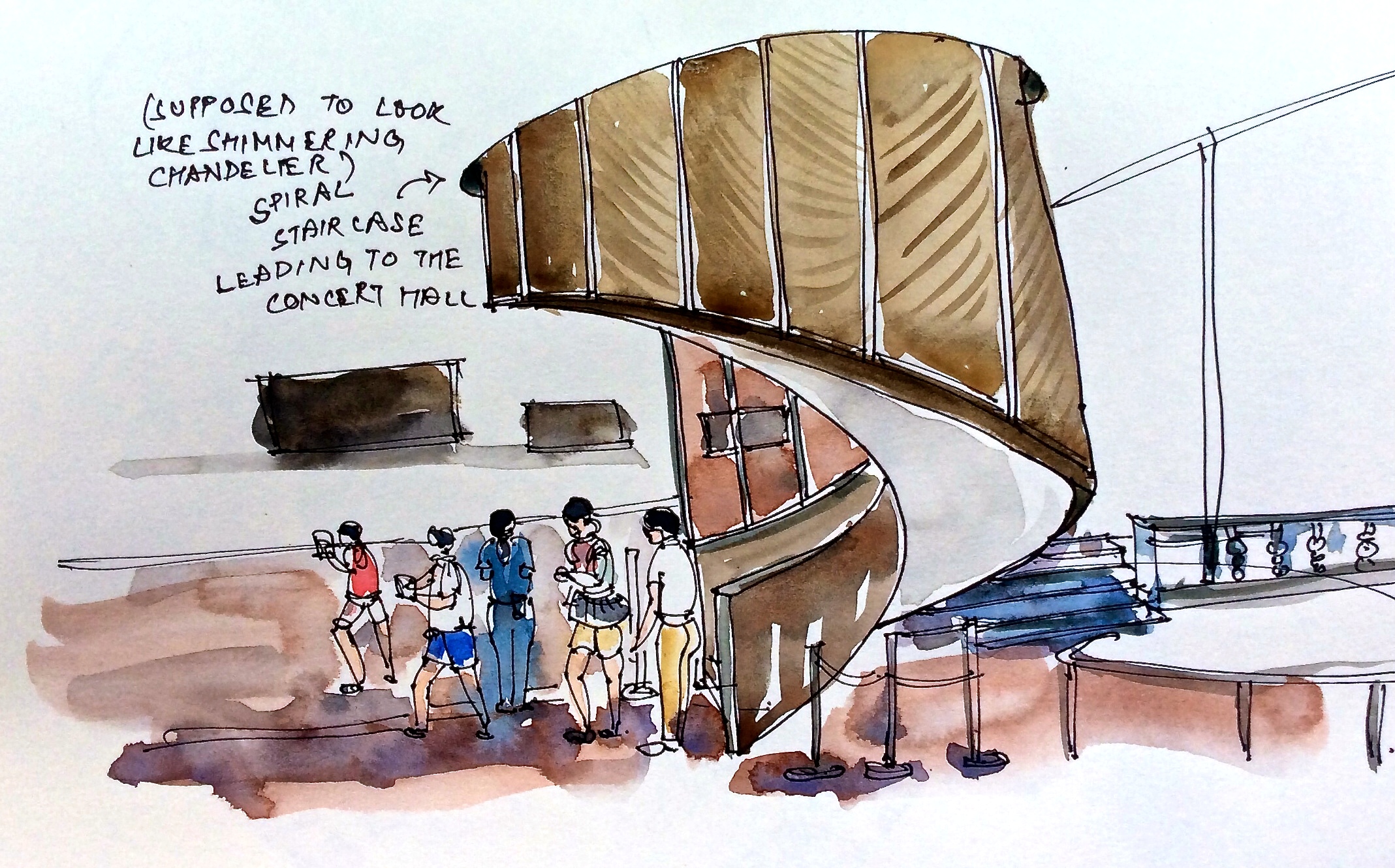
Spiral Staircase

Spiral Staircase

Leaving Clementi, we climb up a flight of marble stairs to find an interesting fixture – a spiral staircase leading to the concert hall. ‘Can anybody tell me what the architect designed it to resemble?’ A raised hand said – ‘Organ pipe’ .  Though she was given credit for imagination, the correct answer was – a shimmering white-silver chandelier. We were advised to look at it from outside after dark to corroborate this fact.

‘During second world war, the Victoria Theatre and Memorial Hall escaped destruction’ continued our guide. It was used as a hospital and housed survivors of Japanese airraids. Later during the Japanese Occupation it became a cultural center for the Japanese and many shows were performed here. ‘Did you know in 1947, this place held a mass trial of Japanese prisoners in public?’  Few nodded. ‘How do you expect the public to react during such trials? she asked, looking at each one us in the eye. ‘Cry for blood’ said a middle aged gentleman in yellow hat getting a bit worked up. His wife agreed.

‘Well, on the contrary, the spectators were very well behaved.’  our guide answered with a calming smile.

Much later while browsing through the information kiosks, I read this vivid first hand account of the trial narrated by a former teacher of Anglo-Chinese Continuation School named Chan Kwee Sung. He says, “A mass trial was held in public at the Victoria Memorial Hall. It was…very well attended every day – The Japanese prisoners were made to sit facing the spectators on a platform on the dias, where the tribunal was. All the witnesses took stand; they gave the testimony in their own dialect. There were interpretations, and there were microphones all around the hall..One would have expected cursing, booing and jeering but there was none of that. (The) spectators (were) quite well-behaved, even when the prisoners were conducted in and out of the hall.”

Back on the tour, pop quiz wasn’t over. ‘A very important political event took place in this building. Any idea what it might be?’ Almost everyone knew that the People’s Action Party (PAP) held its inaugural meeting here in 1954. The information kiosk had a black and white photograph of a young Lee Kuan Yew addressing the meeting.

$158 million and four years of renovation and refurbishment has brought old Vic up to speed with contemporary standards. New spaces have been added such as changing rooms, loading bay; the central atrium has been openend up. ‘The Concert Hall’s balcony has been made smaller and higher so that the acoustics won’t be compromised for the people sitting below’ said our guide. ‘But all this meant sacrificing the seating capacity. From around 900 to 600 seats (883 to 673 to be exact) now..”

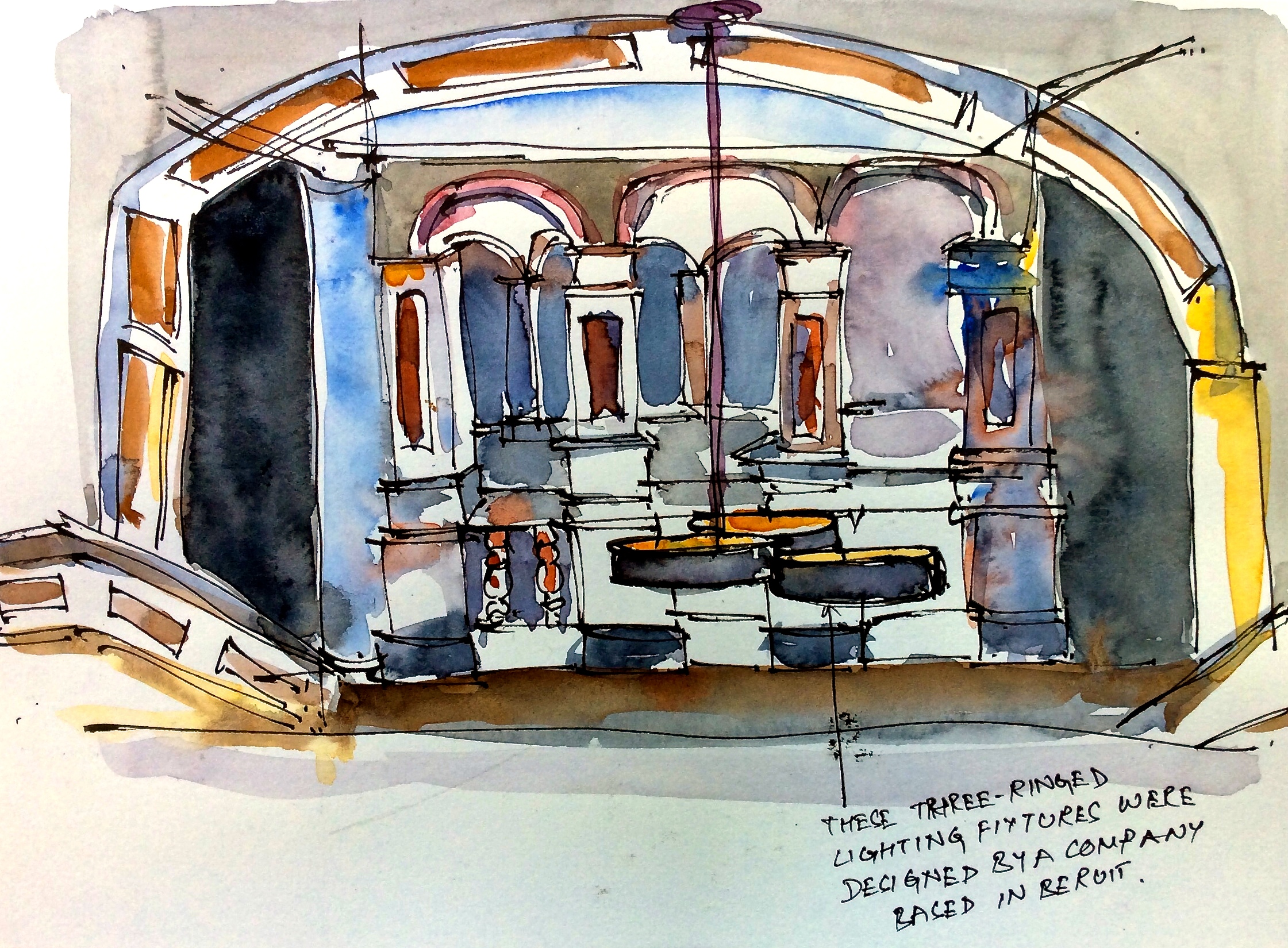
Someone asked if the tour would take us inside the concert halls. ‘Unfortunately not! There are shows going on today, for free. Do take out time to experience one. The stage has curved acrylic panels hung by cables from above to diffuse and reflect the sound”. The lady who asked the question was still bummed – ‘I thought exporing the interiors of the concert hall was part of this tour’. But our guide went on spewing out more information – “…the Grand Klais pipe organ has be beautifully restored by its original German manufacturer. The original St. Clair organ from 1931 was replaced by the fully mechanical Klais organ in 1984..”.

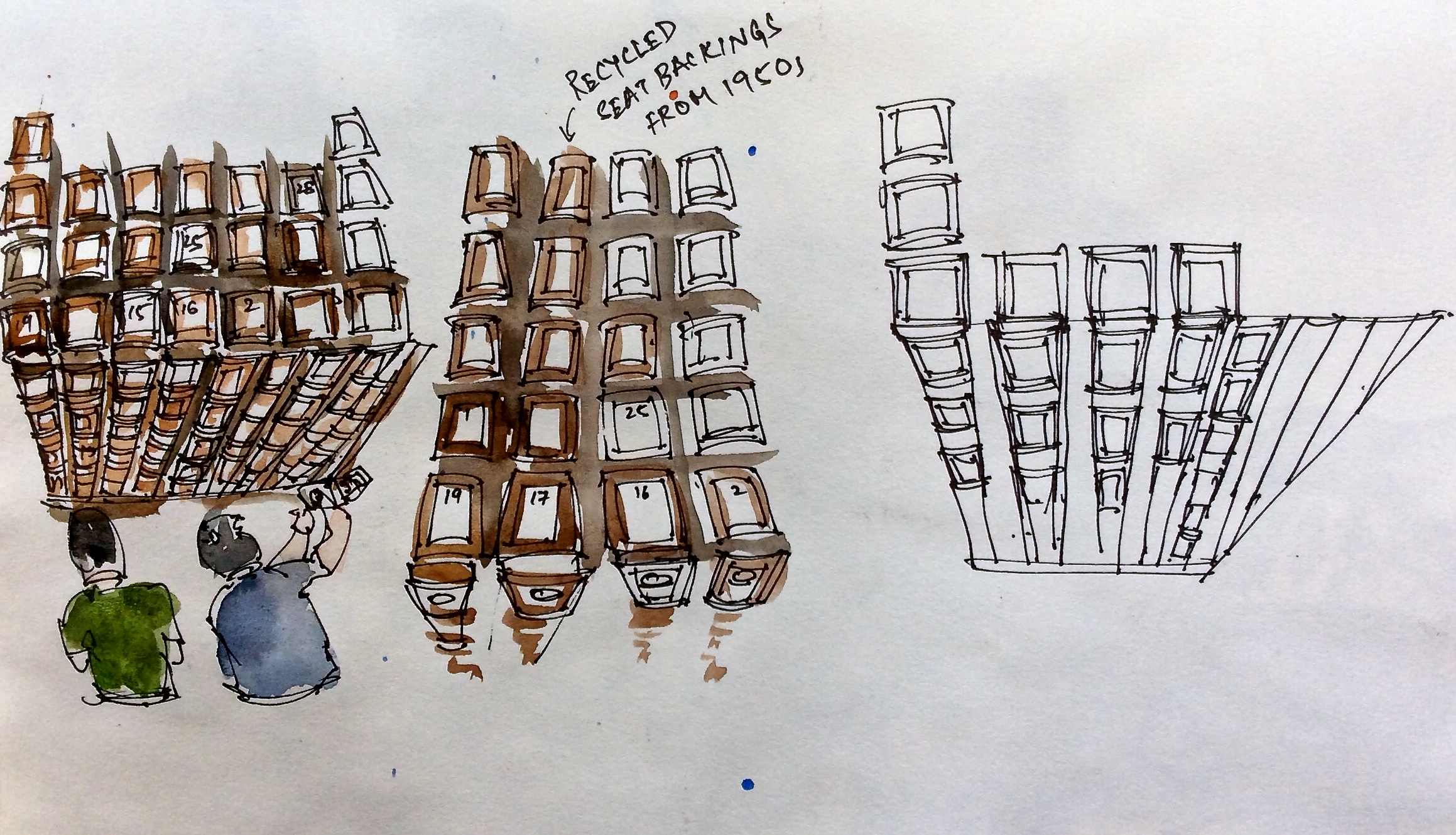
The Theatre foyer made out of recycled seat covers from1950s

The Theatre foyer walls are covered with recycled seat backings from1950s

Ducking the crowd spilling out of the concert halls ( yes! free shows), we walked over to the Victoria Theatre side to admire another ingenious creation of the architect – a rehearsal room for musicians that looks like a hanging rhubik cube made up of chocolate bars. ‘Who can say what these are?’ The hint was ‘something recycled’. But even that didn’t work because – 3cm thick timber seat backings from the 1950s theatre chairs – would’ve been pretty hard to guess.

Besides its role as a performing arts center, Victoria Theatre and Memorial Hall functioned as a community space, where important events such as weddings and exhibitions took place. ‘My memory of this place is from the time when I participated in a Malay dance sequence here’, said our guide reminiscing at the end of our tour. ‘Do any of you have memories of this place? We are looking for memories.’

There was indeed an irememberVictoria collection booth in the Victoria Concert Hall, behind the tour registration desk, where you could drop your ‘Victoria story’ of first dates, backstage jitters, mass weddings from the 1950s into the collective pool of memories associated with this grand dame of Singapore. Millions of dollars may have given Old Vic a facelift, but its the memories that’ll bring her to life. Guess, I am not the only one attracted to nostalgia.


Guess who was in Singapore?

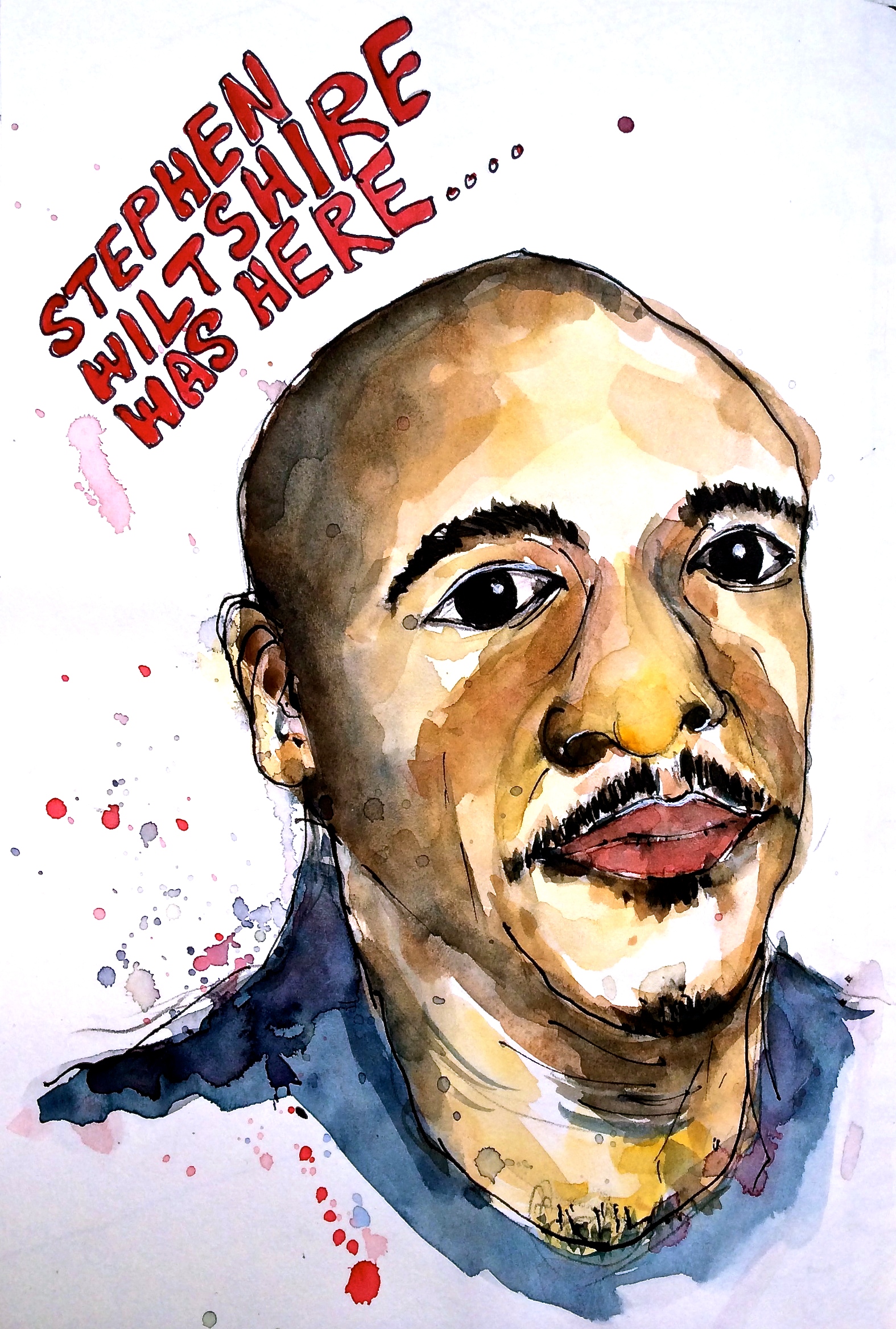
Stephen Wiltshire!

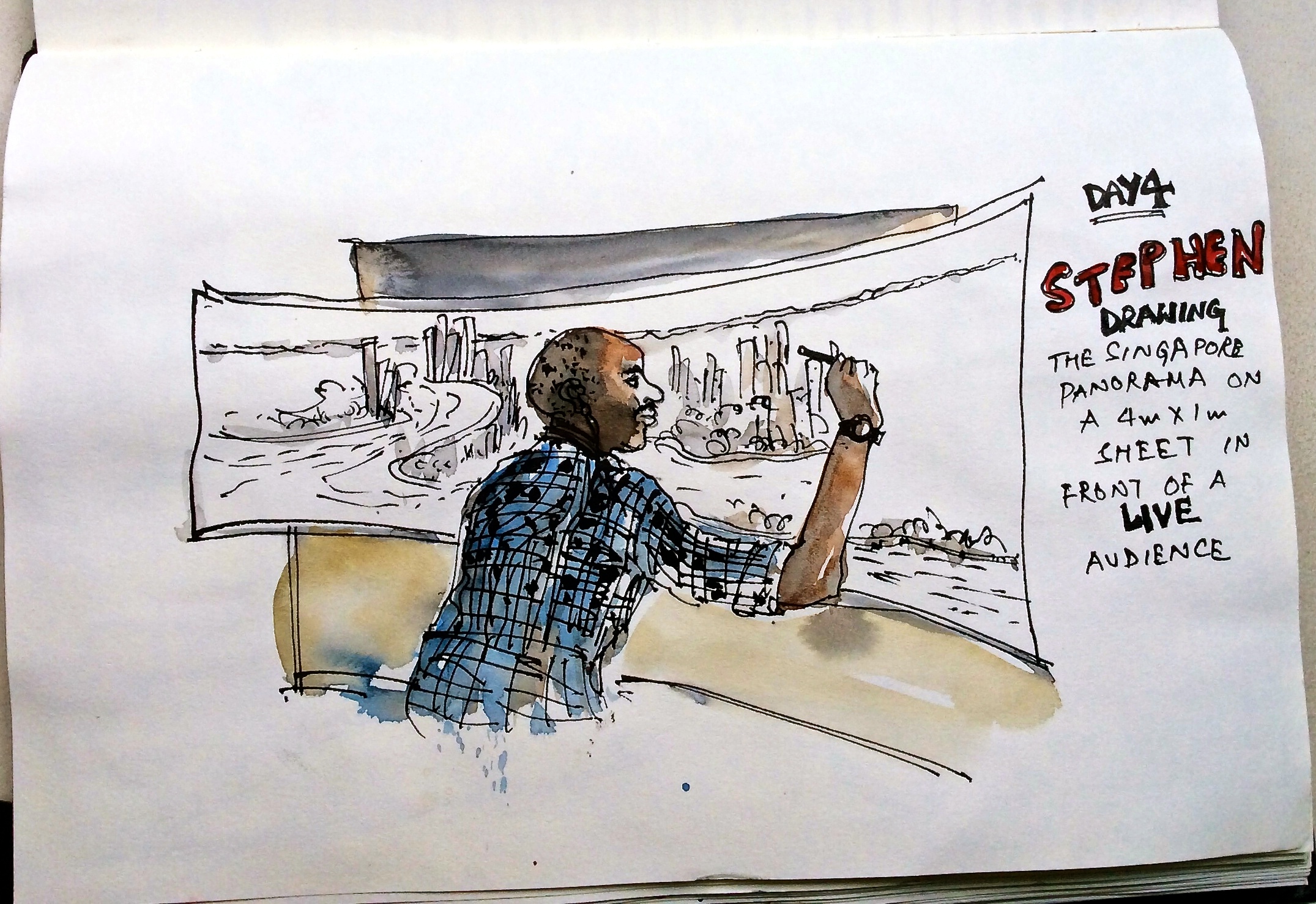
Or the human camera as people like to call him. On the occasion of Singapore’s 50th birthday next year, this British savant, also an architectural illustrator was invited to work his magic, a.k.a sketch the Singapore panorama on a 4m x 1m sheet of paper over 5 days, from memory – which was made during an hour long helicopter ride viewing the skyline.

This intensive drawing didn’t happen from the comfort of a private studio but live in front of an overwhelming audience of veteran fans –  admirers who knew of his work and came to support, on the spot converts – those who read about him in the newspaper and came to douse their curiosity and lastly clueless saunterers – flittering shoppers (the event was held at the atrium of a shopping mall on orchard road) who came to check out what the fuss was about, lingered and took abundant photos.

Stephen Wiltshire was diagnosed with Autism when he was just three.

Stephen Wiltshire was diagnosed with Autism when he was just three and is known for his ability to draw astounding cityscapes from memory

Stephen was propped up on a dais from 10am till 5pm, working nonchalantly with music plugged into his ears, while the crowd hung on every stroke that he pulled out from that brilliant mind of his. With hundreds of eyes watching anybody would deflect, but not this guy. He couldn’t have cared less – zilch performance anxiety. He was in the zone, doing his thing without a worry in the world. Right in front of the dais were a set of chairs where his sister was seated along with art school students who were sketching Stephen sketching Singapore. Photographers were tirelessly clicking the same static subjects from various angles – the students, Stephen, and the crowd which was huddled right outside the cordoned off area, containing the dais and the chairs.

The Human Camera

The Human Camera

About quarter to 5, Stephen would check his watch and start wrapping up. He would then get off from his bar stool, fresh as a daisy, wave to the crowd that would start clapping and hooting, even to those cheering from the floors above and then sign autographs and smile for selfies.

I am not good at battling crowds, so I didn’t indulge in either. Instead, I took pleasure in the second best – observing the ecstasy on the face of every admirer who had his or her brief moment with the world’s ‘human camera’. It was quite the thing!

Zufrieden

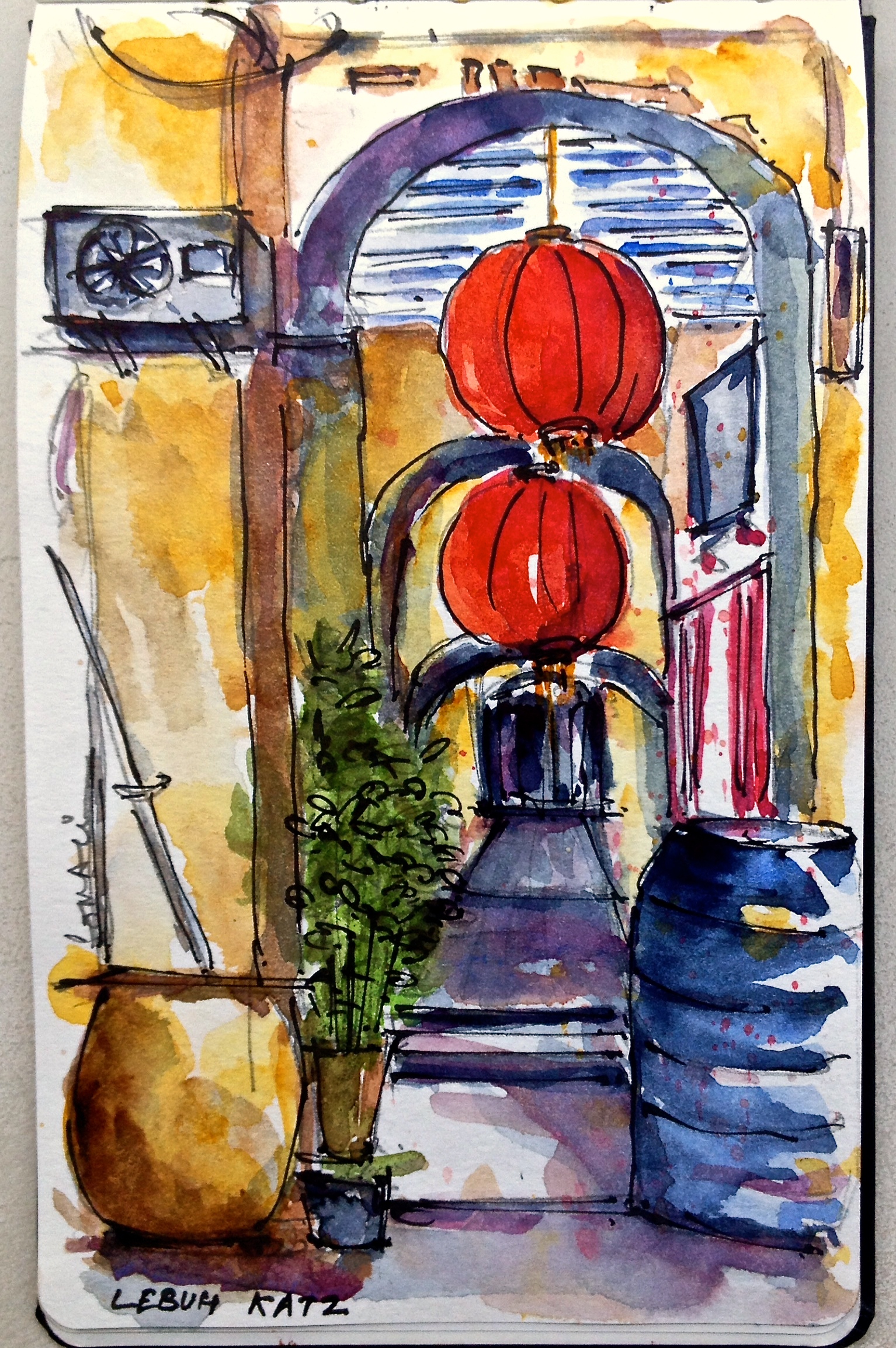
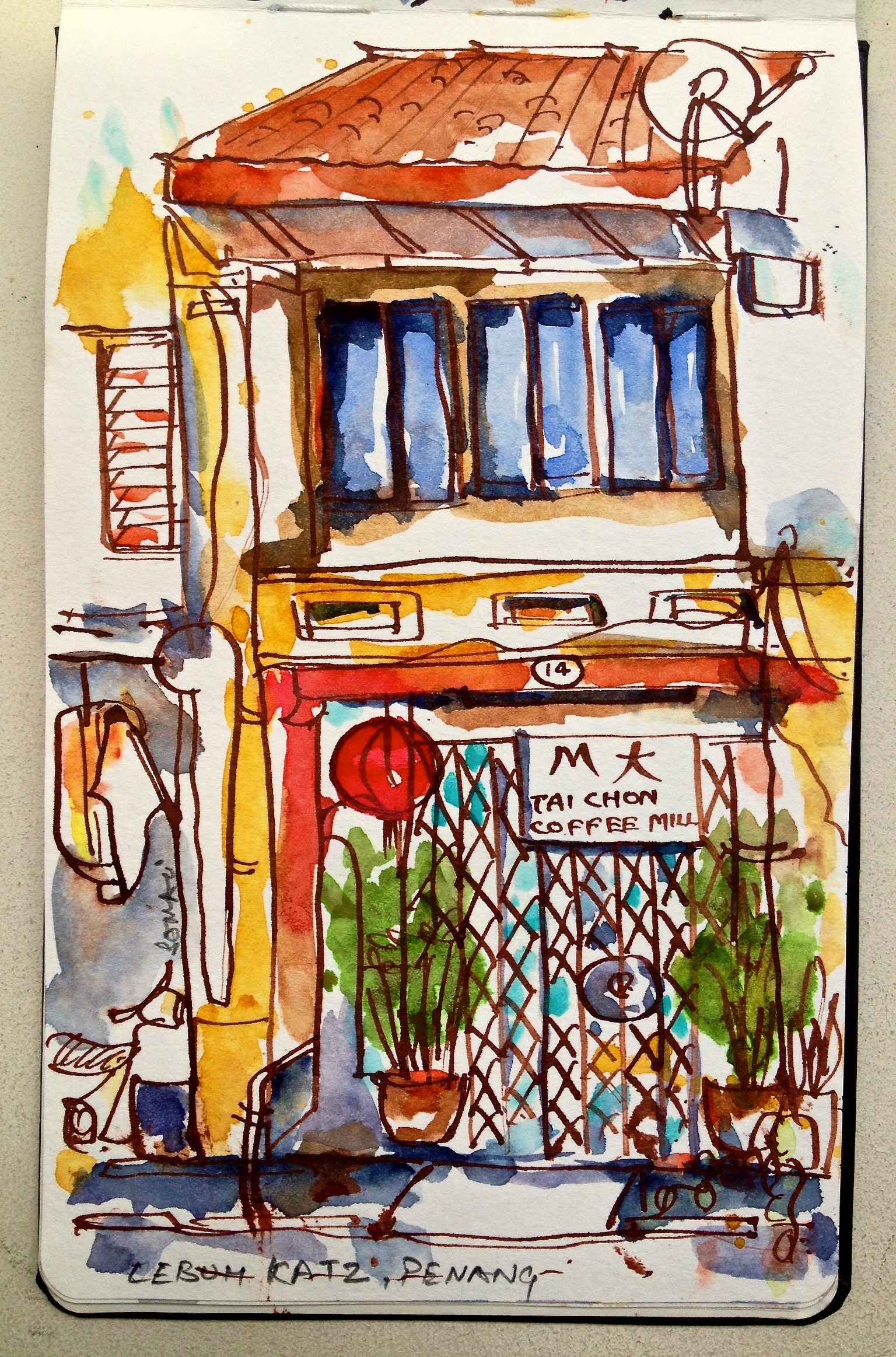
Row of Shophouses on Lebuh Katz

Impression 1 : Lebuh Katz looked sleepy and quiet even at 9 in the morning. Ocassionally a moped or a trishaw would linger past leaving some trail of life. This row of shophouses seemed like the only ornate fixture in this working class neighbourhood with worn down houses that look utilitarian and lived in. Interesting trivia : As I suspected, the street has a German connection. It was named after the German born Katz brothers who established an import business in George Town in 1864.

When I learnt this word in my German class, I remember being instantly enamoured, repeating it several times in class, on the tram, in shower, enunciating it, rolling it around in my mouth to acquaint myself with its nuances, volleying it with my tongue, exploring its soft corners and rough edges and then carefully putting it back in my vocab chest, like a vintage fountain pen with gold nib and sterling silver filigree overlay, something valuable that you take out only on special occasions.

And when you do, you put on a show. You bask in the smug glory of the wonder ricocheted off others’ faces. Then you put it back in your armour again. Such is the word ‘zufrieden‘, which may mean satisfaction in English, but doesn’t feel or sound as hackneyed.


The owner of the shop whose corridor I had blocked came out to survey soon after I had set up. Instead of shooing me away, he moved his bike aside so I could have more elbow room and then he showed me the tap from which I could draw water for painting. A lot gesturing happenned as he didn't speak English and I don't speak Hokkien.

Impression 2 :The owner of the shop whose corridor I had blocked came out to survey soon after I had set up. Instead of shooing me away, he moved his bike aside so I could have more elbow room and then he showed me the tap from which I could draw water for painting. This was accomplished with a lot of gesturing as he didn’t speak English and I don’t speak Hokkien.


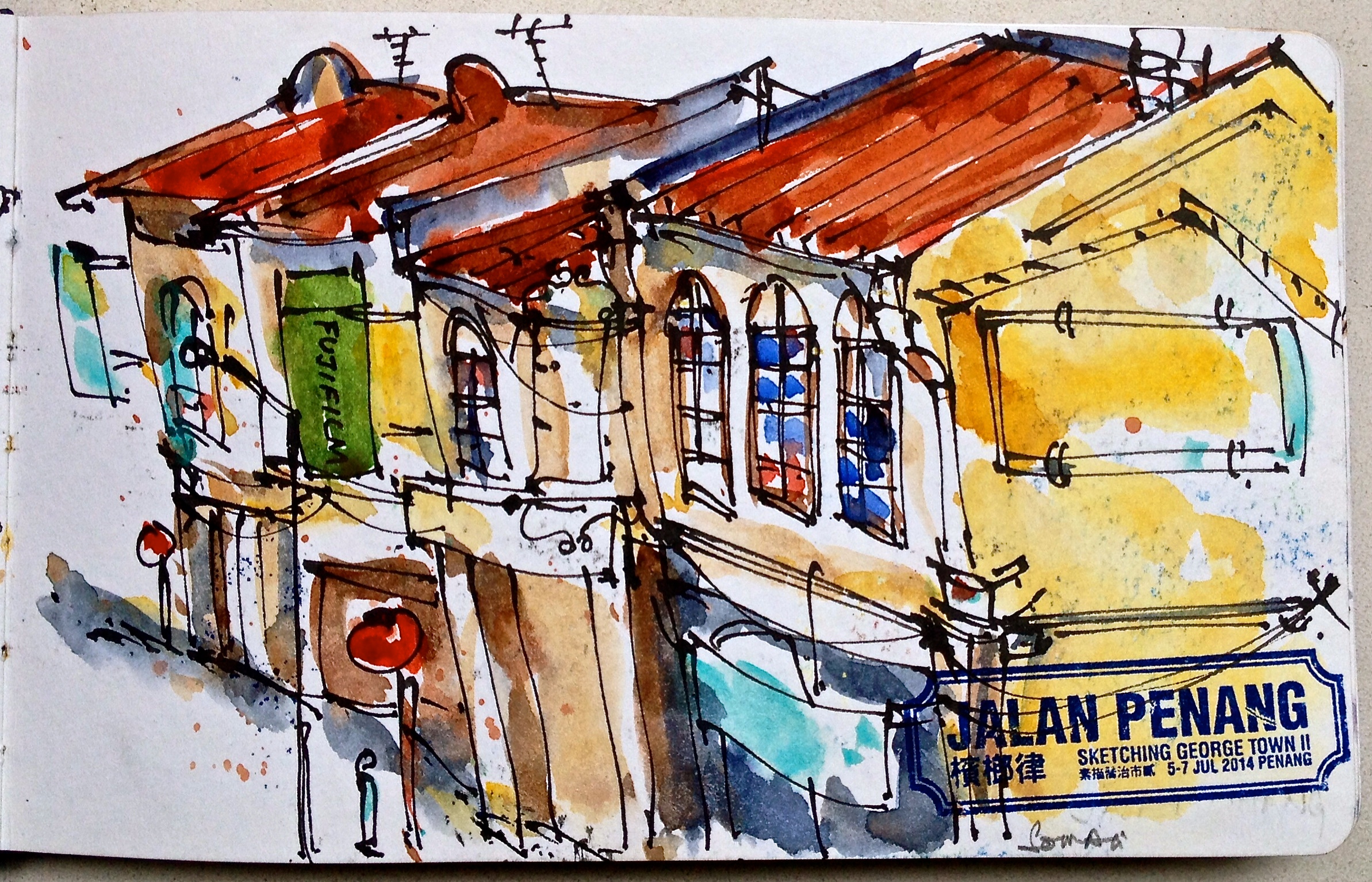
Row of Shophouses on Jalan Penang

Impression 3 :Row of Shophouses on Lorong Stewart. Everyday after workshop ended at 6, I would rush back on the road to utilize the 1.5 hours of leftover sunlight in sketching whatever caught my eye. This time, I was plonked on the floor of another 5-foot way, lined with several fancy restaurants. People sauntered past me, wearing shiny clothes and expensive perfumes. I remember making the ushers really uncomfortable.

Sometimes a foreign tongue can elevate the meaning of a word you’ve heard all your life and transform its ethos into something grand just because it sounds luxurious in your mouth and tantalizing to your ears and also because you didn’t have enough time and occasion to wear it out. What I mean is, I may use ‘satisfied’ to indicate my experience in using the newly opened restroom at the airport, but use ‘zufrieden‘ while reminiscing about a sketching trip to George Town in Penang, that I returned from. To explain why, I have to reiterate that it was my first overseas trip where sketching was the actor in leading role and travelling was the supporting sidekick, not the other way round, like always. The priorities were flipped and the result was glorious.

This epiphany doesn’t mean travelling takes a backseat. I am the parent that’s trying to advocate equal love for each child.

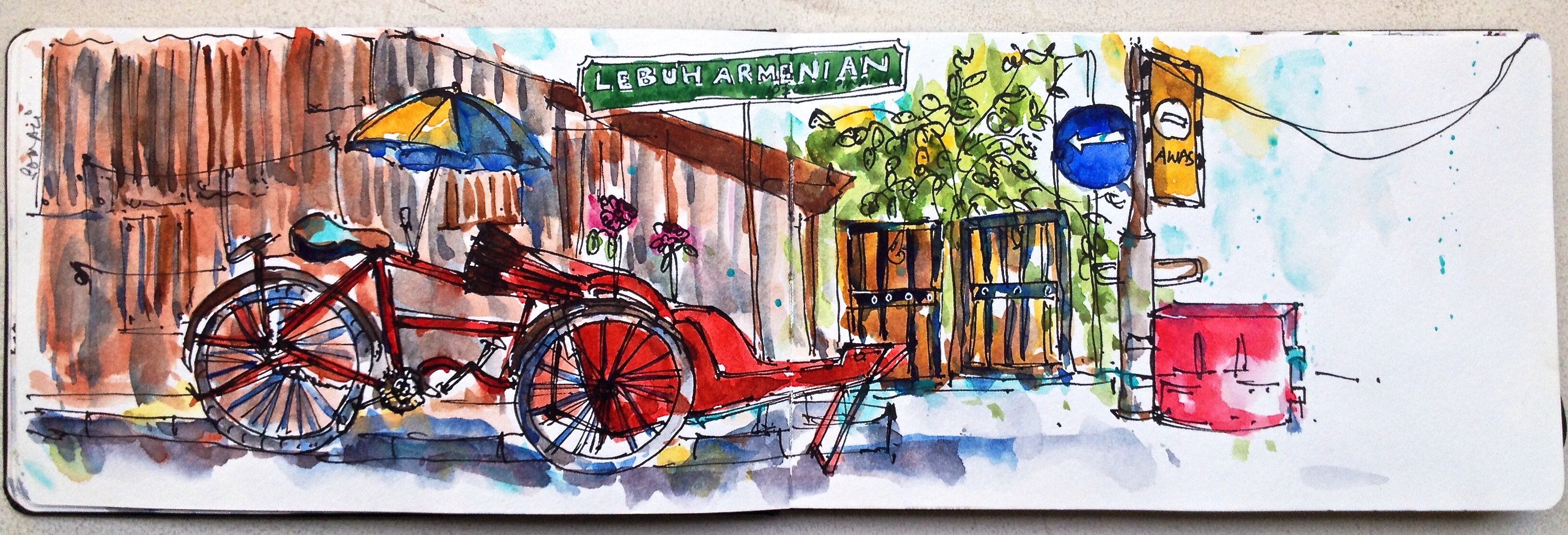
A Red Trishaw parked on Armenian Street

Impression 4 : When I saw this Red Trishaw parked on Armenian Street, I was compelled to sketch it, simply because of this  composition. I found a shady spot beside an Ice Kachang lady who initially tried to sell me her ware but later took the responsibility of shooing people away from my line of vision, including tourists. Halfway through the sketch, the red trishaw left, only to be replaced by another in few minutes but this was parked the opposite way. In an attempt to get it done, I was trying to laterally invert the vehicle in my mind and then draw it. When the trishaw driver, quietly lunching beside me got a whiff of my frustration, (I may have been muttering to myself), he got up and to my utter disbelief turned the heavy vehicle around just so I could finish my doodle and declined to take tourists for rides till I finished. When I thanked him, he just nodded. And the Ice Kachang lady dragged her son out of the house to show him my sketch. She seemed proud.

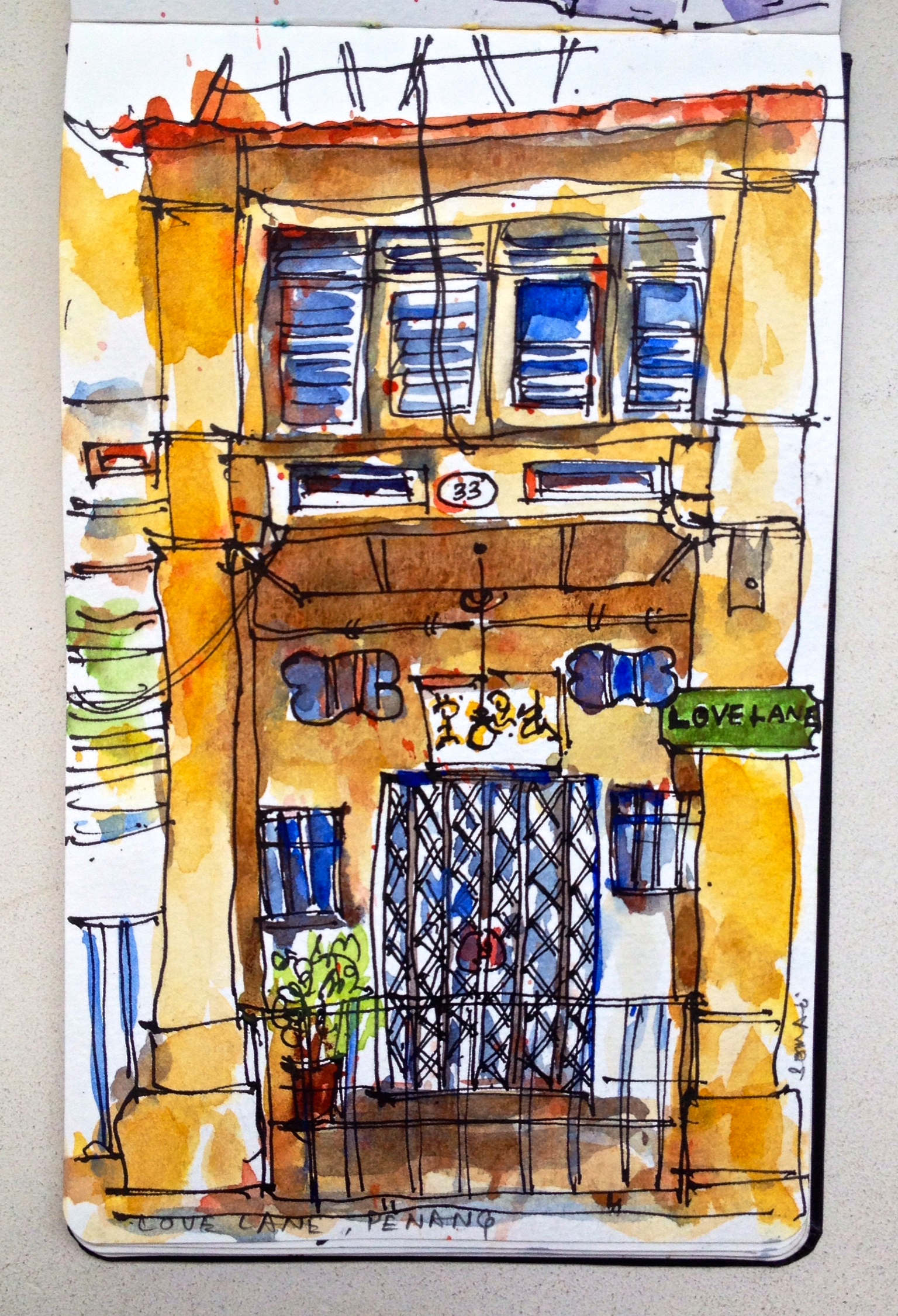
This partially dilapidated shophouse caught my eye on Love Lane.

Impression 5 : I was sketching this aged beauty from a ruined torn down shophouse, right opposite when my husband said, there’s nothing indicative of ‘Love’ on Love Lane. Well, 19th century sailers and soldiers who made a beeline for the brothels lined up here would’ve differed. The amorous frolics of yesteryears have been replaced. Love Lane looked quiet, desolate and monochromatic that evening, except for a gaggle of tourists gathering around cafes chit-chatting about guesthouses, wi-fi, backpacking and travel. Perhaps somebody will talk about Love.

Travelling

For me, travelling isn’t just fun, it is also an yearning. The fact that I feel more happy, and alive on the move is established and I don’t second guess it.

What is travel’s worth in one’s life can be gauged from the motivation to travel.  Is it to break away from the mundane seeking ‘change of scenery’, or to relax and recoup before you go back on the hamster wheel, is it to check off places from Lonely Planet’s 1000 places to visit before you die , is it to reclaim your twenties because you’re about to step into your 30s? Or is it that unsettling lifelong ‘need’, not a want but a need, right out of Maslow’s heirarchy, that thrusts you into the unknown from time to time?


Dinner at China House

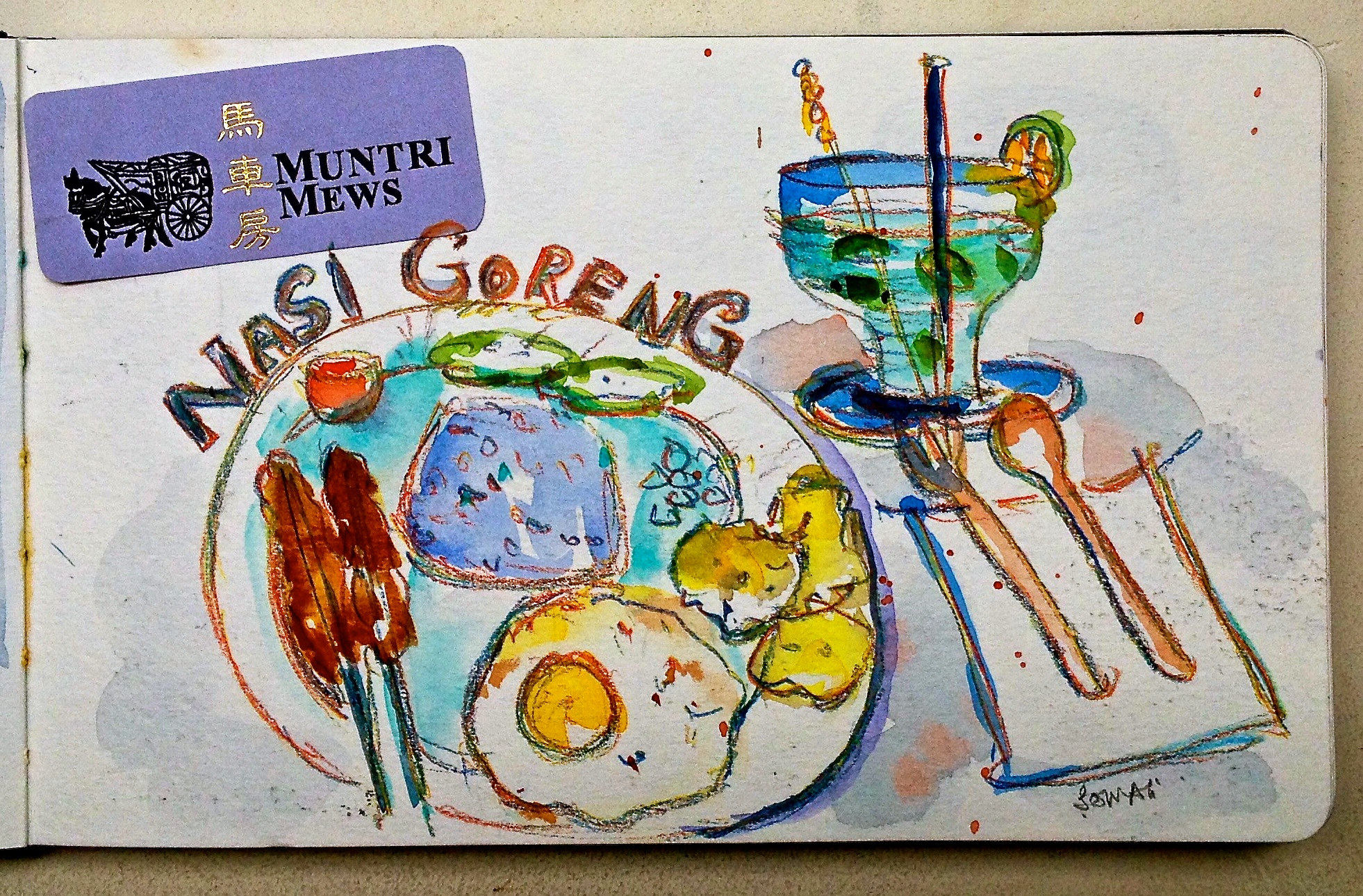
Impression 6: China House, a beautiful shop house turned cafe has tables that are covered in white paper. A small bucket of crayons is set on the table for you to scribble while you wait for your meal. This sketch is colored using the same crayons. For dinner, I had spaghetti with grilled chicken and sadly, it was a let down. The pasta was overcooked and flavours were all over place. The lime soda with mint and mango slices was a disaster – I have never tasted anything so incongruous. But DO NOT leave this place without trying the ginormous slice of out-of-this-world Tiramisu. I have a feeling desserts are their strong suit.

My motivation to travel, my ‘need’ to travel, comes from my insatiable inquisitiveness to see, explore, thus discover and know. I believe, we are all inquisitive, differing in the intensity, perhaps. I mean, don’t we all like to take a peek, a swift glance into other’s living rooms through their open windows at night or others’ plates in a restaurant or try to read the label on a bag hanging from a stranger’s shoulder, try to peel off the discounted price sticker on a garment to reveal the actual price or take a peek at the answers behind the Math book?

The apogee of my German learning classes in Munich, was the day I could understand overheard conversations on the tram. It was as if a stubborn blocked nose had cleared and I could smell the roses again. Untill then it was unfathomable background noise instead of funny jokes, twee endearments, silly fights or crass comments. If you are inquisitive to such a degree, then travelling is one pursuit that requires each of your five senses to be in a constant state of high-alert. You are a walking sponge, absorbing an overwhelming amount of information sent by your five, foot soldiers who are working in a frenzy.

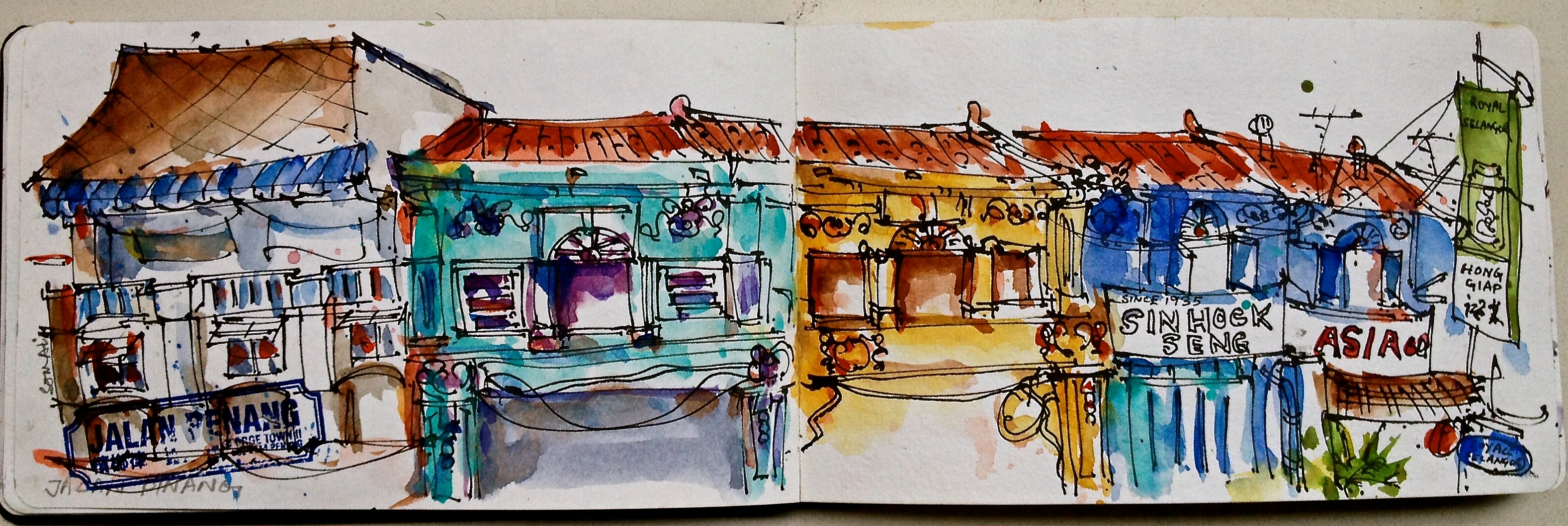
Row of Shophouses on Jalan Penang

Impression 7 : I sketched this row of Shophouses on Jalan Penang – an important thoroughfare during the colonial era –  from the Komtar pedestrian bridge. Shophouses in different stages of restoration like in this sketch is such a common sight in Penang. One crumbling and abandoned shophouse shares a wall with its fully restored neighbour, housing a bustling guesthouse or a cafe or a bistro in full regalia, which in turn shares its wall with another that is being mended and prettied up for better prospects. The famous Teochew Chendol sold at the junction of Keng Kwee Street is only a few minutes away. The Assam Laksa sold there is fresh and flavourful.

Sketching

Now let me add another dimention to this self-absorbing pursuit called travel. Suppose you’ve been quietly nurturing the habit of documenting your life, the sights and sounds around you on a regular basis in a sketchbook and have been taking immense pleasure out of it. Yes, it’s been two years. Darn, you’ve even gotten good at it. It has brought you joy, won you friends across the world and admirers who say how much they love your ‘style’ (to which, you have chuckled more than once muttering smugly and questioning at the same time – “I have a style? I have a style!”).

Shop house on Lebuh MacNair

Impression 8 : Any visitor to Penang will be awed by the potpourri of architectural styles – Early Penang Style (1790s – 1850s), Southern Chinese Eclectic Style(1840s – 1900s), Art Decco style (1920s), Anglo Indian Style (3rd quarter of 19th century) to name a few – representing various periods of the city’s history. It’s like a rainbow cake, each layer unique and different. It’s interesting to view two buildings standing side by side that may have been built in different centuries! I sketched this house on Lebuh MacNair because its architectural style seemed different from the two storied pre world war shop houses peppered across the city. It is probably an Indo-Malay bungalow but I can’t be sure.

You’ve showed your work at exhibitions, and sold. Yes, somebody actually paid money to hang your creation on their living room wall. You’ve counted the money gleefully, but you’ve also felt the pang of loss. It’s complicated.

The Conundrum

Nevertheless the burning question is what do you do with this situation of yours, when you travel? Do you accomodate it because it’s becoming second nature or do you abandon it lest it comes in the way?

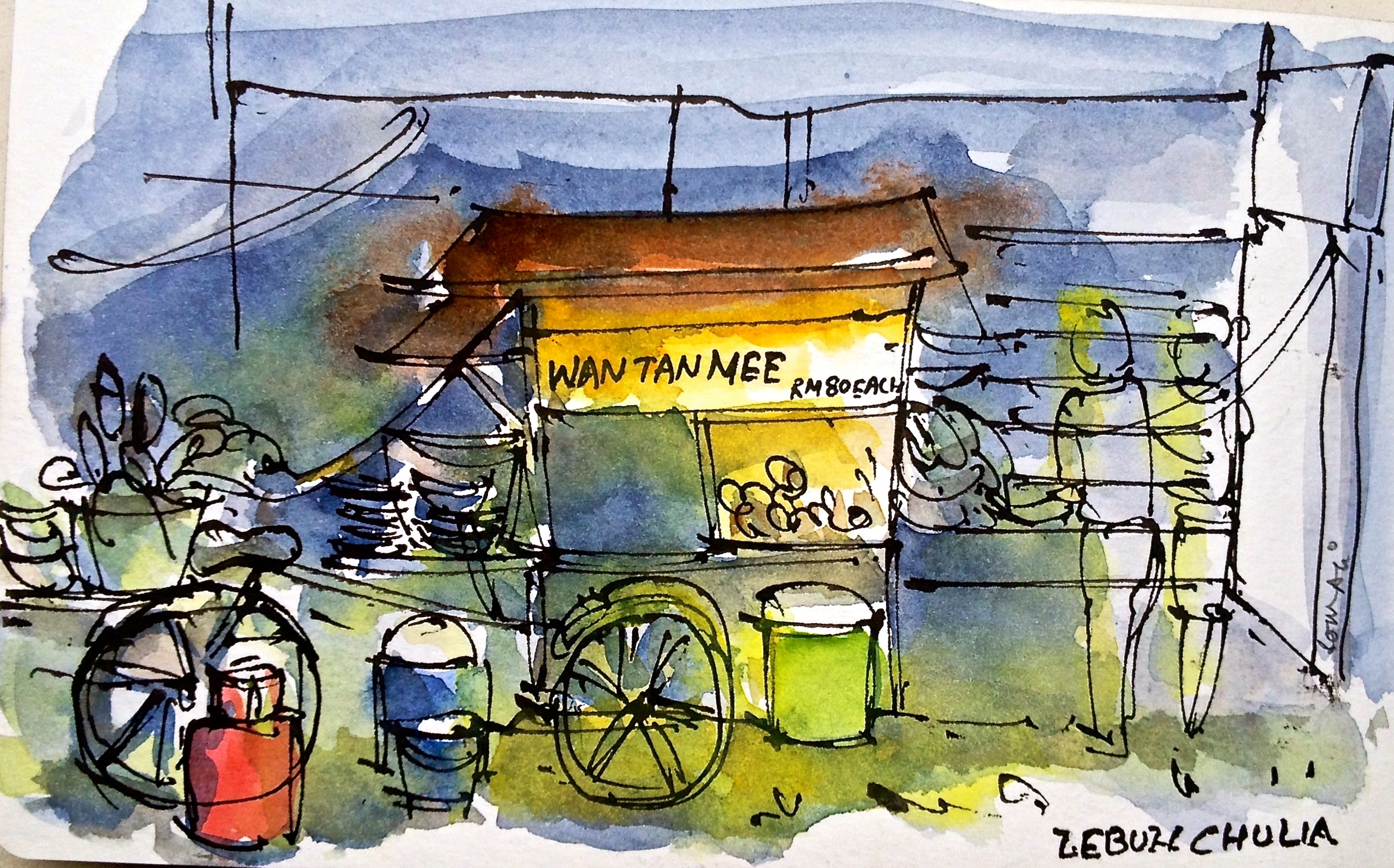
Stall on Lebuh Chulia

Impression 9:  In the darkness of the night, this Wan Tan Mee pushcart twinkled like a firefly on Lebuh Chulia. In the pale bulb light I could make out a stooped figure handing out steaming bowls of springy noodles with soft wantans floating in an irriesistible dark sauce. The whole shebang was in the open, with pots and pans, buckets, gas cylinders strewn all around. Business was hot. From the enormous queue snaking around the stall, anybody could gauge its popularity.

Shophouse on Armenian Street

Impression 10 : Shophouses make such great subjects for sketching. Even across similar architectural style, each house seemed unique and full of character. Swatow Lodging house at no. 16, had all its windows closed. The worn out facade had pockmarks of mildew, faded and peeled paint. The ground was covered in weed. A whole lot of trash – dust covered broken and discarded furniture, toys, cardboard boxes was strewn right across its doorstep. But nobody seemed to care. It was even atmospheric, perhaps exhibited as such deliberately to recall vestiges of the past. After all ‘heritage’ is a fast seller among tourists. For a shophouse sketch fanatic, which I am, Armenian Street has plenty to offer. I picked this one to spend my time on because it stood like a little punctuation mark after a long sentence of shophouses.

If you are inquisitive, you probably have been badgered by the ‘let’s see what happens’ shtick. That’s what I caved in to. I carried my sketchbook everywhere I travelled to see how it felt. And surprise surprise! Sketching did come in the way I travelled, the way we – I and my husband were used to traveling all this time. Aching shoulders from lugging around A4 size sketchbooks and watercolours, making more and longer stops at sights than usual, leaving my partner to fend for himself while I doodled, battling the desire to sketch but moving on instead because, well..tick tock..tick tock, fighting the guilt of cutting on the ‘us’ time – looking into each others eyes, holding hands et al and feeding the ‘me’ time was what happened.

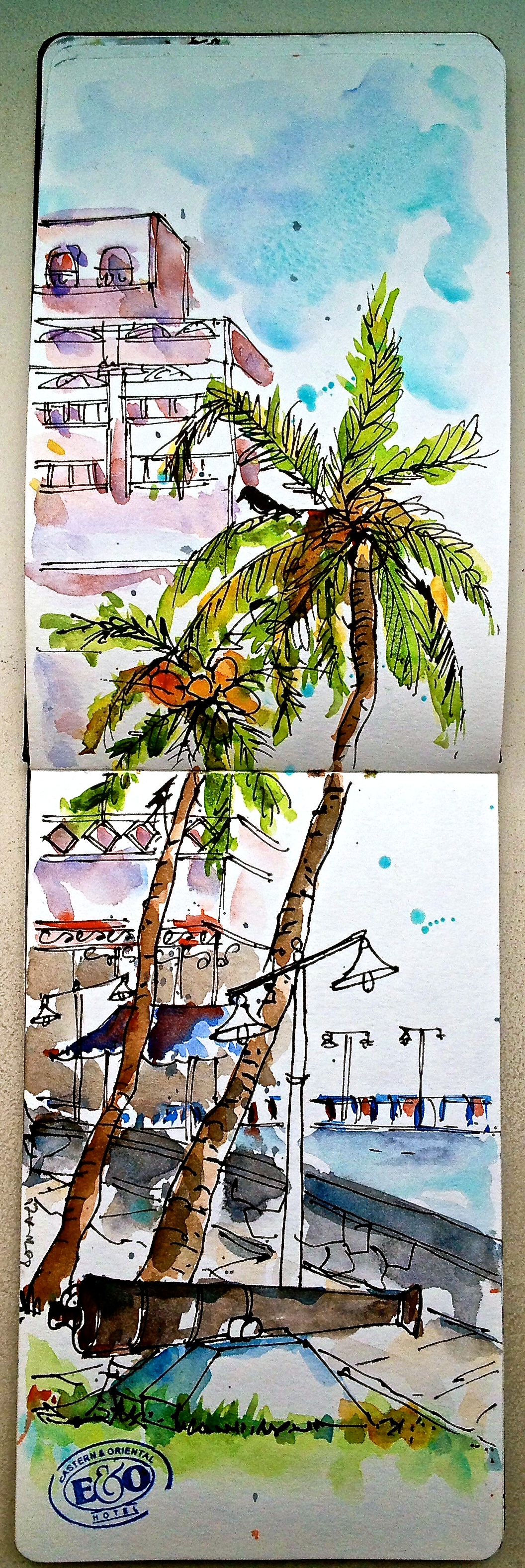
Sketching on the grounds of the colonian Eastern and Oriental Hotel

Impression 11 : Spending even one night at the 1885 built colonial style Eastern and Oriental Hotel( called E&O) could be the highlight of Penang trip, especially if you find out that your favourite authors Rudyard Kipling, Somerset Maugham, Herman Hesse were fellow boarders. Every room faces the sea and the black and white floor of the opulent bathrooms will steal your heart. Do request for a heritage tour at the concierge – this will be your chance to view some of the original fixtures and furishings in the Heritage Wing rooms.

The Decision Making

But if something feels remotely right you hang in there, right? You see it through. Let the unsure wobbly wheels roll, in the hope of finding balance.  Truth be told, I haven’t found balance yet, I still falter and fumble trying this third wheel to roll with us in tandem, on our travels, in our lives but guess what, it is getting easier by the day, week, month and year. And what more! I am reaping the benefits. Already.

Cafe 55 housed in a shophouse on Lorong

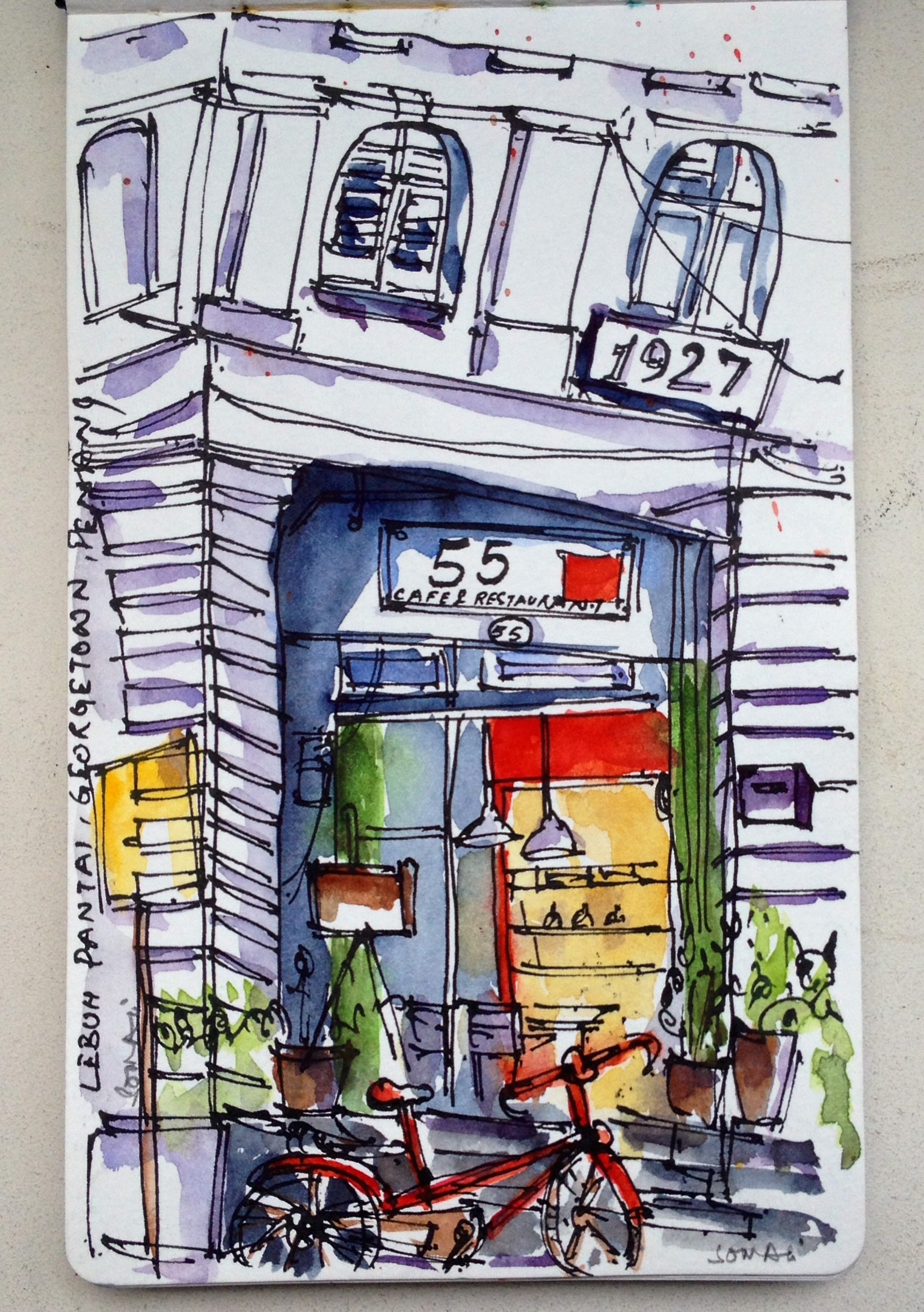
Impression 12 : While sketching Cafe 55 housed in a shophouse on Lebuh Pantai, we realized how narrow the roads in the historic district of George Town were. Soon we were betting if the next car could turn without grazing the parked car. There were few hits, but mostly misses. Too bad the rickshaws have been replaced.

The Consequence

If you are a mercenary, do not read further. Disenchantment follows. Because the benefits which I am reaping, which many others before me have reaped and those who are yet to follow this path will reap in future is hopelessly Zen. When I am sketching, specially on my travels, I connect with my subject and my environment much more deeply than I would have if I was merely visiting or passing by, because sketching involves intense observation.

Shophouses along Jalang Penang

Impression 13 : If you’re sketching on the road, keep your privacy tucked away in the backpocket because you’ll attract people like flies to a candy. And your work of course is open to unsolicited criticism. On this single occasion of sketching   shophouses along Jalan Penang, I had an Indian migrant worker at my elbow the entire time, three families and a group of girls lingered and quietly took overhead shots. An elderly gentleman stopped by and said, ‘If this was up for judging , I would give you first prize”. I took off my oversized sunglasses and gave him a genuine smile. The smile was wiped off by the Korean tourist who requested for a photo of me with my sketch and kept me hanging while she fixed her lens and cleaned it before the shot.

It invokes mindfulness, devoid of distraction, to such a degree that you participate in the scenery you are capturing on paper. Your fingers trace the eaves of the ancient temple roof, you knock on the louvered windows, ride the creaking bicycle, you flutter the laundry, skip the puddle on the fractured road and is caught up hopelessly in the nasty bunch of gnarly wires crisscrossing the facade of a shophouse. You become the pigeon sitting on the pole.

Eastern and Oriental Hotel

Impression 14 :The Plantation Lounge at E&O has these luxurious chairs that will engulf you when you sit on them. In combination with retro reading lamps, a small library, choice of board games, free flowing coffee and tea, this place is a perfect hideout any time of the day. The constant sound of waves washing up the shore takes the experience up a notch.  If you are staying here, don’t miss the elaborate breakfast options at Sarkies. For the first time in my life, I ditched toast and omelette for lamb curry and coconut rice for breakfast. Try a spoonful of roasted peanuts and fried anchiovies with it.

Dinner at Muntri Mews

Impression 15 : Dinner at Muntri Cafe, on Muntri Street was rewarding after a day of sketching in Penang’s heat and humidity. We ditched the relaxing alfresco seating outlined by exhuberant green boughs for air-conditioning. Wiser choice perhaps, till it became dark, temperature dropped and those tiny tea candles on the tables outside were lit up. It was romantic, but we weren’t there. Then came the food. It wasn’t just warm and comforting but also delivered on taste and presentation. We snapped right back into the zone.

“The courage- to-be, right here and now and nowhere else, is precisicely what Zen, at least, demands : Eat when you eat, sleep when you sleep!'” says Peter Mattheissen, in his book ‘Snow Leopard. Sketching lets you practice exactly that without even making an effort.

When you travel through a destination, sketching slows you down, so you don’t just eat, but taste, not just look but see, not just hear but listen. And do you know what comes out of this beautiful partnership ? You are zufrieden, truly.


Impression 16 : The owner of this coffee mill on sleepy Lebuh Katz hadn't opened shop yet. But that didn't stop him from keeping us company and conjure a 'thumps up' from time to time as the sketch progressed and muttering in Hokkien - 'beautiful, beautiful'.

Impression 16 : The owner of this coffee mill on sleepy Lebuh Katz hadn’t opened shop yet. But that didn’t stop him from keeping us company and conjure a ‘thumps up’ from time to time as the sketch progressed and muttering in Hokkien – ‘beautiful, beautiful’.

Bye Bye Penang!

Impression 17: Right before our flight, we had dinner at Kaffa, which is at Penang Airport. The nifty decor and the ambience does not match food quality (we had Salmon and pasta) or the portion size. The drinks were pale and watered down with plenty of ice. The trip advisor sticker on the door has to really work its charm!

This sketch of my face on the identity card, was the first one on this event

Impression 18 : I am terrible at drawing myself! Anyway, this was the first sketch done at the event.

The Happily Ever After

I have come back with 20 sketches from a 3 day trip to the UNESCO world heritage site of George Town in Penang, Malaysia. And since I slowed down on these 20 ocassions ( and almost all of these were off the tourist map) , I have 20 deep and distinct impressions of the city (see below each sketch) relating to it’s architecture, history, food, people, culture, ambience, temperament that someway or the other has characterized and demystified the place for me. I had first hand experiences which are real and personal.

And I am sure, the 170 odd skechers from the entire South East Asia plus UK and New Zealend, who assembled here to participate in the USk SGT II (Urban Sketchers Sketching Georgetown II) event, experienced the same.


Coffee with kids in tow? Maybe!

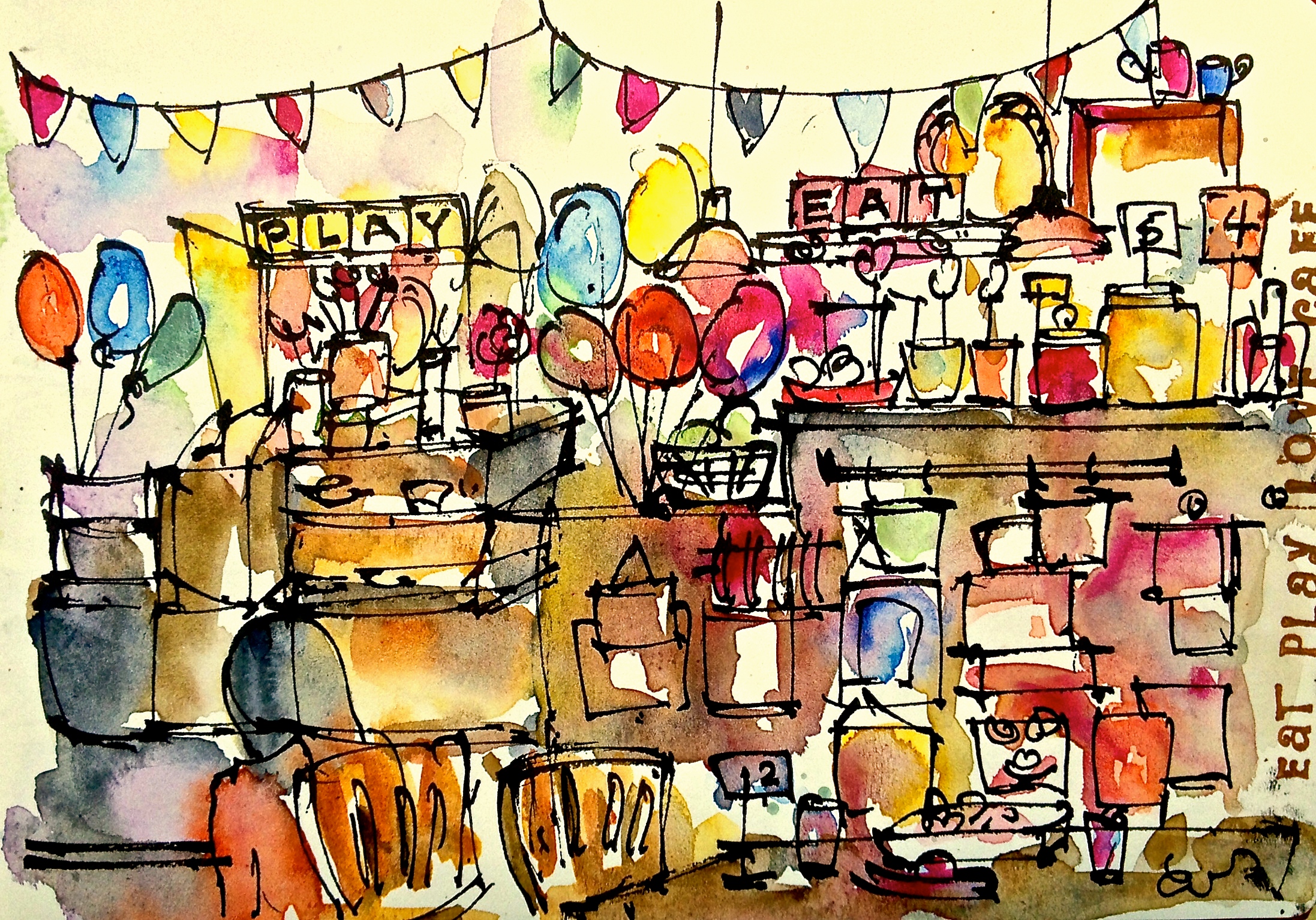
Eat Play Love Cafe

I have always been amused by the predicament of folks visiting cafes with small kids. Unless the child is tiny enough to be strapped to a stroller with a pacifier inside its mouth – basically tied and gagged – parents have a problem. Okay, not so much a problem, but a challenge, a herculean task, of engaging a pint sized energy ball with the attention span of a hummingbird such that it is sedentary, at least for a little while so they can sip at their drinks and let their sleep deprived minds wander.

Now, if there are pigeons in the vicinity of the cafe, which is quite common in Singapore, that is good news, not for everybody though. These urban birds are the least flighty and the most purposeful creatures I have come across on this island. They have adapted surprisingly well with the country’s economic boom and change in lifestyle. Instead of gouging out worms from the soil (which is so last century!) they swoop down on molten chocolate cakes or puff pastries lying in front of unsuspecting patrons and parade in between tables, hawk-eyed, puff-chested and taut-bodied, without a tinge of remorse.

And it is this sight of pigeons marching on the tarmac, that holds an universal appeal to kids across the world. They would tear away from protective arms, squeal in ecstacy and scuttle after the birds, who are surprisingly unflustered, till they are about to be stepped on, which is when they spread their wings and fly few meters away only to be chased again. This hobnobbing can continue for hours, giving enough time and space for the guardians to ‘keep calm and enjoy their drink’.

However, if thou cannot spoteth pigeons, do not despair. I have also watched anguished parents slowly relinquish their grip on electronic tablets or smartphones and surrendering them to tiny hands that urgently tap away at them for hours on end. So there is that. Another trade-off for solitude and a cup of coffee.

Some make their kids carry homework or sketchbooks to cafes. But that doesn’t quite cut it. While you sit back, relax and are about to zone out with the steaming cuppa, the last thing you need is to be badgered for help in Math or to be asked what crayon to use to paint the hut. This is also when the spouse flashes the ‘I told you so’ look.

With a thriving cafe culture in the country, new cafes sprouting like mushrooms, and Time Out featuring yet another list of ‘best cafes on the island’, I was surprised some entrepreneurial 20-something-Melbourne returned-grad student hadn’t thought of catering to this niche already. With a book cafe (“a book themed cafe that offers a relaxed ambience and casual dining”) and even a cat cafe (‘we strive to give you the perfect combination of cats, coffee, tea and pastries‘) around, it seemed such an oversight. Untill one day I stepped inside ‘Eat Play Love’ on 28 Aliwal Street.

Eat Play Love

For S$5, kids get 2 hours of unlimited access to Eat Play Love cafe’s collection of crafts

From the taxi’s window, this calm cerulean blue space, fitted with wooden hand painted furniture and vintage signages, barrage of colourful crafts, toys and knick knacks looked especially eye catching. Once inside, prepare to be drowned in the cacophony of gleeful kids huddled at a crafts table – playing, painting, sketching, sticking, cutting, wrapping and what not, all by themselves. Their guardians have the peaceful look of a Zen monk. Life’s sorted.

However, if you’re there minus the bambino, well, a slightly uncomfortable feeling akin to showing up for class without books, may tug at your sleeve. Obviously, you cannot share or borrow these metaphorical books! But thankfully the cafe has enough room for you to slink away from the hubbub, grab a table by the window, sip a latte or aromatic tea infusion, read a book, paint and chit chat with your spouse.


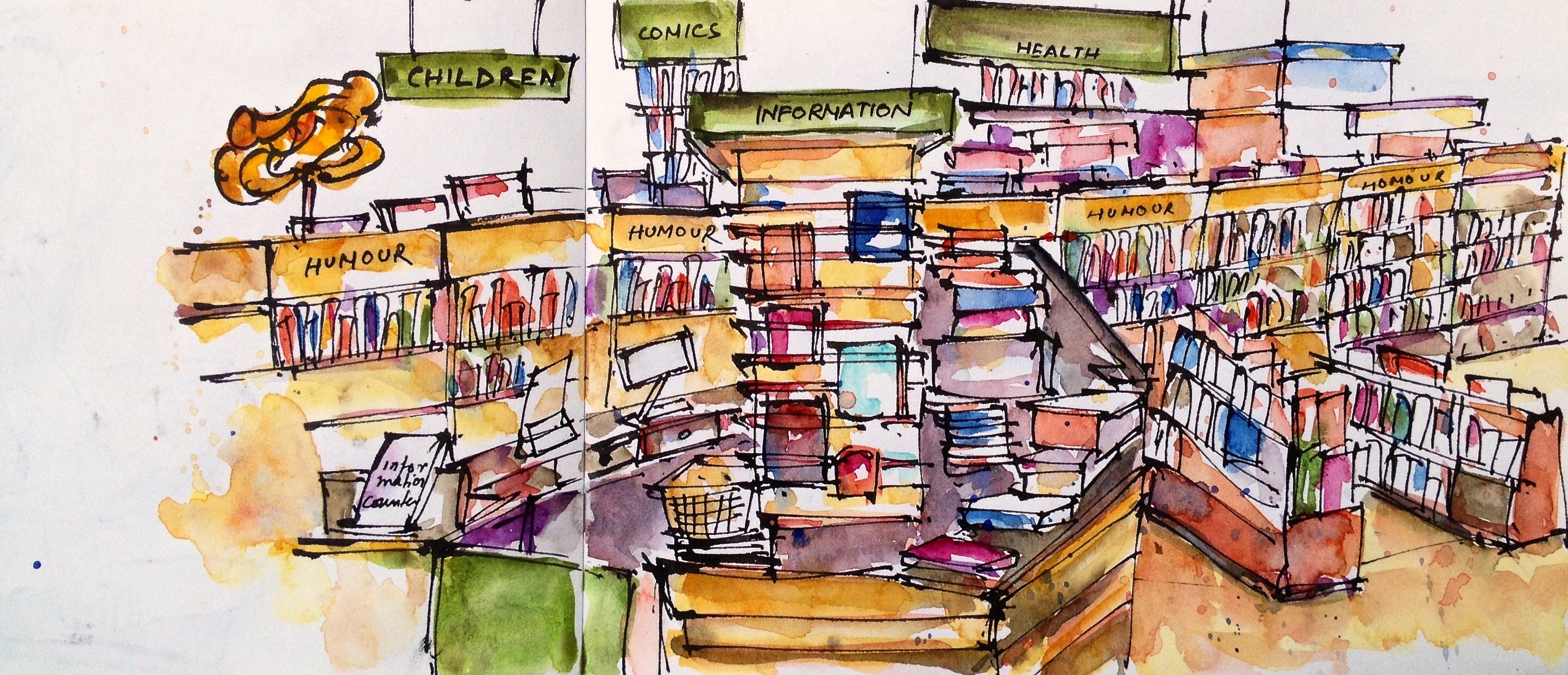
Weekend morning trip to a bookstore

I have seen people queuing up for croissants and baguettes outside bakeries on a weekend morning, or waiting for breakfast at cafes after walking their dogs or heading to yoga classes with a lurid pink mat under their arms, but I’ve never spotted people huddling outside a bookstore, checking their watch, waiting for it to open its doors.

These people are my idols, my brothers (or sisters) in arms. I could have been any one of them or will be when my love for books trumps my desire to sleep-in on weekend morning. But today I am here with a different motive. Urban Sketchers Singapore have been allowed to invade the 43,000 sq feet space of Kinokuniya’s flagship store at Ngee Ann City for 3 hours. Why the privilege? Because the store is moving out and when it does, our sketches will serve as sentimental memorabilia.

Now before you start brooding and beating your chest in agony, Kino is not vamoosing for good. It is just moving to the floor above, which – here comes the caveat – will be a smaller space. So if anything, you should be worried about the possible downsizing of your favourite section.

As for me, I am rapidly using my Kino gift cards to buy more books to propitiate the mighty book goddess, praying that my favourite Art and Design section remains forever bountiful. Add to that the travel literatures and also the cookbooks. And the classics.


The books were calling my name, especially the art & design section. It was very hard to concentrate.

The books were calling my name, especially those from the ‘art & design’ section, right behind me. It was very hard to concentrate.

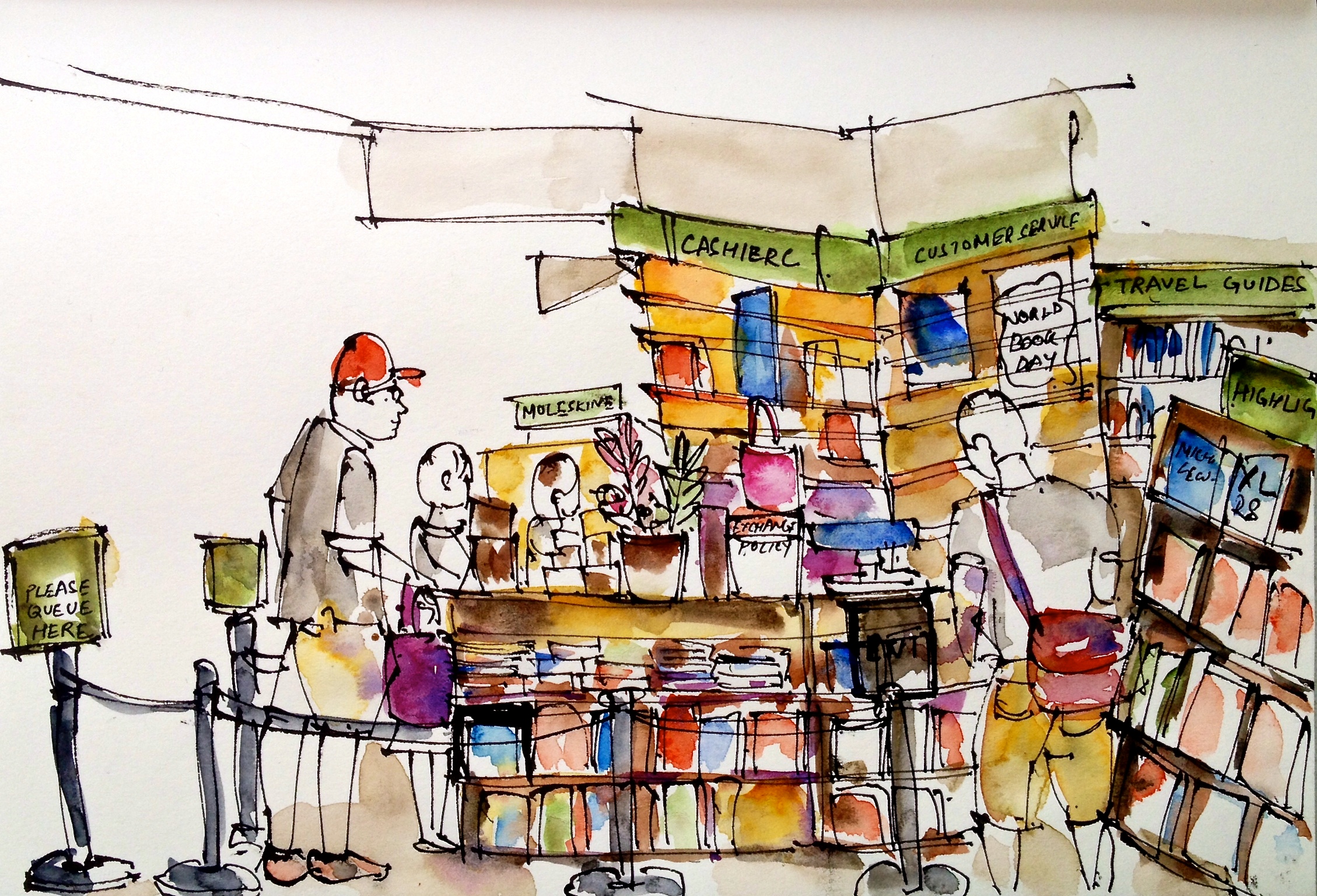
In the age of small screens, it is reassuring to see people buy the real thing.

In the age of small screens, it is reassuring to see people buy the real thing.

Thumbs up for this mother (also an urban sketcher) who brought her munchkin to a bookshop early morning.

Thumbs up for this mother (also an urban sketcher) who brought her munchkin to a bookshop early morning.

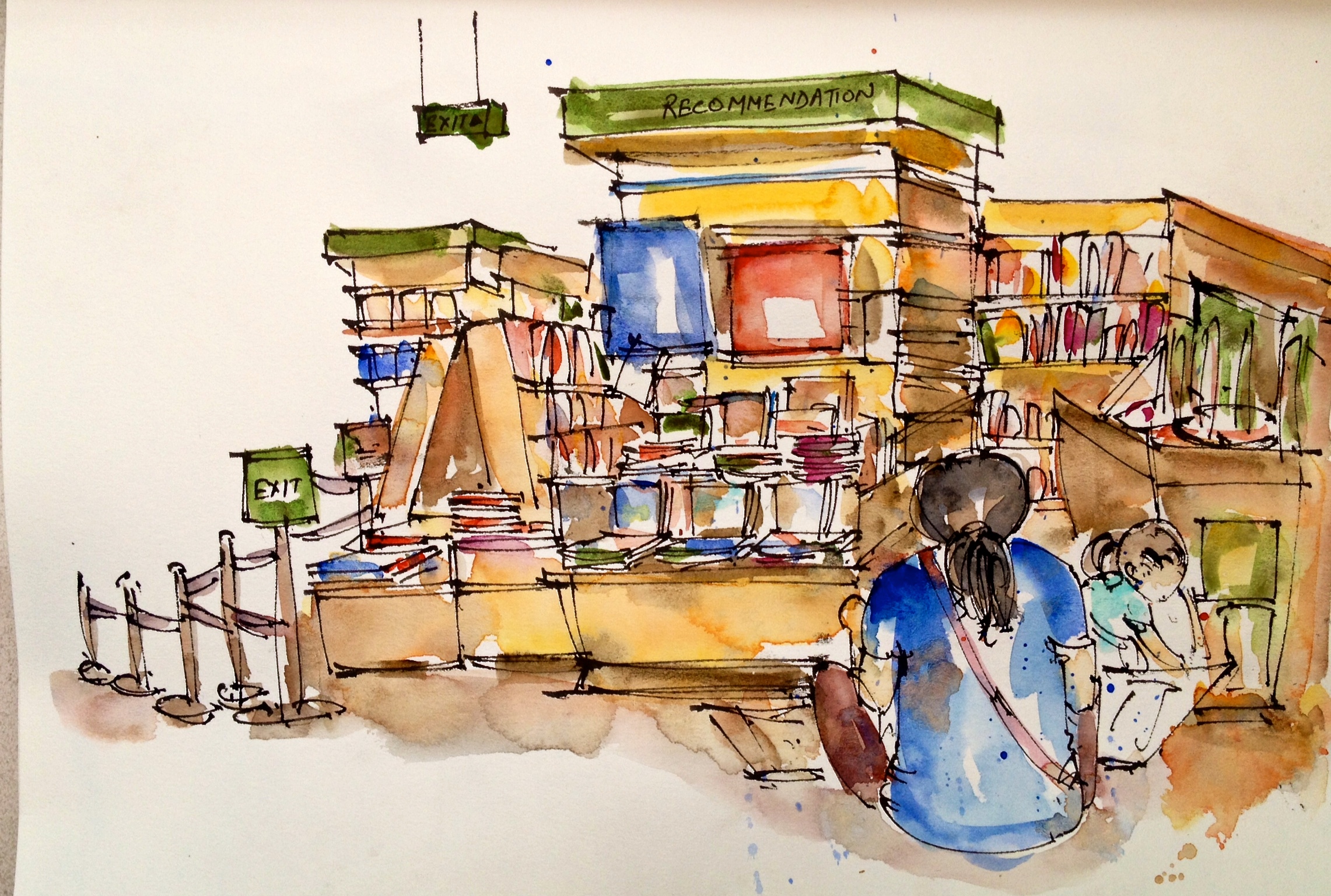
Ignoring the resounding book pleas and sketching more shelves. I am a saint!

Ignoring the resounding book pleas and sketching more shelves. I am a saint!

Tale of two cities

Once every year, I and my husband are India bound. Only this year, in addition to our self-prescribed vacation in Kolkata- our hometown, we squeezed in two days of Mumbai, to make the aquaintance of the prima donna of India’s west.

Mumbai

Marine Drive

Marine Drive

Even if you’re new to Mumbai, just like me, chances are Mumbai isn’t new to you. You may still have a fair idea of what to expect and experience, thanks to the innumerable books ( Elephanta Suites by Paul Theroux, Sacred Games by Vikram Chandra ; Shantaram by Gregory David Roberts, Maximum City by Suketu Mehta, Narcopolis by Jeet Thayil) and movies ( Salaam Bombay, Slumdog Millionnaire, Metro, Bombay and plenty others) that have expressed the ethos of the city through narratives and plots based in the dusty folds of this audacious, over populated, rambunctious metropolis.

If Mumbai were to impress you, the first time visitor, she’d spew her impressive credentials upfront, like being the financial and commercial capital of the country, the mecca of Hindi film industry, the melting pot of communities, cultures and so on. But she doesn’t because she’s isn’t pretentious. She is industrious, sharp witted, resilient and hopeful, qualities I saw mirrored in the people I met on my short visit. The driver of our car that we hired (for 8 hours worth Rs.1500 or S$30 from Savaari Car Rentals) for the day, was an immigrant from Bihar, rather a country bumpkin who arrived in the 80s with nothing on his back, worked his way up, learnt English, married a local and now drives tourists around and guides them through the very city he was once foreign to. Mumbai is rife with stories like this.

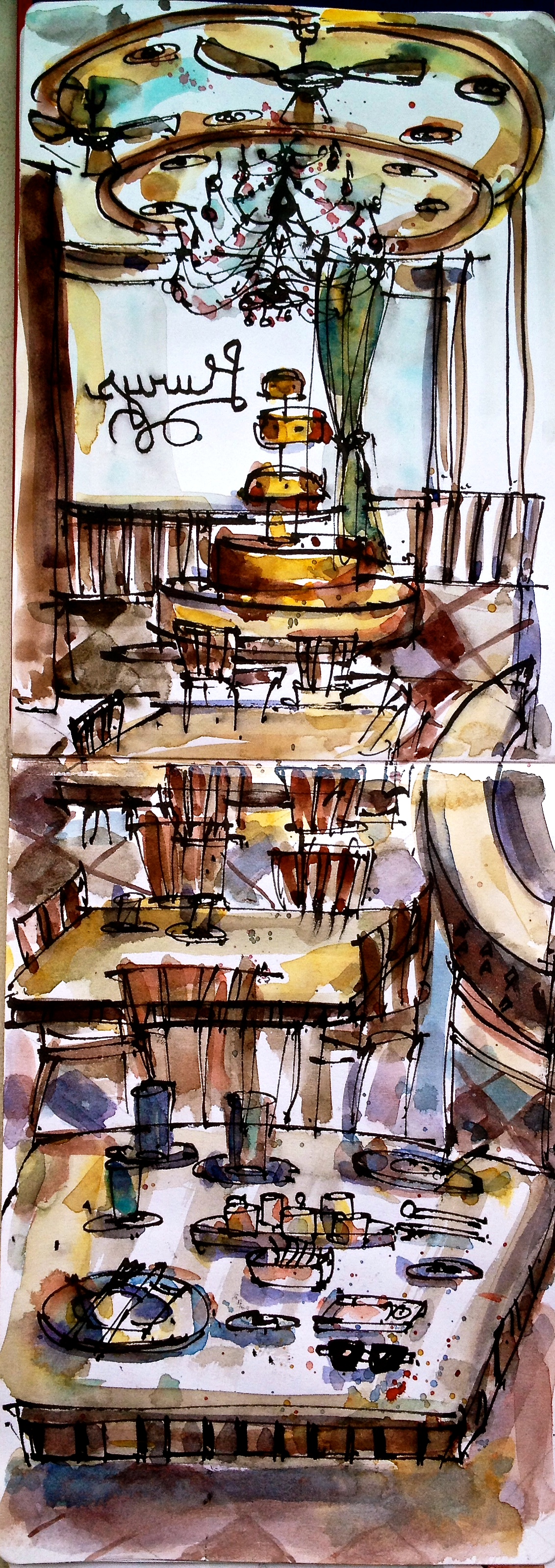
Leopold Cafe & Bar

Leopold Cafe & Bar

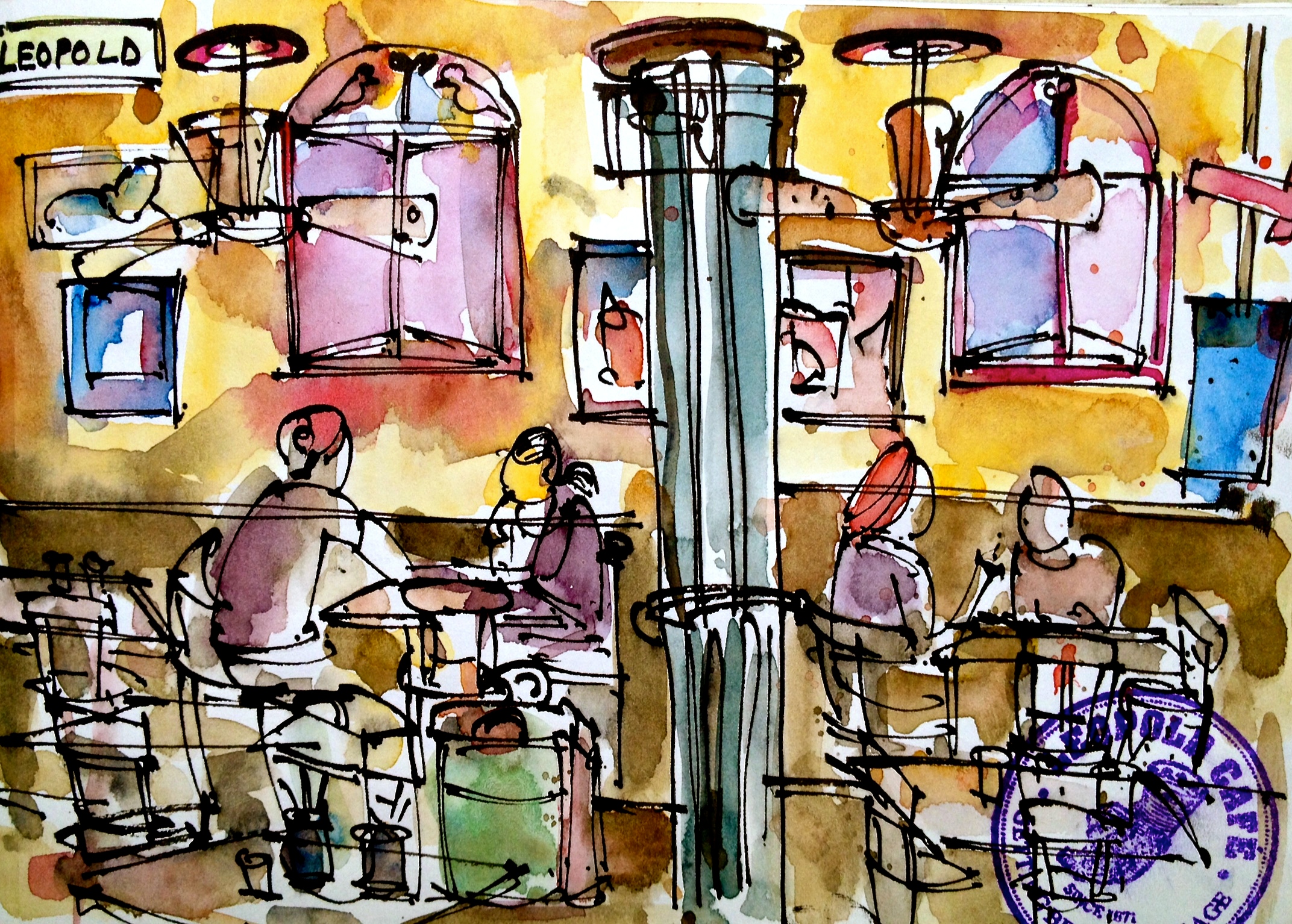
After a lazy walk and sketch along Marine Drive – a picturesque promanade, our first stop was Leopold Cafe and Bar for breakfast. One of the most popular haunts in the city (especially with the backpackers), has been around since 1871. I don’t know how much the interior has changed since the old days, but even today, this ensemble – of dark wood furnitures, chequered table cloth, dated wall paintings and old fashioned ceiling fans seem right out of musty sepia toned photographs. What is new however are the bullet holes, from the heinous 2008 terrorist attacks.

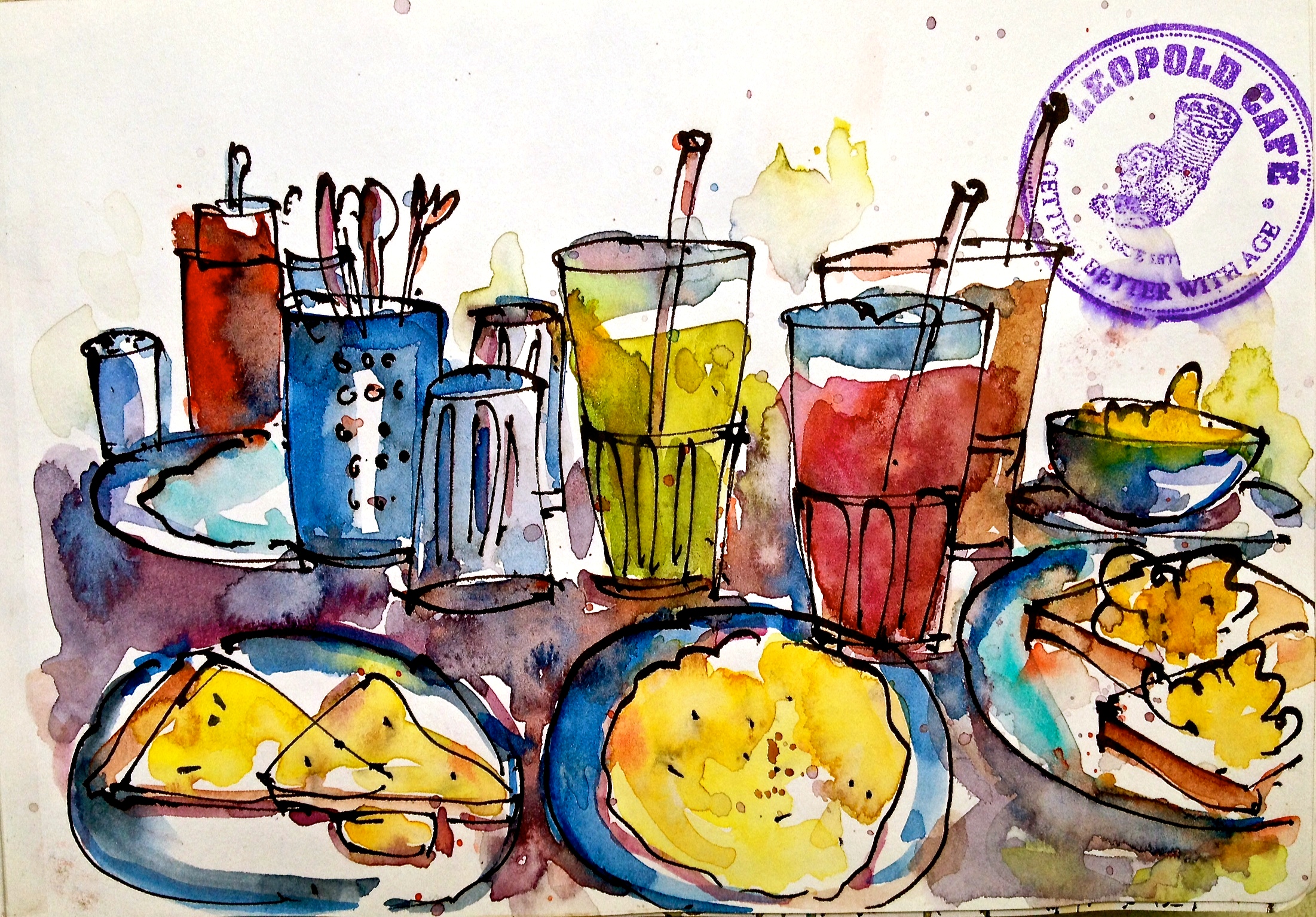
We order omelettes with toasts, a plate of über-delicious melt-in your-mouth keema and bread to be washed down with orange, lime and watermelon juice as illustrated in my sketch. I request the geriatric guy manning the cash counter to put the cafe’s seal on my sketches to officially validate my visit. He approaches this gargantuan task with dopey eyes and few vapid sigh. Perhaps, I should’ve asked for a tissue instead. His social ineptitude is quickly compensated by the cafe manager, flips through my sketchbook and hands me two postcards in return.

“You didn’t sketch the bullet holes? he said. I was surprised he asked. It didn’t feel right to record the horrific reminder of an incident that shook the country and carry that with me as a trip souvenir. If that was so, I could’ve bought those kitschy Leopold branded coffee mugs with an image of bullet shots. Yes, the cafe hasn’t shied away from cashing in on the sentimentality.  Nevertheless it’s a survivor- Leopold opened for business, three days after the incident – and survivors don’t need to hide their scars.

Breakfast at Leopold cafe

Breakfast at Leopold cafe

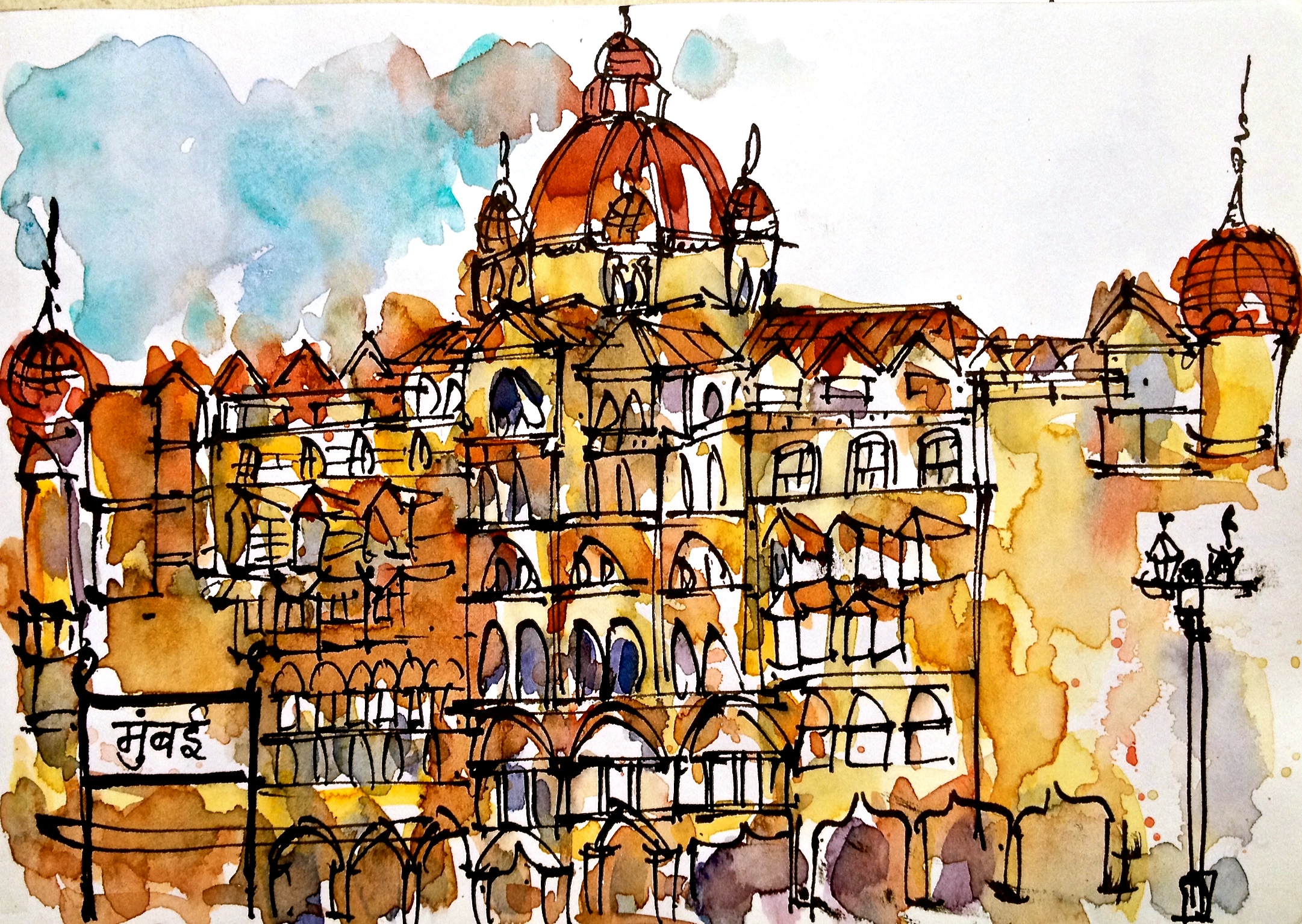
We turn the corner, walk a few hundred meters and meet the shimmering Arabian sea, the towering Gateway of India at it’s bank and the proud, historic, magnificent Taj Hotel. I have watched this scenery and read about it so many times in my life that my first impression wasn’t of wide-eyed wonder, but that of disorientation – I was recalculating the perspective, size, distance anomalies my mind’s eye had made while visualizing this scene. ‘I imagined The Taj to be aligned with the Gateway” ; ‘The space in front of the Gateway isn’t as expansive as I had thought’ was what I was muttering.

Taj Mahal Hotel

Taj Mahal Palace Hotel

The gate way is barricaded by a voracious slew of photographers (mostly natives of Bihar) dangling chunky DSLRs from their shoulders and thrusting sample photos of people posing with these iconic monuments, into you face. Being Indians, we aren’t accosted by them as much as the foreign tourists. But still a ‘ Sir/Madam, please take a pikkchur..berry nice foto I taking..you like..see this one..or that one..only 20 rupees’ sneaks in now and then.  My husband waves his DSLR and asks, if he could take ‘their’ picture instead. All at once they are shy and recede a few steps.

It’s only 10 in the morning and the heat is punishing. I stand in the shade of the towering Gateway and sketch the Taj hotel. The details of the facade are mindboggling, so I try to simplify while little streams of sweat trickle down my lower back. Right on my left, locals and tourists are making a beeline for the ferry leaving for Elephanta caves, ‘only a 50 minutes boat ride away’ – reported our driver later in a tone that hinted our misjudgement in skipping the site. We squint our eyes at the shimmering jetty and at the fatigued tourists fidgeting in the sun, waiting in a queue that is snaking around one arm of the gateway and walk away.

Gateway of India

Gateway of India

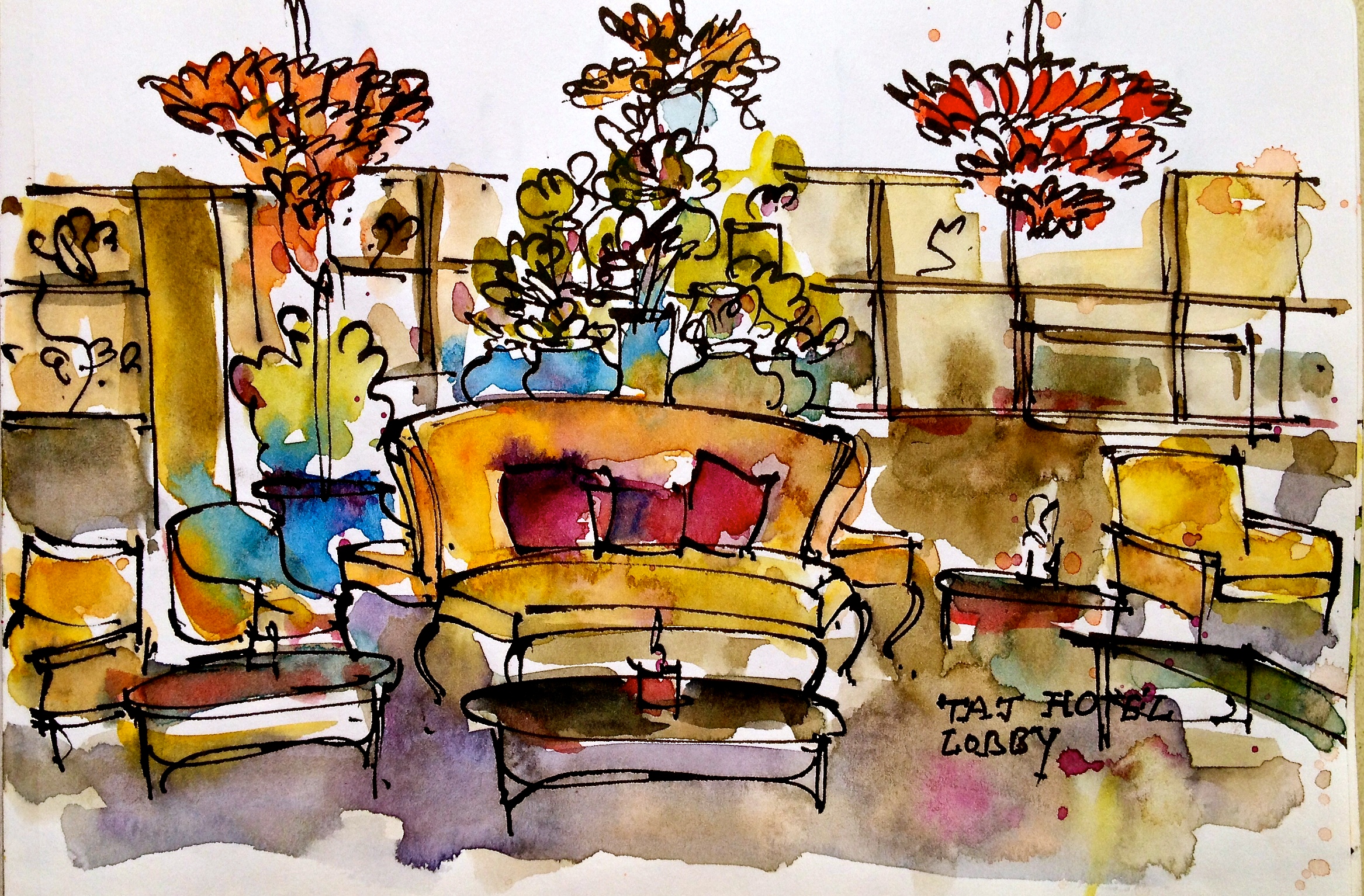
I try to squeeze in a quick sketch of the Gateway before we step inside the Taj Mahal Palace Hotel to cool down. The interiors are as regal as I had imagined with sparkly chandeliers, nifty flower arrangements and luxurious upholstery. Waiters flitted around obsequiously ushering, chaperoning, and in some cases placating indignant guests. One side of the lobby was lined with premium stores, mostly vacant and the other side was fitted with glass cases flaunting Taj’s flamboyant past. Photographs of notable guests from Jac Kennedy, Mick Jagger, Oprah Winfrey, Duke of Edinburgh to Beatles adorn the walls. A smart uniformed staff in a saree and well coiffed hair was manning the ladies room and proffered a rehearsed smile when we entered. Each time a guest left the stall, she promptly flushed the toilet ‘again’ and wiped clean the wash basin. When we left, she smiled again.

Cooling off Inside Taj

Cooling off Inside Taj

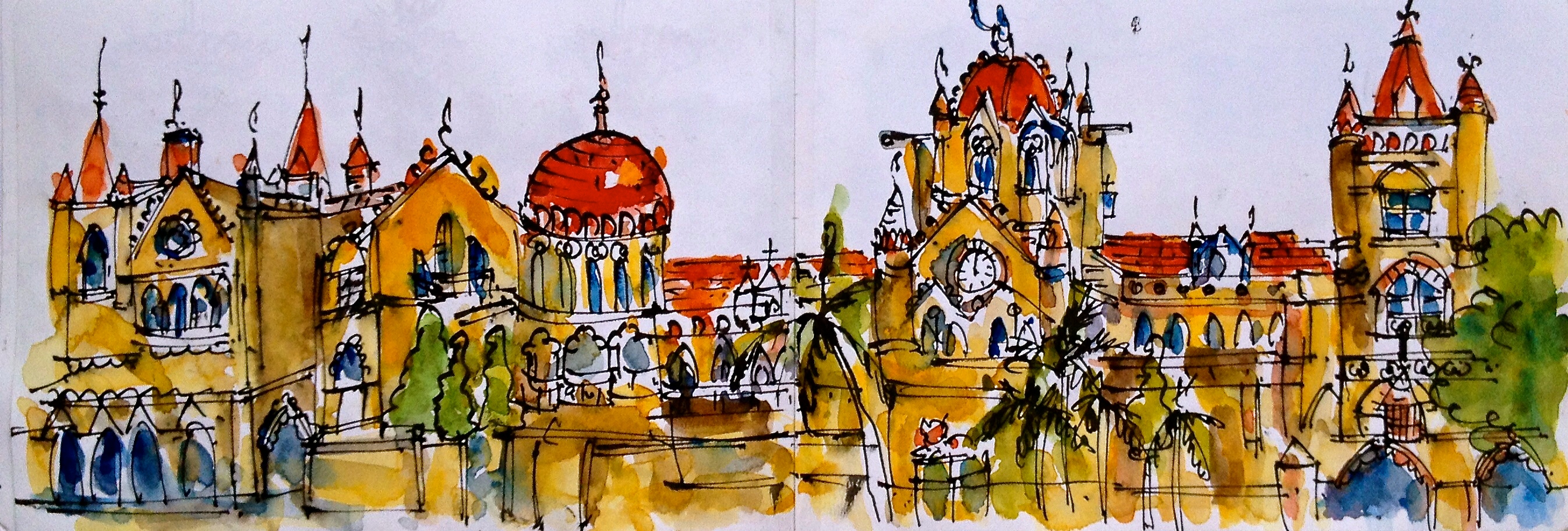
Very slowly, we drive past the Bombay High Court, admiring the impressive neo-Gothic building from 1848 and made a short stop in front of the Victoria Terminus Railway Station ( officially called Chhatrapati Shivaji Terminus or CST ) because I couldn’t, rather wouldn’t leave Mumbai without pinning this massive, 1888 built, palatial world heritage site down on paper. Perhaps, more than the Taj or Gateway, it was VT’s cocktail architecture – Victorian, Italian, Gothic, Mughal –  and sheer size that made it an absolutely delightful ( albeit challenging!) subject to gawk at and sketch. Once again pressed for time, I simplified – my pen obliterating the numerous arches, windows, turrets, grotesques friezes, bas reliefs and other embellishments so painfully put together by the architect – to capture the essence of the place in simple urgent strokes.

VT Station

VT Station

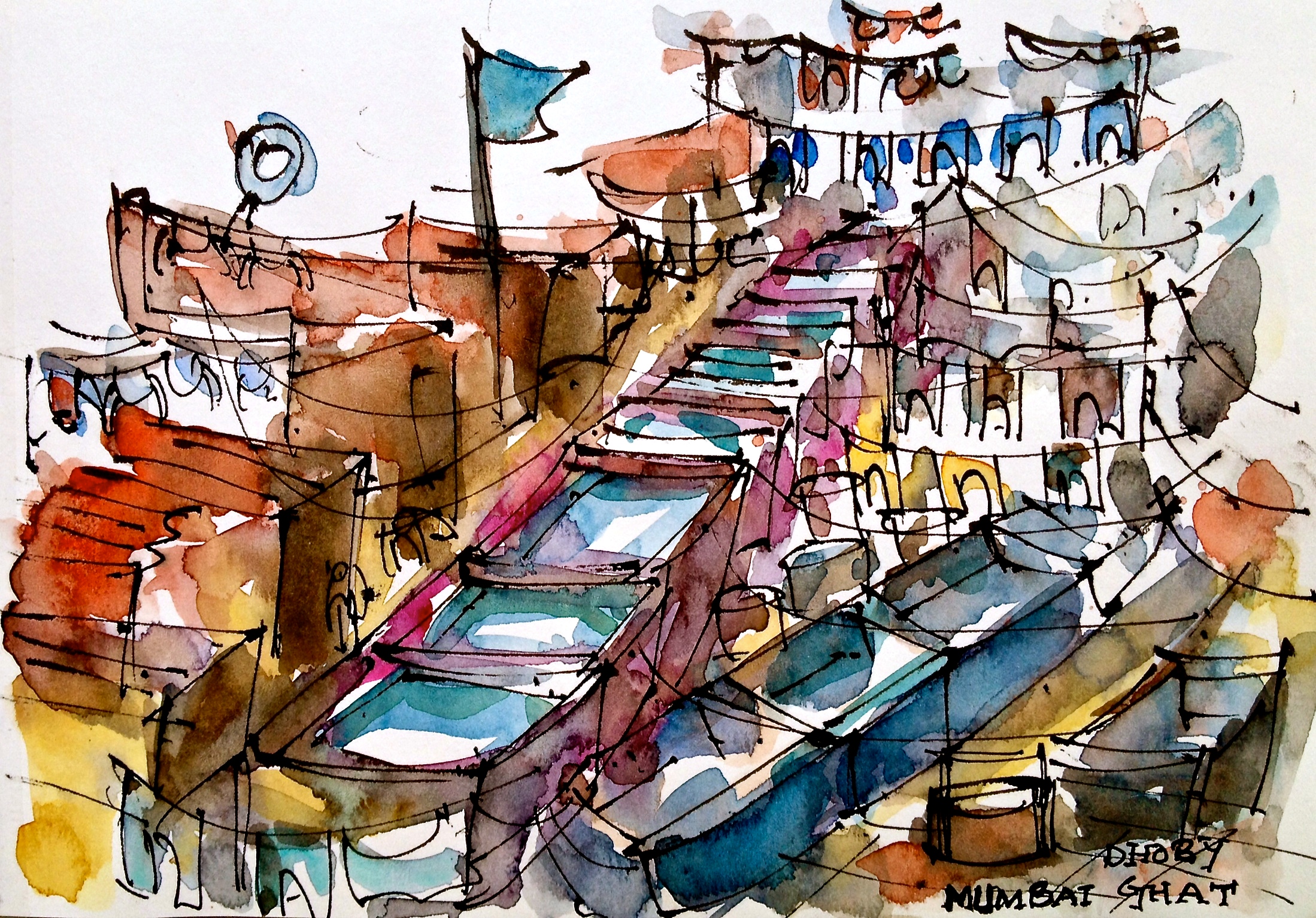
Tearing away from VT, we insisted on visiting Dhobi Ghat – which in our driver’s opinion was suited ‘for foreigners’. Not entirely, though. Our senses might be numbed to sights of men and women washing laundry in the open, along ponds and streams, but this was something else. This was large-scale, to the stature of ‘Central Laundry Station of India – the headquater of all laundry units across the country’, if something like that existed.

Dhobi Ghat

Dhobi Ghat

Amid a grungy shantytown bordered by railway tracks, all we could see far and wide were clothesline hanging spotlessly white sheets that were fluttering in the breeze. Down below, it was all business –  network of concrete troughs fitted with floggng stones, were filled with water, where the clothes would be soaked, scrubbed, washed, starched and dried by taut swarthy men and their families. This 1890s establishment now has a website http://www.dhobikalyan.org, where you can register for a tour.

The Shoe House

The Shoe House

One of the most famous public beaches in Mumbai – Girgaum chowpatty, looked practically abandoned and therefore unrecognisable in the swelter of the afternoon whereas during Ganesh Chaturthi celebrations, hundreds of people gathered here to immerse the idol, jostle for an inch of space. The white toasty sand reflected the sun right into our eyes, sending us scampering for shade. Post a ‘gola’ (ice shavings) in kala-khatta flavour from one of the venders, we settled for a drive around adjoining Malabar Hill – the dwelling grounds of the rich and famous. Our driver insisted we stop at Hanging Gardens, built on top of a water reservoir and admire it’s greenery and the sweeping view of Chowpatty and Marine Drive from it’s vantage point.

The cynosure of all eyes however, was this giant shoe house, which was infested with giggly school kids, who just couldn’t wait their turn to climb it.

Having about two hours to spare, we headed towards Dharavi– one of the largest slums of the world- that popularly wears the ‘genuine leather goods at great bargains’ tag.  There are thousands of leather factories in the district that churns out handbags, jackets, wallets, belts and what not. And in the absence of middlemen, the shopowners offer wholesale prices, which is quite low, while making decent profit at the same time. The catch however (isn’t there always!) is – if you have refined tastes, it will be hard to find something you like from the scores of knock-off designs that the shopowners proudly exhibit and the parsimonious yet fashion conscious college crowd readily laps up. Just keep looking till you find ‘the one’ and haggle when you find it.


Kolkata

People, to be specific cousins and close relatives are curious, if the sanitised and systematic Singapore lifestyle muddles our visit to India; if we find it disconcerting to brace the heat, noise, dust, crowd, traffic, chaos; if we tire of the hackneyed idiosyncracies and the constant impedimets to get through each day.

‘Nothing has changed here’, they’d say plaintively.

To this, I’d say, ‘What, another shopping mall on VIP Road?’, gaping at the newbie. Mango and Marks and Spencer have stores in Kolkata? When I asked my sister in law, what does she substitute Mascarpone with when making Tiramisu, she said, “Why, I get all ‘foreign’ ingredients from Spencer’s ( food retailer) these days”. Sifting through The Telegraph’s glossy lifestyle section, one evening , I found hand purses of premium global brands advertised along with local ones. A walk through Park Street, led me to an Apple store sharing a wall with a RayBan, Prada, Gucci, Chanel sunglasses retailer sharing a wall with Pizza Hut; cafes of international design and standard and bakeries with fancy French names like Au Bon Pain, riddled with white tourists clad in hot pink salwar kameezes and Indian women in short skirts and body hugging blouses.

Gone are the, reserved, reticent and nervous school kids, specially girls burdened with moralities, chaperoned by their parents to and from schools or tuitions, lest they befriend the opposite sex and malign their family’s reputation. Such species have been replaced with fluent English speaking teenagers, confidently strutting along their male compatriots, texting on phones, cracking jokes, giggling – basically being young. They looked confident, equal and in control. They also look well groomed. The Indian comfort attire – the traditional Salwar Kameez – that was the default garb for majority of women, has undergone a ‘workplace appropriate’ transformation, making it smart and chic.

Having a cake at Flury's

Lunching at Flurys – the legendary tearoom on Park Street from 1927

The ubiquitus salwar-kameez has also been replaced with western attire, most common being denims. Dresses that remained the domain of the Anglo-Indians or the liberal bengali women are being picked up by more eager consumers that work in global companies offering a multicultural work environment. How can one not see this transformation?

Fashion is changing, so is the attitude. From where I see, looking good matters in this Indian city as much as it matters in any other city of the world. Top-end beauty salons like Jawed Habibs, which wwere populated by the well heeled, have cropped up like weed in my neighbourhood, with a one hour collagen facial setting you back by over Rs.3000 (or S$60). As the prices of commodities and services have increased, so has the disposable income and people have become conscious on what to spend their money on, which is not just on the basics anymore.

Annoyed with the traffic I was, but the city is on it’s way to build yet another flyover that promises to clear many terminal road blockages in future. Proposed metro lines, half dug shopping malls, gigantic residential complexes with cranes, exposed iron rods and metal sheets and men breaking their brown sun burned backs, make grey appearances all over the city, making it look like a perpetual work-in-progress. Nearly seven hotels are due to be operational in the city in the coming years, 3 new ones including JW Marriot, just on EM Byepass, which already has ITC Sonar Bangla and Hyatt.  A year after the liquidity crunch in 2008, the works on the projects have picked up after the economy and the stock market has rebounded.

Random guy at Flury's

Random guy having tea with a woman at Flurys

There was a time not too long ago when internet connection at home was a far fetched thought. There was this one cyber cafe in the vicinity where I had to queue up during weekends to get access my mails. My hapless parents have been struggling with the prehistoric dial-up connection for as long as I can remember. Two whole minutes of uninterrupted Skype call was divine. Then came broadband, offered by BSNL, which was an upgrade but not a smooth ride either.

On our way from the airport this year, I saw the city flooded with hoardings, posters, marquees advertising a Wi-Fi internet dongle with built in hotspot that can be fixed into any plug point and is capable of serving five Wi-Fi devices at a time. “Go Live, Go unlimited” says the tag line. What more – minimum paperwork, online bill payment and house visitation for servicing, if anything goes awry! A media report from last year states Kolkata has 4.4 million internet user now with 47% y-o-y growth which is the highest growth of internet users among top cities in India. If this isn’t change, what is?

While the city’s trials and tribulations which are in multitude, render an unchanged image to it’s residents, once-a-year visitors like us, who bring in fresh pairs of eyes, see movement. My send-off was from the swanking new state of the art airport terminal ( a magnificent glass and steel structure sprawled over 1,89,815 square meters that cost Rs. 2,325 crores) – a testament to the fact that things are changing. But sometimes the change isn’t so apparent because this city is like a goliath centipede with thousands of years of baggage, making slow but sure progress.


Skewer-y Thaipusam

“I am Karna”, said a voice on my right. Since I didn’t look up from my sketchbook, he said, “You know Karna, the warrior prince from Mahabharata? ”. When I am sketching in crowded public spaces, I am used to people peering over me, breathing over my neck, appraising my work like art connoisseurs, pointing cameras to my face, nudging friends to take a look, but rarely does one talk to me while I am working, except slipping in a few words of encouragement when they leave, to which I nod or smile in bashful acknowledgement.

 
But not Karna, the warrior prince from Mahabharata. He wanted to butt right in.
 
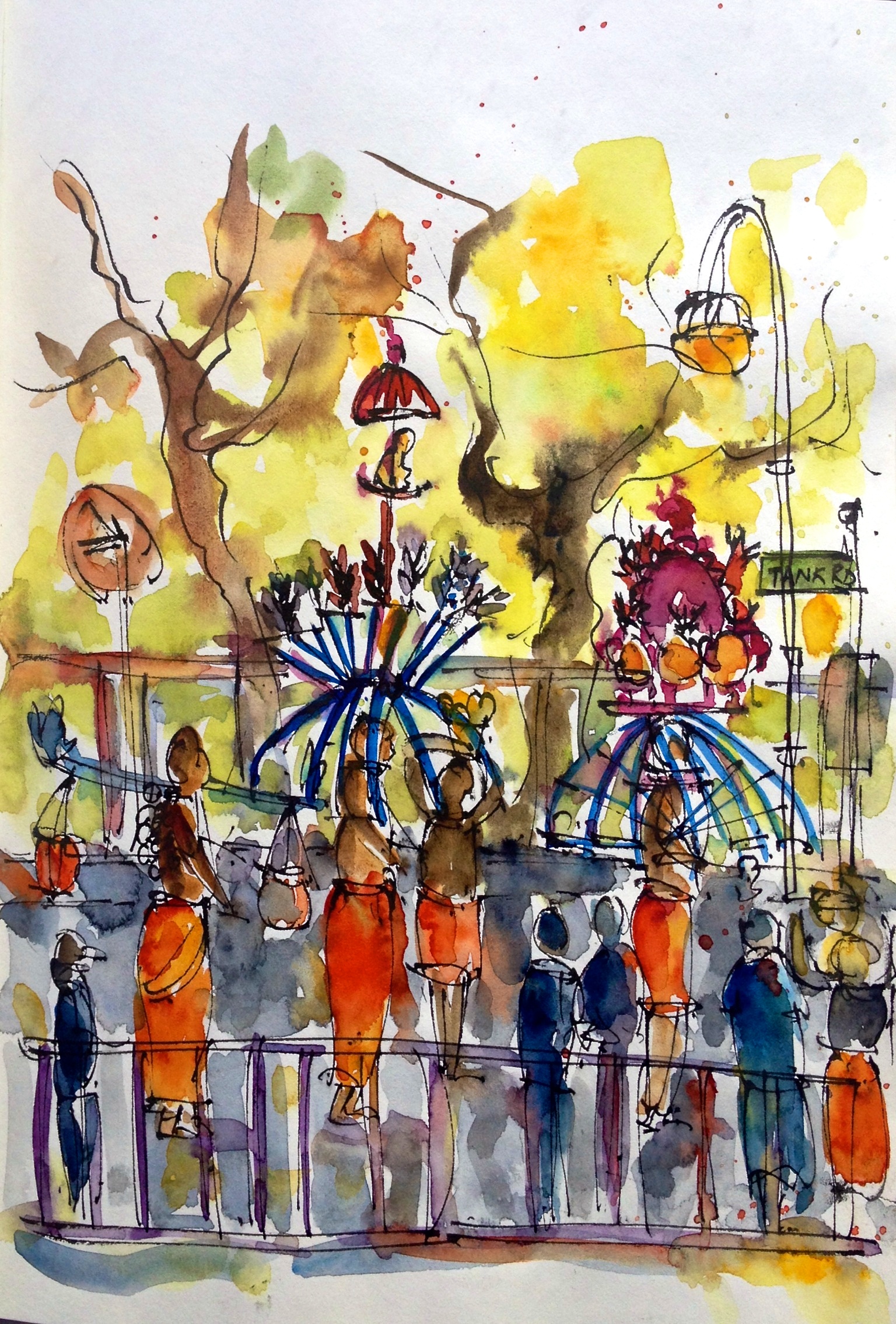
Thaipusam celebrations in Singapore

Thaipusam celebrations in Singapore

 
His gigantic frame in an untucked white pinstripe shirt and loose trousers leaned against the yellow barricade and faced me. A mop of dark curls, slick and shining with oil was pushed back; round dancing eyes like two pingpong balls smiled under the shade of bushy eyebrows and an inch wide moustache revealed the largest, whitest pearls I had seen in a long time.  ’The skill you have there’, he said pointing to my sketches and folding his hands and looking heavenwards, ‘is God’s gift’. He scrunched up his eyebrows such that the long tilak on his forehead disappeared between the folds. First time in my four year stay in Singapore, when I finally mustered the courage to watch Thaipusam – a Hindu festival celebrated by Tamils by honouring Lord Murugan –  up close, I was victim of small talk.
 
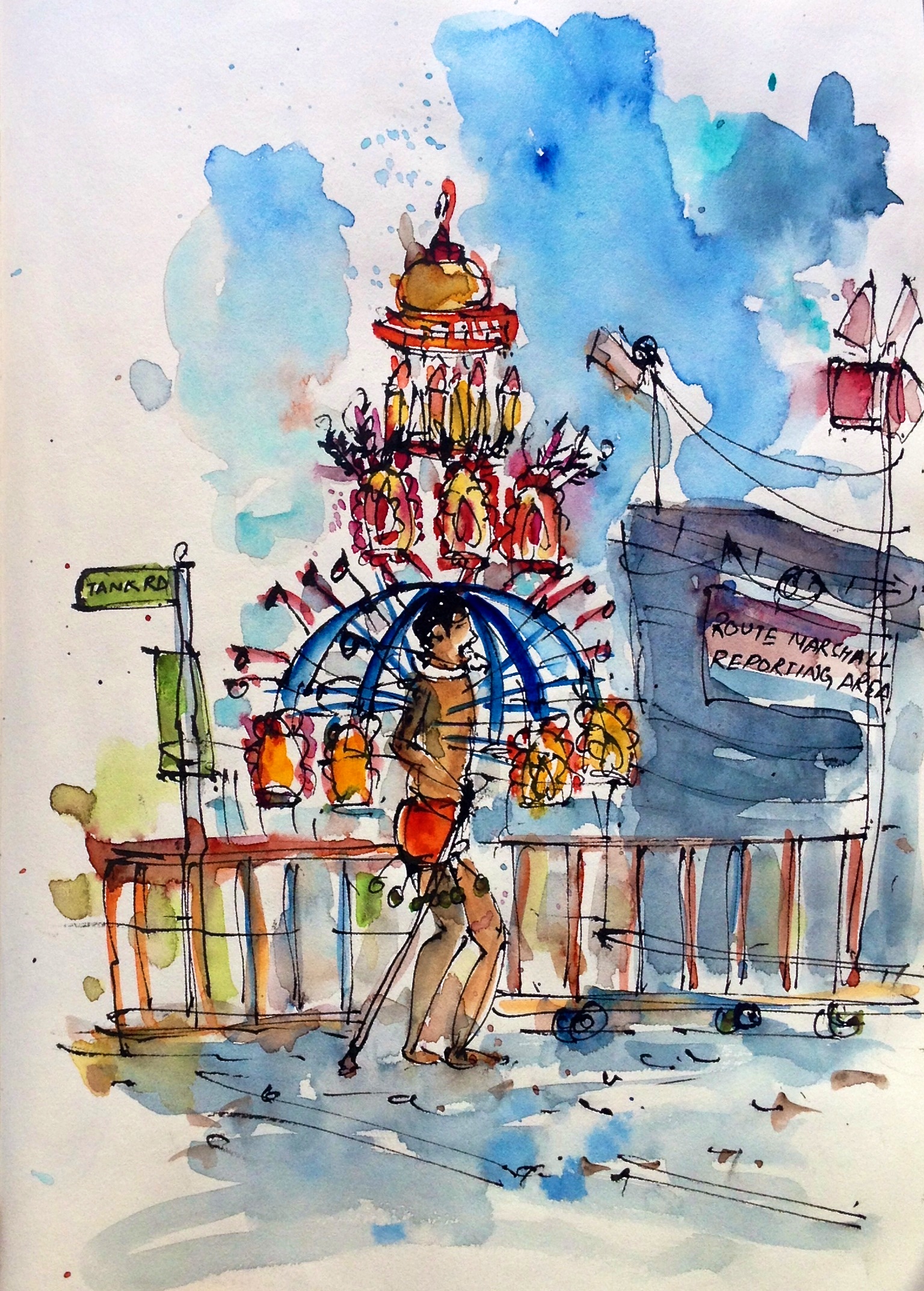
Thaipusam in progress

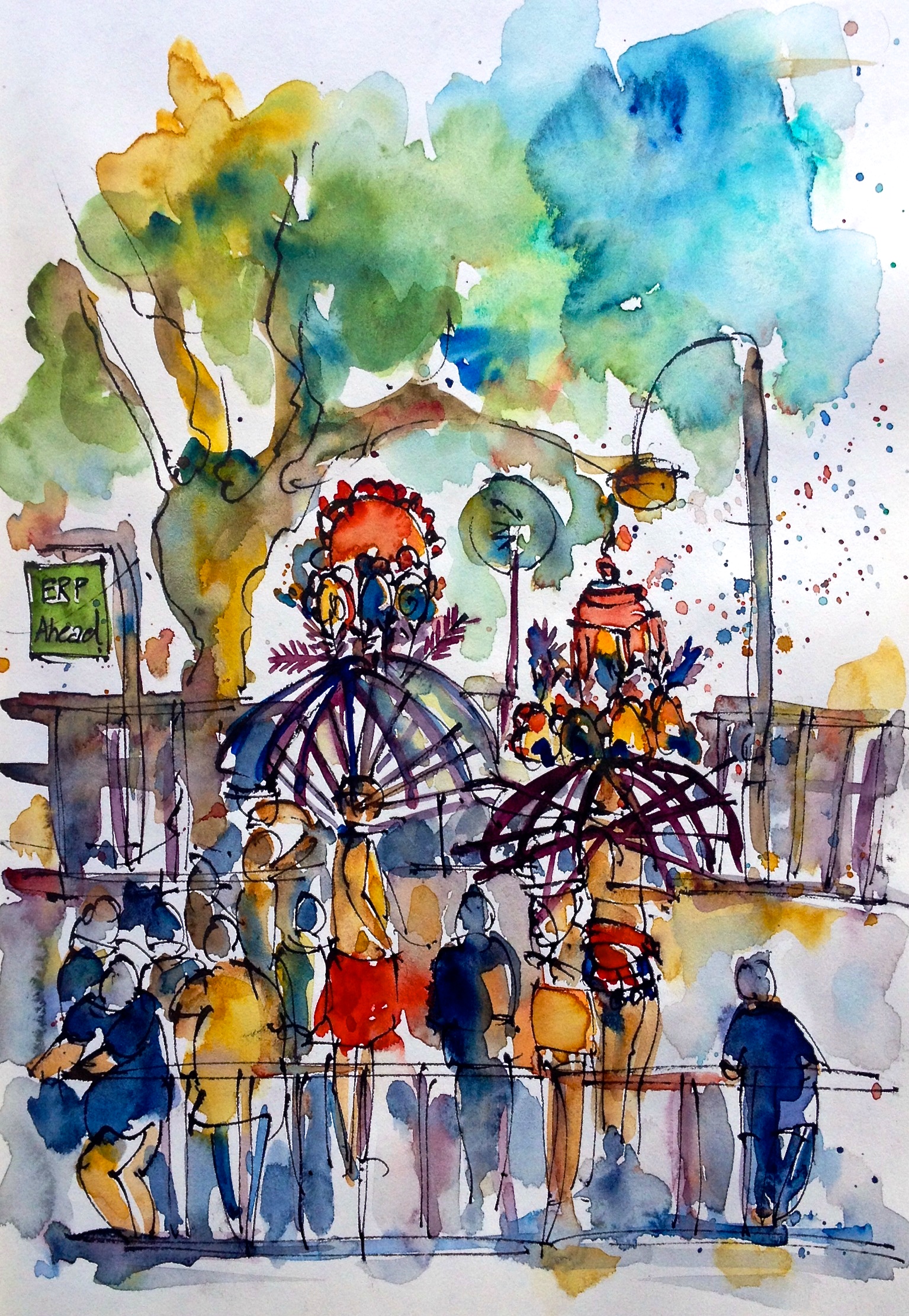
The kavadi bearing men are bare chested, bare footed and wear yellow, orange or red loincloths

 
But, when you’re on foreign soil and want to make sense of the place, it isn’t a bad idea to indulge local voices to tell you their stories, from their perspective, laced with their sentiments. I didn’t want to kill the story yet, if there was one. So waving at the pilgrims, I asked Karna, a question that was on the top of my mind, “Aren’t they in pain?”.  There was no blood, it was hard to tell.
 
 
“When you fast and pray for 48 days, your body is prepared to endure such pain”, said Karna,  slightly irked at the mushy overtones. But for the uninitiated, Thaipusam is extreme. Thaipusam isn’t for the faint hearted. Even the befuddled spectator needs to keep her nerves. The sight of these men, regular men – perhaps one of them is your office colleague, your school teacher, a neighbourhood grocer – turn into a pincushion overnight, with scores of metal skewers fastened to their chest and back, one going right through the cheek or tongue, a gigantic, elaborately decorated canopy balanced on the head will elicit the question I just asked.
 
 
But bearing a kavadi or physical burden by undertaking such painful ventures is how one expresses gratitude to Lord Murugan, the god of war and victory. “In return the god, protects you from misfortune.” says Karna.  As each devotee passed by, I searched his eyes for signs of exhaustion, discomfort, resignation. All I got was a misplaced sense of calm.
 
Devotees approaching Tank Road

Devotees approaching Tank Road and the supporters are cheering them on, singing religious songs and clapping

I had joined the procession midway on foot from Dhoby Ghaut station, and reached Tank Road, where they were slowing their march and queuing up to enter the Sri Thendayuthapani Temple, which would terminate their 4.5 km trek from Sri Srinivasa Perumal Temple in Little India. Canary yellow barricades had been laid on roads directing the devotees and separating them from the curious spectators, omnipresent photographers and culture-shocked tourists. Volunteers were directing people at road crossings with urgency and handing out water in plastic cups and food from capacious tents pitched along the road, to exhausted participants and their families who were walking with them, cheering them on, singing religious hymns to drum beats. The police were calm and observant from their posts.
 
Close-up of a Thaipusam participant

Some kavadis are flower and peacock feather embellished wooden structures with arched metal frames that are supported by skewers hooked to the chest and back of the bearers.

 
‘It wasn’t like this before, you know’, said Karna, when a group of devotees slowed before us, offering a close up. A bunch of supporters, perhaps friends and relatives circled a thickly skewered and canopied man and broke into a perky devotional song, clapping their hands animatedly. The man started swinging and swaying to the chants along with his kavadi. The ankle bells tied to his feet tinkled. The energy was palpable. I don’t understand a word of Tamil but my feet didn’t need to. They were tapping on their own.
 
“Even a few years ago, there was much greater fanfare and spirit; now there are too many restrictions on what you can and cannot do”, said Karna, reminiscing. “ The music used to be so loud, it would ring in your ears long after you left.”
 
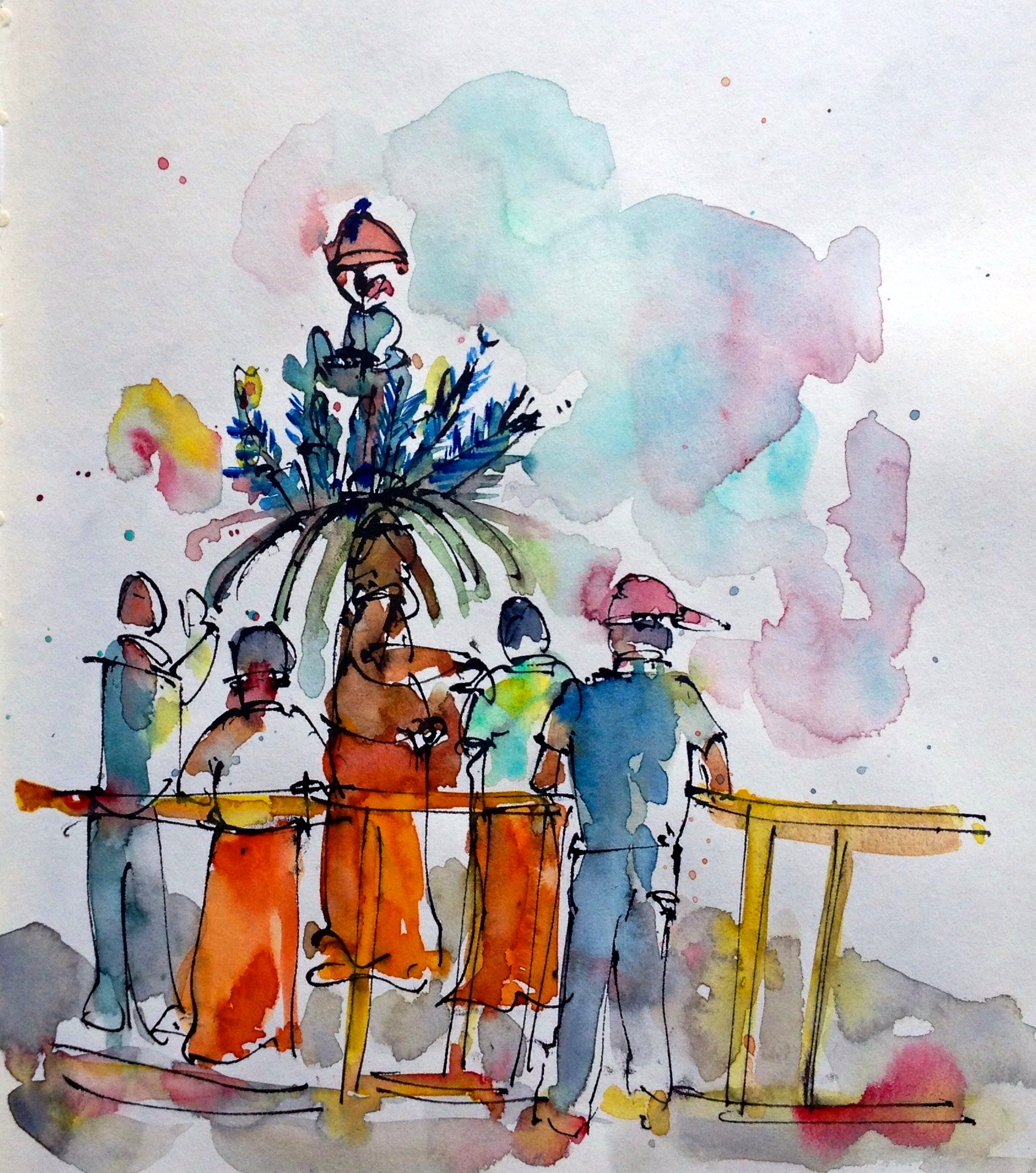
Thaipusam in progress

A kavadi bearer, swinging to the beat of drums

I was frantically sketching, trying to capture the guy with at least three dozen lemons hooked to his back, quickly outlining the exhausted drummers catching a breather and getting the many kavadi bearers balancing a gigantic mass of flowers, peacock feathers, folded metals and sharp skewers down on paper. The jubilant yet awestruck crowd guarding the fanfare made the scene complete. There was almost a kilometre long wait to enter the temple and at having their subjects come to a halt, the photographers went delirious.
 
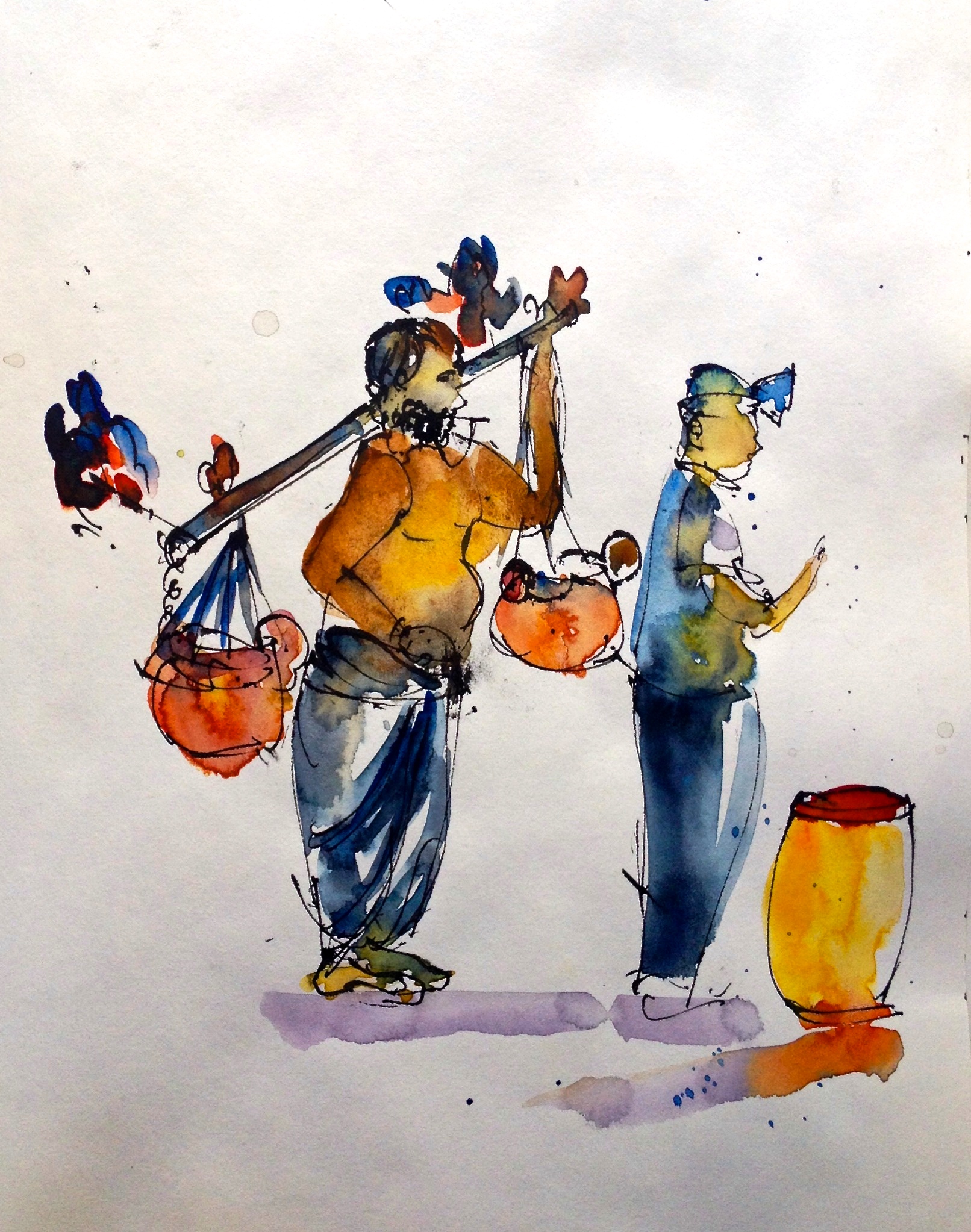
Kavadi bearing devotee swinging to the drum beats

A not-so-extreme kavadi of milk pots balanced on a wooden rod. He still has his tongue pierced.

Few steps away from the temple door, decorated with banana leaves, a pilgrim was approaching with his kavadi on two wheels. It looked like a wooden toy chariot. The steel skewers hooked to his back flexed under the load and stretched his skin, while he negotiated a bump on the uneven stretch. Standing on the sides, we clenched our fists and held our breath. The remaining few steps would end his arduous yet spiritual journey. He tilted his head, arched his back and pumped his chest. Then he pulled hard. The sidekicks cheered him as loudly as they could, their heave-hos bold and distinct, but the kavadi slumped back. Others glided past him with no trouble. Some people have a bumpy ride till the end. Or perhaps he’d asked for a much bigger favour.
 
The pilgrims entering Sri Thendayuthapani Temple to offer their kavadis to Lord Murugan

The pilgrims entering Sri Thendayuthapani Temple to offer their kavadis to Lord Murugan and end their arduous trek

 
Pilgrims exiting the temple, freshly relieved from their kavadis, seemed visibly transformed – smiling and spirited – with only red holes on their body – that they were now proudly flaunting as a proof of their penance.
 
Karna didn’t accompany me till the end. In fact, midway through our conversation, he abruptly shook hands, wished me luck and left me alone to experience the festival and make my own stories. When I reached home, the songs, the chanting, the drum beats and fervent clapping were still ringing in my ears. I think Karna would’ve approved.