Tag Archives: illustration

Nanyin Concert at Singapore’s Oldest Temple

Sketching has its perks, specially in this country because you get invited to all sorts of interesting events, that you otherwise wouldn’t have a clue about. Well, it might not be entirely true for everybody, considering  how well networked and resourceful some people are, but being an expatriate trying to get intimate with the country she is living in, invitations to events featuring local history, culture, heritage and people in some way or the other is serendipity dropping into your hands like a ripe plum.
And what better way to explore a country intimately than sketching your backyard and writing about it, specially if it’s a diverse 710 sq km city state, that you can cross via subway in less than two hours! The possibilities are endless, although I didn’t harbour this mindset two years back when like many others I was trapped in the hamster wheel of shopping malls, food courts,  boutique cafes and movie theatres. That’s all there is to do in Singapore, I thought.
But somehow, this simple attempt at documenting life through sketching has freed me off the nasty blinkers. Since then, I have befriended locals and heard their stories, observed their diurnal rhythms, their idiosyncrasies, mannerisms, their pidgin lingo, their obsession with food, their materialism and altruism, their traditions and customs – those celebrated widely with pomp across the island as well as those that falter at the brink of oblivion, their collective sense of pride and also their anxiousness,  their self expression, their drive to grow, develop, compete and succeed both globally and locally and also their struggle to conserve their identity and heritage in the wake of urbanisation and immigration.
Not just sketching, but sketching with a purpose has opened my eyes.
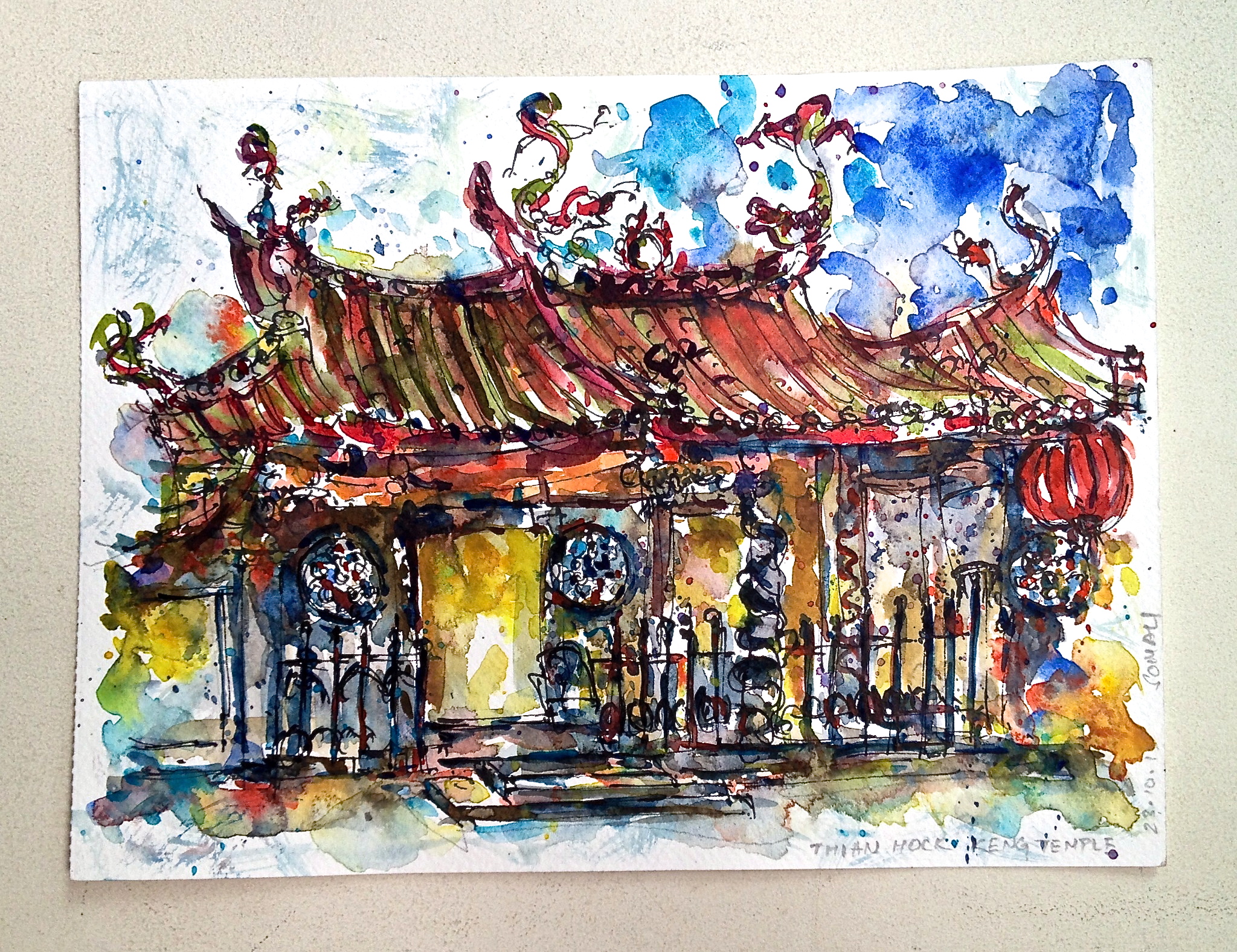
My impression of Thian Hock Keng Temple

Artist’s impression of Thian Hock Keng Temple

My sketch reportage of many such events I’d been invited to, though disparate – like recording the make-up session of a Teochew opera group, or trying my hand at wrapping rice dumplings at a Taoist temple, or drinking coffee at a shophouse kopitiam or visiting a heritage Peranakan house and so on – have brought me closer to understanding the country I live in. And what more, the equation is symbiotic – while the invitee gets an interesting premise to sketch and talk about,  the inviter gets to promote a cause or create awareness, which brings me to the courtyard of Thian Hock Keng Temple, on 158 Telok Ayer Street, where I along with other fellow sketchers have gathered upon one such invitation – to sketch and see a Nanyin concert performed on the temple premises only thrice a year by Siong Leng Musical Association.
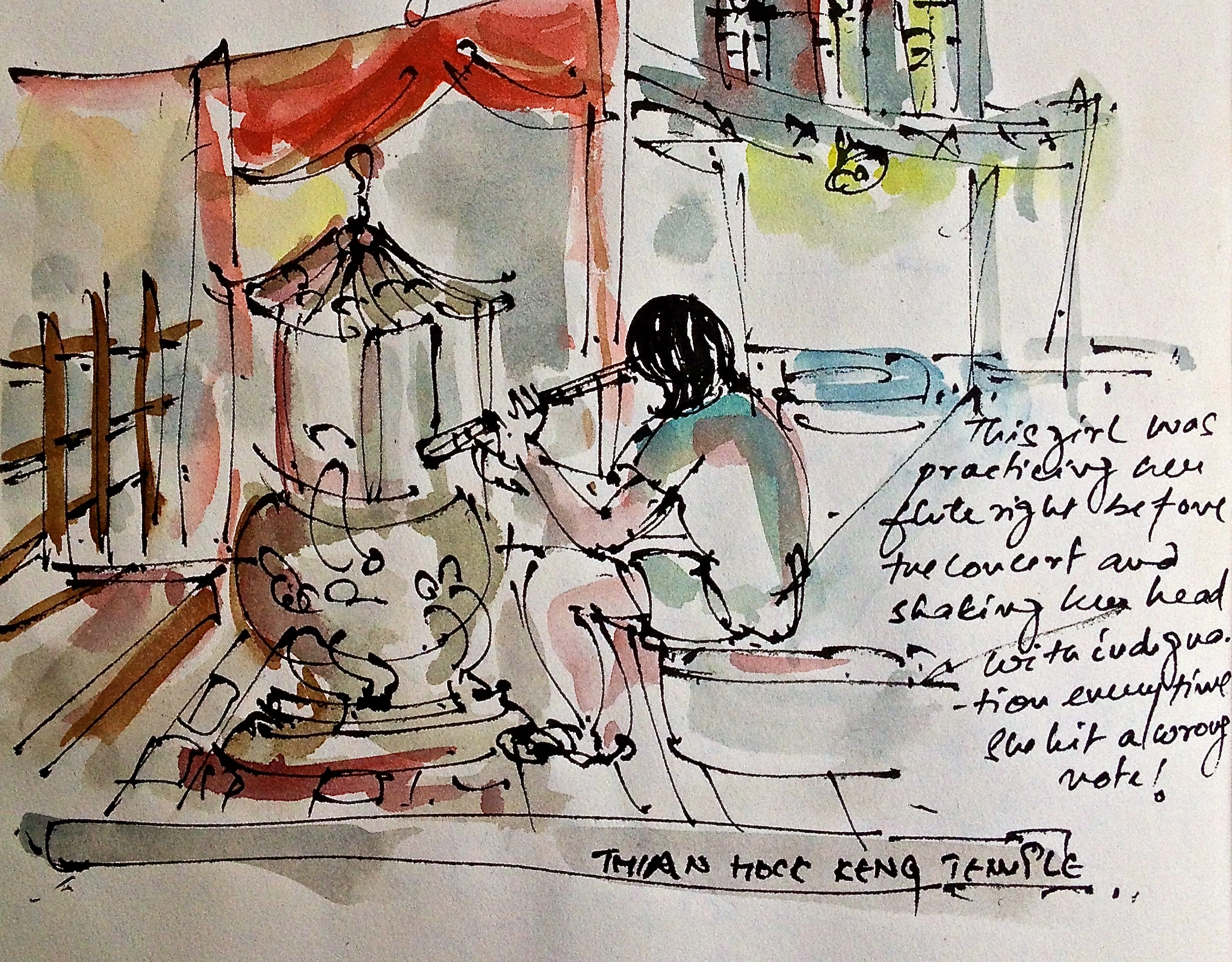
Sitting in a lone corner in the outer courtyard,  this girl was practicing her flute right before the concert began.

Sitting in a lone corner in the outer courtyard, this girl was practicing her flute right before the concert began.

It is not everyday that you experience centuries old and preserved art form, performed against an equally historic backdrop, so I took the bait the moment it appeared in my newsfeed.  The temple’s location couldn’t have been more incongruous, with sparkling high-rises, nifty eateries and watering holes in the vicinity. I wanted to slow down and process the interesting juxtaposition but instead was taking long strides towards the temple, to catch some of the receding light and start sketching before it hit 7. Because at 7 in the evening, the sun goes down in this country, every single day of the year with such mundane consistency that can only be managed if you’re just a degree away from of the equator.

By the time I post myself by a kerb opposite the magnificent facade of the temple, a gigantic truck plonks itself in front and blocks my view. Cars are zipping past and waves of people are making their way from work, without so much as glancing at the imposing green tiled roofs and the multicoloured motifs, the fiery dragons charging at the sky, the carved pillars and the massive red lanterns. It is amusing to even imagine that in 1820, when the temple used to be a humble joss house, early immigrants from Fukien Province in China,  who’d voyaged across the turbulent South China Sea, flocked in to offer their gratitude to Ma Zhu – the goddess of the sea, even before they went scouting for work and shelter. Before land reclamation of 1880, Telok (bay in Malay) Ayer( water in Malay) was the seafront!
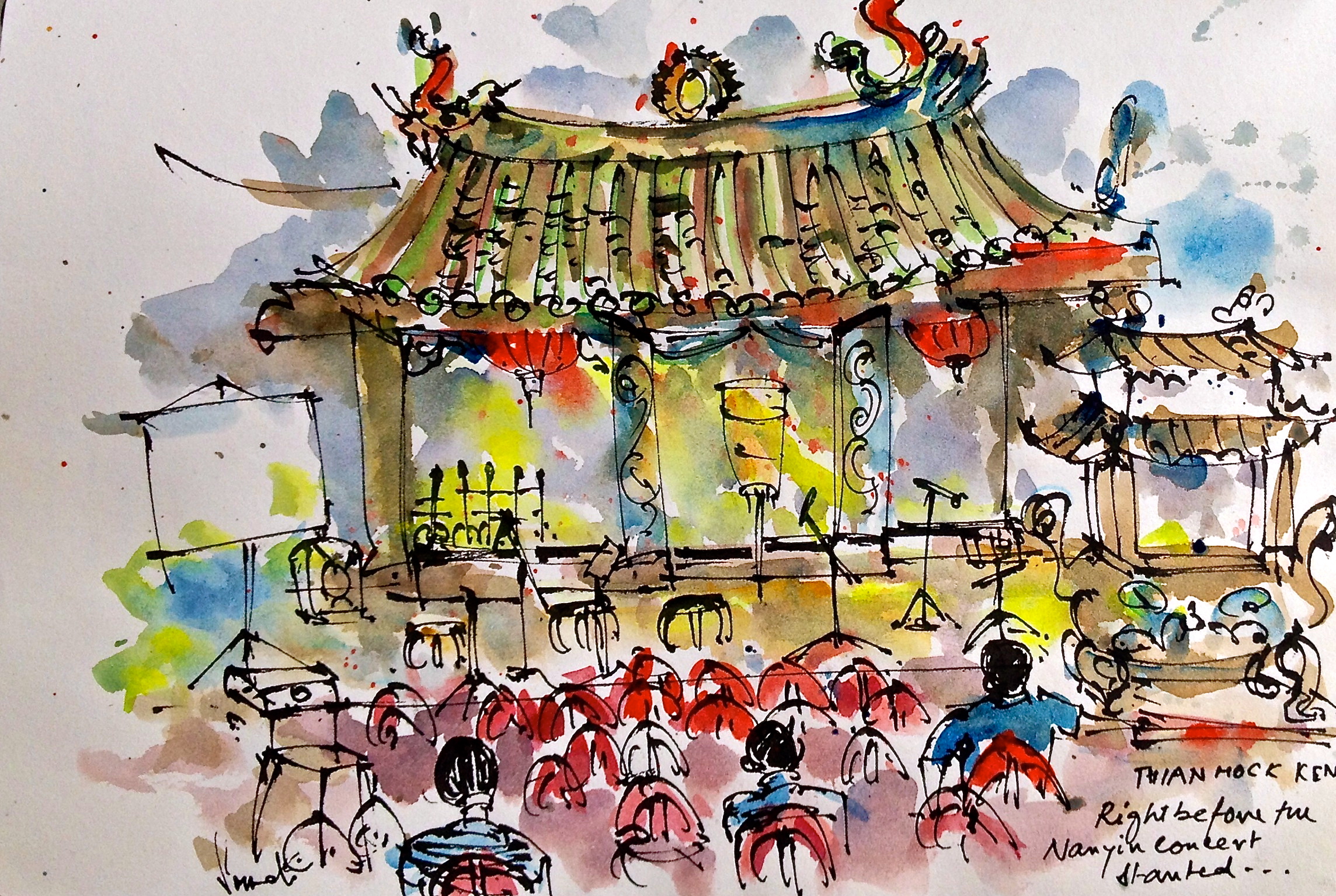
The stage being set up for the concert
From where I stand, I can see plastic chairs being arranged and the stage being set up for the concert. TV crews are interviewing the organisers and the glare from their portable LED light is gushing out through the massive wooden doors and blinding my vision. Dodging the parked truck and the dazzling light, I further shift my vantage point and begin sketching the facade. But darkness has fallen on the city. I struggle to capture the relief patterns on the roof ridges that have been rendered using chien nien technique, a Fujian architectural stylewhich involves breaking unusable pottery and porcelain to create beautiful three-dimensional work.
That’s when Paul, a fellow urban sketcher quipped, “Don’t go for the details, try to capture the essence”. He made it look simple with his casual yet bold strokes that told the story and held it back at the same time for the onlooker to be amused and bemused – a dab of yellow for the blinding light, few sinuous strokes for the temple’s roof, some dark shadows around the threshold and so on. But for some, simplifying isn’t all that simple. The left brain kicks up a storm when you try working at a scene holistically, leaving hints here and there like breadcrumbs leading to a revelation, rather than getting sucked into the details and showing all your cards. The left brain implores you to mark and annotate every stone, tile, wood and all the amazing carvings, intricate sculptures, imposing columns and the decorations with dragons and phoenixes. I try to heed Paul’s advice and try to sketch and paint from what I feel, rather than what I see or straining to see. It isn’t easy.
In the temple courtyard, a stage has been set with mikes, stools, projectors and floodlights, the participants are hustling up, some donning make-up, some straightening the creases of their flowing costumes and fixing their hair. A volunteer hurriedly places the concert schedule on every chair. The musical instruments – pie, pipa, samhen, xiao, lihen are lined at the corner, waiting to be picked up. Guests are streaming in, taking places incoherently. A young girl, away from the action is practicing her bamboo flute and shaking her head in indignation, every time she hits a wrong note.
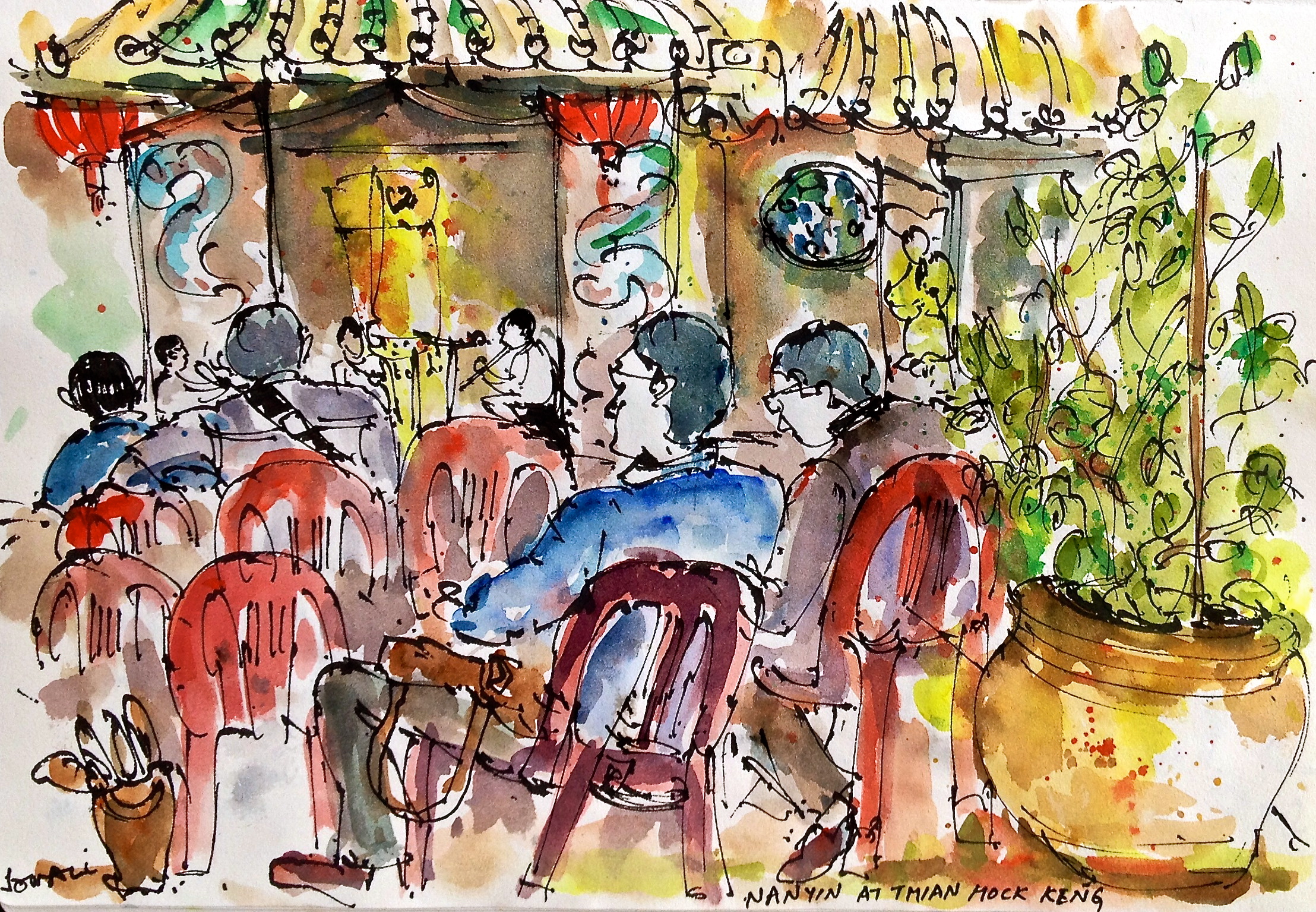
Nanyin in progress. The audience is enthralled.

Nanyin in progress. The audience is captivated.

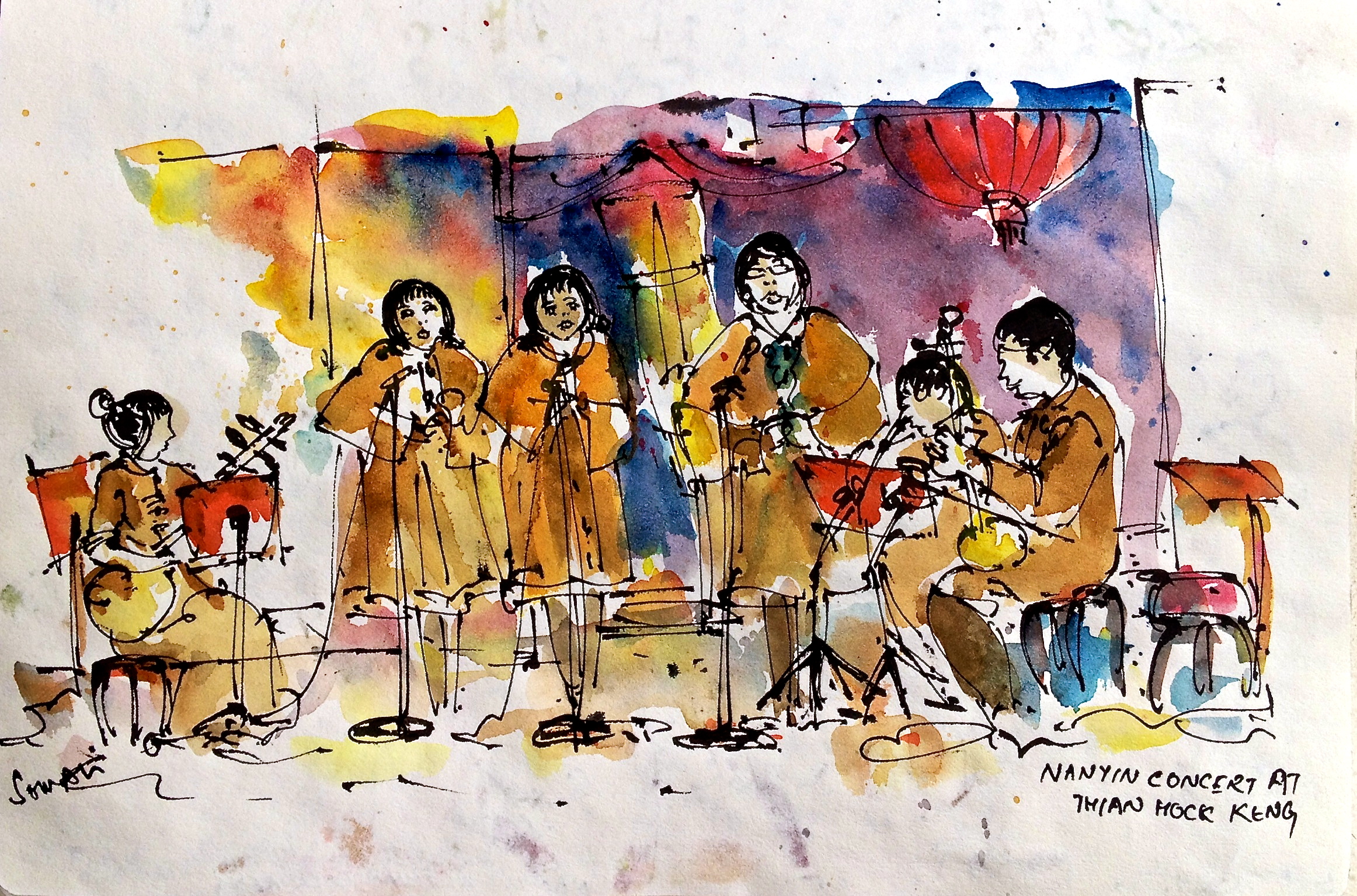
Nanyin, which literally means the ‘music of the south’ has originated from the southern Chinese province of Fujian and is one of the oldest music genres of China that still exists. The music is soft, gentle and graceful – something that would seep through the pores of your skin and serenade you and fill your senses to the hilt. As the music trickled into the temple’s ancient courtyard, the audience – a motley crew of young and old, locals and foreigners, residents and tourist – sat enthralled and motionless, which was perfect for sketching.
Understanding the lyrics would’ve heightened my experience, because most of the time it felt like standing at the edge of an alluring pool and not knowing how to swim. Perhaps, my inability kept me rooted to the task at hand without getting emotionally invested. On that night, I let the music guide my pen.
Nanyin performers at Thian Hock Keng

Nanyin performers at Thian Hock Keng

Visiting Singapore’s Baba House

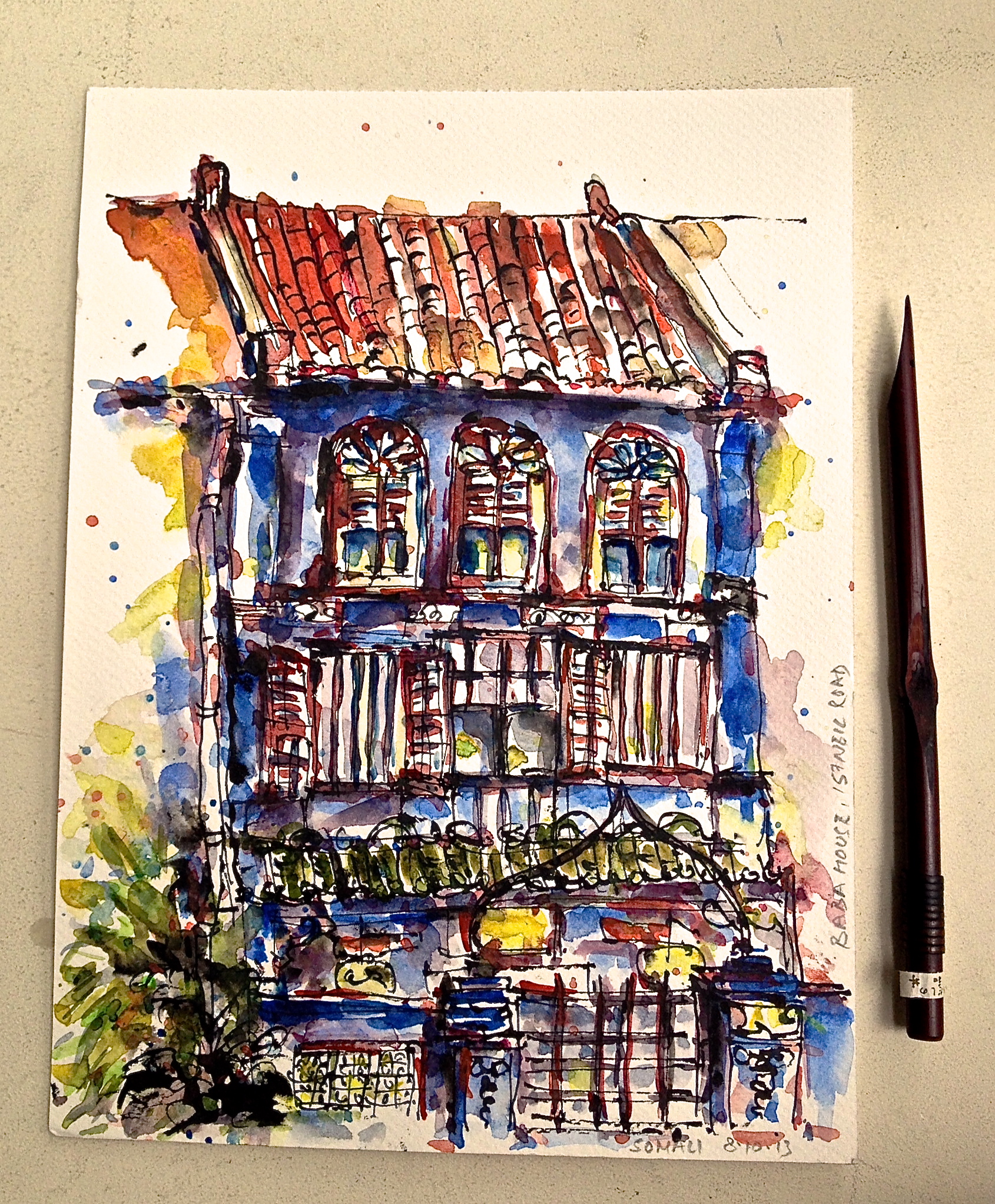
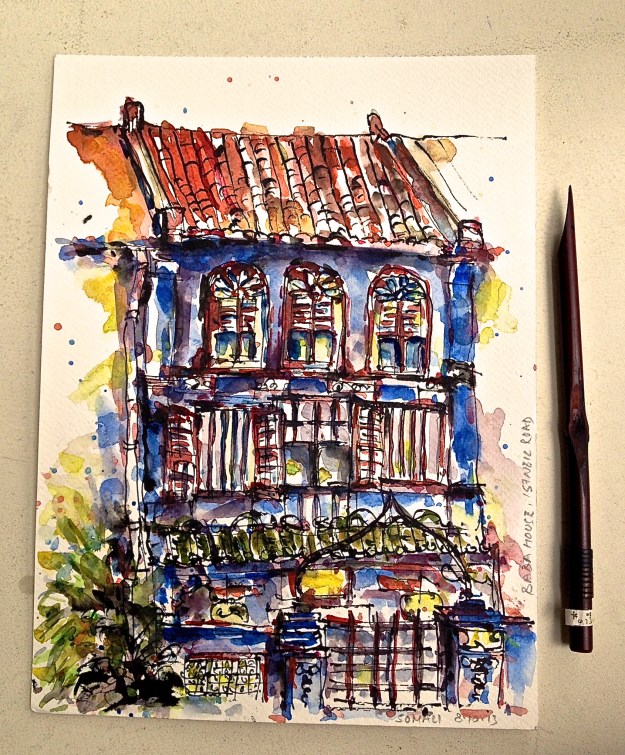
Facade of Baba House, drawn with a bamboo stick

Facade of Baba House, drawn with a bamboo stick

The Setting
The old British couple was posted right before a dark wooden cupboard. An American man, probably in his middle age was sitting on a decorative oriental chair, hunched over a notepad and pen, the Russian dame in a sleeveless maxidress was leaning against the heavy ornamental door, arms akimbo and a fidgety Spanish duo of mother and daughter with disheaveled hair and brutally sunburnt arms and face was just waiting for it to start and then finish, so they could go back to their hotel, put a tick on their list of things to visit in Singapore and order room service. Then there was the suave Australian couple – the man in a tailored suit and the blond woman in a red dress with long distracting legs emerging from it, poised on the short rotund chairs in the middle of the room. I was of course with my sketchbook and pen lingering at the back, trying to read them as much as they would let me.
It felt like walking into one of those penultimate scenes in the small screen adaptations of Agatha Christie stories, where the inimitable Poirot has called upon the suspects in the living room so he could unfurl the mystery. My ears are almost tuned in to hear the rising crescendo of David Suchet’s voice – “Mesdames et Messieurs, it’s time to reveal the truth about this terrible crime” – and finally pinning down the murderer – “After everybody left, it was you Mr. Doyle, who picked up the gun, ran along the deck and shot your wife in her sleep.”
A tap on the shoulder requesting me to deposit my bag before the tour, broke my post-lunch reverie. Egg-headed Poirot had been replaced by grey-haired Chia Hock Jin, our amicable tour guide and I along with the other ‘suspects’ were crowding inside the remarkably restored living room of ‘Baba House’, the ancestral home ( built around 1895) of a wealthy Peranakan shipping merchant Wee Bin.
The Peranakan Story
Having introduced himself, Hock Jin warmed us up with a short history of the Peranakans, which started with the settling of Chinese merchants in the Straits of Malacca during the 15th century, who began integrating certain traits of local Malayan culture into their own Chinese heritage, thus giving birth to a distinctive hybrid culture with an identity of its own. By the 19th century, the Peranakans were mostly working as intermediaries between the mainland Chinese traders and the Dutch, Portuguese and British colonial traders, thus amassing immense wealth, which they spent lavishly in building such elaborately decorated houses.  “They were sending their children to English medium schools rather than Chinese schools, or abroad for tertiary education or professional qualifications, so when they were back they could join the British administration.” said Hock Jin with arms deep inside his trouser pockets.
The Facade 
Leading us out of the drawing room through the main door, Hock Jin insisted, we take a closer look at the cobalt blue facade of the house with red gable and pitch roof, and not just admire its many architectural components for their beauty but understand their significance and symbolism as well. “Houses in those days were not numbered, so to understand who lived where, all you had to do was look at the facade”, he says, pointing at the two lanterns which have the origin of the family and surname of the resident written on them in winding strokes. The Chinese signboard with golden characters above the main door spell out the name of the house – ‘Everlasting Prosperity’. Motifs of peonies and phoenix on the facade, signify prosperity, peace, good wealth and luck. Hock Jin has been cupping a canary yellow ceramic bowl, which he suddenly holds out in public view. “Notice those friezes below the louvered windows? Those were made from tiny ceramic chips of different colours.”
The facade seems deceptively narrow for its wealthy owners but Hock Jin reassures that the house is much longer inside than what its entrance suggests. “During the Dutch rule, property owners were taxed as per the width of the frontage”.
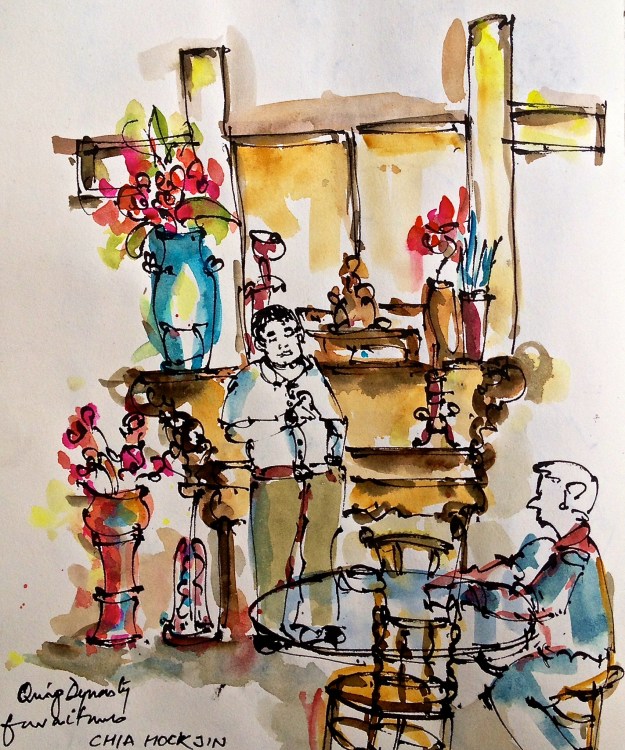
Hock Jin standing in front of the Living Room alter

Hock Jin standing in front of the Living Room alter

Living Room
“The living room is where the patriarch entertains his guests” begins our guide as we make our way inside again. Ornately carved Qing dynasty blackwood furnitures with mother of pearl inlay frames border the room on all sides giving it a rich luxurious feel; dainty ceramic vases, porcelain figurines and crockery adorn the corners atop side tables and cupboards; decorative venetian mirrors hang from the walls, an Austrian round table and chairs set, popular in the 19th century, sits at the centre while one of the four family altars that every Peranakan house must have, is placed at the head of the room facing the main corridor. Despite the heat and humidity outside, the dark interiors help in keeping the temperatures down.
“Feng Shui played an important role in the design of the house in those days. Do you know why there are two side entrances from this drawing room into the house?” Most nod their heads in negative.”So any bad energy that barges into the house through the front door, dissipates before flowing inside.” More fascinating details stumble out of our guide that we greedily lap up – demons tend to shuffle their feet and the high threshold serves as a hurdle for them to trip and fall if they enter the house, or the mirrors are hung so when the demon looks at his reflection, he realises how ugly he is and leaves pronto!
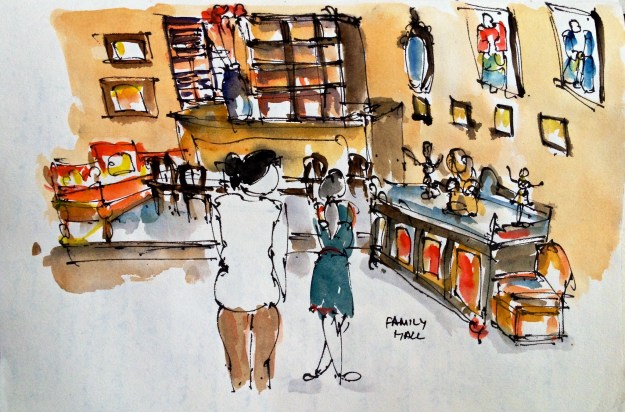
Family Room of Baba House

Family Room of Baba House

Family Room
 
“The women and the children were not allowed in the living room in those days. But that didn’t mean they couldn’t see what was happening here”, says Hock Jin with a obscure smile as he points at the small openings in the carved wooden partition screen dividing the first and the second hall, through which unmarried Nonyas could peep through. The Family Hall was the matriarch’s domain, where the second altar was kept along along with a cupboard that stored ancestral tablets with recordings of the family’s eldest son’s birth details, through several generations. Elaborately painted portraits of the Wee family adorns the walls. The architecture is predominantly tropical with a refreshing airwell on the side that also helps keep the house cool. “This is where the family well was supposed to be but since this house is on a slope, the well is at the back.” explains our guide.
After the extravagant and slightly dark living room, the unexpected indoor-outdoor feel of the family room is refreshing. “Design of Peranakan houses always account for the five elements of Feng Shui – wood, fire, earth, metal and water” says Hock Jin, as we scrutinize the interesting amalgamation of Eastern and Western architectural elements. The colourful tiles lining the wall of the air well were distinctly British, there’s a buddhist swastik in the room and an attractive white panel on the wall with Chinese zodiac signs etched on it.   
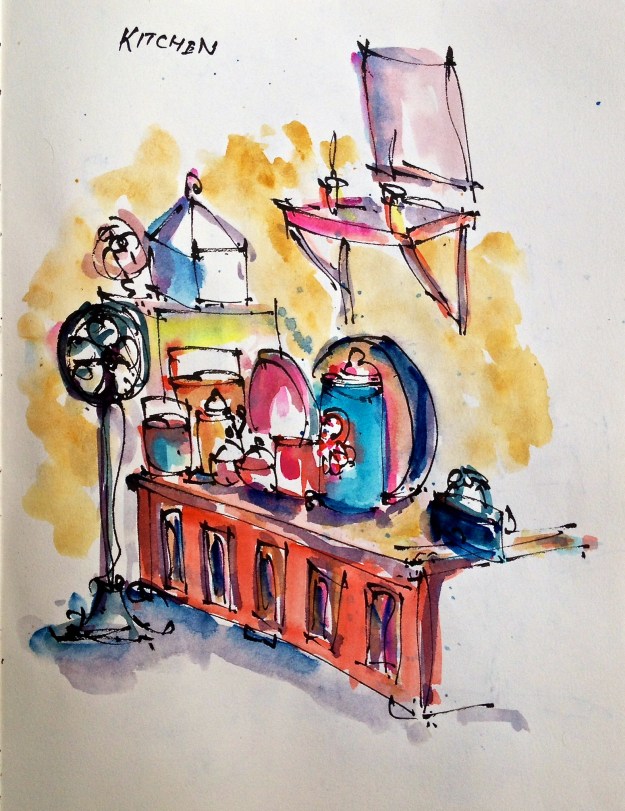
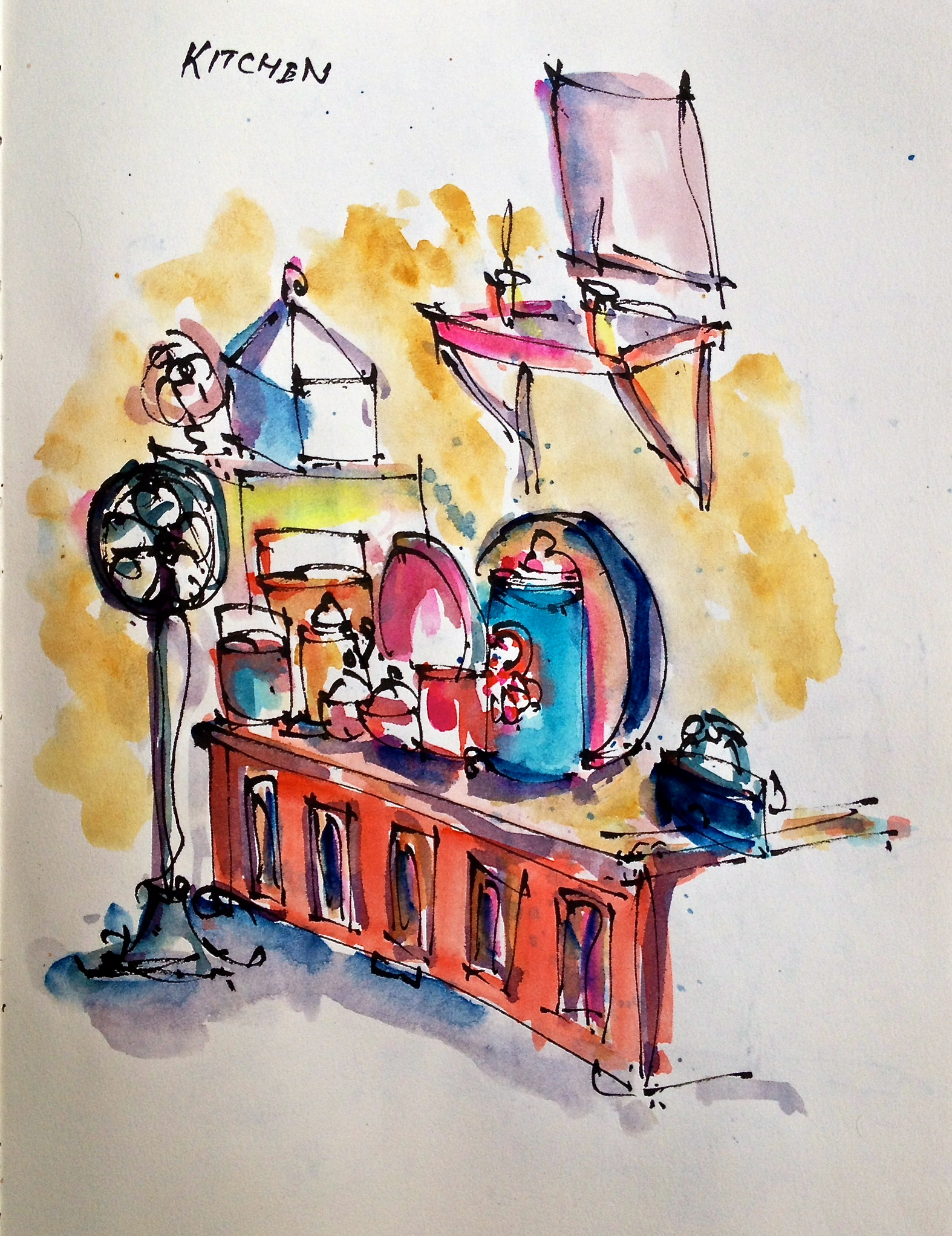
Kitchen

Kitchen

Kitchen
Hock Jin leads the group from the family room to a surprisingly sparse kitchen with brightly coloured Nonya cooking paraphernalia neatly displayed – lacquered stackable meal containers, scarlet coloured dishes, cups, jars, vases, dessert moulds, a traditional grinding stone along with an oven from yesteryears with metal woks stacked atop, a mortar and pestle, and a blue ceramic kettle. The alter of the kitchen god is affixed to the wall, as if to oversee and bless the laborious cooking of mouthwatering Nonya dishes.
Second Floor Bedrooms
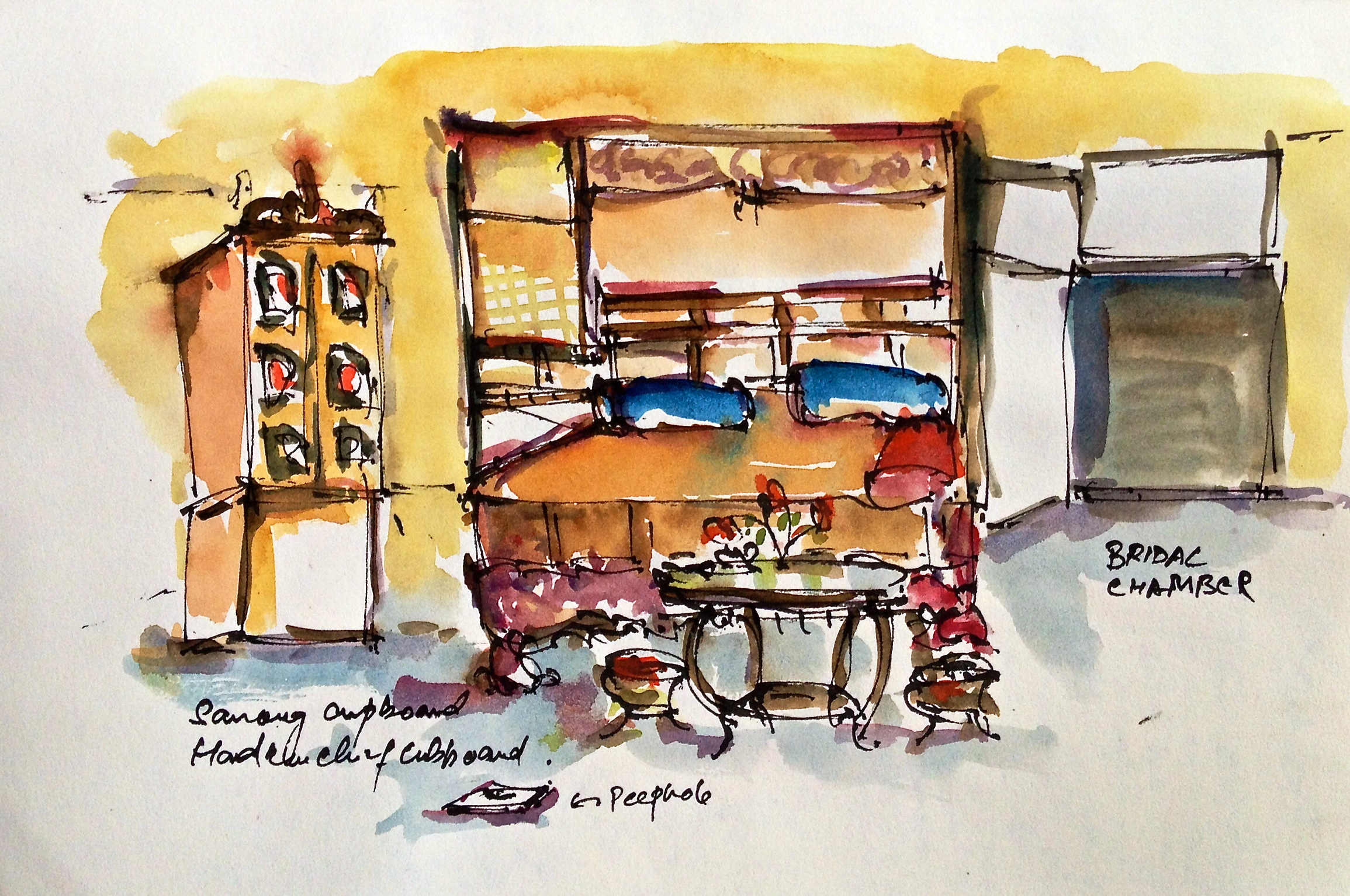
A flight of wooden stairs lead us to the highly polished second floor with more Chinese dark wood furnitures and two bedrooms, one of which is a bridal chamber, dedicated to the 12 day ritual of Peranakan weddings.  Just like the living room, the bridal chamber is flamboyant with an exquisitely carved, lacquered and gilded canopied bed from 19th century with motifs featuring fertility symbols. Across the room are several ornate armoires for storing the bride’s sarongs, kebayas, handkerchiefs and so on.  The most intriguing feature that hooked the tour group was the peephole on the floor, that gave an unobstructed view of the living room and the main door. “So a Peranakan wife could see all who came to call on her husband.” says Hock Jin to his audience, now sitting on their haunches, trying to shove their face into a tiny gap on the floor.
 

Bridal Chamber

Bridal Chamber

End of Story? Not quite!
The tour ends on the third floor which houses a contemporary exhibition on Batik. “Please feel free to look around” says, Hock Jin and offers a perfunctory “thank you” for taking his tour, which sends the Spanish mother and daughter scooting down the stairs towards the exit. Others follow, making thumping sounds on the wooden steps as they climb down. But some of us linger around Hock Jin because his eager eyes haven’t dulled yet. He might have more to say if we poke the fire. He begins talking about the Great Depression of 1930s, when prices of tin and rubber on which the Peranakans heavily relied, fell rock bottom. The two world wars dealt heavy blows to Peranakan wealth, status and influence (as loyal British subjects, they contributed to the wars by making considerable donations), when many fell into poverty and had to sell off their landed houses and family heirlooms. “Then came the Rent control Act of 1947” says Hock Jin, pausing briefly. This mandated the rent of pre war houses like this, to be controlled in Singapore, and in effect frozen, resulting in further deterioration of income.
In 1966, Lee Kuan Yew’s government enacted the land acquisition act, to promote urban renewal, which empowered the government to acquire land for compensation, to be paid on a predetermined formula. Pre-war houses made way for high rises. “Many Peranakans converted to Christianity in the 1940s and 50s, women started working after the war and gradually with urbanisation, intermarriages and modernisation, the Peranakan culture stagnated and their identity suffered”, says Hock Jin, with eyes cast on the parquet floor.
Howver, the recent years have marked a conscious revival in all things Peranakan, with the conservation of heritage Straits Chinese buildings, with exhibitions showcasing the Peranakan way of life, with growing interest in the language, food, attire; and with restaurants serving Peranakan cuisine and antique shops selling artefacts such as silverware, beads slippers, porcelain, furnitures etc cropping up across Singapore. “Restoring Baba House and opening it to the public was one such revival effort” says Hock Jin.
Sketching Moscow – Part III

Making travel itineraries for the last five years have led me to a displeasing yet profound axiom. It states that the number of sites and activities that you want to visit or experience in a place will inevitably exceed the number of days that you stipulate for them. Be it 3 days or 3 months, you can never fit in everything you want to see and do. After hours of handwork, persistence and deliberation, you may pat your back on birthing a befitting itinerary, customized to your very needs, but there in it’s shadow will always lurk a nasty ‘waiting list’, of sites that were your second and third choices – those that couldn’t make it to the list but are dangerously sneaky. While you pet and fawn over your prized itinerary, they’ll plot and scheme to wriggle their way in. Most of the times you surrender. Is it worth it? Sometimes it is.

Like in the case of the historic Novodevichy Convent , that wasn’t in our itinerary simply because we didn’t have enough time to fit it in plus it was a bit far off from the cluster of sites we were hanging about. But we squeezed it in, on an early morning even before the ticket counter opened, when the men were still cleaning with huge water hoses, mopping and dusting the place, the gardener was still trimming the bushes and nuns were hurriedly moving in and out of the many churches in the expansive compound, prepping for morning prayer, when people were still walking their dogs along the river outside its red and white fortified walls, and when the air was cool and there was dew on the grass and every tree, when you could still hear the song of the birds piercing the meditative silence, that only such an hour of the day can claim.

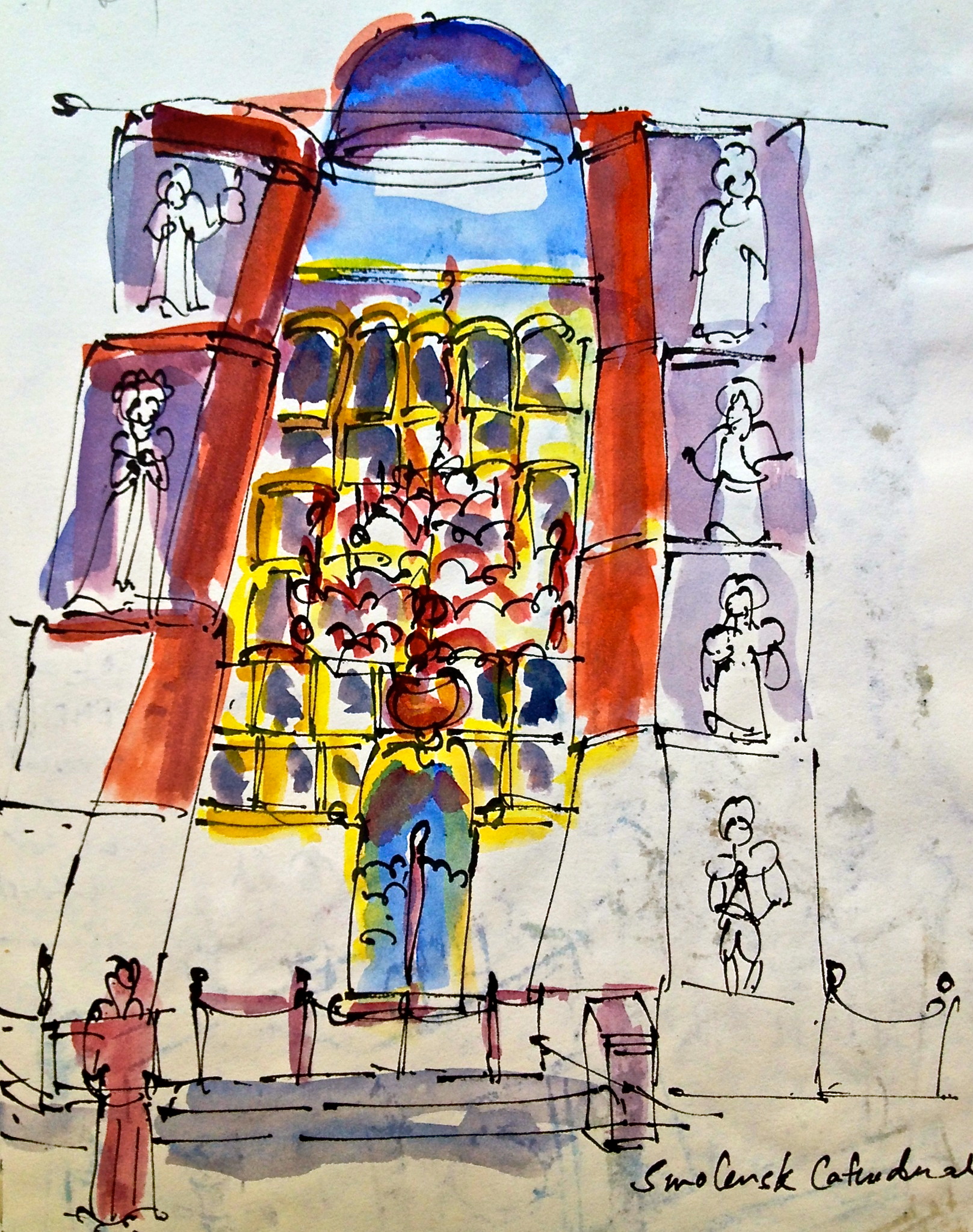
Hands down this is the perfect time to visit because, you have the place to yourself. In an hour or two, the tour buses and tour groups will appear with their guides speaking all at a time and over each other. The transient magic will be lost. While you are allowed to roam inside the fortified compound amid greenery and beautiful golden domed churches free of cost, a ticket worth 250 roubles will gain you entry inside some of these churches, like the breathtaking Smolensky Cathedral (dating back to 1524) and the Assumption Church.

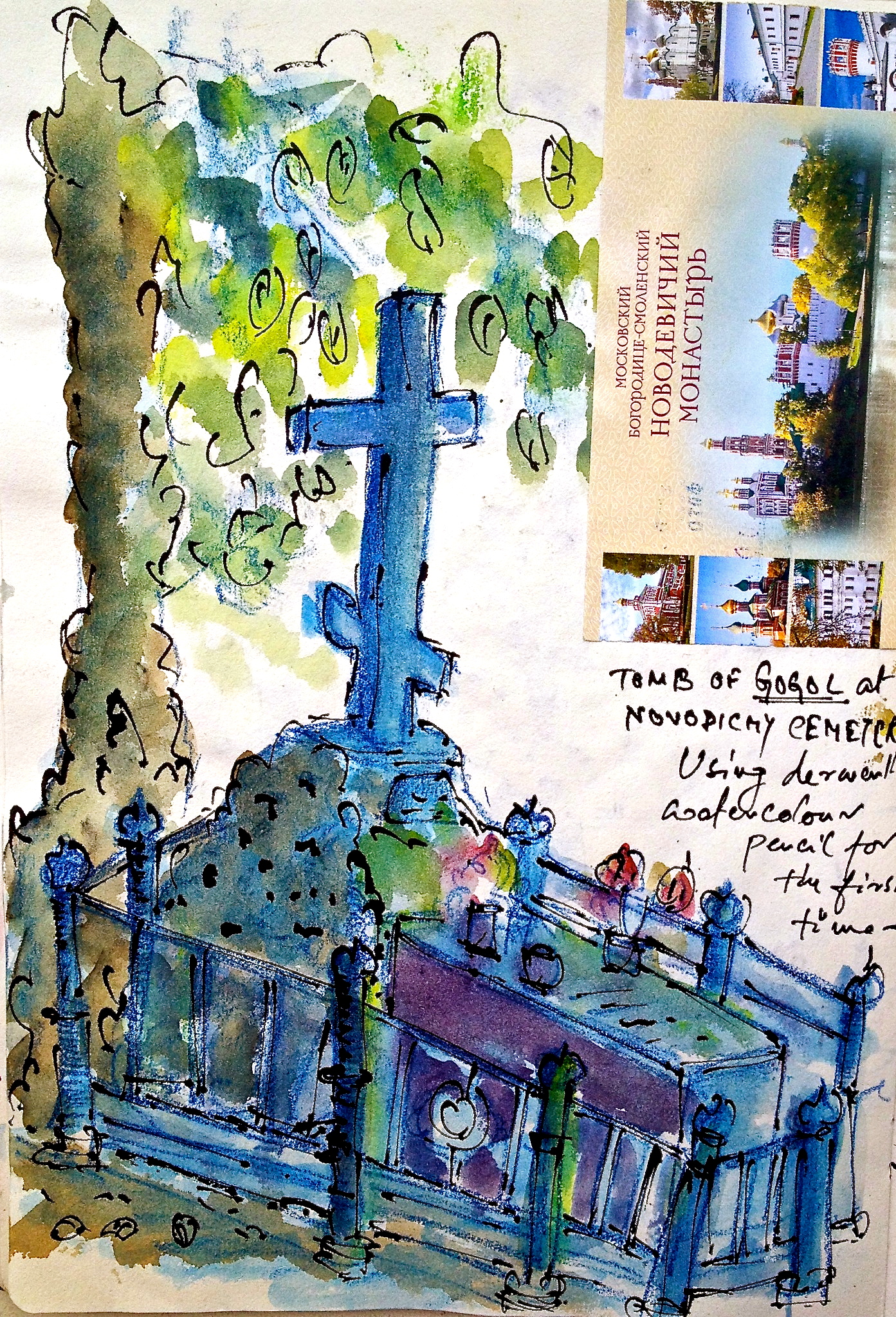
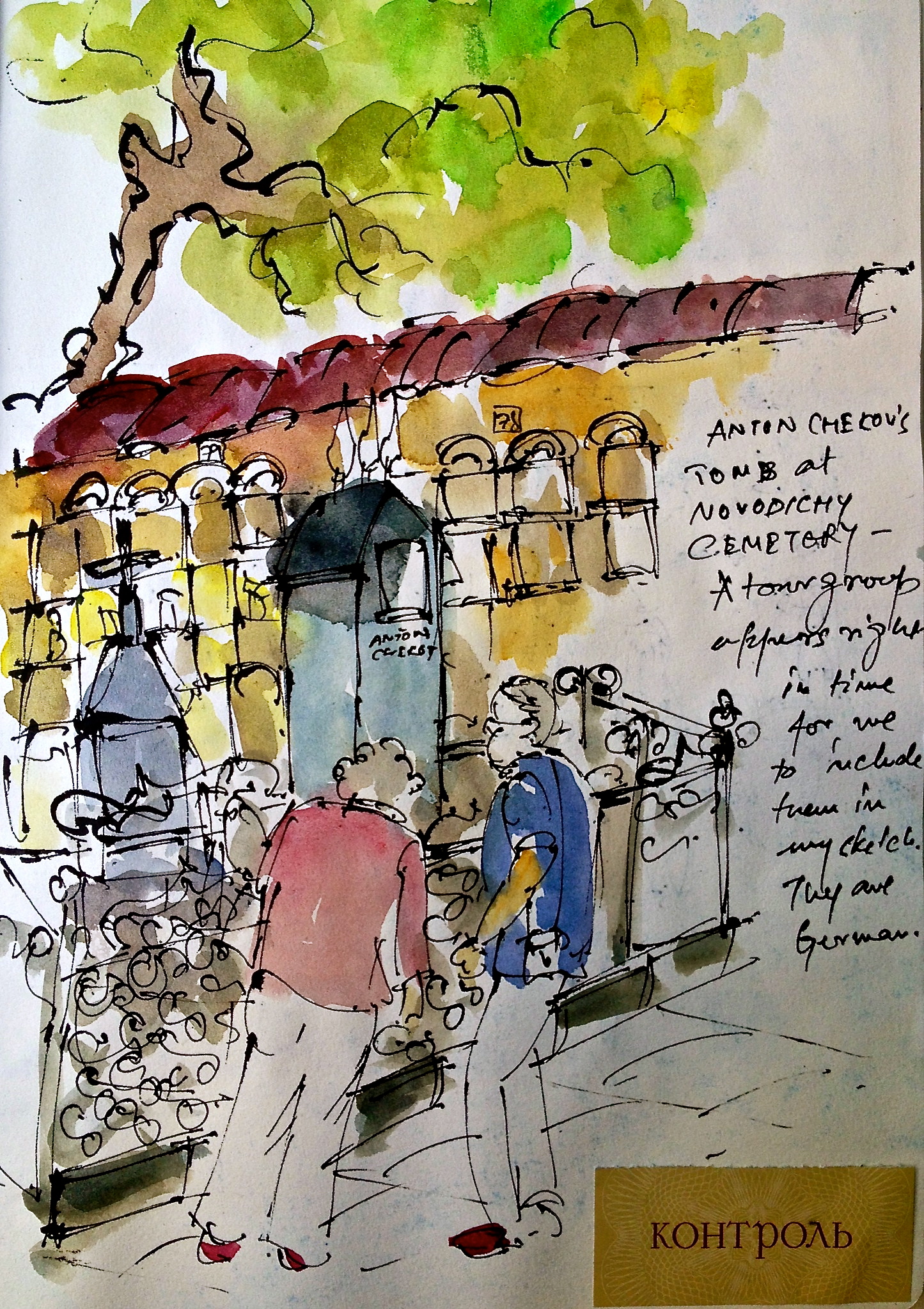
Behind the Cathedral, within ten minutes walking distance is the Novodevichy Cemetery, theTomb of Gogol resting place for Russia’s many stalwarts from different walks of life – poets, playwrights, political leaders, academicians and many more. Admission is free and the absolute lack of English signs turn the grave hunting for Russia’s who’s who into a guessing game bordering on frustration, if you are running on a schedule. After combing through rows upon rows of fascinating stone sculptures decorating the graves – a life size dog resting at his master’s feet, a sensuous ballerina holding a precarious pose, a swan taking flight  – we hunt down the glass covered grave of Tchaikovsky. It’s unpretentious, unseemly modest in comparison to its neighbours. Seeking help from the resident gardener on the grounds, we further hunt down the resting place of Chekov, Bulgakov and Gogol – all impressive in their austere simplicity. Tour guides make hurried stops and even before their patrons can absorb the solemnity of their surroundings, they leave. I take my time and sketch in peace.

What is fascinating and peaceful to one may seem depressing to others. “Excuse me, how do IAnton Chekov's Tomb exit from here?” ask two women. The frown lines on their face give away their distaste for the necropolis. “We don’t like graveyards. Which way is the convent?” We show them the way out, but linger around. The sun has climbed, but the cool serenity of the manicured garden, keeps us comfortable. A forlorn woman dressed in a flowing gown is poised on a gravestone, her head slightly tilted, eyes downcast and with a delicate hand she’s touching her heart.

The sun shines a side of her face, but casts a melancholy shadow on the other. The flowers at her feet have dried and there’s gut-wrenching sadness in her eyes. If she weren’t in stone, I would beseech her with questions. The Cyrillic alphabets at her feet mean nothing to us. I wonder who she was, what was her sorrow and how she passed. Did she leave somebody behind? But, sometimes, knowing less, is feeling a great deal more. Such is the beauty and majesty of the stone sculptures here, that they bring the deceased as close to life as possible to strangers who can’t even read their names. The language of hammers, chisels, rasps and rifflers on these stones transcend the need for anything more comprehensible and for now this seems enough.

Pavillion at Patriarshy PrudyLunching at the exquisite “Pavillion” on wooden chaise set up on a summer patio, overlooking a tree-fringed lake at Patriarshy Prudy (Patriarch’s Ponds) was a fantastic idea. The food is good and a bit expensive, but you’ll lose your heart to the still unchanged 19th century locale – where Michael Bugalov’s The Master and Margarita is also set. The author himself lived nearby and so did many prominent Russian poets, singers, painters, scientists and authors. No wonder the area has been stamped as the cultural heritage of Russia and is protected by the government. While noshing on bread and chicken Kiev, you’d almost feel like floating on water. And if you hint the ducks and the two majestic white swans that you might have something for them to nibble at, they’ll happily glide right to you seat, clacking all the way. Walk around the pond lazily or spend hours sitting on one of the benches beside the ornate lamps, under the cool shade of trees. Feel the breeze on your face, unwind and think nothing.

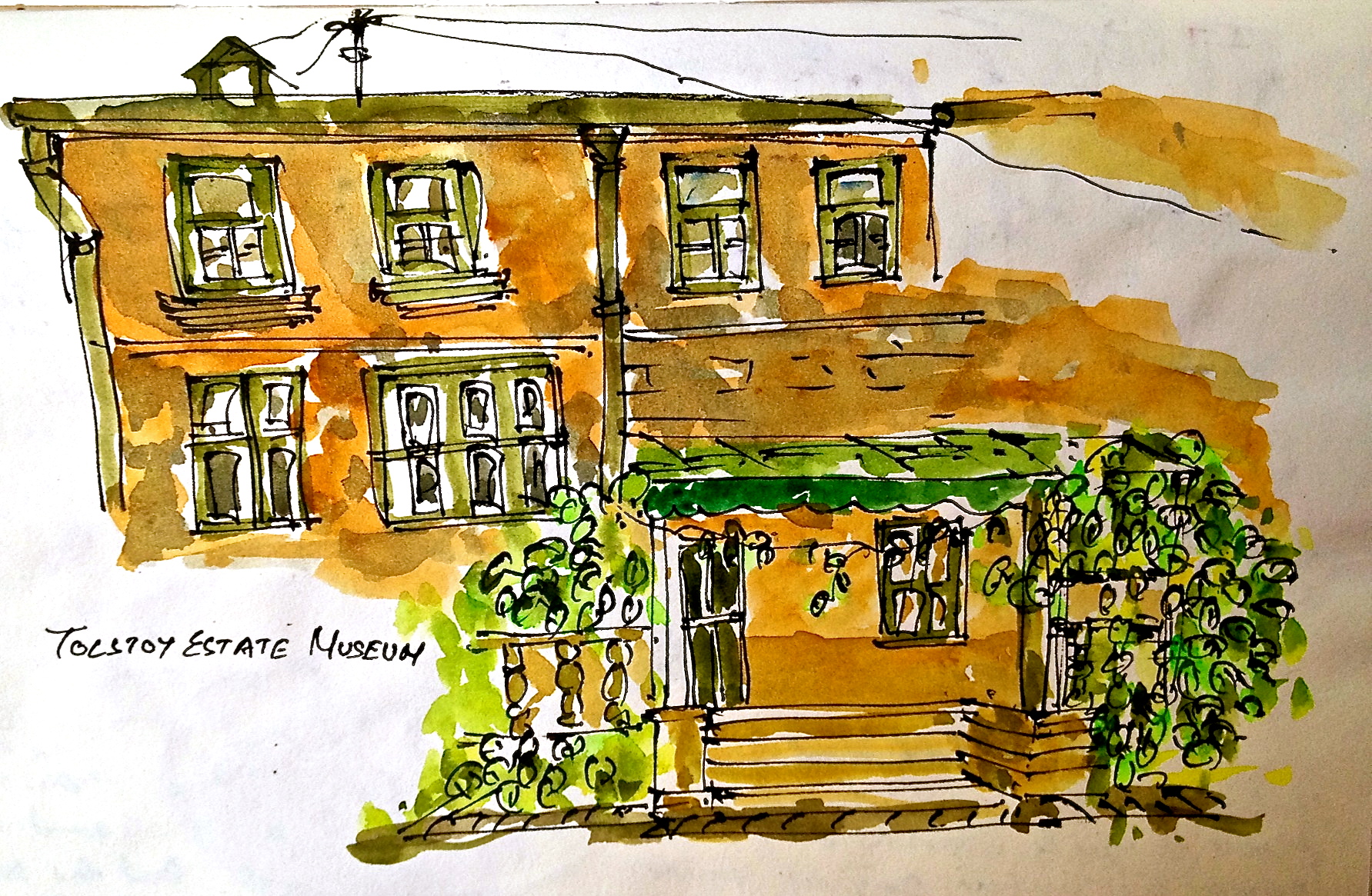
Tolstoy Museum EstateI arrive at the Tolstoy Estate Museum with barely an hour to spare before it’s closed for the day. A handsome yellow ochre house of mediocre size with green windows and a small patio ensconced by ivy, sits amid a small garden with large shady trees. A bottle green picket fence goes round the estate. My mobile phone and hand bag is stowed away before I start touring Tolstoy family’s winter home since 1882.

How does it feel to step inside someone’s private domain? Well, I paid 200 roubles for the privilege and am wearing protective cover over my shoes, but the feeling is that of uneasiness and repressed excitement as if I am about to trespass into private property. But that is a good thing in this context because the 6000 original exhibits of the family has been curated so well that together they lend the house a character that was once its own and get it to tell its story. Short descriptions in English tell you about the display, what the room was used for and stories of their domestic life. The visual imagery is strong and your imagination runs wild. This is how museums should be – not just educational and academic but engaging and inspirational too.

The dishes laid on the dining table where the author had meals with his family, the recreation room where his children played games, the wooden bed where the author and his wife Sofie slept, her desk where she transcribed the author’s manuscripts, the children’s toys splayed on the floor of the nursery, the portraits painted by his eldest daughter adorning the wall, their gowns hanging in their closet with matching shoes, a huge piano standing upon a bear skin in the drawing room and Tolstoy’s study table with his writing paraphernalia and his chair that he trimmed to be closer to the desk (being short-sighted), his clothes, boots, dumbbells, bicycle and such inanimate yet intimate details will get you many folds closer to the author as a man. Later, I sit on one of the benches in the garden and sketch the house. One by one all the visitors leave and I am left with a fidgeting guard with a padlock in his hand, lingering near the gate and staring in my direction. I collect my things and put him out of his misery.

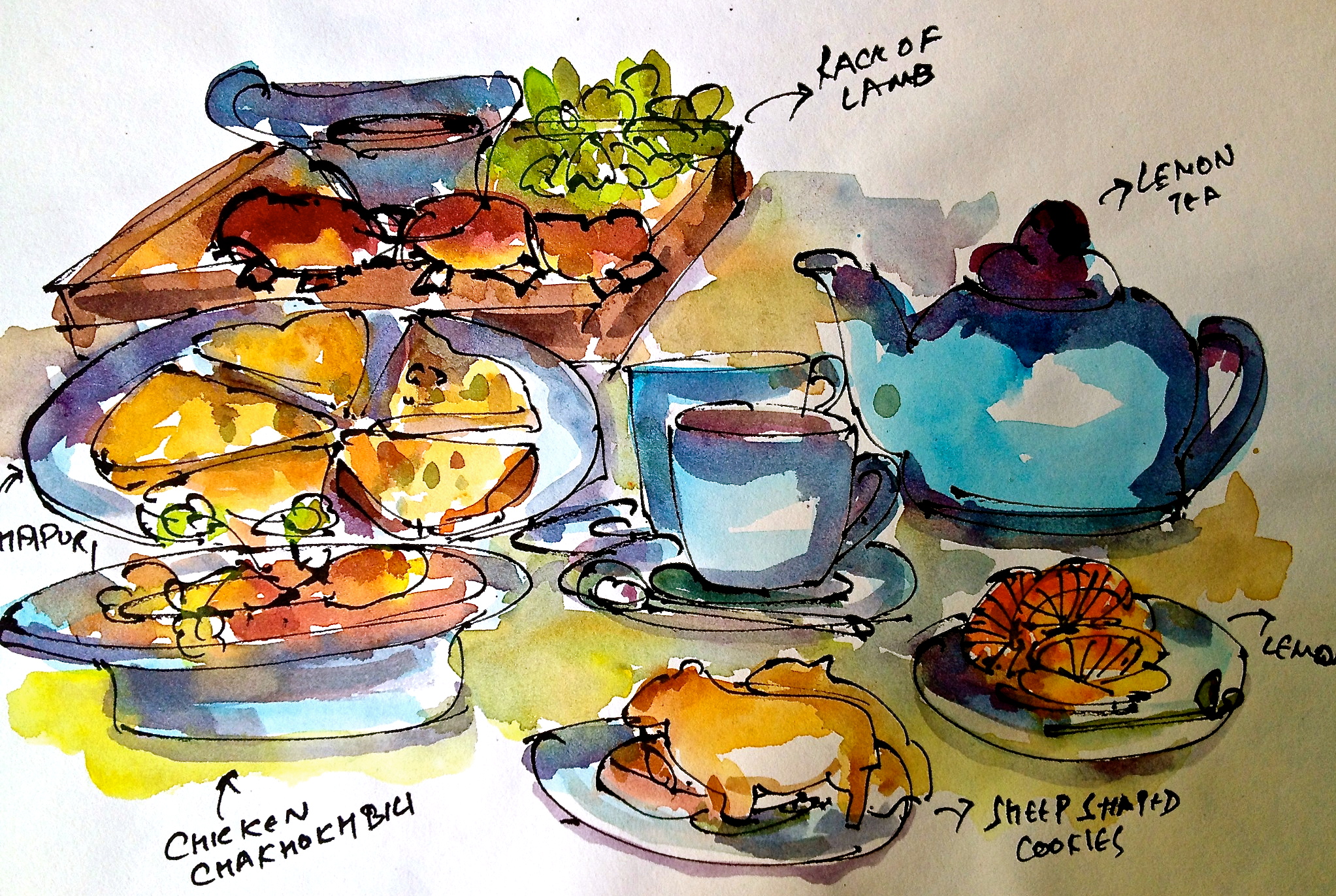
For dinner, we pick Georgian and “Khachapuri” at Bolshoy Gnezdnikovsky per 10,  is perhapsGeorgian Dinner at Khachapuri the most cheerful place to deliver that in a warm, unassuming, homely atmosphere. The strong aroma of fresh coriander wafts out from the spicy yet heartwarming Chicken Chakhokhbili (although later I learn that it has parsley, tarragon, basil and dill as well) – unexpectedly reminiscent of my mother’s Indian curry – and the rack of lamb seems quite contemporary but what surprises us is the addictive Khachapuri – freshly baked cheesy bread or “pizza of the 21st century” as per the cafe’s website! We order lemon tea, munch on the sheep-shaped cookies and head back to the hotel around midnight under a semi-dark summer sky.


Singapore – Moscow – St.Petersburg – Moscow – Singapore

Itchy feet strike again.

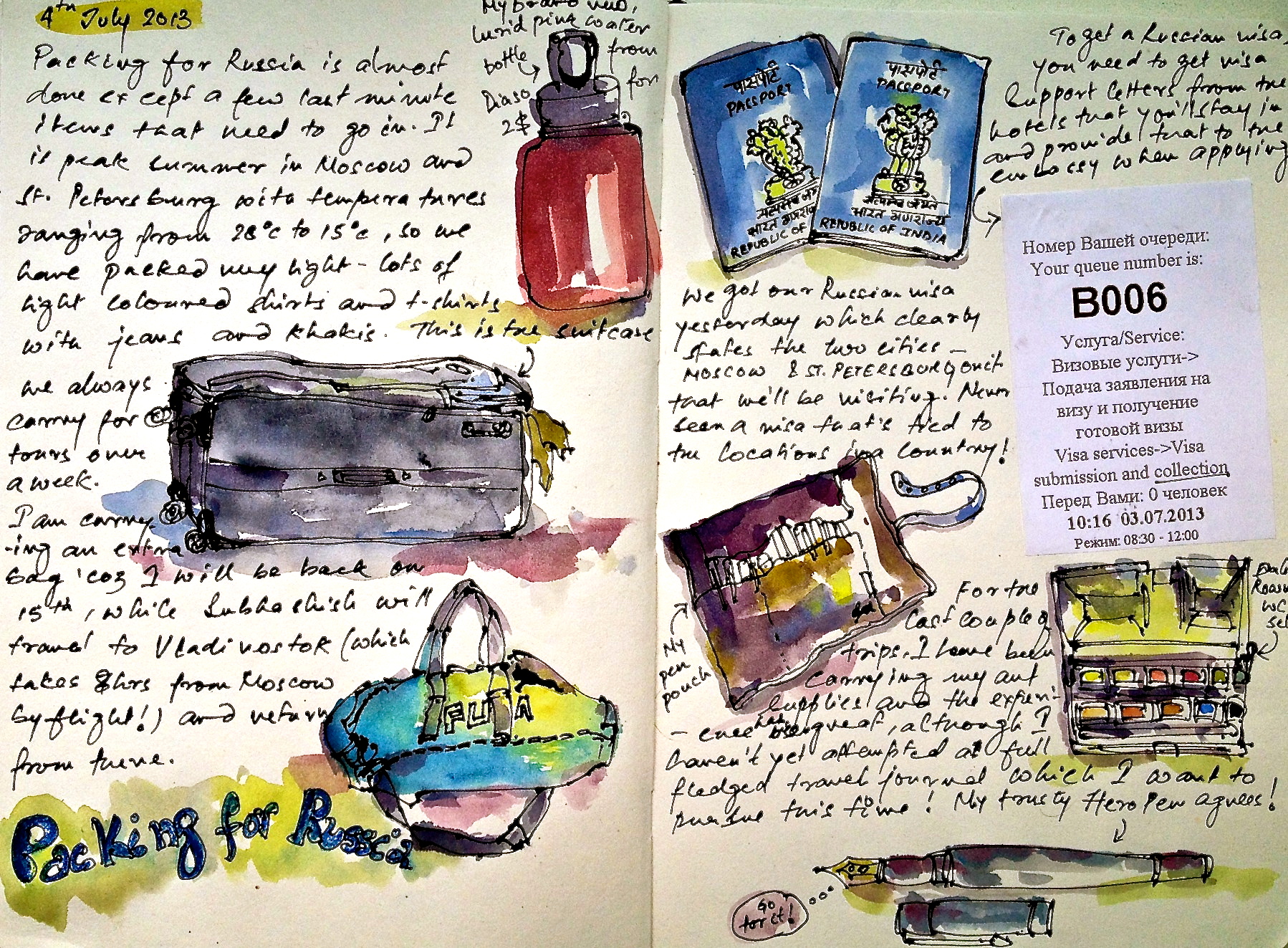
I am accompanying my husband on his official trip to Russia for 9 days and that up there will be my itinerary. The plan is, on the days he doesn’t work, we’ll explore the sights together and the days he works – which is most of the time – I will be on my own on the streets of Russia with a sketchbook and a map. Mixed feelings! On my own I’d amble along the streets without an itinerary, direction or purpose, just soaking up history and culture as it comes. But trying to record the sights and experiences in sketches, requires planning and a certain amount of alertness. The former is convenient, the latter is revelatory.

Packing for Russia

Packing for Russia

However, this isn’t the first time I plan to sketch while travelling. I’ve done it before in Cambodia, Japan and Malaysia, though with trepidation and on a very small scale. I was disorganised, clueless and conscious of people watching me and judging my craft. It was more like testing the waters before taking the plunge. If ‘testing the waters’ mean everything from timing my sketches, revising the itinerary to include that time to analysing the patience threshold of my travel companion while I take sketch breaks every 2mins; by ‘the plunge’ I mean an exhaustive record of my trip in sketches, no matter what.
And I am consciously moving towards that other end of the spectrum because for travellers like us, who prefer gallivanting across cities on tight itineraries, adding another element such as sketching slows us down no doubt, but isn’t counter productive.
‘Travelling is like pressing the reset button’, said a travel writer on TV the other day. So, I’m banking on Russia to clear my mind and reboot my machine, so I return home fresh and renewed. Catching a glimpse of Snowden would have been a bonus but we’re landing at the Domodedovo airport.

Wrapping sticky rice dumplings at an old Chinese temple

One of the quickest, most authentic and fun way to get intimate with a city is to speak with the taxi drivers. Seriously, two strangers stuck in a vehicle for a while might as well talk and if possible learn something from each other. It might be an anomaly in many parts of the world, but most taxi drivers in Singapore are amicable and have given me the lowdown on everything from local food, culture, religion to people and politics. Even job leads and life wisdom, though unsolicited.

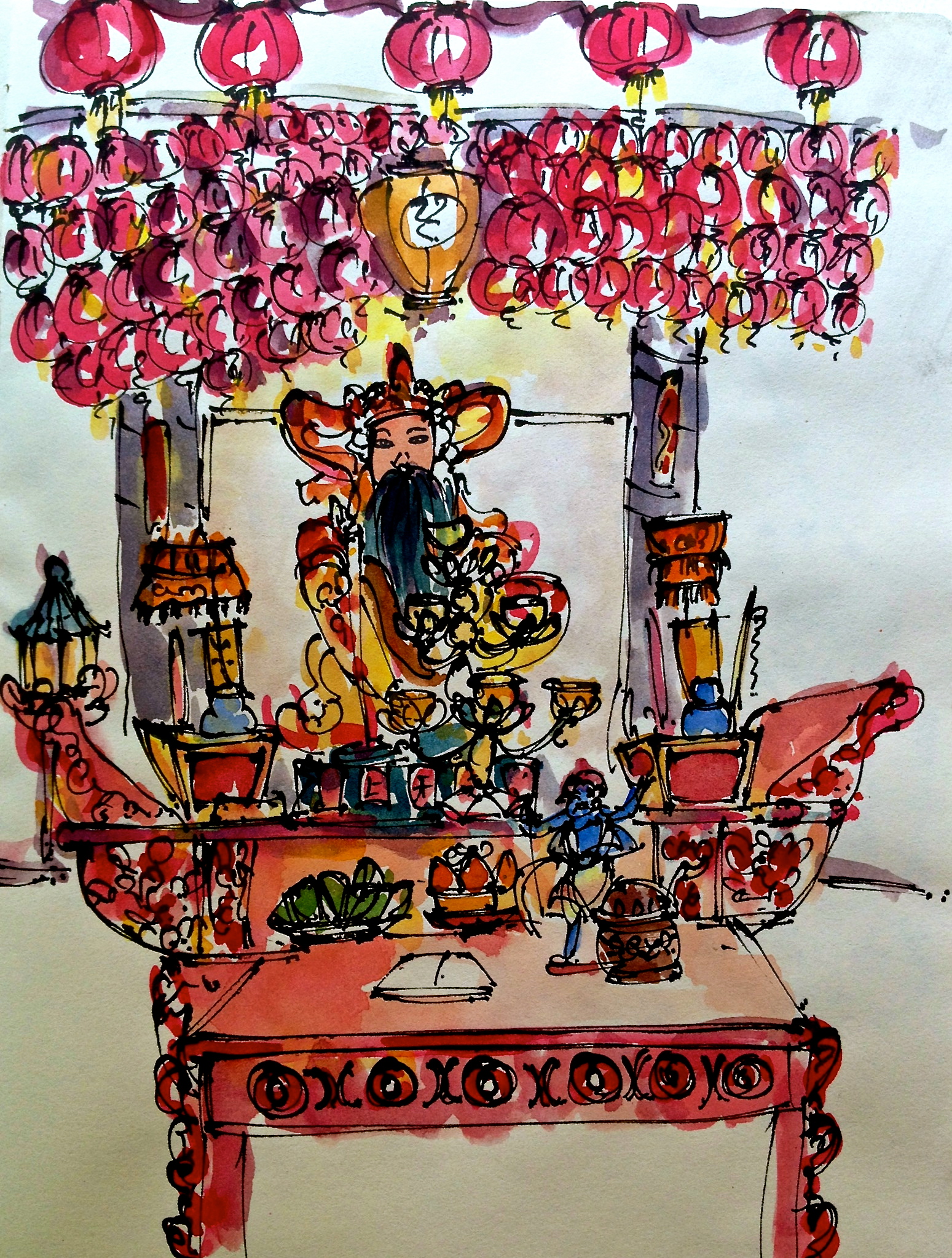
'The general of the north' - a revered Taoist deity in the Xuan Dian Jian temple, Singapore

‘The general of the north’ – a revered Taoist deity in the Xuan Jiang Dian temple, Singapore

Naturally I had no qualms about asking my cab driver the legend behind Duanwu festival, also known as the Dragon Boat Festival or rice dumpling festival, to which I was headed. The venue was Xuan Jiang Dian, an eighty-plus-year-old Chinese temple atop a hill at 85 A Silat Road, where a group of us were invited to hang out, sketch and watch the making of rice dumplings and eat them, of course. “Why don’t you check the story on the internet?”, asked the cab driver.
I could but I pressed him to narrate. Because a folklore is desultory when read in black and white. Because a folklore needs a voice to come alive, its inflection to set the mood and often a pinch of hyperbole to build momentum and pique the right amount of interest.
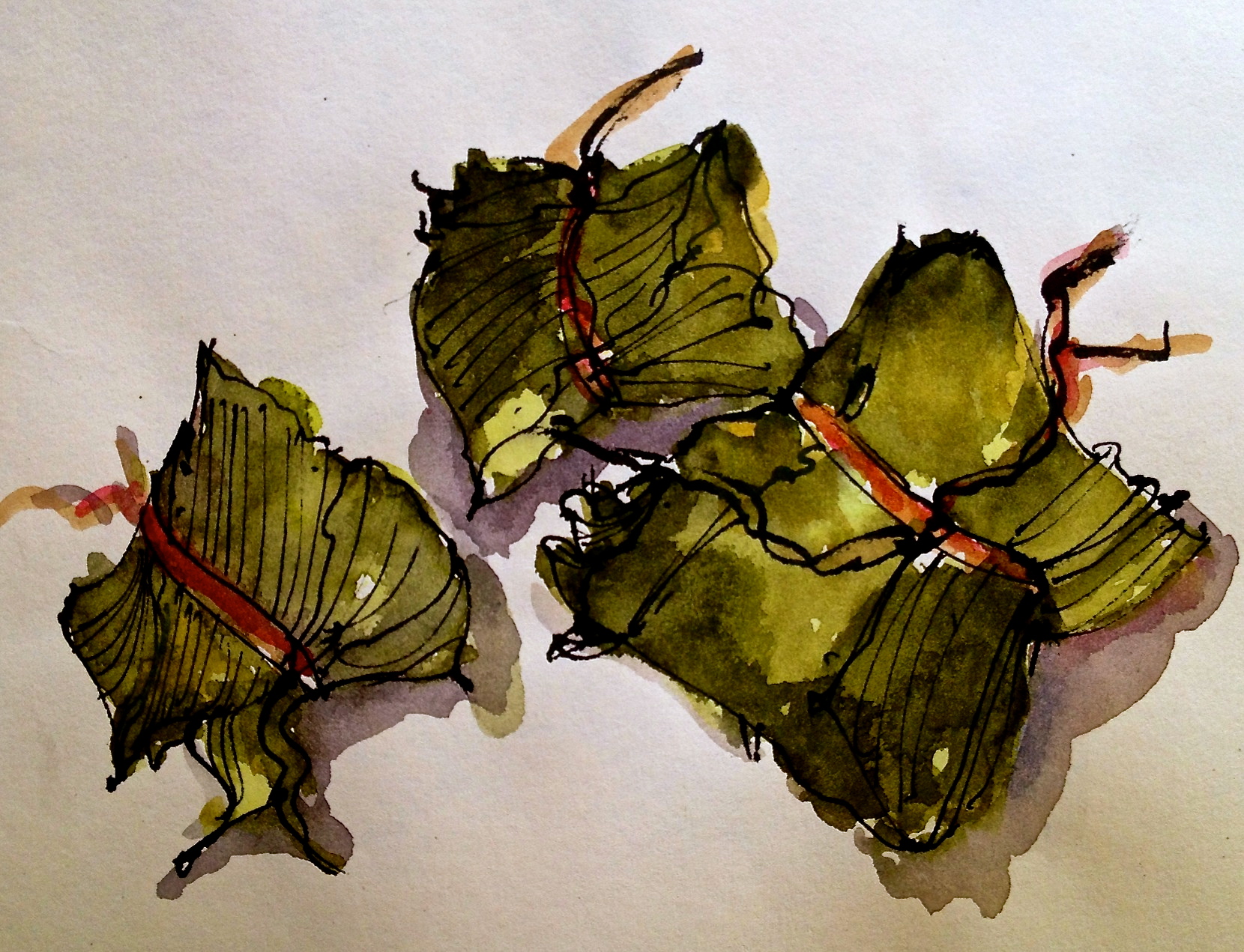
Sticky rice dumplings wrapped in bamboo leaves

Sticky rice dumplings wrapped in bamboo leaves

When we stopped at the second signal, he began with the disclaimer that there are more than one version of the story. I nodded in eagerness, while he cleared his throat. “Long, long ago , an honourable Chinese minister who’d offended the king, was banished from court. In despair the minister committed suicide by drowning himself in the river on the fifth day of the fifth lunar month. When locals failed to find the body, they rowed their boats into the river, beating their drums loudly and splashing their paddles on water to scare the fish. Some dropped sticky rice dumplings wrapped in bamboo leaves into the river to feed the fish and keep them from devouring his body.”
“Fascinating!”. But when did this happen? Who was the minister?” Which river did he drown in? I was curious.
“Dunno lah! All I know, is every year on fifth day of the fifth month of the Chinese lunar calendar, which is…June 12th this year, we race dragon boats and eat sticky rice dumplings for a month.”
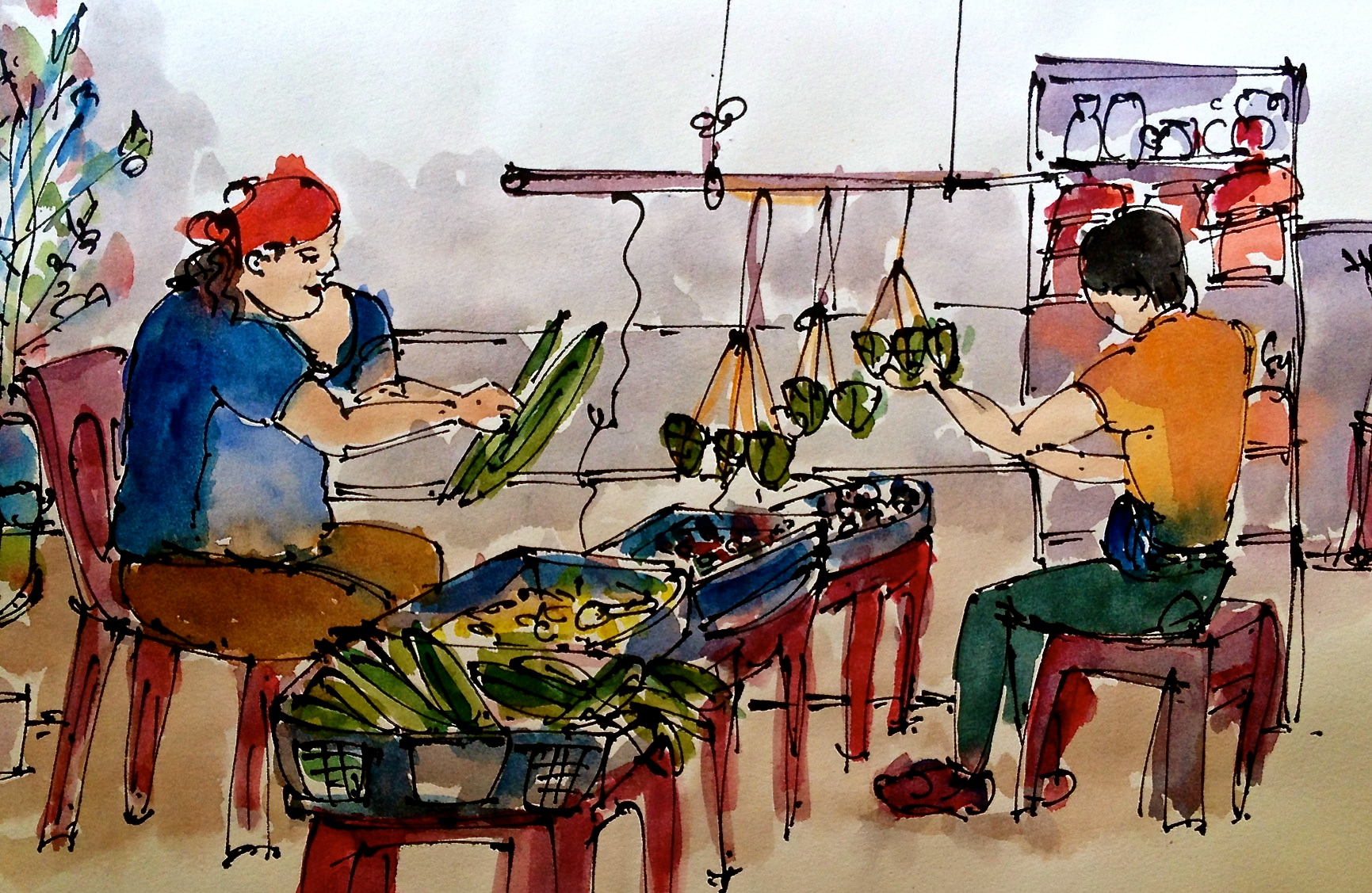
Volunteers at the temple wrapping the sticky rice dumplings

Volunteers at the temple wrapping sticky rice dumplings

The temple was a sight to behold, with bright red lanterns, fiery looking dragons with long tails and formidable statues of Xuan Tiang Shang Ti, the resident deity, also known as the general of the north, dressed in imperial clothes, residing inside one of the most exquisite lacquered alters, I have ever seen. With his red face, large bulging eyes and long flowing beard, he is supposedly one of the most revered Taoist deities. “Notice that his right foot is on a snake and the left one is on a turtle”, said Victor Yue, a salt and pepper haired Engineer who’s a Chinese temple geek, and an excellent storyteller.
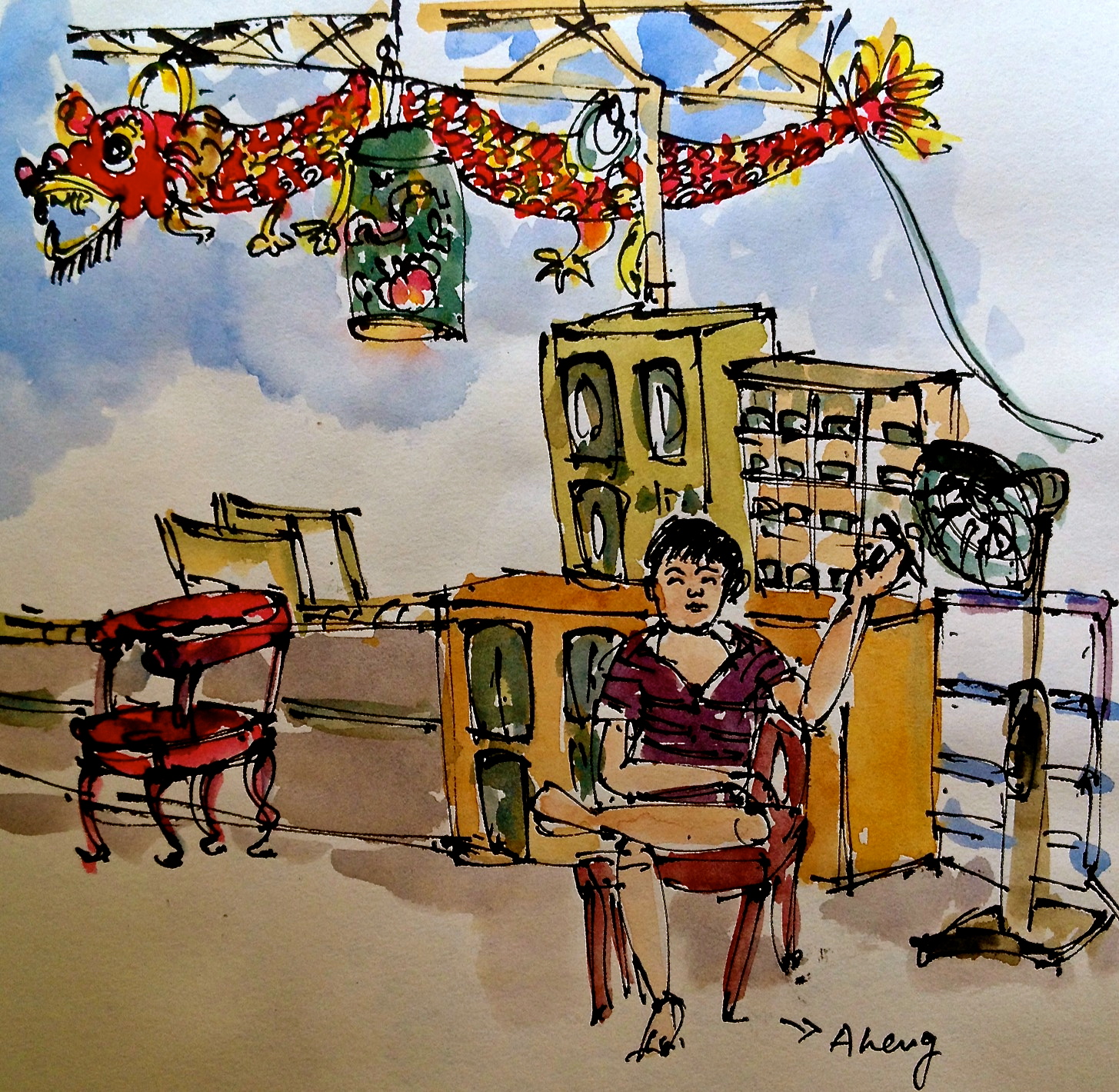
Aheng who's taking it easy with a cigerette between his fingers, is actually the temple's spirit medium who goes into a trance twice a week and offers consultation to devotees on their issues ranging form medical, marital to spiritual.

Ah Heng, who’s taking it easy with a cigerette between his fingers, is actually this Taoist temple’s spirit medium who goes into a trance twice a week and offers consultation to devotees on their issues ranging form medical, philosophical to spiritual.

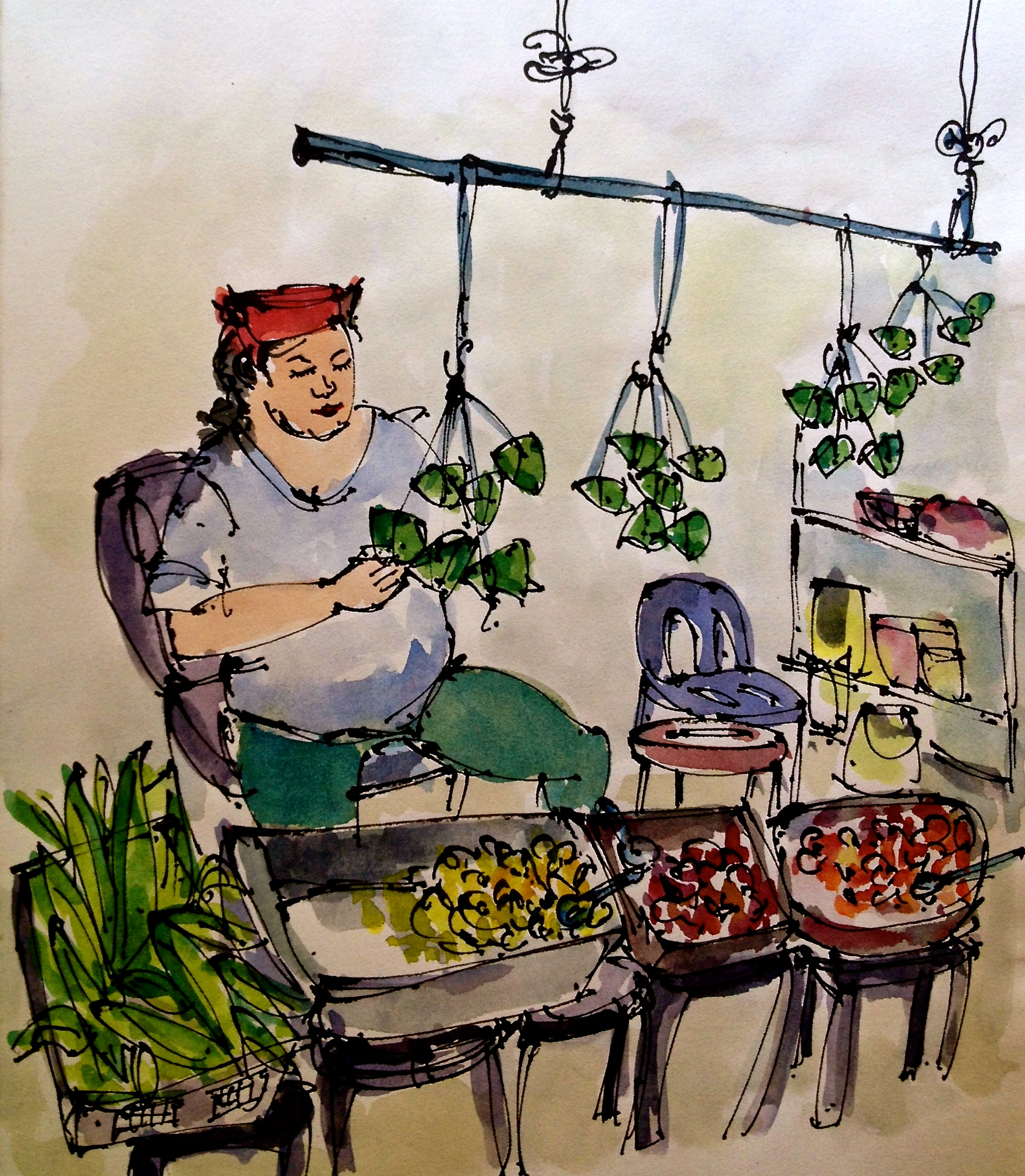
When I started picking his brain, Victor fed my curiosity with an enthralling tour of the temple and a crash course on Taosim and spirit mediums such as Ah Heng (see my sketch above) who are consuted on a regular basis by devotees to cure their ailments. The only thing that distracted me from our intense spiritual discussion was the smell of rice dumplings. Two volunteers had fixed themselves a make shift rice dumpling station on plastic chairs with a basket of steamed bamboo leaves, a tray each of rice, cooked mushrooms and pork.  
 
When friends tease and taunt you with stories of how hard it is to wrap a rice dumpling, how mothers and grandmothers still do it with ease and finesse and they can’t make it happen after years of practice; you are naturally instigated to try wrapping at least one and see for yourself, rather than agreeing like an idiot. When I hovered around the fringes of the crime scene, the volunteers dared me. “Want to try?” They were wearing surgical gloves and bandanas. “Go wash your hand first.”
Hanging the finished dumplings on the steel rod, to be boiled later.

Hanging the finished dumplings on the steel rod, to be boiled later.

The bamboo leaves are soaked in water before they are ready to be used.” said Victor. Three leaves overlap each other, two on one side and the third on the other, making an anorexic “Y”, which is then twisted to make a cone; into which goes a spoon of rice, a spoon of mushroom and a spoon of pork. The cone is then folded, tightly shut, tied with a string and hung from a steel rod hanging from above. To the two dumplings that I wrapped, the volunteers matched five each and giggled a lot, probably at my expense. Friends cheered me and clicked photographs as if I was wrangling a croc with my bare hands. But wasn’t I merely wrapping a very sloppy rice dumpling? 
 
Yes and no. My fruit of labour was shoddy no doubt but by rolling up my sleeves and getting my hands dirty ( or sticky) that morning, I had tacitly shed my wide eyed tourist garb. The volunteers warmed up to me. “Do visit anytime you want to” and “Eat one more dumpling, won’t you?” and “Did you see, she wrapped two dumplings?”. 
The rice dumplings were dropped into a large metal can of boiling water atop an open fire made out of wood and coal. “We can’t have such big pots in our homes, so my mother steams the dumplings in batches through the night, so we can have them in the morning on the festival day.” said Chao Zhu, a fellow urban sketcher, who was visiting the temple on a second consecutive year to celebrate Duanwu. I was curious to know if she could wrap rice dumplings nearly as good as her mother. “Gosh no! Unfortunately it’s becoming more and more obscure. I don’t think I can pass it down to the next generation.” Sadly there were too many heads nodding in agreement.
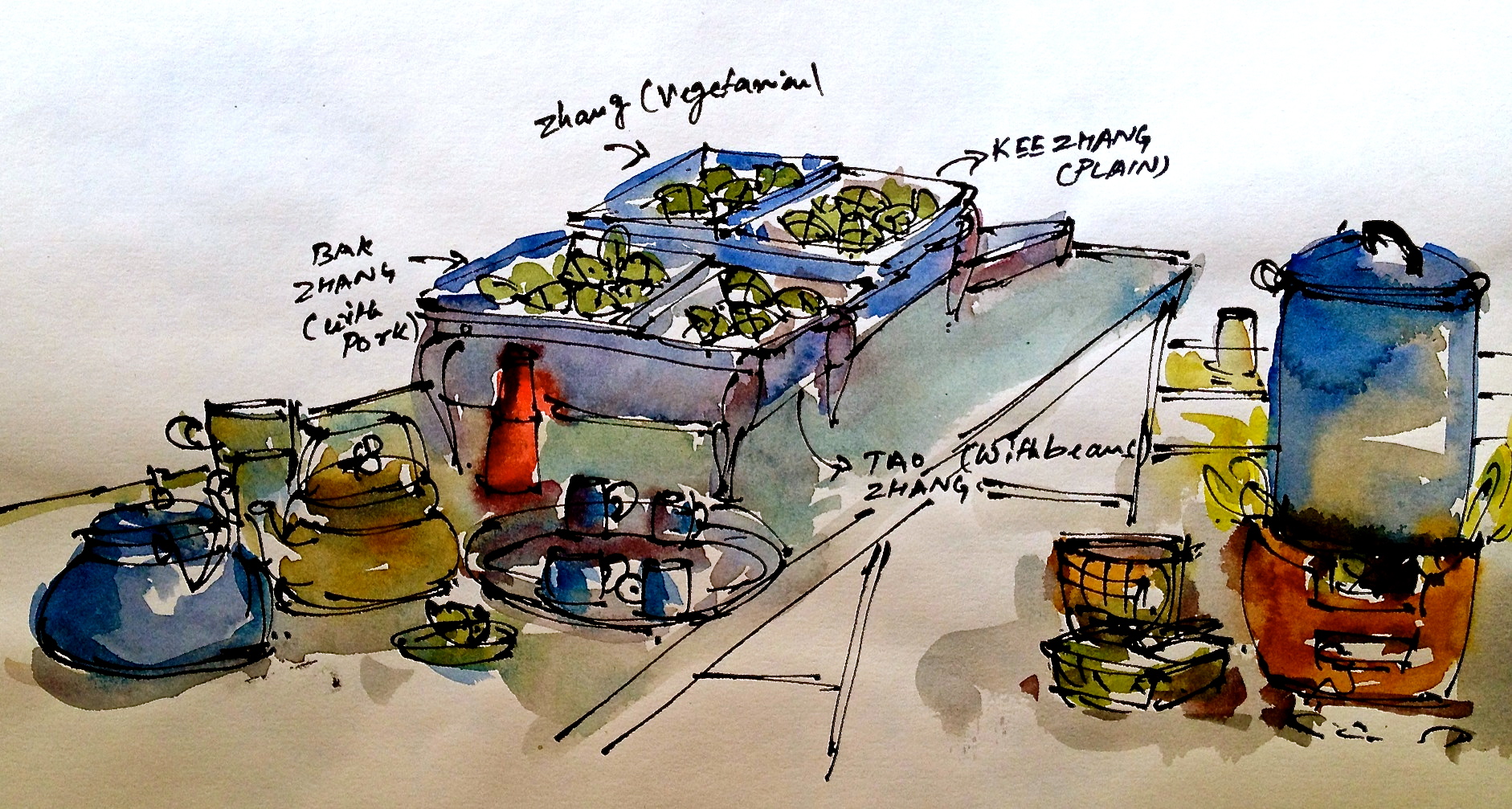
Four different types of dumplings laid out with hot tea and ketchup

Four different types of dumplings laid out with hot tea and ketchup

After the dumplings were boiled, the volunteers laid them on a table in separate trays with name tags indicating their type – Kee Zhang (plain rice dumplings with no filling), Zhang (Vegetarian dumpling), Bak Zhang ( dumplings with pork filling) and Tao Zhang ( dumplings with beans). Kettles of tea, disposable plates, cups, bottles of ketchup (to accompany the dumplings) were set up. After our fill, when we were ready to leave, the volunteers packed us the leftover dumplings. “Souvenirs from the temple!” said Victor.
Victor, regaling me with his stories

Victor, regaling me with his stories

Back home, I checked the internet all right –  Duanwu festival commemorates the death of the patriotic poet and revered minister Qu Yuan ( 340 – 278 BC) of the ancient state of Chu. He committed suicide by jumping into the Miluo river in Hunan province, because he was accused of treason and exiled by the king for opposing an alliance with the state of Qin.

So much for getting the facts straight, it’s still the cab driver’s dramatic narration that rings in my ears.