Behind the scenes at a Teochew Opera

“Look, the philosopher is picking his nose again! Make sure you get that in your sketchbook!”, a giggling deity instructs me from her chair, putting down the newspaper she’d been reading. The entire room bursts into laughter.
My timing isn’t perfect though. When I look up, the philosopher has paused his excavation (or perhaps found gold) and gives me a sheepish look. Different people seek different means to calm their nerves before appearing on stage, so I quickly dismiss his antic as a means of personal solace and avert my eyes.
Since 3 in the afternoon, I am at the backstage, observing and recording the hair and make up process of a group of Teochew Opera performers in my sketchbook. In a span of six hours I have watched these 21st century men and women metamorphose bit by bit into ancient Chinese officials, philosophers, scholars, lovers, courtesans and further back in time, into celestial beings such as deities of wealth, success, longevity and such.
I had arrived to a room full of opera performers scattered at various make up stations. Javier, one of the performers who’d invited me backstage was poised motionless on a chair, while her face was being powdered and eyes shaded with a black pencil. Still clad in pyjamas and sneakers, she was a deity in the making, who’d soon be summoned by Kim Bor – the ‘queen mother of the west’ to celebrate her birthday on stage.
Javier will be playing a deity in the play "A Celestial Birthday"

Javier will be acting as a deity in the play “A Celestial Birthday”

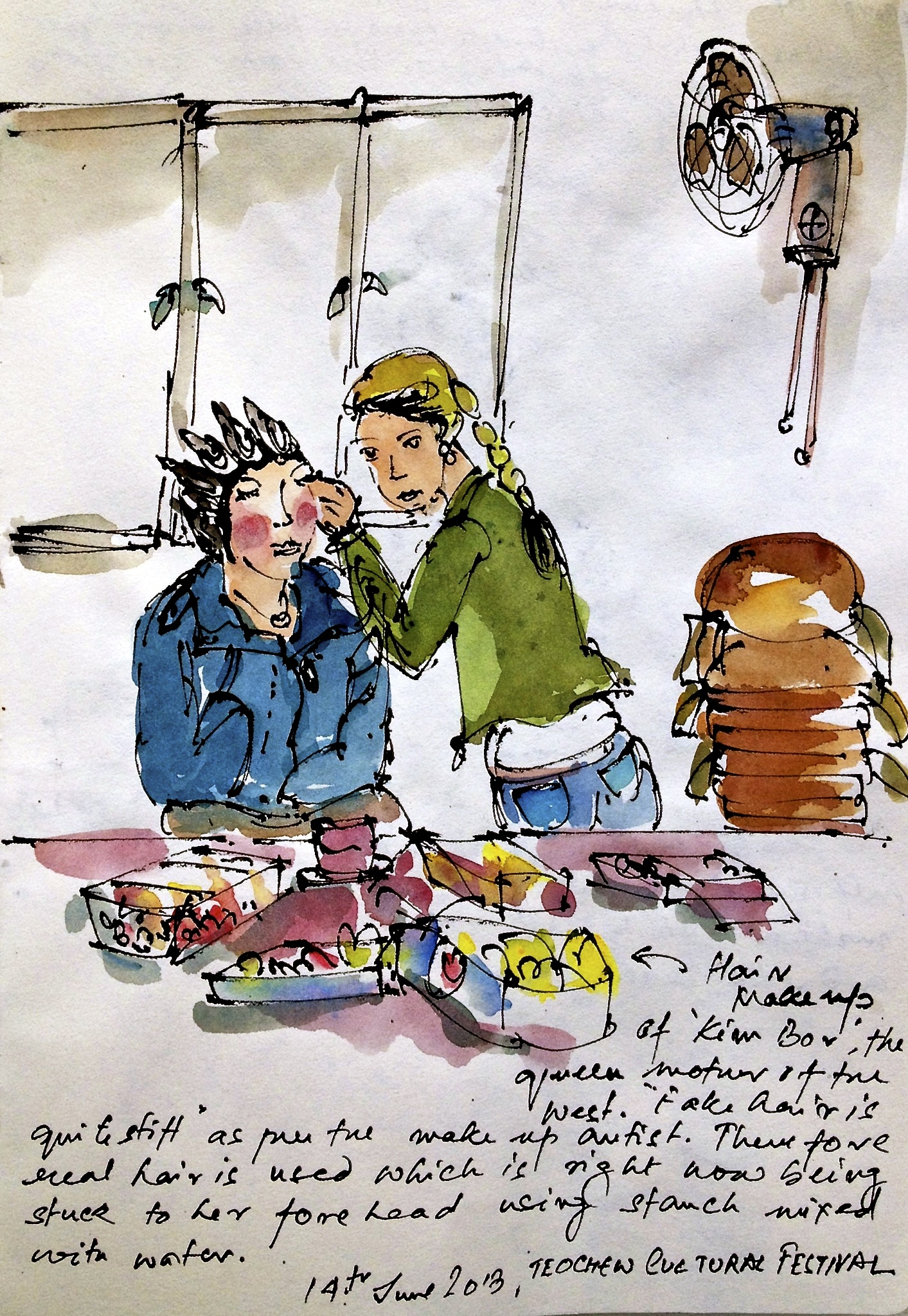
 While Javier was getting ready for Kim Bor’s party, five feet away the queen mother herself was having her hair done. Two hairstylists were folding a bunch of hair strands and sticking them on the birthday girl’s forehead in a semicircle using starch and water. ” It will last for a day, but if I had to make it last longer, I’d mix starch with vinegar. Doesn’t stink and lasts for three days!” said one of the hairstylists expelling her trade secret to me.
I don’t ask her why it needs to last for three days. Do celestial birthdays last that long?
“Also the hair we’re using here is real because false hair is too stiff”, explains another, when she catches me gaping at her make up paraphernalia that has taken up an entire table. Hair of all shapes, sizes and designs from fringes to buns to braids; crowns with exquisite stone settings, necklaces, hairpins, clips, hair bands, hair nets amongst many others lay in neat compartments inside transparent plastic boxes. Four opera groups that are performing today at the ongoing Teochew Cultural Festival, are keeping them on their toes.
Before the performance, I meet with Mr. Lim Chunheng, the events manager to know more about the Teochew people, their culture and more precisely about their opera. Mr Lim starts by pointing out Chaoshan province on the map of China, from where the Teochew people originated, carrying their language, culture and tradition to all the places they emigrated to.
Talking of the Teochew Opera which is a genre of the Chinese opera performed in the Teochew dialect, Mr. Lim says, “This 450 year old art form is beautiful, unique and worth preserving.”
The Teochew Opera was greatly influenced by Nan Xi, an early form of Chinese drama that can be traced back to the Song dynasty in the 12th century AD. Over the years, by integrating Teochew folk music coupled with the unique intonation of the Teochew dialect, Teochew opera evolved as a distinctive art form. Mr. Lim tells me, of the seven characters, the Dan (female) and Chou (clown) roles are the most artistic and well defined in Teochew opera. And the stories evolve around the themes of love, family and ethical relationships.
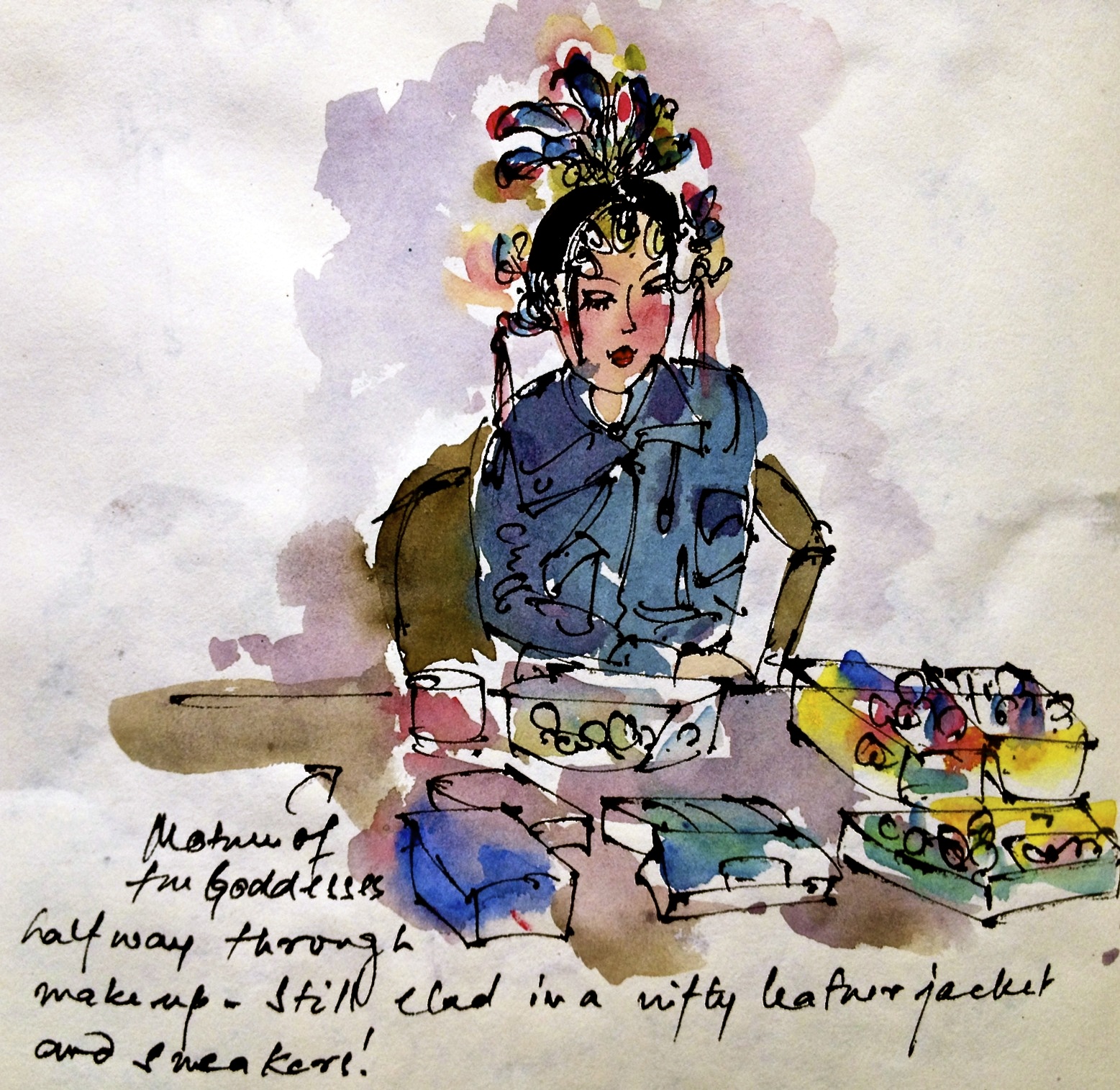
Kim Bor - The queen mother is getting her hair done

Kim Bor – The queen mother is getting her hair done

“Teochew Opera involves stylised body movements, facial expressions, vocal modulations and many other subtleties that takes time to master”, says Mr. Lim. “Youngsters these days don’t want to put in that much effort in learning an art form. So through cultural festivals like these, we want to create interest and awareness in them about their own heritage.” he adds.

Another deterrent responsible for the dwindling popularity of the Teochew Opera, as Mr. Lim points out, is the Teochew dialect. Though Teochew remains the ancestral language of many Chinese in Singapore, Mandarin is slowly replacing Teochew as their mother tongue, especially among the young population.
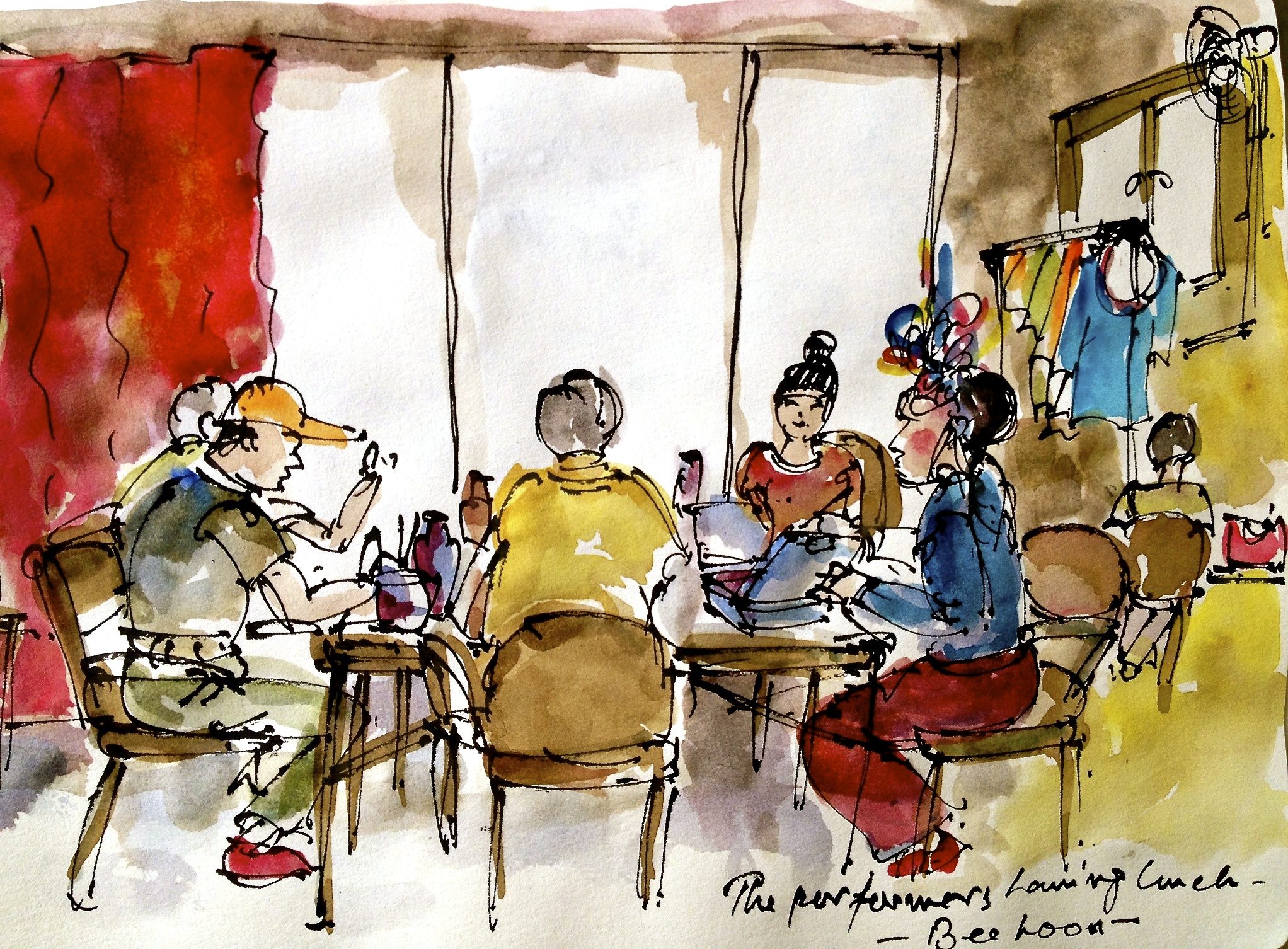
The performers having 'Bee Hoon' for lunch

The performers having ‘Bee Hoon’ for lunch

At the backstage, everything comes to a temporary halt, when lunch arrives in takeaway boxes. Performers, volunteers, makeup artists gather around and fill up on Bee Hoon. The queen mother extracts herself from the hairstylists and joins the group. In the next few hours, tiny microphones are distributed to the performers to be attached to their bodies, flamboyant costumes in the most elegant colours with matching shoes are donned, headgears from small to large, simple to the most exquisite adorn the heads.
One of the deities approaches the hairstylist, holding her head in pain. “Too tight, the headgead’s too tight!”  This headgear like many has two tiny holes on either side and comes with a matching pin as long as a chopstick that is passed from one end to another, through the hair bound in a bun, and wound a couple of times like a screwdriver, till the headgear fits the head snugly. The hairstylist fiddles with the screw and fixes the problem.
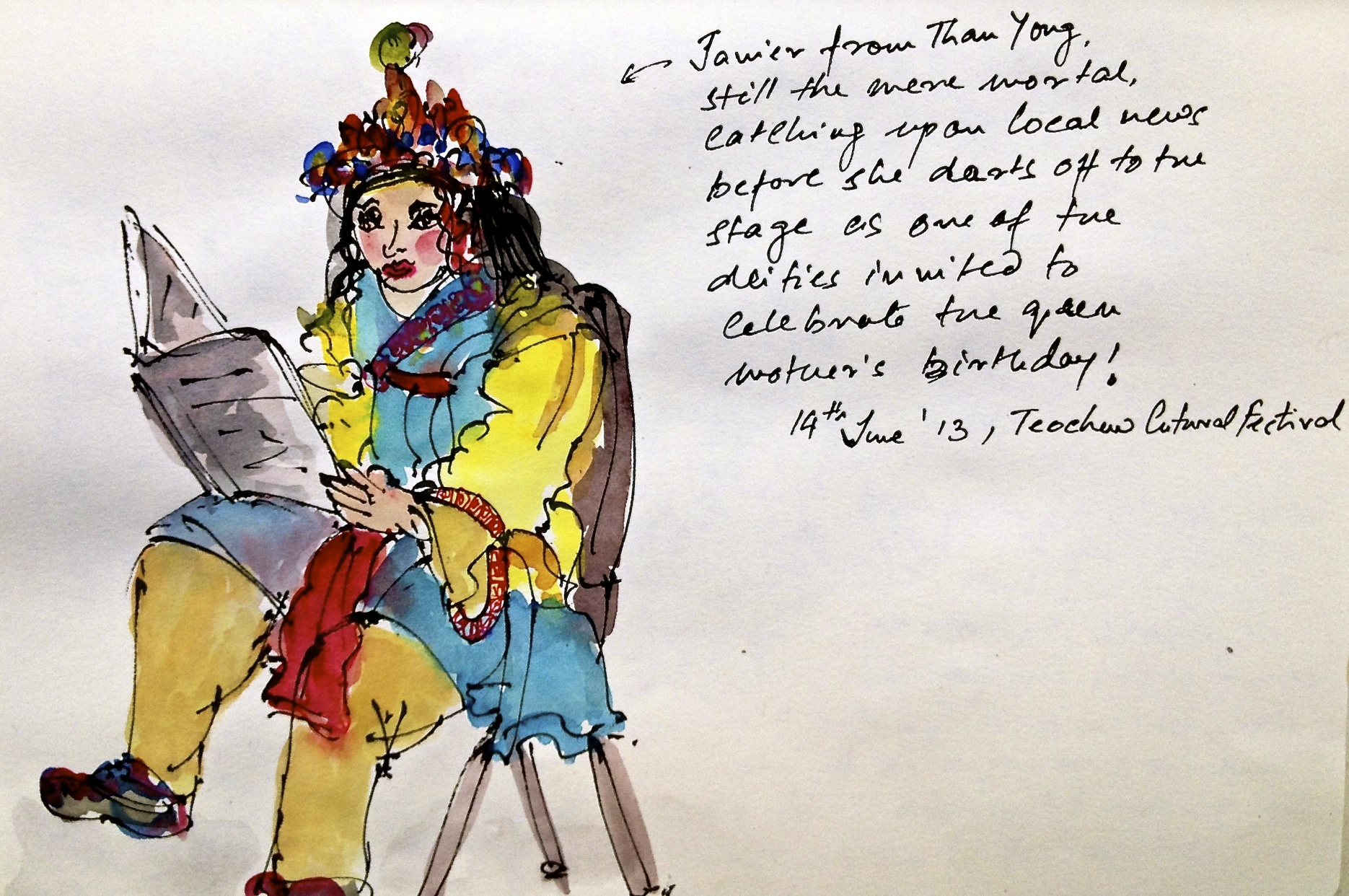
Javier catching up on local new before the performance

Javier from Thau Yong Amateur Musical Association, Singapore

As the deadline approaches, performers are getting themselves in the zone.
The queen mother and the scholar’s wife are pacing up and down the room in their flowing costumes; the deities are shaking their heads to check the fit of their headgear or humming quietly with their eyes closed; Javier is reading a newspaper and the scholar is relaxing his vocal chords by breaking into high pitched songs.
The philosopher is digging his nose, but I am not judging.
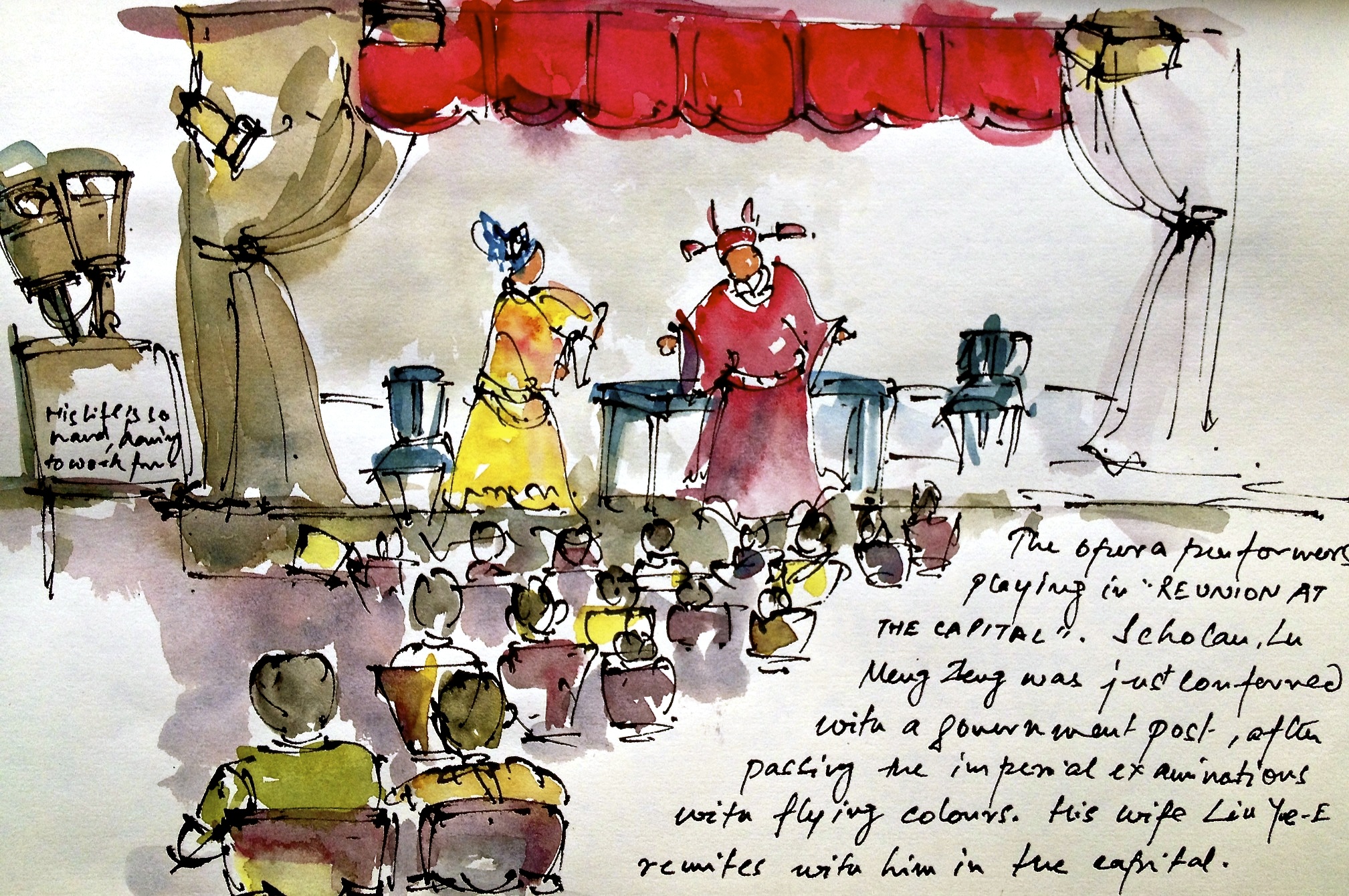
The scholar and his wife perfom in "Reunion at the capital"

The scholar and his wife perfom in “Reunion at the capital”
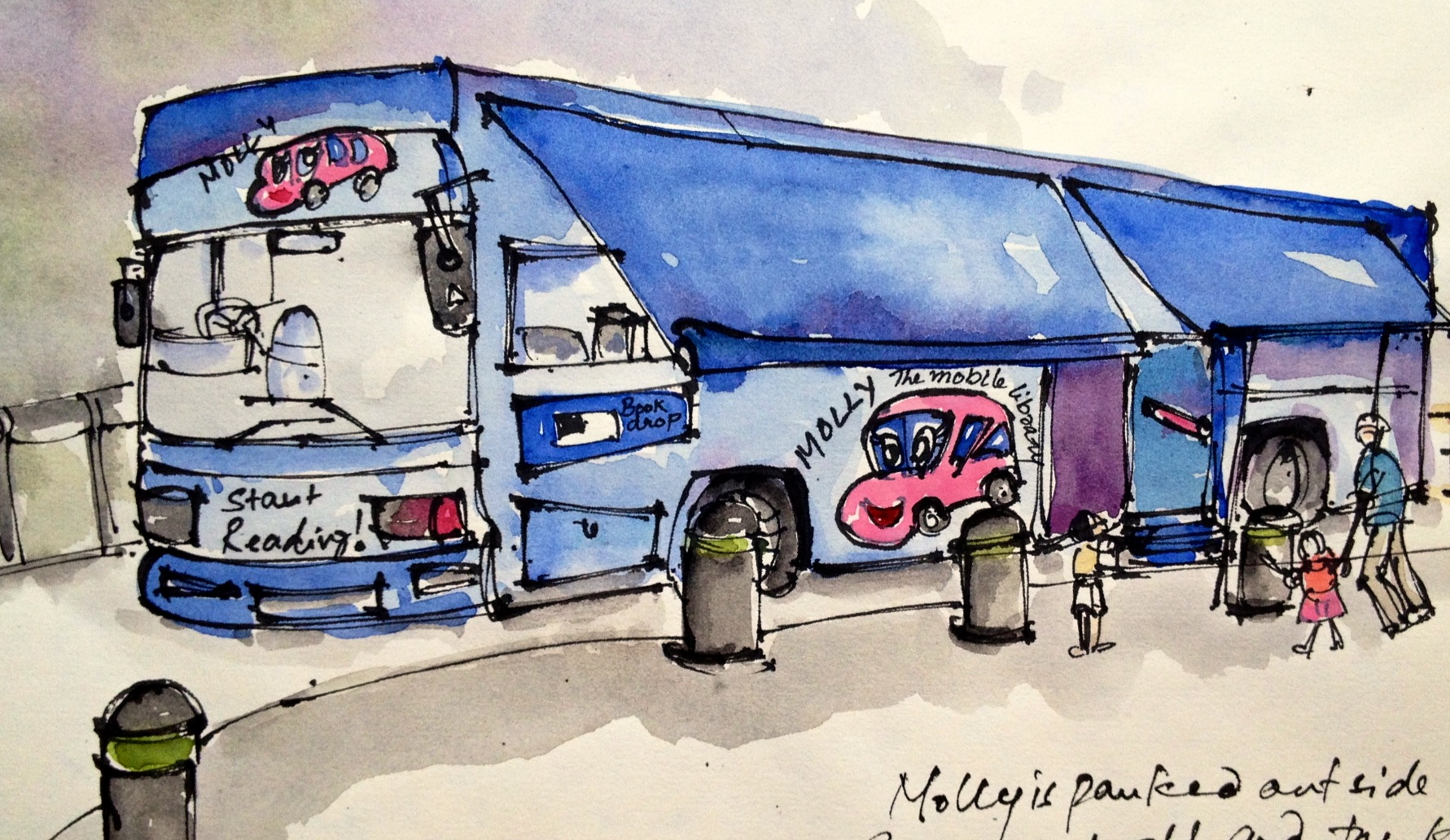
Have you met MOLLY?

I don’t know how I missed her but I did. Hurrying home from a writing workshop on the other side of the town, there were only two things that occupied my mind at that hour – a satisfying lunch and an even more satisfying nap. Eyes peeled on the road for shady spots and corners to walk by in the blazing afternoon sun, I passed her like a galloping horse with blinkers, till a gang of kids hailing MOLLY’s name in chorus, brushed past me.

MOLLY parked at United Square Mall

MOLLY parked outside United Square Mall

Turning around, I looked straight into the big fluttering eyes of MOLLY, Singapore’s only mobile library. A refurbished public transport bus with imposing body stats – 11 meters in length, 2.2 meters in width, 2.1 meters in height and 16 tonnes in weight, MOLLY makes quite a statement on the road. Sporting an attractive decal of vibrant blue with animated characters, tiny trees and fluffy clouds drawn across her body, Molly’s visitor profile isn’t worth a guess either.

Parked along the kerb, in front of our neighbourhood mall, the bus’s door is wide open and the retractable awnings are drawn. Molly is open for business and the little ones are pouring in. Some are even returning books at the nifty ‘book-drop’ unit fitted below the bus’s window.

Inside the mobile library

The bus was retrofitted with shelves, airconditioner, generator, electronic borrowing units and such

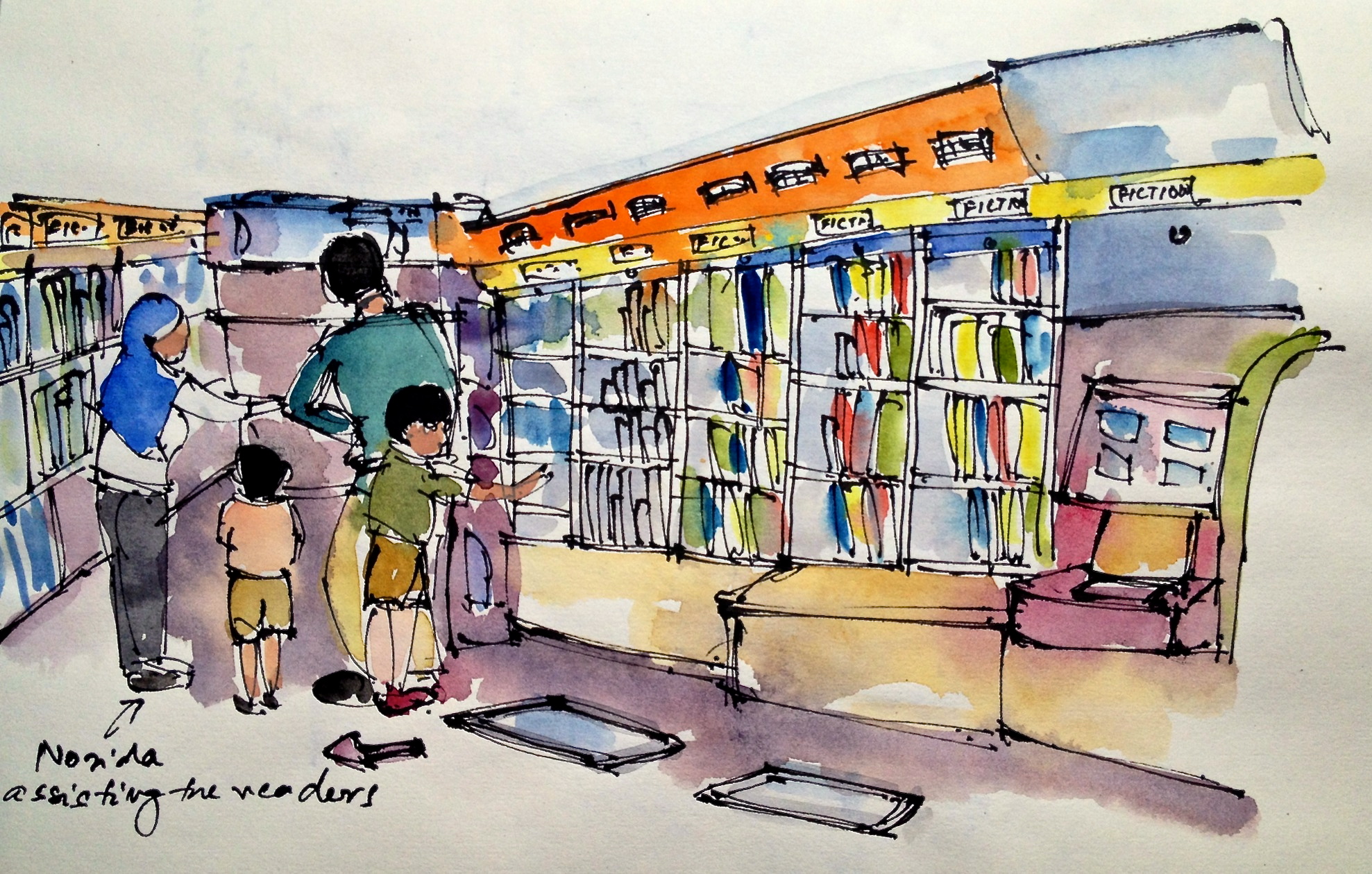
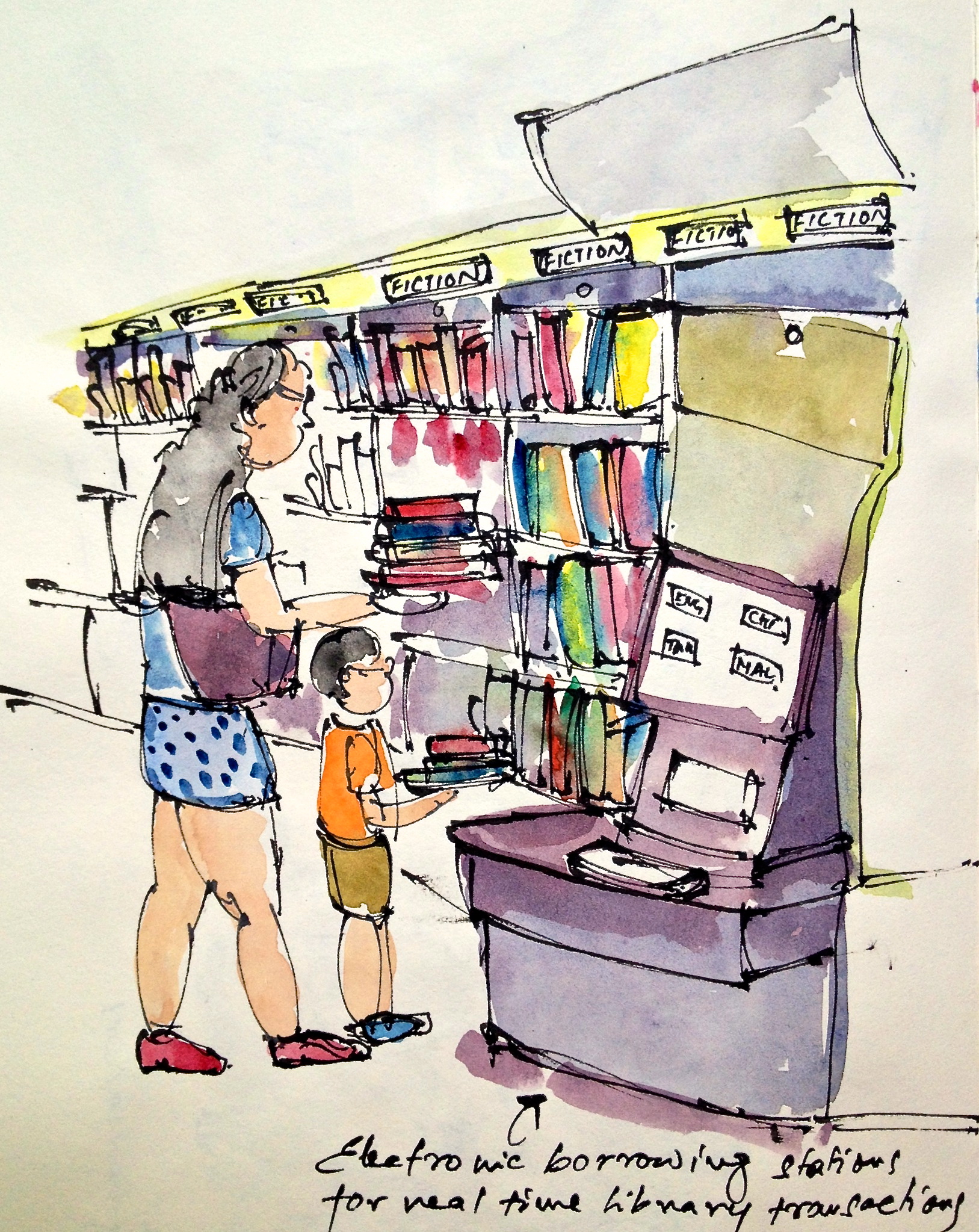
Sandwiched between the eager little readers, I squeeze myself through the door. Housed in a bus it may be, but it’s a library all right. Neat shelves on either side hold about 3000 books, that are grouped by age and labelled as per genre. An electronic book borrowing unit is stationed at the rear end of the bus, where a uniformed library assistant is familiarizing children with the borrowing process and encouraging the curious first timers on board to register themselves as library members.

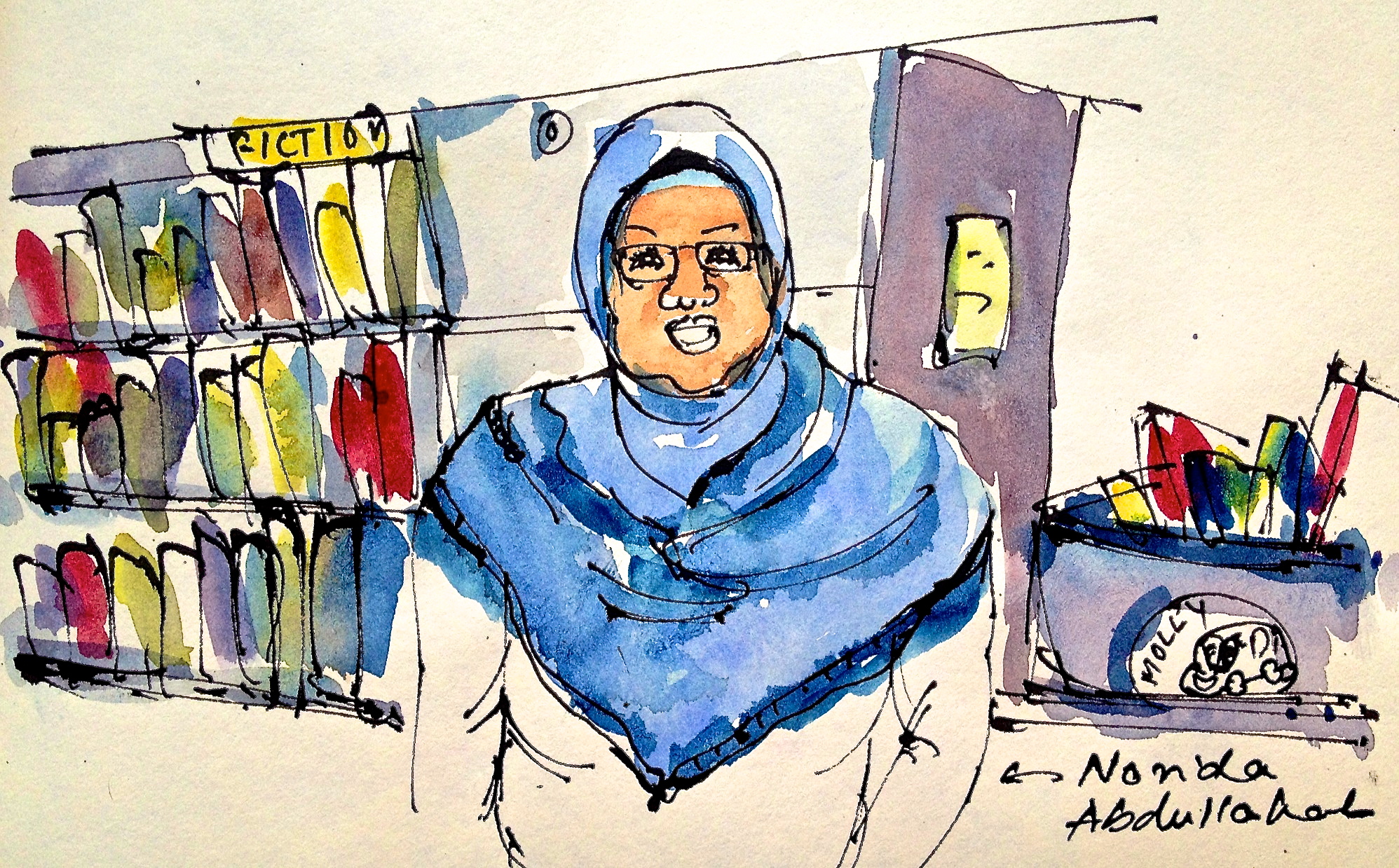
I am the last person in the queue, and with the same tenderness that she was showing the children, this 50 plus years old library assistant Norida Abdullahab, helps me not only borrow the books but renew them as well. ‘So you can use these for an extended period.’ she says, flashing a reassuring smile.

Norida Abdullahab

When I asked Norida’s permission to sketch her, she gave me the cutest expression

Though the passage inbetween the shelves is narrow, the interior is well furnished. Good lighting and air-conditioning make for comfortable browsing and reading . Needless to say, the kids are having a ball.  Some are sitting on their haunches, pulling out one book after another and sifting through them, while others are slouched on the floor, reading meditatively. The shorter ones are begging their mums and dads to be picked up, so they can reach a higher shelf.

“How about Emperor’s new clothes?”, suggests a mother. Or “City mouse and country mouse? That sounds interesting!”, coaxes another, whose girls are sitting around a pile of fairytales. It’s harder than it looks to convince their little minds.

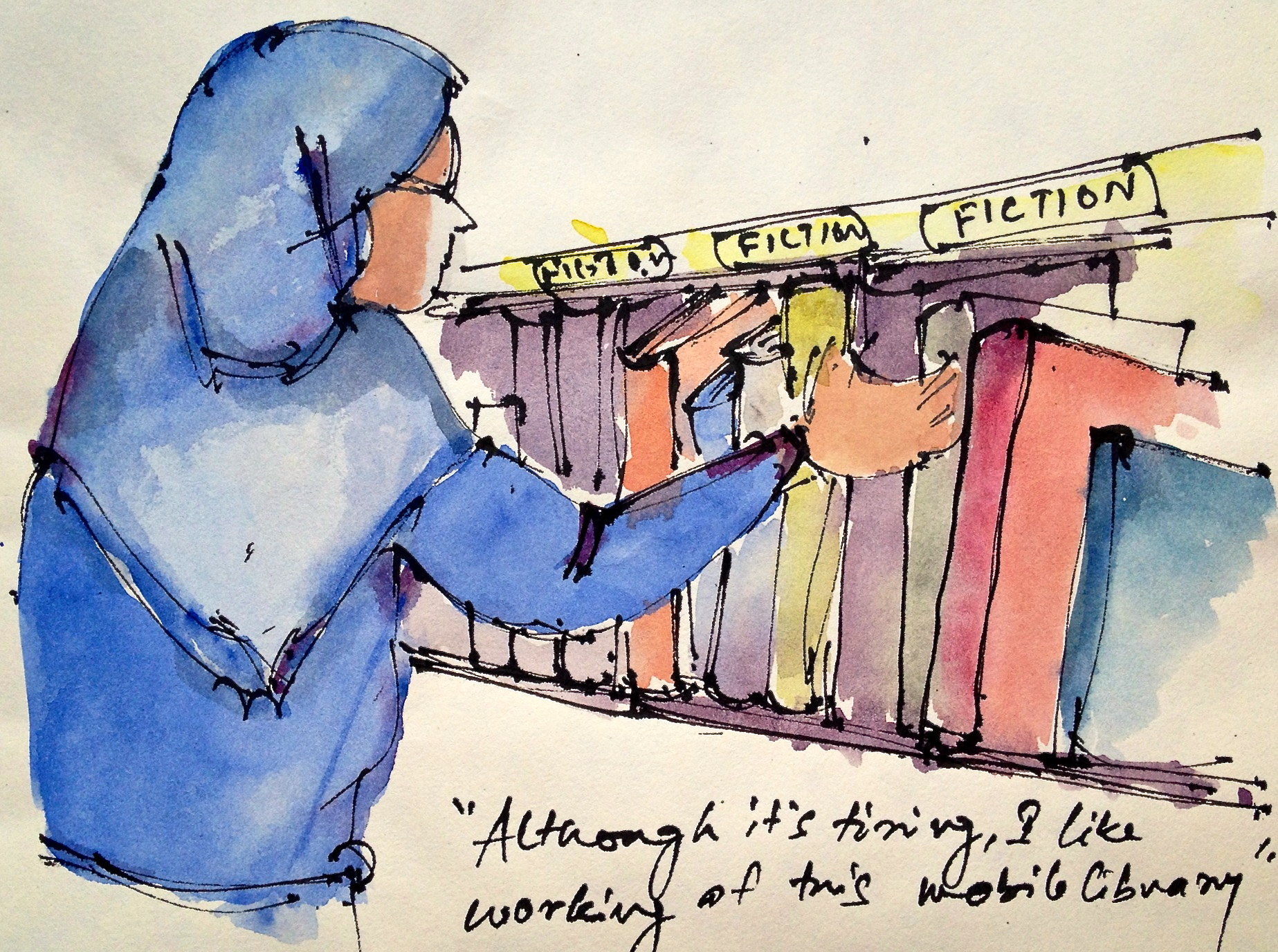
'Although it's tiring, I love working at this mobile library'

‘Although it’s tiring, I like working at this mobile library’

Norida is picking up the books from the floor and putting them back on the shelves. “Although tiring, I like working at this mobile library.’ she says. MOLLY has been her workplace for the last seven months. “I have worked at the National Library for 16 years and only recently did I request for a transfer” she adds.

The mobile library has two teams with 3 members each –  two library assistants and a group leader – visiting various locations on the island. Norida points out the printed schedules on the wall, with names of 8 locations each, to be covered on the following Saturdays and Sundays.

“Every second Saturday of the month, we visit these public venues. But that’s not our main job.” she says. On weekdays, throughout the year, MOLLY visits schools for the underprivileged. “Like schools for children with intellectual and physical disabilities, autistic children, deaf and dumb children, children with down’s syndrome to name a few.” explains Norida. “Since they can’t come to us, we go to them.”

I learn from her that, MOLLY is a 5 year old endeavour of the National Library Board of Singapore to make library services more inclusive and accessible to all, especially the undeserved community, so they too can discover the joys of reading.

Looking at the gleeful children lined at the borrowing station balancing piles of books, waiting for their turn, I feel comforted and happy thinking whether privileged or otherwise, this outreach activity of simply promoting the use of a public library at this tender age, so they become active users in the long run and use public libraries as a part of their lifelong learning journey, bears more value today than ever, specially in the context of kids growing up in a digital age with no dearth of multimedia at their disposal.

Electronic borrowing stations inside the mobile library

Children are familiarized with the electronic borrowing stations inside the mobile library

A mother asks Norida to help her locate books for children at level 3. “Boy or a girl?” she asks, springing right into action. ‘Girl’. “Well, then she might like these.”, says the library assistant, handing her few carefully selected options. Norida not only has sound knowledge of the library’s collection but she also provides customised recommendation to every reader requesting her assistance.

Turning back to me, she says, “I love my job at the library, but I always wanted to go out and make a difference, instead of being stationed at one place.” Reaching books to those with limited or no access to a library on a mobile bus, has fulfilled both her wishes. This is the reason she voluntarily requested for a transfer, after a decade and a half of service at a public library.

‘I love bonding with children, you know. I am also a grandmother of three.”

People watching and more coffee chronicles

Working as a freelancer from the confines of ones home isn’t as palatable as the images it may conjure. Besides a disciplined work environment – which needs to be strictly self imposed by freelancers – you miss out on the day to day office camaraderie, the human connection, the collective sense of belonging to a place.

A starbucks outlet

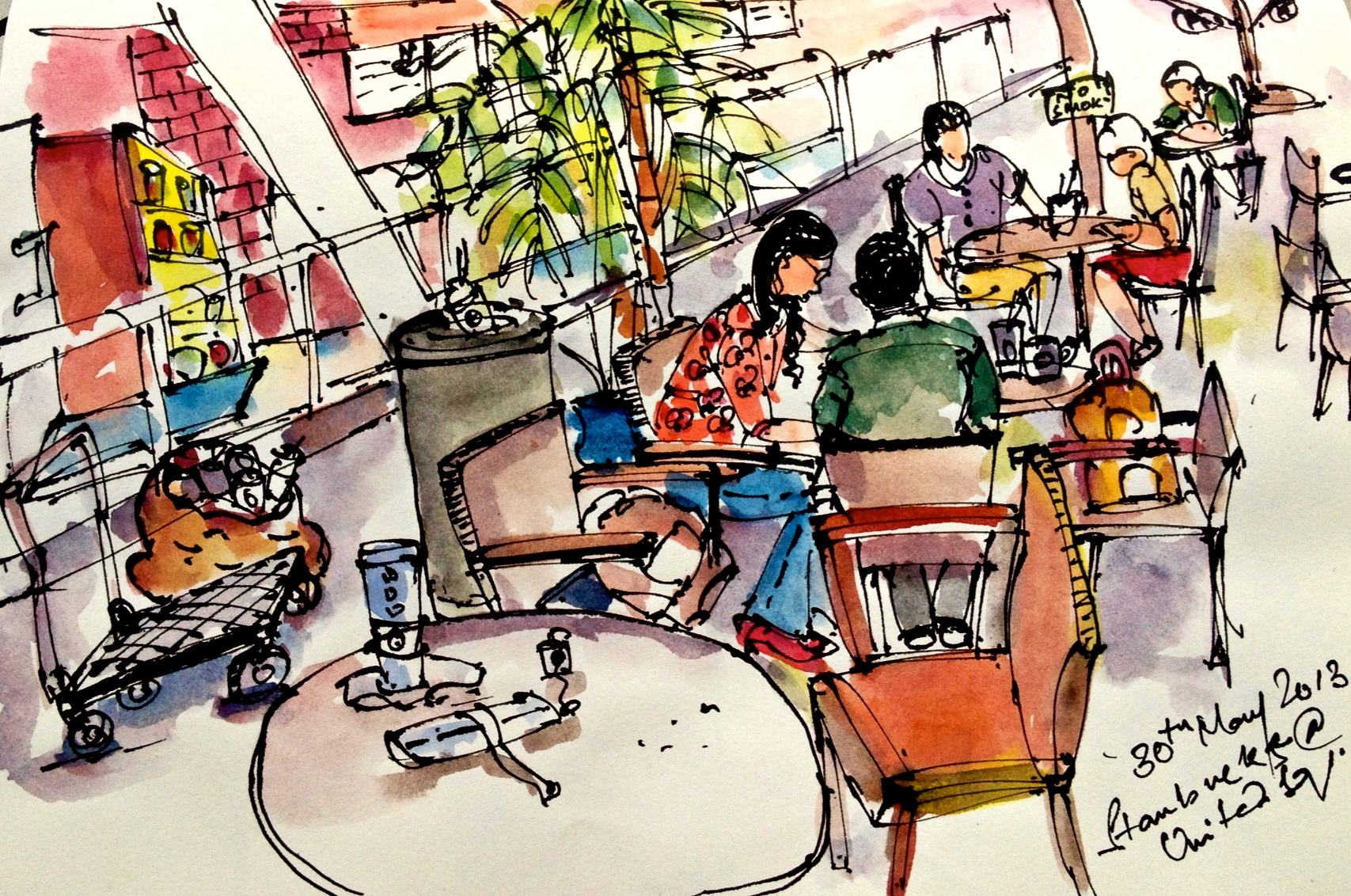
While not contesting on the shade of the grass on either side, when I find the scales tipping in other’s favour i.e  when I start feeling cooped up and lonely, I simply carry my work, 5 mins from my house, to the nearest coffee shop, where I get people to sit around me while minding their own business, listen to pleasant music and have access to air-conditioning, wifi and plug points.

To my surprise and delight, there is no dearth of the like minded, so much so that between 9 to 5, it is hard to find a place.

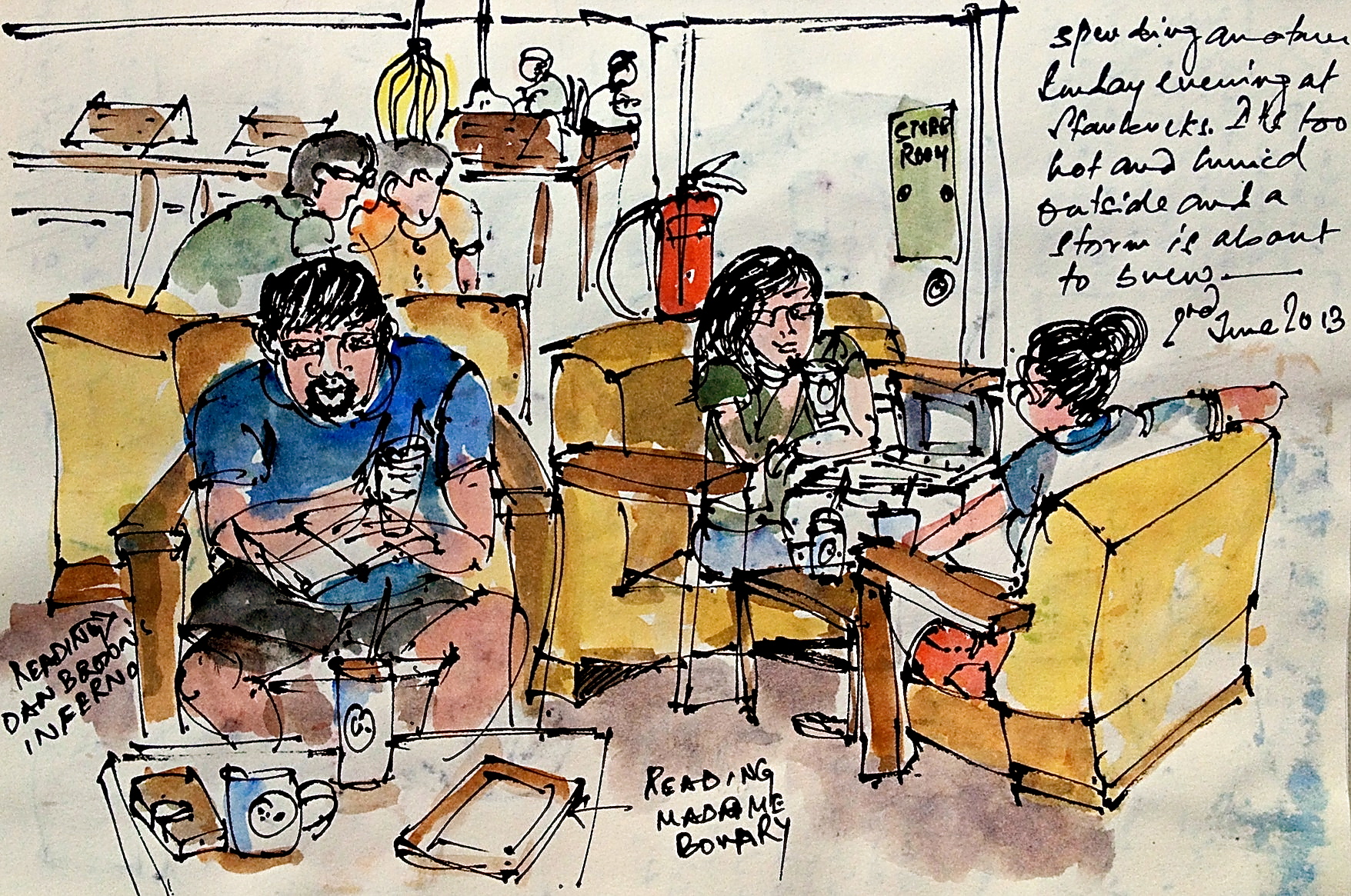
There are official meetings presided by dapper looking men and women over cappuccino and cookies. And these madams and sirs care to perch their prissy bottoms only on the plush leather sofas with handrest (also the most coveted in the entire cafe) by the windows with the lovely view. If this coincides your entry, it pays to linger around, as they usually leave as soon as they finish their drink or their talking.

School kids working on their assignments

School kids working on their assignments

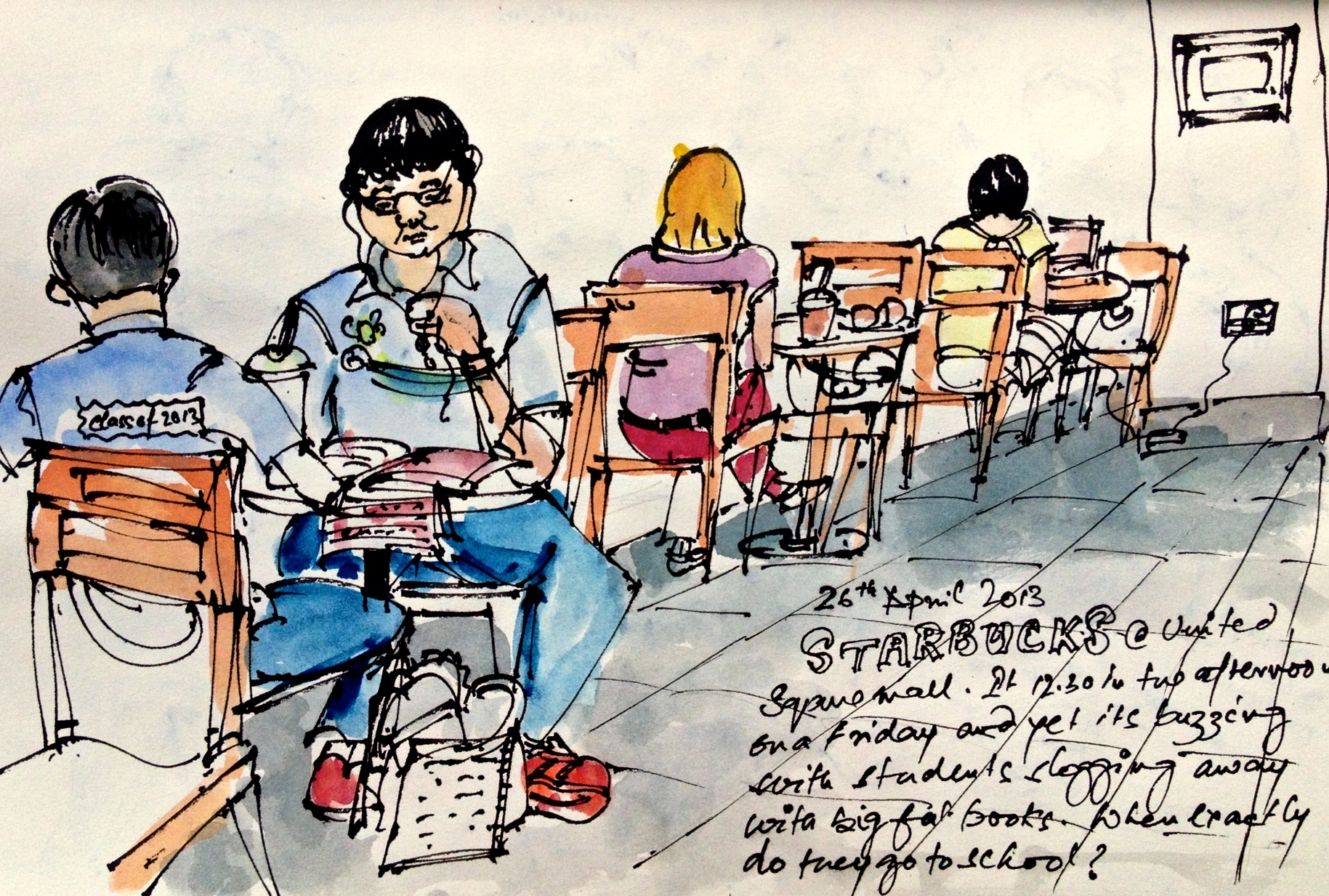
But the same theory is redundant when it comes to the cafe’s biggest headcount – the scraggy school kids finishing assignments over a glass of plain water and maybe, just maybe a tall sized green tea frappe that was finished eons ago and has the frothy bits left at the bottom. Now, they cost the cafe, the entire upper and lower deck with high stools and convenient plug points.

And they also kind of live here, only getting up for toilet and food breaks (which is usually a packet of chips).  While away which sometimes is for an hour, their personal laptops in dayglo covers, scribbled notebooks, stationaries, chargers, headphones, snacks, wet wipes and sweatshirts scattered on the table will stand sentry. Yes, it’s Singapore, nothing gets stolen but avoid this zone like plague, if you wish to be seated in this lifetime.

More students

More students

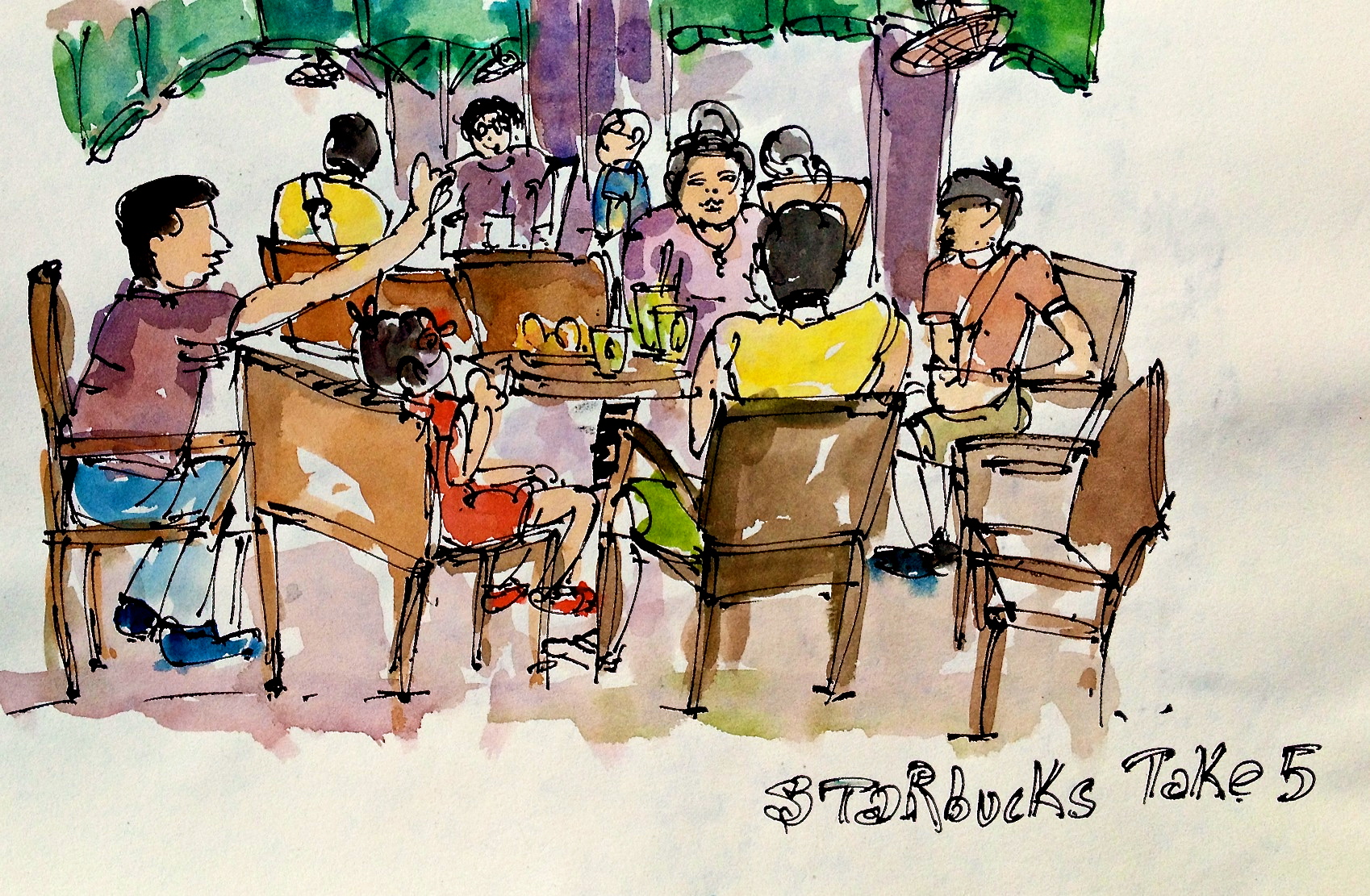
Then there are the moms. All kinds of moms. The ones feeding chocolate fudge cake to their  primary schoolers sitting upright (only at the behest of mommy), and doing their home works; and the ones with toddlers learning to use cutlery and making a gruesome mess by repeatedly stabbing the delicate chicken puff, while their eyes are peeled on the iPad; and lastly the pregnant ones with a wailing brat in tow, struggling to get a heaving stroller (from the weight of groceries) inside the cafe door with one hand and shoving the pacifier into the child’s mouth with another .

Al fresco seating at the cafe

Al fresco seating at the cafe

Moms populate the cafe’s alfresco seating so their kids can run around and chase pigeons, when they can tear away from their wondrous gadgets. If you’ve been around for a while like me, you’ll know – smaller the kid, battier is the mother, and the fidgety she gets, higher is the probability of finding a seat. So hover like a bee over a bed of flowers. Your luck might just turn.

The rest belong to the mixed bag, where taking your chances could be be a bit hit and miss. Like the older school kids in uniforms caught in between school and private tuitions or college goers, congregation of elderly people or maids on their off days. They could leave in an hour or lounge for half a day. I’d play it by the ear.

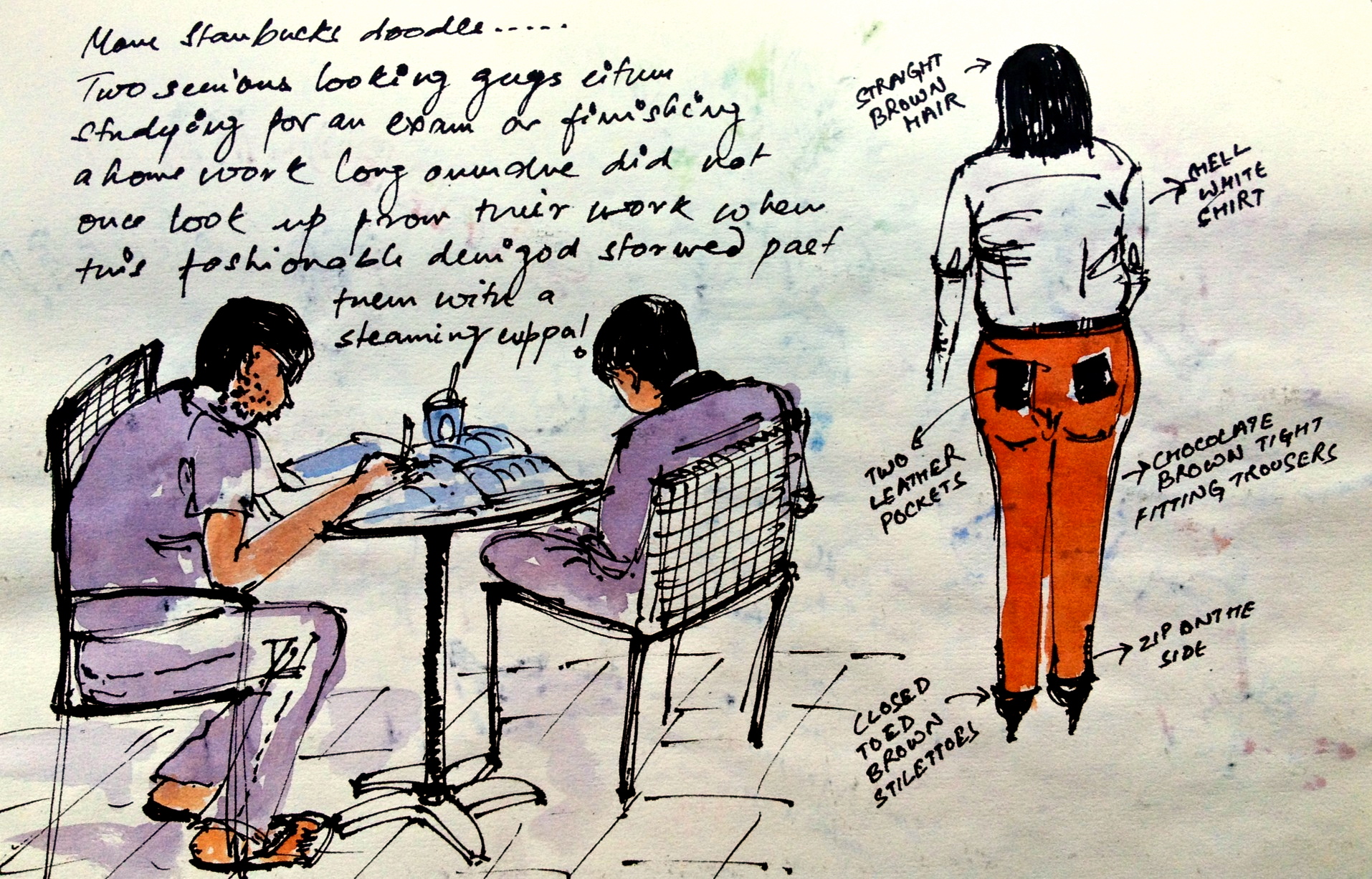
Possibly a fashion designer

Possibly a fashion designer

But if you are desperate for a seat and nothing else has been working, you might want to sneak up on those sitting all by themselves – alone with their coffee and reading a book/newspaper or updating their blog or looking at Google maps. Most of the time, they get bored with themselves too easily and leave. Jump right in.

Saving the best for the last because you spot this kind only if you are alert and have been paying attention – the kind that rolls in, does their business and leaves. Pin your hopes on anybody without a laptop. Or without a smartphone, but that’s asking too much in Singapore.
An evening at Starucks

An evening at Starbucks

Watch out for people with big shopping bags, or those with dogs, or those taking quick interviews ( I’ve been witness to many job interviews over coffee – lasts as long as the drink), making a hurried presentation, mulling over houses with property agents or bickering like the two local film producers I came across, trying to prove whose job sucked more. I could swear, their heated debate rose to a crescendo but cut out as soon as the last drop of coffee trickled down their throat. After which they left and I moved in.

It is within this group that, if you are lucky, you get a seat that isn’t already choped – a typical Singaporean phenomenon of reserving seats by placing a harmless tissue or hasn’t been pooped upon by one of the three notorious pigeons that pick at the leftovers.

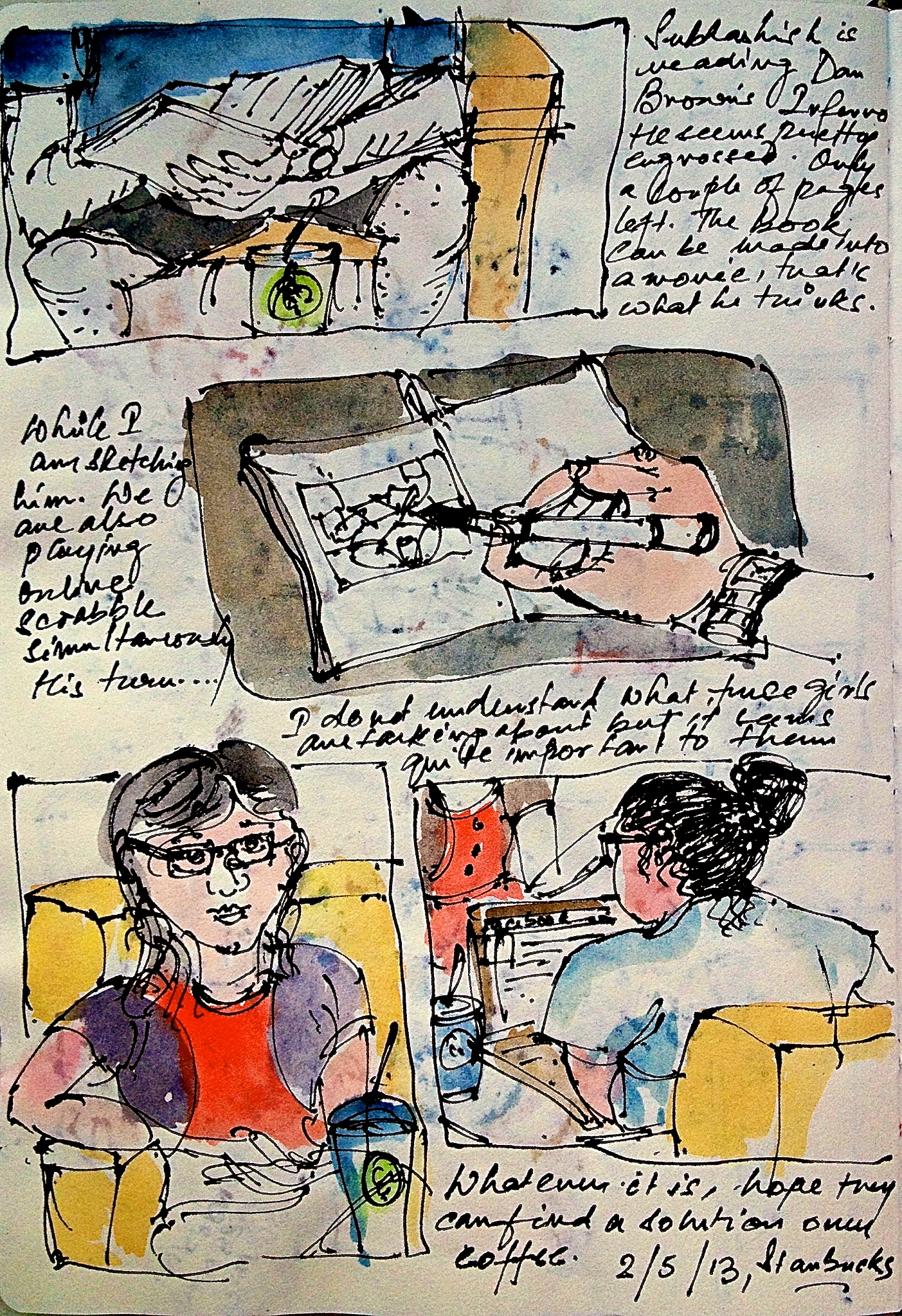
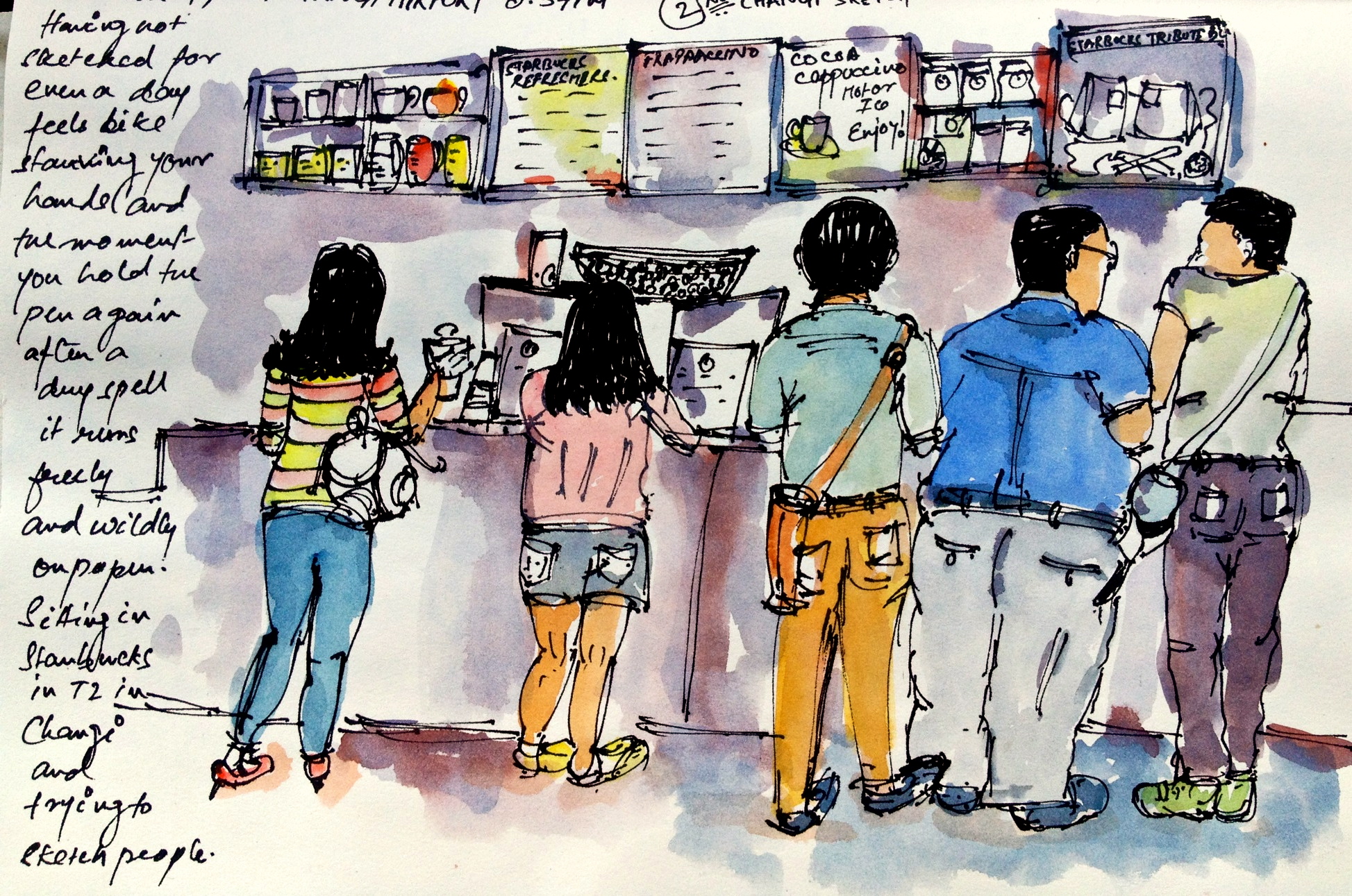
I have honed my seat grabbing skills over three years of Starbucks patronage at my neighbouring outlet where I’ve worked, planned vacations, played scrabble, finished several tomes and drank gallons of coffee and tea. And only recently, have I started sketching and it isn’t surprising that in my 90 page sketchbook, which I finished recently, there are more than twenty sketches done at this location of the same individuals, groups and clusters I talk about. I observed them only because I sketched them.
This is why I accompany my stories with hand
drawn sketches instead of photographs. More than any other medium, sketching requires complete immersion of senses, gets you to pay attention and slow down.
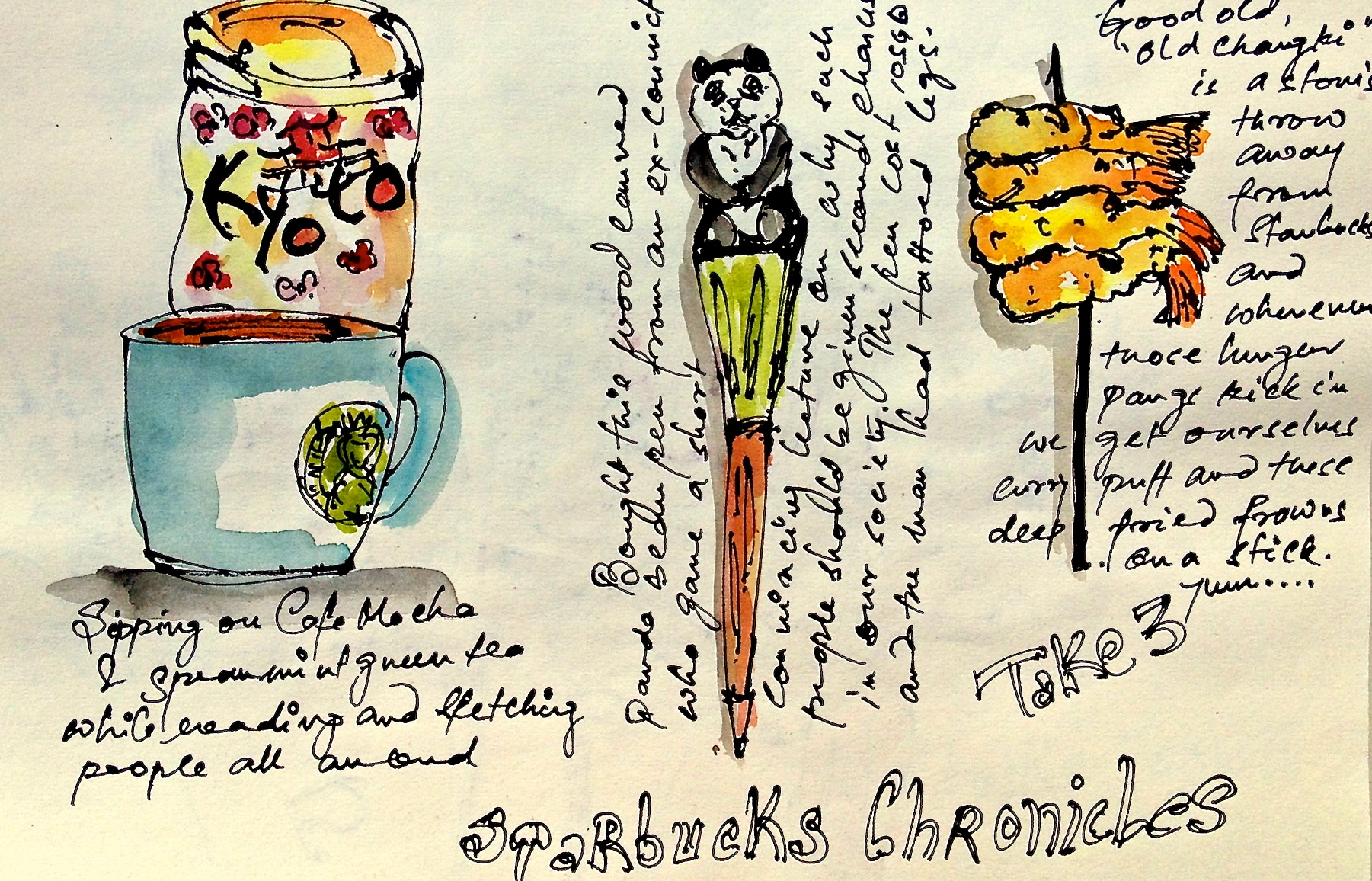
Any sketch when looked at several days or months later, evokes the moment, in its tiniest details.  Like this hand carved wooden panda bear pen that was sold to me at the cafe by an ex-convict with heavily tattooed legs.
Hand carved panda pen sold by an ex-convict

Hand carved panda bear pen sold by an ex-convict

The opening line of his very impressive speech, that led to the sale was, ” Do you believe in second chances?”.  Cheesy, yes? But the sketch helped me pin that memory down.

Coffee in a historic shophouse, anyone?

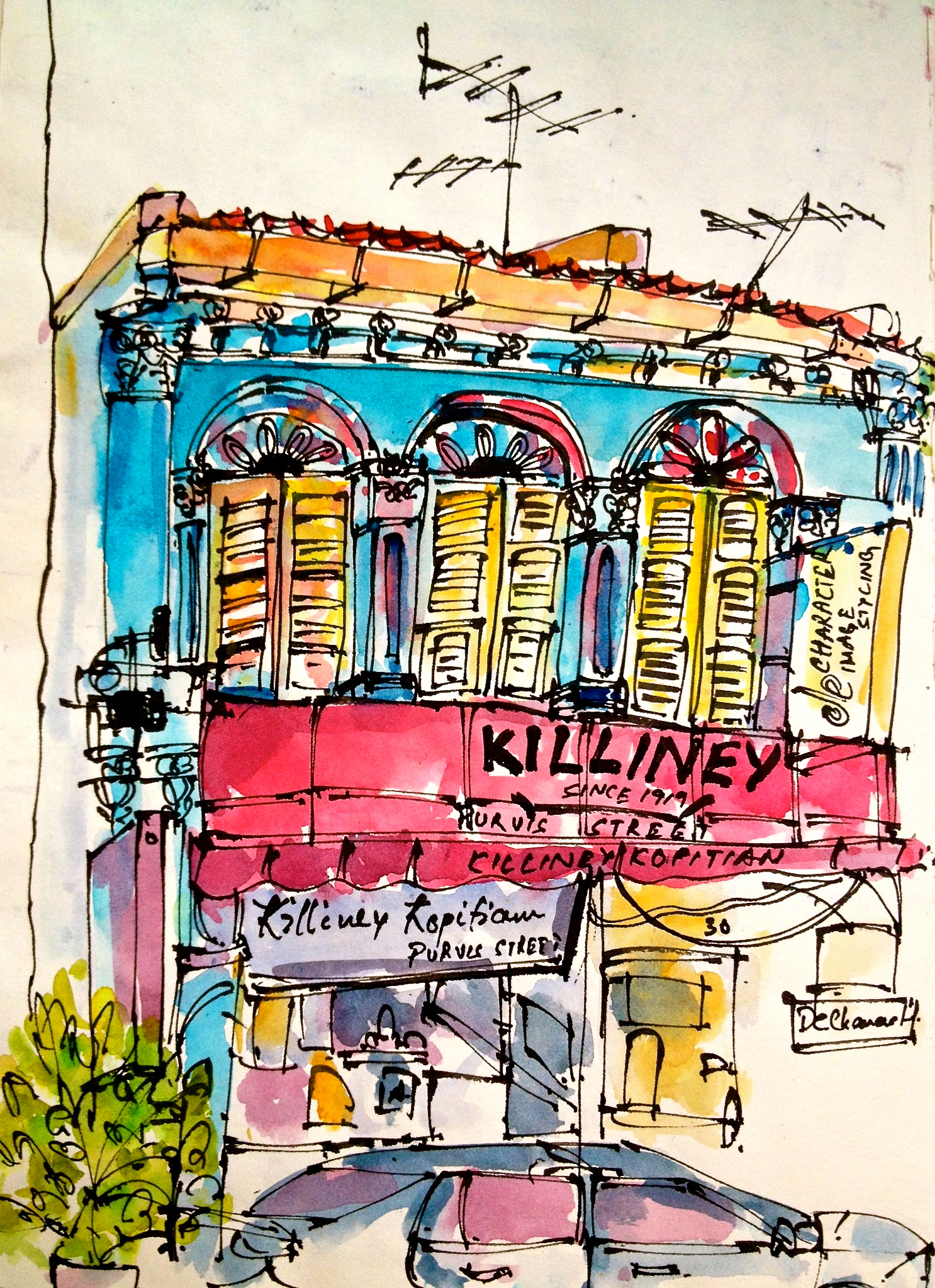
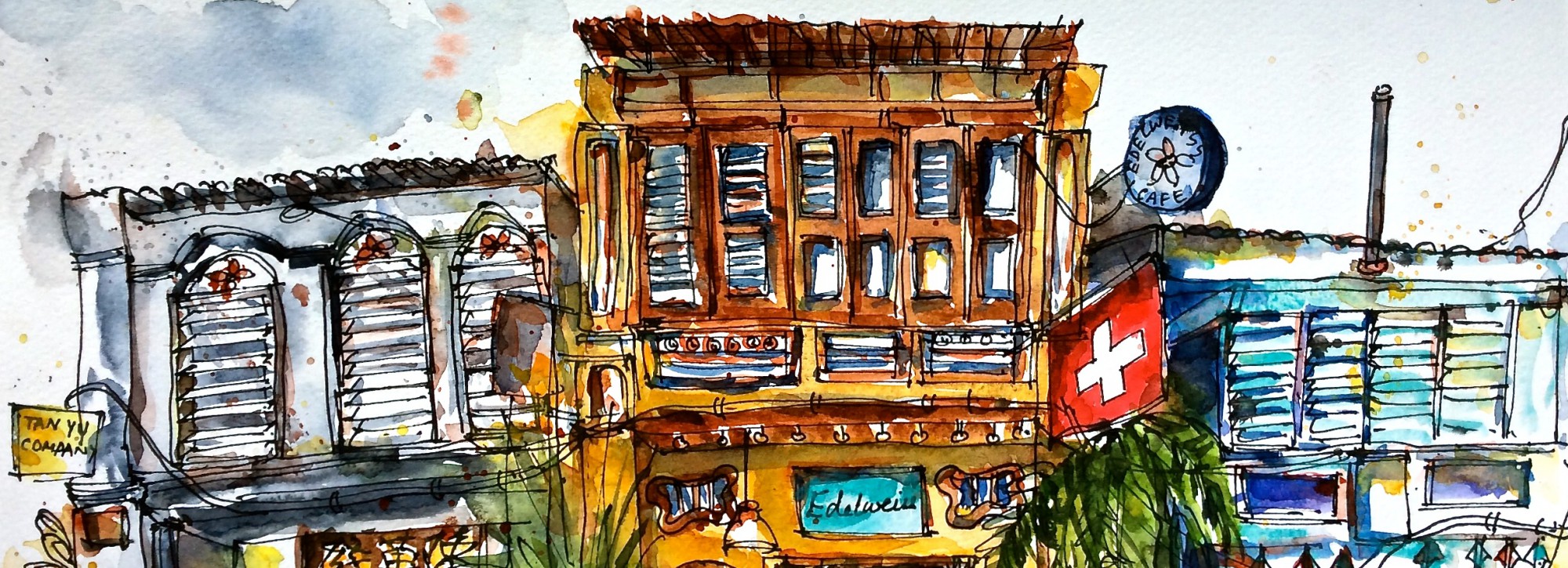
Killiney Kopitiam

An artist’s impression of Killiney Kopitiam

Singapore is not all high-rises and glitzy malls. Occasionally, just like a mirage in a abounding desert, a series of pre war shop houses loom up on a side street which you would’ve missed, had you blinked twice. Beautifully restored, these historic gems seem stuck in time with their wide arches, thick columns, colourful louvered windows and ornate motifs.

Most of these are now homes to pricy restaurants, artisanal cafes, bars, patisseries, art galleries, designer boutiques and such, presumably for a clientele with aesthetic tastes and deep pockets. Therefore, paying little over a dollar for a cup of joe, while lounging inside one of these timeless spaces, seemed like an inexpensive way of experiencing history and local culture.

Couple of days ago, on my way back from the Singapore National library, I spotted a brick red awning that says ‘Killiney Kopitiam on Purvis Street; Established in 1919’, in the same breath. Kopitiams ( Kopi for coffee and tiam for shop) are traditional coffee shops, very popular in Southeast Asia, that serve simple meals like egg, toasts along with coffee and tea.

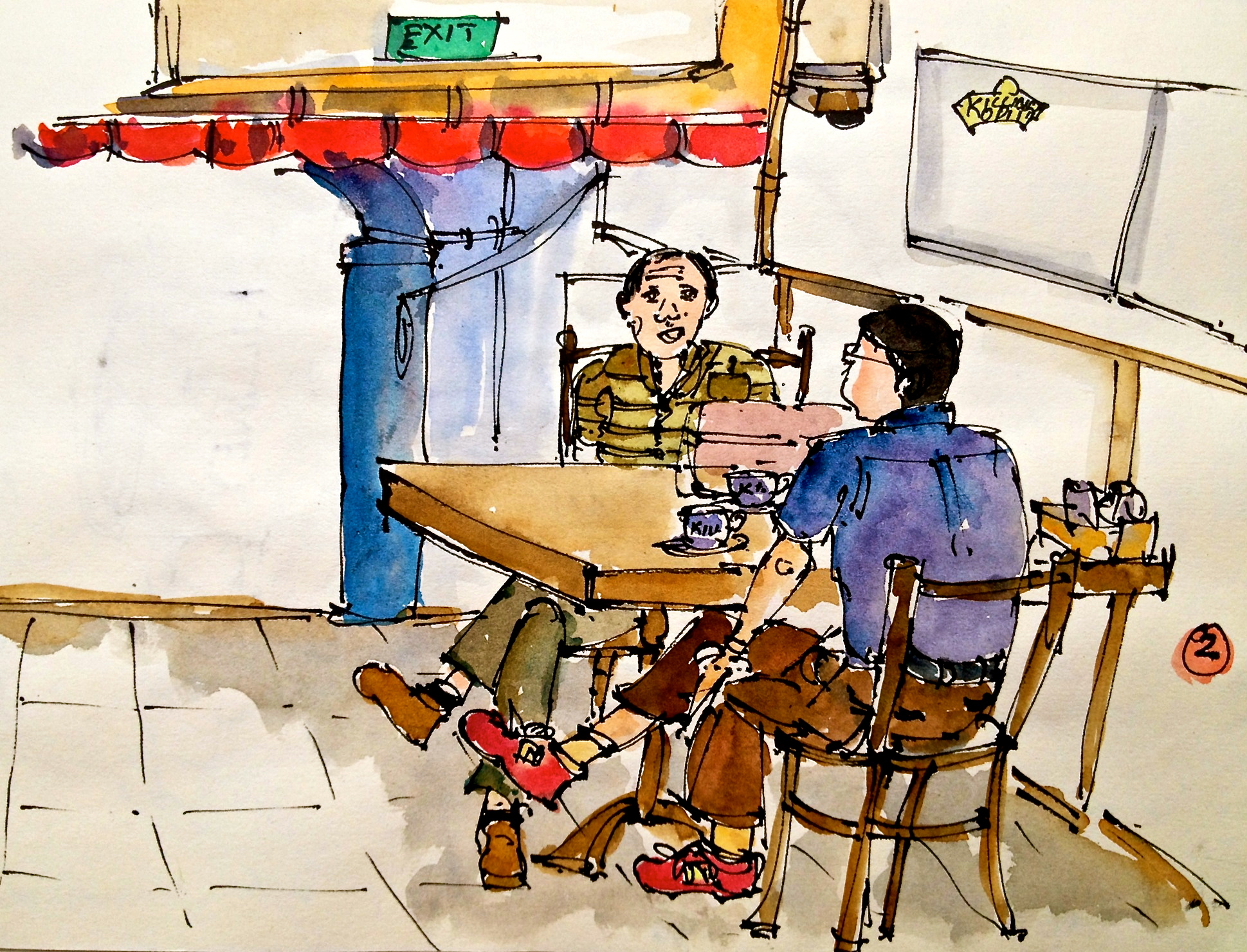
Something about this place, perhaps the convivial banter of families, animated conversations between friends and the murmur of hunched retirees cross-leggedly poised on wooden stools on the patio, sent a message that it’s okay to walk in without hurting your wallet.

Alice ushering guests in with a smile

Alice ushering guests in with a smile

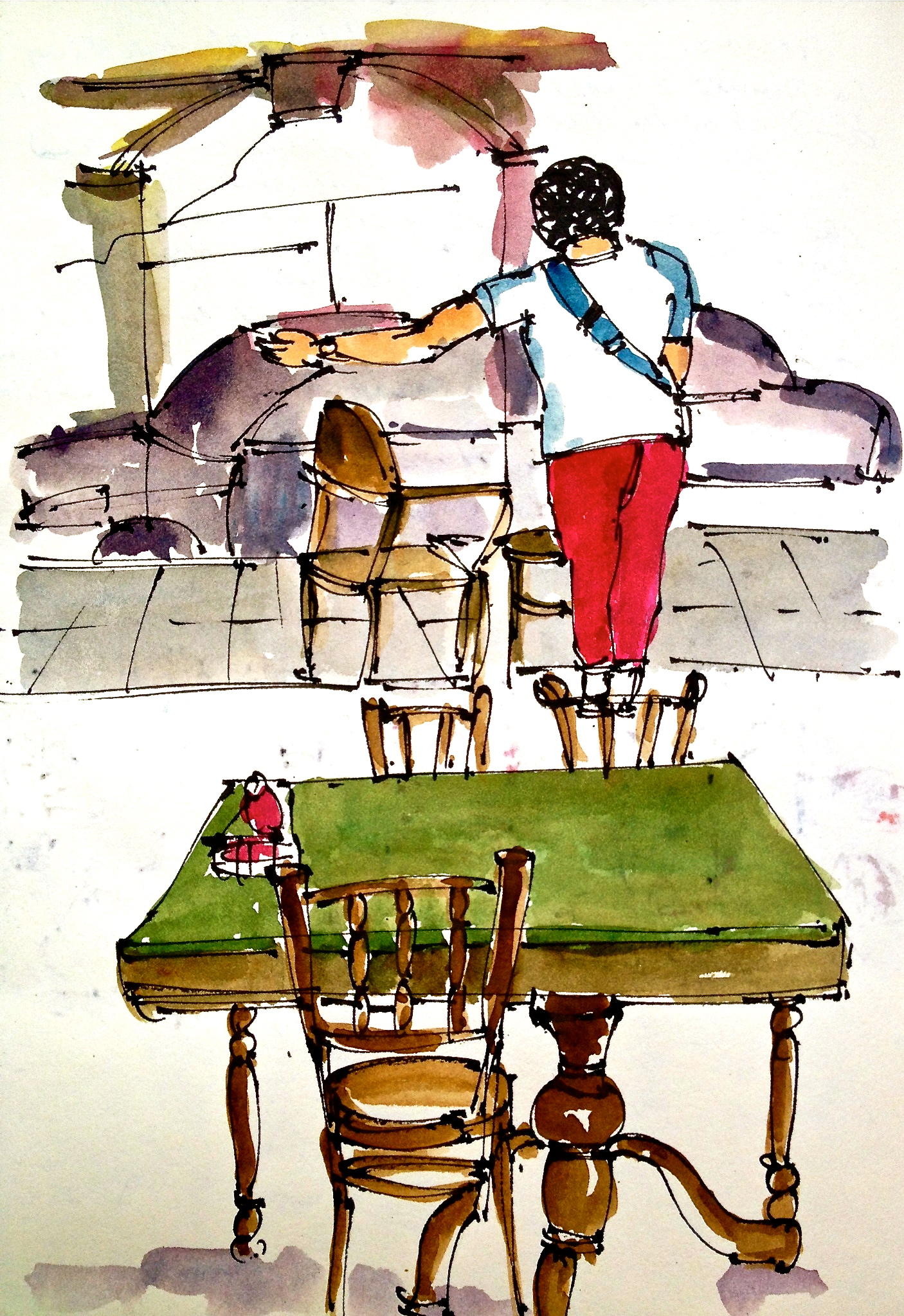
Its spartan interiors look like a canteen from the 80s. The walls are white and bare saving few signboards with Killiney’s history, a photograph of its flagship store and few items from the menu. Handful of bright tube lights light the mosaic floor; ceiling fans creak above dark wooden tables with emerald green tops and round stools, making for a simple, unpretentious homely setting, where you are almost tempted to put your feet up and holler your mother for a cup of coffee.

Coffee inside a shophouse

Coffee inside a shophouse

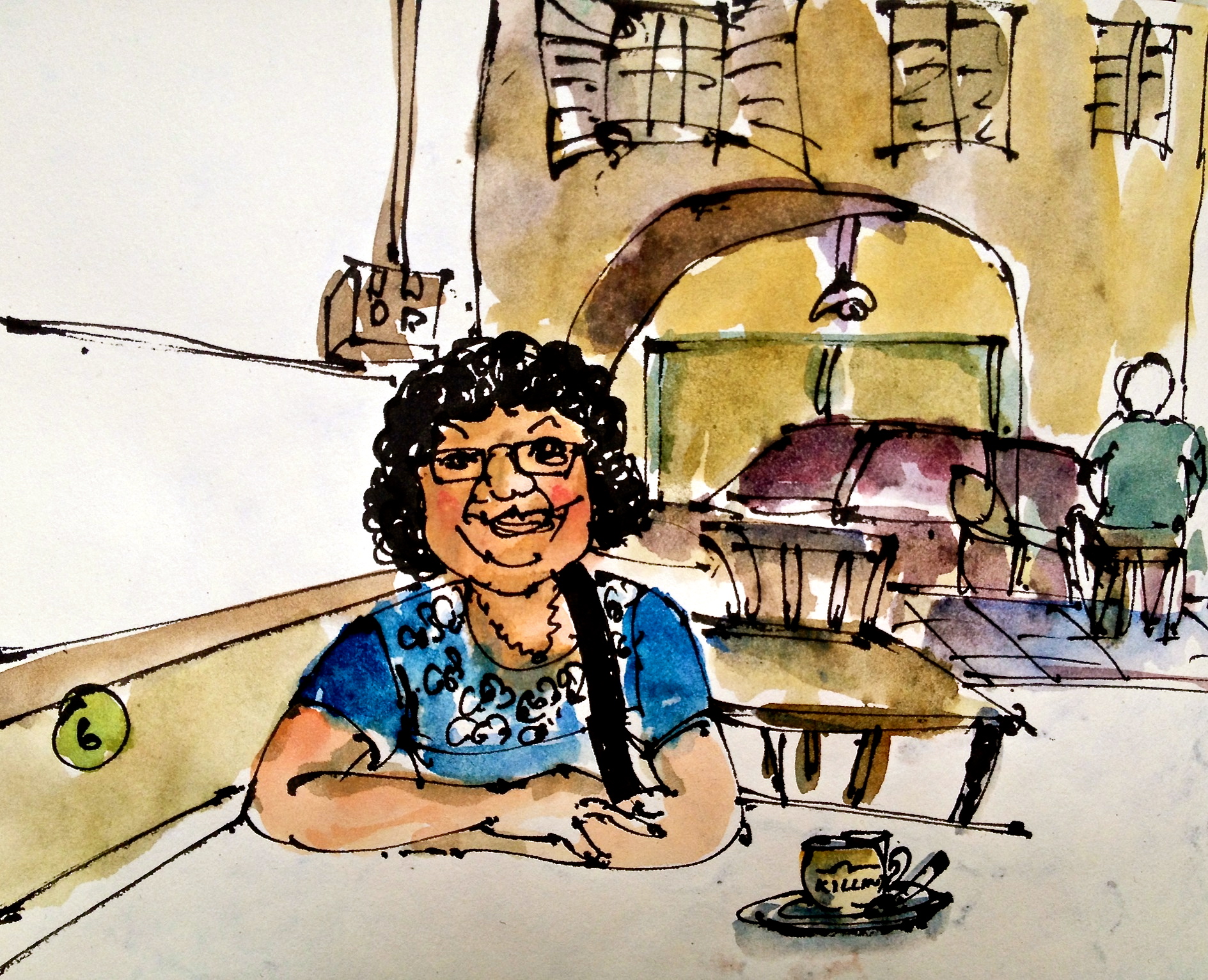
“Don’t let your food get cold. You should eat quickly”, booms a matronly voice into my ear before trailing off to another table. Meet Alice Tan, the 70 year old aunt of Killiney’s owner who has lived her entire life on Purvis Street,  and has been at its helm for 12 years, right from day one.

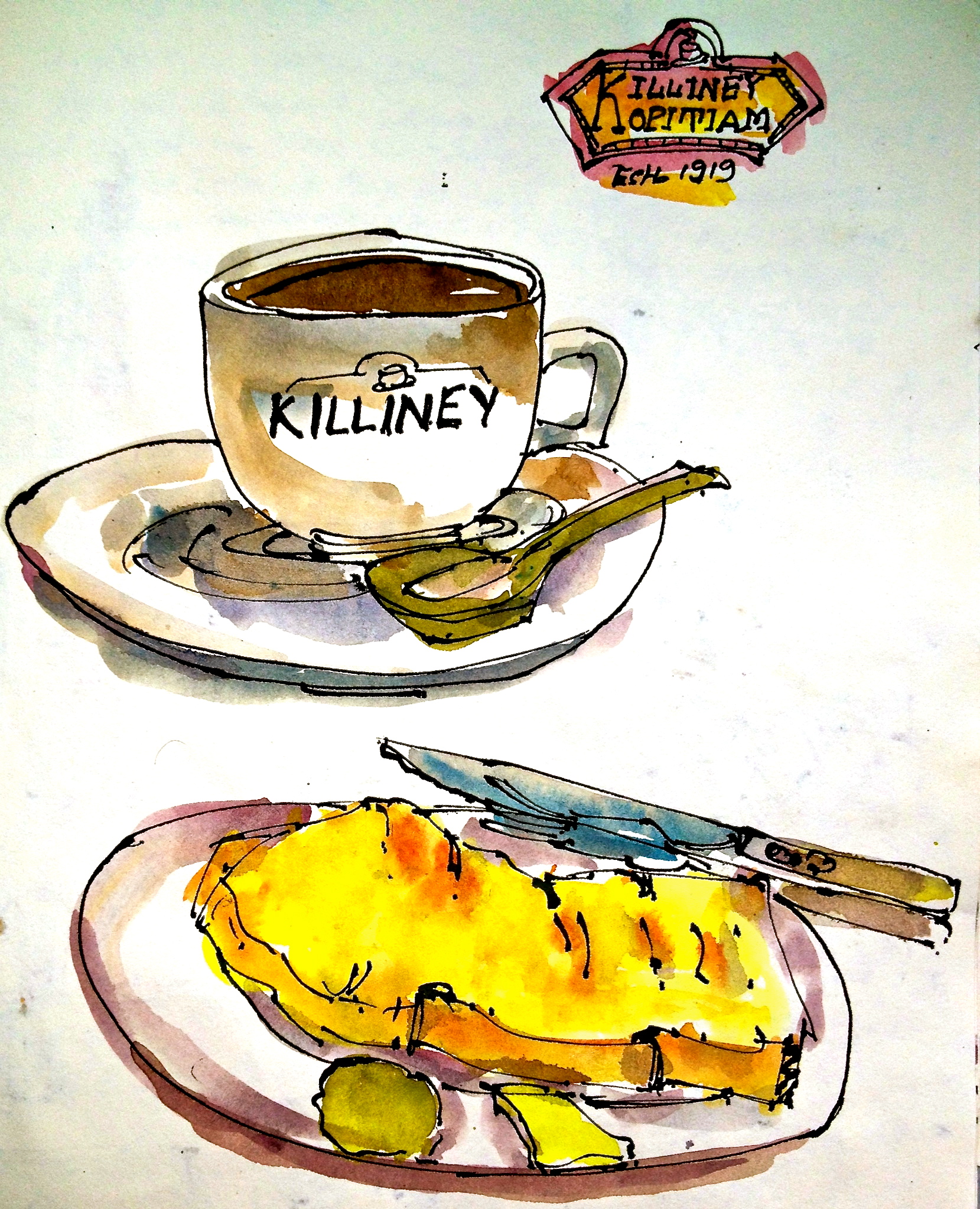
Kopi O and a French toast served with kaya and butter

Kopi O and a French toast served with kaya and butter

The warm reprimand gets me back to my half eaten french toast. I spread a layer of butter and kaya served alongside and wash it down with the Kopi O – sweetened black coffee – from an impersonal white melamine cup. Clad in bright pink trousers and a laced shirt with a satchel slapped across her shoulders, short haired, round faced Alice has the agility of someone half her age. “When I say I am 70, the kids laugh. They say – Auntie don’t bluff ah!” she says animatedly, pointing towards some of her younger patrons. ‘Now they call me “Amah“, used to address older people, you know’.

Alice chatting away with me

Chatting away with Alice

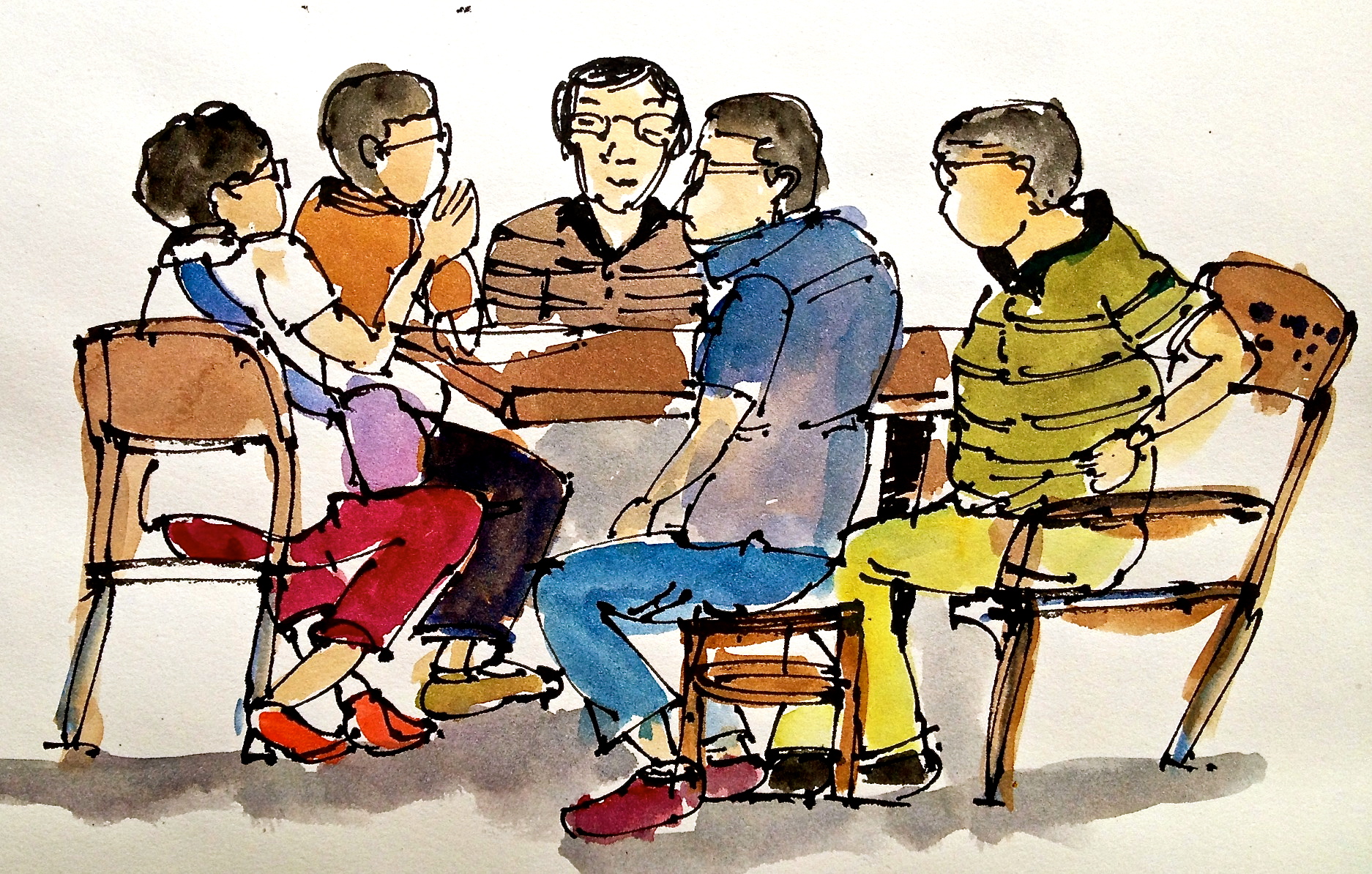
Alice is the soul of this kopitiam that flitters about like a butterfly on a roll. One moment she rushes inside the kitchen, the next she is out, patiently resolving a staff issue before joining in the camaraderie of her patrons at a nearby table, graciously slipping off to another and asking a lone woman who just walked in about her day at the office. Nothing escapes her hawk-eyed vision and overflowing warmth. Glancing over a charming group of silver haired patrons, she says, “You see, those are Purvis Street boys, who grew up here and have been visiting my shop since it opened. These days they meet for Kopi every Monday.” They wave at me and I wave back.

Alice and the Purvis Street boys

Alice in pink and the Purvis Street boys

It seems she knows everybody, and everybody knows everybody or wants to know everybody. I am constantly greeted by patrons passing by me, with a smile, a nod that segues into short conversations. With a Starbucks loyalty card snugly tucked in my wallet, I am already bemused at the difference in scene and my experience over a simple cup of coffee or rather Kopi.

But if the modern coffee chains come with all the fancy stuff like air conditioning, plush seating, Wi-Fi and charging points, what makes such no-frill joints tick, I wonder aloud. “Personal attention”, says Alice. “I am friends with anybody who walks through that door, black or white; Indian, Chinese or Malay”. While I take a long sip of my coffee, she adds with a beaming smile, ” And now you are my friend”.

I gobble up the rest of my food and order a tall glass of lime juice to beat Singapore’s sultry weather. The Purvis Street boys are getting ready to leave and so is Alice. They wave at me and smile gleefully through their wrinkles. “Hey girl!” one calls out. I look up from my drink. ” Come back on Monday.” Maybe I will.